
Fire facts for kids


Fire is a fast chemical reaction that creates light and heat. It's a type of process called oxidation, where a substance combines with oxygen.
Humans have used fire for thousands of years. We've used it for rituals, to clear land for farming, for cooking, to keep warm and see in the dark, for sending signals, and for making tools like metals.
Uncontrolled fires, like wildfires, can cause a lot of damage. However, fire also plays a big role in nature. It helps new plants grow and keeps ecosystems balanced. On the downside, fires can harm living things and property, pollute the air, and even contaminate water. When fire burns away plants, heavy rains can cause soil to wash away.
Contents
What is Fire?
Fires are usually combustion reactions. This means they happen when things like carbon, hydrogen, and oxygen mix and react quickly. There are many kinds of fires, and they can be very dangerous if not handled properly. For example, there are wood fires, gas fires, and even metal fires.
The Colors of Fire: A Fiery Rainbow
Have you ever noticed that flames aren't always just orange? Fire can be many different colors, and these colors can tell us a lot about how hot the fire is and what's burning!
- Red and Orange: These are the most common colors you see in a campfire or candle flame. They usually mean the fire isn't as hot as blue flames and there might not be a lot of oxygen reaching that part of the flame. The orange color often comes from tiny soot particles glowing brightly.
- Yellow: Similar to red and orange, yellow flames are also common and indicate a moderate temperature.
- Blue: Blue flames are usually the hottest! This color appears when there's a lot of oxygen available for the fuel to burn completely. Think about the flame on a gas stove – it's often blue because the gas is burning very efficiently.
- Other Colors: Sometimes, if certain chemicals are burning, fire can even appear green, purple, or white! For example, copper can make a flame look green.
The Story of Fire: From Nature to Our Homes
The first signs of fire in nature appeared about 470 million years ago. This was when plants started growing on land, releasing lots of oxygen into the air. When oxygen levels went above 13%, wildfires became possible. The oldest evidence of wildfires, like charred plants, dates back 420 million years.
Fire became even more common when grasses spread across many ecosystems about 6 to 7 million years ago. Grasses are like excellent tinder, helping fires spread quickly. This increase in wildfires might have made the climate warmer and drier, which then led to even more fires.
Putting Out Fires
Fire is a chemical reaction where a fuel and an oxidizing agent (usually oxygen) combine. This process, called combustion, produces carbon dioxide and water. For fire to start, you need three things: a fuel, an oxidizer, and heat. This is often called the fire triangle. If you add a fourth element, a chemical chain reaction, it becomes the fire tetrahedron. All these parts must be present in the right amounts.
Once a fire starts, it needs to keep producing its own heat to continue burning. It also needs a constant supply of fuel and oxygen. On Earth, gravity helps by creating convection. This moves the smoke away and brings fresh oxygen to the fire. In space, without gravity, fire burns differently. It becomes spherical and can go out quickly because the carbon dioxide from burning doesn't move away easily.
To put out a fire, you need to remove one part of the fire tetrahedron:
- Remove the fuel (like turning off a gas stove).
- Remove the oxygen (like covering a flame to smother it).
- Remove the heat (like pouring water on a fire).
- Stop the chemical reaction (using special chemicals like Halon, though many are now banned).
To make a fire burn stronger, you can increase the fuel and oxygen, raise the surrounding temperature, or use a catalyst to speed up the reaction.
Fire Safety
Fire prevention aims to reduce things that can start fires. It also includes teaching people how to avoid causing fires. Many buildings, especially schools, have fire drills to prepare people for a fire emergency. Modern buildings use passive fire protection (like fire-resistant materials) and active fire protection (like fire sprinklers) to reduce fire damage. In many countries, furniture and building materials are tested for how well they resist fire.
Studies show that working smoke detectors cut the risk of death in a fire by 50%. Sprinkler systems can reduce deaths by 100%. Fire-resistant clothing and furniture also help prevent injuries. In the United States, most home fires start from unattended cooking. Cigarettes are also a major cause, especially for fires involving furniture, and they lead to many fatalities. Using fire-safe cigarettes has helped reduce these fires.
Fire is extremely hot, so you should never touch it. If fire touches human skin, it can cause painful blisters that take time to heal. If a fire starts, try to cover your mouth with a wet cloth. This helps prevent you from breathing in too much smoke, which can make you faint. Always make sure there are no flammable materials close to a fire when people are nearby.
Humans and Fire


Learning to control fire was a huge step for early humans. It allowed them to cook food, which made it safer to eat and provided more nutrients. Cooking also helped people stay warm in cold places and dark caves. Fire also kept dangerous animals away at night.
Evidence suggests humans were cooking food occasionally about 1 million years ago. Regular use of fire became common around 50,000 to 100,000 years ago. Over time, people became very skilled at using fire. They used it to make charcoal and to manage wildlife.
During the Neolithic Revolution, when farming began, people used fire to manage their land. They would do "controlled burns" or "cool fires." These were different from uncontrolled "hot fires" that destroy soil and plants. Cool fires were done in spring and autumn to clear small plants and dry leaves. This prevented big, dangerous fires later on. It also helped create different environments for plants and animals to thrive.
Another way farmers use fire is to clear land for planting. This is called "slash-and-burn" agriculture. Farmers cut down plants and then burn them. This releases nutrients back into the soil, which helps new crops grow. While useful for small farmers, this method can also cause problems. As populations grow and the climate warms, these fires can get out of control. This harms nature, damages buildings, and creates smoke that can cause health problems and even more warming of the atmosphere. Today, huge areas of land around the world burn each year.
Modern Uses of Fire
Fire is still a big part of our culture. Bonfires are used for celebrations. Barbecues are a popular fire-based tradition in the United States. Fireworks light up the sky to celebrate the New Year.
Most cars and trucks use fire inside their engines to make them move. This happens in the internal combustion engine.
Many power plants use fire to heat water and create steam, which then generates electricity for homes and businesses.
Interesting Facts about Fire
- On Earth, flames usually have a teardrop shape because hot air and soot rise due to convection. But in microgravity (like on the ISS), convection doesn't happen. This makes flames spherical and often more blue.
- NASA experiments show that flames in microgravity burn soot more completely. These discoveries could help us improve fuel efficiency here on Earth.
- Since fire is light, it doesn't cast a shadow on its own! If you shine a light on a flame, you might see a shadow from the smoke or objects around it, but not from the flame itself.
- The blue part of a flame is usually the hottest because it has the most oxygen for complete combustion, meaning the fuel is burning very efficiently.
- In very rare cases, certain materials like piles of hay or compost can generate enough heat internally to catch fire without an external spark.
Images for kids
-
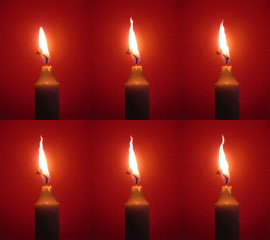
A candle's flame
-
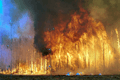
Northwest Crown Fire Experiment, Canada
-
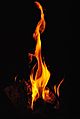
Photo of a fire taken with a 1/4000th of a second exposure
-
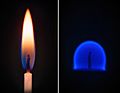
Fire is affected by gravity. Left: Flame on Earth; Right: Flame on the ISS
-
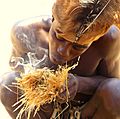
Bushman starting a fire in Namibia
-
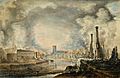
Painting of the Cathedral and the Academy building after the Great Fire of Turku, by Gustaf Wilhelm Finnberg, 1827
-
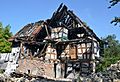
Fire-damaged restaurant waiting for demolition


.jpg)
See also
 In Spanish: Fuego para niños
