
Hubble Space Telescope facts for kids

The Hubble Space Telescope during STS-125
|
|
| Mission type | Astronomy |
|---|---|
| Operator | STScI |
| Mission duration | 36 years, 5 months, 21 days (ongoing) |
| Spacecraft properties | |
| Manufacturer |
|
| Launch mass | 11,110 kg (24,490 lb) |
| Dimensions | 13.2 m × 4.2 m (43 ft × 14 ft) |
| Power | 2800 W |
| Start of mission | |
| Launch date | April 24, 1990, 12:33:51 UTC |
| Rocket | Space Shuttle Discovery (STS-31) |
| Launch site | Kennedy, LC-39B |
| Contractor | Rockwell International |
| Deployment date | April 25, 1990 |
| Entered service | May 20, 1990 |
| End of mission | |
| Decay date | 2030s (estimated) |
| Orbital parameters | |
| Reference system | Geocentric orbit |
| Regime | Low Earth orbit |
| Eccentricity | ≈ 0.00028 |
| Periapsis | 472.0 km (293.3 mi) (as of 2026[update]) |
| Apoapsis | 475.0 km (295.2 mi) (as of 2026[update]) |
| Inclination | 28.47° |
| Period | 94.0 minutes |
| Main telescope | |
| Type | Ritchey–Chrétien reflector |
| Diameter | 2.4 m (7 ft 10 in) |
| Focal length | 57.6 m (189 ft) |
| Focal ratio | f/24 |
| Collecting area | 4.0 m2 (43 sq ft) |
| Wavelengths |
|
|
|
|
The Hubble Space Telescope (often called HST or simply Hubble) is a large scientific telescope orbiting Earth. It was launched into space in 1990 by NASA aboard the Space Shuttle Discovery. It orbits above Earth's atmosphere, which allows it to capture clear views of the universe.
Hubble is named in honour of the American astronomer Edwin Hubble. He discovered that our universe is expanding. The telescope is one of NASA's Great Observatories. It collects visible light, ultraviolet light, and some near-infrared light.
During its mission, Hubble has sent back hundreds of thousands of breathtaking images. It has helped scientists measure the age of the universe. It has also discovered new moons around Pluto and proved that supermassive black holes sit inside distant galaxies.
Contents
- History and development of the space telescope
- How the Hubble Space Telescope works
- The mirror flaw and the space repair
- Space Shuttle servicing missions
- Major scientific discoveries
- How Hubble shares images with the world
- Spacecraft maintenance and future operations
- Amazing Facts about Hubble
- Images for kids
- See also
History and development of the space telescope
Early ideas and pioneer scientists
In 1923, rocket scientist Hermann Oberth suggested sending a telescope into space using a rocket. In 1946, astrophysicist Lyman Spitzer wrote an important paper explaining why a telescope in space would work better than telescopes on the ground. Spitzer spent decades working to turn this idea into a reality.
.jpg)
On Earth, the atmosphere causes stars to twinkle, which blurs telescope images. Earth's atmosphere also blocks certain kinds of light, like ultraviolet rays. Spitzer pointed out that a space telescope would avoid both problems completely.
Astronomer Nancy Grace Roman, often called the "Mother of Hubble," made huge contributions to the project. She set up the scientific committees and convinced the U.S. Congress to fund the mission. Her leadership helped create NASA's modern science research programs.
.jpg)
Before Hubble, NASA and international partners launched smaller test satellites. The Orbiting Astronomical Observatory 2 (OAO-2), launched in 1968, proved that space-based telescopes could study distant stars for years. These early successes led NASA to design a much larger observatory.
Designing and funding the telescope
In 1970, NASA formed teams to plan the engineering and scientific goals for a large space telescope. Securing funding was difficult because building a space observatory is very expensive. In 1974, budget cuts temporarily stopped funding for the telescope project.
.JPG)
Astronomers across the country organized meetings and wrote letters to lawmakers to save the mission. In response, NASA partnered with the European Space Agency (ESA). ESA agreed to provide solar panels and scientific instruments in exchange for telescope viewing time.
To save money, engineers reduced the main mirror size from 3.0 meters to 2.4 meters. Congress approved funding in 1978. In 1983, NASA officially named the spacecraft the Hubble Space Telescope.
Construction challenges and launch delays
Building the complex spacecraft required the work of many aerospace companies. Perkin-Elmer built the optical mirrors, while Lockheed constructed the protective body of the spacecraft.

The telescope was scheduled for launch in 1986. However, the tragic loss of the Space Shuttle Challenger in January 1986 grounded the shuttle fleet for years. The telescope had to be stored in a clean room filled with protective nitrogen gas.
Engineers used this extra time to test the spacecraft systems, upgrade batteries, and refine ground software. Finally, on April 24, 1990, Space Shuttle Discovery carried Hubble into orbit on mission STS-31.
How the Hubble Space Telescope works
Optical system and mirrors
Hubble uses a design known as a Ritchey–Chrétien reflector, which relies on two curved mirrors to focus light. Light travels down the open tube of the telescope, strikes the 2.4-meter primary mirror, bounces forward to a smaller secondary mirror, and passes through a central hole to reach the scientific instruments.
.jpg)
The primary mirror is made of ultra-low expansion glass and weighs around 828 kg (1,825 lb). Its surface has a thin reflective layer of pure aluminum and a protective coating of magnesium fluoride.
The mirror had to be extremely smooth. If Hubble's mirror were the size of Earth, the highest bump on its surface would be only a few inches high.
Power and pointing systems
Hubble orbits Earth at an altitude of about 540 kilometers, circling the planet every 94 minutes. It experiences extreme temperature changes as it moves in and out of Earth's shadow. A blanket of multilayer insulation keeps the delicate electronics warm.

Two large solar arrays turn sunlight into electricity to charge onboard batteries. Hubble uses reaction wheels and gyroscopes to turn and point toward distant targets. These devices allow the telescope to lock onto a target without drifting.
Hubble uses Fine Guidance Sensors to track bright guide stars. This pointing system is so steady that it is like holding a laser pointer steady on a coin miles away.
Scientific instruments
Hubble holds five scientific instruments inside its body. Over the years, astronauts replaced older equipment with newer, more sensitive tools.

The instruments installed throughout Hubble's history include:
- Wide Field Camera 3 (WFC3): Hubble's main camera, capturing wide views in visible, ultraviolet, and infrared light.
- Advanced Camera for Surveys (ACS): A powerful camera designed to hunt for distant galaxies and map dark matter.
- Cosmic Origins Spectrograph (COS): An instrument that splits ultraviolet light into rainbow patterns to study galaxy chemistry.
- Space Telescope Imaging Spectrograph (STIS): A versatile tool that measures the speeds and temperatures of celestial objects.
- Near Infrared Camera and Multi-Object Spectrometer (NICMOS): An infrared sensor used to see through thick dust clouds in space.
The mirror flaw and the space repair
Discovering spherical aberration
Shortly after Hubble reached space, scientists noticed a major problem with its first images. The pictures were better than ground images, but stars appeared surrounded by blurry halos of unfocused light.

Engineers discovered that the main mirror had been polished into the wrong shape. The outer edge was too flat by just 2.2 micrometers—a fraction of the width of a human hair.
This flaw, called spherical aberration, meant light reflecting off the edge focused at a different point than light from the center. The mistake occurred because a testing tool used during manufacturing was assembled incorrectly.
The historic repair mission
Scientists realized they did not need to replace the entire mirror. Instead, they designed special corrective mirrors that worked like a pair of eyeglasses to fix the light path.

In December 1993, NASA launched Space Shuttle Endeavour on mission STS-61. Astronauts spent ten days conducting multiple spacewalks to install two key devices: the Corrective Optics Space Telescope Axial Replacement (COSTAR) and the Wide Field and Planetary Camera 2 (WFPC2).
The repair was a triumph. In January 1994, NASA released new images showing crystal-clear stars and galaxies. Hubble was fully restored to its planned capability.
Space Shuttle servicing missions
Summary of servicing flights
Hubble is unique because it was designed from the start to be repaired and upgraded in space by astronauts. Five Space Shuttle servicing missions visited the observatory:

- Servicing Mission 1 (1993): Installed corrective optics, new solar panels, and replacement gyroscopes.
- Servicing Mission 2 (1997): Added the STIS and NICMOS instruments to observe deeper infrared and ultraviolet light.
- Servicing Mission 3A (1999): Replaced all six gyroscopes and installed a much faster onboard computer.
- Servicing Mission 3B (2002): Installed the Advanced Camera for Surveys and added new solar arrays.
- Servicing Mission 4 (2009): The final shuttle visit, which added WFC3, the COS spectrograph, new batteries, and repaired broken instruments.

During these missions, astronauts caught Hubble with the shuttle's robotic arm and anchored it in the payload bay. Astronauts spent hours in bulky spacesuits replacing modules to keep the telescope operating.
Major scientific discoveries
Age and expansion of our universe
Before Hubble, scientists could only estimate the age of the universe to between 10 and 20 billion years. Hubble measured special pulsating stars called Cepheids in distant galaxies.
.png)
These measurements helped astronomers calculate the rate of cosmic expansion, known as the Hubble constant. Scientists narrowed down the true age of the universe to roughly 13.8 billion years.
Hubble also helped astronomers discover that the expansion of the universe is speeding up. This surprising discovery led scientists to propose dark energy, a mysterious force pushing space apart.
Black holes and distant galaxies
Hubble provided direct evidence that supermassive black holes exist at the centers of nearly all large galaxies. By tracking the high speeds of gas swirling around galactic cores, Hubble allowed astronomers to calculate the masses of these unseen giants.

Hubble pointed at tiny, dark patches of sky for days at a time to create the famous Hubble Deep Field images. These pictures revealed thousands of young, faint galaxies stretching back to the early universe, just hundreds of millions of years after the Big Bang.
Discoveries inside our solar system
Hubble has provided valuable close-up views of planets, moons, and comets inside our own solar system:
- Comet collision: In 1994, Hubble captured images of Comet Shoemaker–Levy 9 crashing into Jupiter.
- Hidden oceans: Hubble spotted signs of an underground saltwater ocean beneath the icy crust of Jupiter's moon Ganymede.
- Moons of Pluto: Hubble discovered small moons orbiting Pluto, including Nix, Hydra, Kerberos, and Styx.
- Giant comets: Hubble measured the nucleus of comet C/2014 UN271 (Bernardinelli–Bernstein), the largest icy comet core ever observed.

Radio signals and image processing
Hubble stores observation data electronically and beams it toward NASA's Tracking and Data Relay Satellite System (TDRSS). The radio signals travel down to ground stations in New Mexico and are sent to the Goddard Space Flight Center in Maryland.

Hubble's cameras take pictures in black-and-white using special glass filters. To make a colour picture, scientists take separate exposures through red, green, and blue filters.
When these exposures are combined on a computer, they reveal full-colour portraits of nebulae, star clusters, and distant galaxies.
Public outreach and citizen science
NASA and the European Space Agency share Hubble images online for students, teachers, and scientists around the world. Projects like Galaxy Zoo allow students and citizen scientists to help classify galaxies captured in Hubble photographs.
.jpg)
Hubble pictures have appeared in textbooks, science museums, and magazines worldwide, helping millions of people appreciate the beauty of astronomy.
Spacecraft maintenance and future operations
Overcoming hardware issues
Because Hubble has operated for decades without a shuttle visit since 2009, parts like gyroscopes slowly wear down. Engineers on Earth write new software updates so Hubble can point accurately using fewer gyroscopes.
When computers or power supplies experience errors, mission controllers switch to backup circuits to keep the telescope running safely.
Future of the mission
As Hubble orbits, tiny amounts of friction from the outer atmosphere slowly lower its altitude. Eventually, the spacecraft will re-enter Earth's atmosphere.
.jpg)
Astronauts attached a ring called the Soft Capture Mechanism to Hubble during its final servicing flight. This ring will allow a future robotic spacecraft to safely guide Hubble into the ocean when its mission ends.
Hubble and newer space observatories
Hubble now works alongside newer space telescopes like the James Webb Space Telescope (JWST) and the Nancy Grace Roman Space Telescope.

.jpg)
While newer observatories observe deep infrared light, Hubble remains humanity's premier telescope for visible and ultraviolet light from orbit.
Amazing Facts about Hubble
- Length: 43.5 feet (13.2 meters) — about the length of a large yellow school bus
- Weight: Approximately 24,500 pounds (11,110 kg) — roughly the weight of two full-grown African elephants
- Orbital Speed: About 17,000 miles per hour (27,300 km/h) — fast enough to travel across the entire United States in about 10 minutes!
- Before Hubble, scientists only knew the universe was between 10 and 20 billion years old—a huge question mark! By measuring special pulsating stars called Cepheid variables in distant galaxies, Hubble helped narrow down the precise age of the universe to 13.8 billion years.
- The telescope has made over 1.6 million scientific observations since its launch!
- In 1995, Hubble took one of the most famous space photographs in history: the Pillars of Creation inside the Eagle Nebula.
- Hubble does not actually take color photos like a smartphone camera! Instead, it uses specialized digital sensors that capture black-and-white images. Hubble takes multiple pictures of the same object through different colored filters—such as red, green, and blue, as well as filters that detect invisible ultraviolet and infrared light. Back on Earth, scientists combine these separate exposures and assign colors to each filter.
- Hubble is unique because it was designed from the beginning to be visited, fixed, and upgraded by human astronauts in space.
- When Hubble first opened its robotic eyes in 1990, scientists were shocked to discover that its pictures were blurry. What went wrong? Hubble's giant primary mirror had been polished into the wrong shape by an error smaller than 1/50th the thickness of a single human hair! Even though that mistake was invisible to the naked eye, it prevented light from focusing properly. Astronomers and engineers later corrected the flaw during a special repair mission.
Images for kids
-
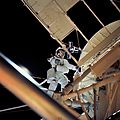
Astronaut Owen Garriott working outside Skylab's solar observatory in 1973.
-
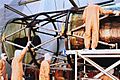
The internal frame and mirrors of Hubble during early assembly.
-
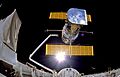
Hubble being released into orbit from Space Shuttle Discovery in 1990.
-
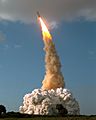
Space Shuttle Discovery launches into space carrying Hubble on mission STS-31.
-
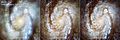
Spiral galaxy M100 photographed before (left) and after (right) the optics repair.
-
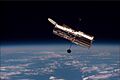
Hubble photographed during Servicing Mission 2 in 1997.
-
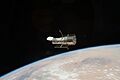
Hubble floating in space following its final repair mission in 2009.
-
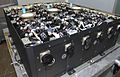
A replacement nickel-hydrogen battery pack built for Hubble.
-

Logo for the OPAL project studying the outer gas planets.
-
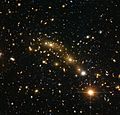
Galaxy cluster MACS J0416.1–2403 bending distant starlight.
-
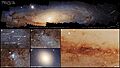
Huge detailed mosaic view of the nearby Andromeda Galaxy.
-
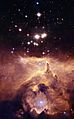
Young stars glowing inside the nebula NGC 6357.
-
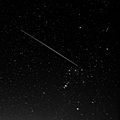
A time exposure showing Hubble moving across the night sky in Orion.
-
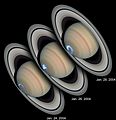
Glowing auroras at Saturn's pole captured by Hubble.
-
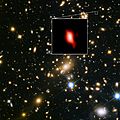
Combined space image showing distant galaxy cluster MACS J1149.5+2223.
-
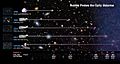
Chart showing how space telescopes observe distant cosmic history.
-
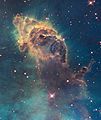
A detailed view of the Carina Nebula taken by Wide Field Camera 3.
-
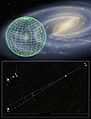
Hubble measuring precise distances to stars across the Milky Way.
-
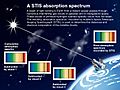
A spectrum reading showing the chemical contents of cosmic gas clouds.
-
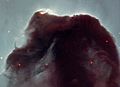
The famous Horsehead Nebula photographed by Hubble.
-
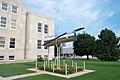
A model of Hubble located in Edwin Hubble's hometown of Marshfield, Missouri.
-
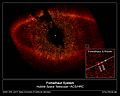
Hubble image examining the dust ring around the star Fomalhaut.


.jpg)


See also
 In Spanish: Telescopio espacial Hubble para niños
