
Hydra (constellation) facts for kids
| Constellation | |

List of stars in Hydra
|
|
| Abbreviation | Hya |
|---|---|
| Genitive | Hydrae |
| Pronunciation |
|
| Symbolism | the sea serpent |
| Right ascension | 8h 10m 56.2029s–15h 02m 31.3847s |
| Declination | 6.6302376°–-35.6938896° |
| Quadrant | SQ2 |
| Area | 1303 sq. deg. (1st) |
| Main stars | 17 |
| Bayer/Flamsteed stars |
75 |
| Stars brighter than 3.00m | 2 |
| Stars within 10.00 pc (32.62 ly) | 4 |
| Brightest star | Alphard (α Hya) (1.98m) |
| Messier objects | 3 |
| Meteor showers |
|
| Bordering constellations |
|
| Visible at latitudes between +54° and −83°. Best visible at 21:00 (9 p.m.) during the month of April. |
|
Hydra is the largest of all 88 modern constellations in the night sky. It looks like a long, winding snake stretching across space. Its southern end touches Libra and Centaurus, while its head borders Cancer. The ancient Greek astronomer Ptolemy included it in his list of 48 constellations. Today, stargazers see it as a giant water snake gliding through the stars.
Contents
Stories and Legends of the Giant Water Snake

Long ago, people created fun stories to explain the shapes in the night sky. In Babylonian astronomy, stargazers saw this area as a snake-like creature from the MUL.APIN. It was a cool mythological hybrid animal made from a serpent, lion, and bird!
Ancient Greek myths tell exciting adventures about this starry snake. One famous tale connects it to the hero Hercules, who has another constellation nearby. In the myth, Hercules had to face the sneaky monster called the Lernaean Hydra. Another story tells of a crow sent by the sun god Apollo to fetch water. The bird brought back a snake inside a cup, making Apollo angry. He tossed the crow, the cup, and the snake into the sky together. In Chinese constellations, these bright stars belong to the Vermilion Bird and the Azure Dragon. In Arabic, people named its head "Min al Az'al," meaning an uninhabited spot.
Finding the Stars and Deep Space Treasures

Even though Hydra is huge, it has only one truly bright star. That star is named Alphard, which means "the solitary one" in Arabic. Alphard is an orange giant star sitting 177 light-years away from Earth. Another cool star is Gamma Hydrae, which shines as a glowing yellow giant. The snake's head holds a dimmer star called Sigma Hydrae.
Hydra also contains interesting binary star systems, where two stars orbit around each other. One famous example is Epsilon Hydrae, also called Ashlesha from the ancient Āshleshā Nakshatra. Hydra also has variable stars that change their brightness over time. A bright example is R Hydrae, a pulsing Mira variable star. Nearby, the red star V Hydrae and the glowing U Hydrae slowly shift in light. Scientists also found an exciting star named GJ 357 with a planet called GJ 357 d. It is an icy "Super-Earth" located in a habitable zone where liquid water might exist!
Cool Objects Hidden in Deep Space


Hydra holds three famous cosmic objects from the Messier object catalog. One of the prettiest is M83, known as the Southern Pinwheel Galaxy. This amazing spiral galaxy is shaped like a giant whirlpool with bright spiral arms. It has hosted six exploding supernova stars. You can also spot M48, a huge open star cluster of shining baby stars. It is actually wider across than the full Moon! Another fun sight is M68, a tightly packed ball called a globular cluster. Astronomers also love NGC 3242, a glowing planetary nebula nicknamed the "Ghost of Jupiter" because of its cool blue-green shape. Looking closely reveals many more wonders across this massive constellation!
Images for kids
-
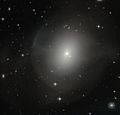
NGC 2865 is a youthful galaxy with a rotating disc of young stars.

See also
 In Spanish: Hidra (constelación) para niños
