
Incandescent light bulb facts for kids

An incandescent light bulb is an electric light that creates light by heating a thin wire, called a filament, until it glows brightly. This filament is inside a glass bulb. The bulb is either empty of air (a vacuum) or filled with a special gas. This protects the filament from burning up. Electricity reaches the filament through wires in the glass. A bulb socket holds the bulb and connects it to power.
Incandescent bulbs come in many sizes and voltages. They are simple to use and inexpensive to make. They work with both alternating current and direct current. Because of this, they were once very common in homes, businesses, cars, and flashlights.
However, incandescent bulbs are not very energy efficient. Less than 5% of the energy they use turns into visible light. Most of the energy becomes heat. Modern lights like LED lamps and compact fluorescent lamps (CFLs) use much less energy. Many governments have encouraged people to switch to these more efficient lights.
Contents
The Story of Light Bulbs

Many inventors worked on creating electric lights. Historians say that Thomas Edison made the first truly practical incandescent bulb. His design worked well because it used a good glowing material, had a strong vacuum, and had high electrical resistance. This made it possible to power many bulbs from one central source. However, Joseph Swan in London also had a practical incandescent bulb that was used daily in 1881, before Edison's became widely available.
Historian Thomas Hughes noted that Edison's success came from building a complete system. This included not just the bulb, but also the generator and the way electricity was distributed.
Early Ideas for Electric Light
In 1761, Ebenezer Kinnersley showed that a wire could glow when heated. But these wires quickly melted or burned in the air. Later, in 1802, Humphry Davy used a large battery to make a thin strip of platinum glow. Platinum was chosen because it could get very hot without melting. This early light was not bright or long-lasting enough for everyday use.
For many years, scientists tried different materials like platinum, iridium, and carbon. They also experimented with glass containers that had little or no air inside. Many of these early devices were shown to the public.
- In 1835, James Bowman Lindsay showed a constant electric light in Scotland.
- In 1838, Marcellin Jobard from Belgium invented a bulb with a carbon filament in a vacuum.
- In 1840, British scientist Warren De la Rue used a coiled platinum filament in a vacuum tube. This worked but was too expensive.
- In 1841, Frederick de Moleyns received the first patent for an incandescent lamp in England.
- In 1845, American John W. Starr patented a carbon filament bulb, but it was never sold.
- In 1859, Moses G. Farmer built a platinum filament bulb.

In 1872, Russian inventor Alexander Lodygin created an incandescent bulb. He used carbon rods in a sealed glass receiver filled with nitrogen. He later patented bulbs with filaments made from metals like tungsten.
In 1874, Canadians Henry Woodward and Mathew Evans patented a lamp with carbon rods in a nitrogen-filled cylinder. They later sold their patent rights to Thomas Edison.
Light Bulbs for Everyone
Carbon Filaments and Vacuum Bulbs


Joseph Swan was a British scientist. In 1850, he started working with carbonized paper filaments in a vacuum bulb. By 1860, he had a working device. But it didn't last long because of poor vacuums and weak electricity supplies. In the 1870s, better pumps became available. Swan returned to his experiments.

In 1878, Swan developed a way to prevent the bulb from blackening quickly. He demonstrated a working lamp in 1878 and 1879. His lamps used a carbon rod and lasted about 40 hours. Swan then created a better carbon filament from treated cotton thread. In the early 1880s, he began installing light bulbs in homes and famous places in England. His own house was the first in the world to be lit by electric lights. In 1881, the Savoy Theatre in London became the first public building fully lit by electricity.


Thomas Edison began his own research in 1878. He tried many materials, including carbon and platinum. He eventually returned to a carbon filament. His first successful test was on October 22, 1879, and it lasted 13.5 hours. Edison improved his design. He found that a carbonized Japanese bamboo filament could last over 1200 hours. In 1880, the ship Columbia became the first to use Edison's incandescent electric lamps.
Other inventors also made progress. Lewis Latimer, who worked for Edison, improved how carbon filaments were made. This made them stronger and allowed new shapes.
Metal Filaments and Inert Gas

In 1897, Alexander Lodygin patented filaments made of rare metals, including tungsten. He later sold these rights to General Electric.
In 1902, Siemens developed a tantalum lamp filament. Tantalum was more efficient than carbon. These lamps had long filaments that needed many supports.


On December 13, 1904, Sándor Just and Franjo Hanaman from Hungary patented a tungsten filament lamp. Tungsten filaments lasted longer and gave brighter light than carbon ones. The Hungarian company Tungsram started selling these in 1904.
In 1906, William D. Coolidge at General Electric found a way to make "ductile tungsten." This meant tungsten could be drawn into thin wires for filaments. By 1911, GE was selling bulbs with these new tungsten wires.

In 1913, Irving Langmuir discovered that filling a bulb with an inert gas (like nitrogen or argon) instead of a vacuum made the bulb twice as efficient. It also reduced the blackening of the bulb. He patented this idea in 1916.
In 1917, Burnie Lee Benbow patented the coiled coil filament. This is a filament that is coiled, and then that coil is coiled again. This design helps the bulb last longer and be more efficient.
In 1925, Marvin Pipkin patented a way to frost the inside of bulbs without making them weaker. This created a softer light.
How Efficient Are Incandescent Bulbs?


Incandescent light bulbs are not very efficient. Most of the power they use (over 95%) turns into heat, not light. This heat is mostly infrared radiation, which we cannot see. Sometimes, this heat is useful, like in heat lamps or toy ovens.
We measure how efficient a light bulb is by its luminous efficacy. This is the amount of visible light it produces (in lumens) compared to the electrical power it uses (in watts). A typical incandescent bulb produces about 12 to 17 lumens per watt. In comparison, modern LED lamps can produce over 100 lumens per watt.
Because they produce so much heat, incandescent bulbs can increase the work for air conditioning systems in buildings. While the heat can help warm a building in winter, it's usually cheaper to use a heating system for that.
| Type | Overall luminous efficiency | Overall luminous efficacy (lm/W) |
|---|---|---|
| 40 W tungsten incandescent (120 V, general service) | 1.9% | 12.6 |
| 60 W tungsten incandescent (120 V, general service) | 2.1% | 14.5 |
| 100 W tungsten incandescent (120 V, general service) | 2.6% | 17.5 |
| Glass halogen | 2.3% | 16 |
| Quartz halogen | 3.5% | 24 |
| Photographic and projection lamps with very high filament temperatures and short lifetimes | 5.1% | 35 |
| Theoretical maximum for a tungsten filament incandescent bulb | 7.6% | 52 |
Light Color
The light from an incandescent lamp looks warm and natural. It produces a continuous range of colors, similar to sunlight. This makes colors look very true to life. Other types of lights, like fluorescent or LED lamps, produce light in specific color bands. While they can be made to look like incandescent light, they sometimes show colors differently.
Cost Over Time
Incandescent bulbs are usually cheap to buy. But they use a lot of electricity over their lifetime. They also don't last as long as other types of lights. This means you have to replace them more often. When considering the total cost of lighting, including the bulb, electricity, and replacement effort, more efficient lights often save money in the long run.
Why Some Incandescent Bulbs Are Banned
Because incandescent bulbs use so much energy, many governments have decided to phase them out. They set new rules that require light bulbs to be more energy-efficient. This helps reduce energy use and protect the environment. These rules have been put in place in places like the European Union, the United States, and Australia.
Some people had concerns about the higher initial cost of new bulbs or the quality of light from early fluorescent lamps. However, LED technology has greatly improved, offering high-quality light and significant energy savings.
Making Bulbs Better

Scientists have tried to make incandescent bulbs more efficient. One improvement is the halogen lamp. These bulbs use a special gas and a reflective coating to send heat back to the filament. This makes the filament hotter and more efficient. Halogen bulbs can be about 30% more efficient than traditional incandescent bulbs.
How Incandescent Bulbs Are Made
Incandescent bulbs have a glass bulb, a tungsten wire filament, and wires that connect the filament to the power source. A glass stem inside the bulb holds the filament and its wires.
When electricity flows through the filament, it heats up to very high temperatures (around 2000 to 3300 degrees Celsius). This heat makes the filament glow and produce light. Most of the energy, however, is released as heat in the form of infrared light.
The Glass Bulb
Most bulbs have clear or frosted glass. Frosted bulbs have a white powder coating inside that spreads the light, making it softer. Colored bulbs are also made by adding special materials to the glass. The glass bulb of a regular lamp can get very hot, between 200 and 260 degrees Celsius.
 |
|
If a bulb's glass breaks, the hot filament quickly burns up when exposed to air.
Gas Inside the Bulb
Most modern bulbs are filled with an inert gas like argon and nitrogen, or sometimes krypton. This gas helps slow down the evaporation of the filament, making the bulb last longer. The gas also prevents the filament from burning up. However, the gas also takes some heat away from the filament, which makes the bulb slightly less efficient.
Older lamps used a vacuum (no air or gas) to protect the filament. Some very small modern lamps still use a vacuum.
Making the Bulbs in Factories

Early bulbs were made by hand. But machines were developed to make them much faster and cheaper. The "Ribbon Machine," invented in 1926, was a huge step forward. It could produce thousands of bulbs per minute! This machine works by moving a continuous ribbon of hot glass. Air nozzles then blow the glass into molds to create the bulb shapes.
The Filament
The filament is the part that glows. Early successful filaments were made from carbonized paper or bamboo. Carbon filaments had a problem: as they got hotter, their electrical resistance decreased. This made them sensitive to changes in power.
Later, metal filaments were used. Tungsten became the best choice because it has the highest melting point of any metal. This means it can get extremely hot and glow very brightly without melting.
Coiled Coil Filament
To make bulbs more efficient, the filament is often made into a coiled coil. This means a thin wire is coiled up, and then that coil is coiled again. This design helps reduce heat loss from the filament. It also slows down how quickly the tungsten evaporates. This makes the bulb last longer and glow brighter for the energy it uses.

Filament of a burnt-out 50-watt incandescent lightbulb in an SEM in stereoscopic mode, presented as an anaglyph image.
 3D red cyan glasses are recommended to view this image correctly. 3D red cyan glasses are recommended to view this image correctly.
Filament of a 50-watt incandescent lightbulb in an SEM in stereoscopic mode, presented as an anaglyph image.
3D red cyan glasses are recommended to view this image correctly. |

Why Filaments Evaporate and Bulbs Blacken
When a bulb is on, the tungsten filament slowly evaporates. Hotter filaments evaporate faster. This is why there's a trade-off between how bright a bulb is and how long it lasts. Most general-purpose bulbs are designed to last 1,000 to 2,000 hours.
The evaporated tungsten can settle on the inside of the glass bulb, making it look dark or black. This "bulb blackening" reduces the light output. The inert gas inside the bulb helps to slow this process down.
Halogen Lamps

Halogen lamps are a special type of incandescent bulb. They contain a small amount of halogen gas. This gas helps to recycle the evaporated tungsten back onto the filament. This process makes halogen lamps last longer and prevents the bulb from blackening. Halogen lamps can also run at higher temperatures, making them more efficient and brighter for their size.
Electrical Details
| 120-volt lamps | 230-volt lamps | |||
|---|---|---|---|---|
| Power (W) | Output (lm) | Efficacy (lm/W) | Output (lm) | Efficacy (lm/W) |
| 5 | 25 | 5 | ||
| 15 | 110 | 7.3 | ||
| 25 | 200 | 8.0 | 230 | 9.2 |
| 40 | 500 | 12.5 | 430 | 10.8 |
| 60 | 850 | 14.2 | 730 | 12.2 |
| 75 | 1,200 | 16.0 | ||
| 100 | 1,700 | 17.0 | 1,380 | 13.8 |
| 150 | 2,850 | 19.0 | 2,220 | 14.8 |
| 200 | 3,900 | 19.5 | 3,150 | 15.8 |
| 300 | 6,200 | 20.7 | 5,000 | 16.7 |
| 500 | 8,400 | 16.8 | ||
Power Use
Incandescent lamps are simple electrical loads. They use power directly from the electricity supply. Bulbs are usually sold based on how much electrical power they use, measured in watts. A higher wattage bulb generally gives more light.
The table shows how many lumens (light output) you can expect from common 120-volt and 230-volt bulbs.
Current and Resistance
The filament's resistance changes with temperature. When a tungsten filament is cold, its resistance is much lower than when it's glowing hot. For example, a 100-watt bulb has about 15 times less resistance when cold. This is why there's a brief surge of current when you first turn on an incandescent bulb.
Physical Features
Safety Tips
The filament is strong when cold but fragile when hot. If a hot bulb is bumped, the filament can break. Modern bulbs often have a built-in fuse. If the filament breaks and causes an electrical short, this fuse melts to cut off the power.
A hot glass bulb can also break if it touches something cold. When the glass breaks, the bulb quickly collapses inward (implodes). This exposes the hot filament to air, causing it to burn out.
Bulb Shapes

Light bulbs come in many shapes and sizes. These are often described by letters and numbers. For example, "A60" means a general-purpose (A-series) bulb with a diameter of 60 millimeters.
| Description | SI | Inch | Details |
|---|---|---|---|
| "Standard" lightbulb | A60 E26 | A19 E26 | ⌀60 mm (~⌀19/8 in) A series bulb, ⌀26 mm Edison screw |
| Candle-flame bulb | CA35 E12 | CA11 E12 | ⌀35 mm (~⌀11/8 in) candle-flame shape, ⌀12 mm Edison screw |
| Flood light | BR95 E26 | BR30 E26 | ⌀95 mm (~⌀30/8 in) flood light, ⌀26 mm Edison screw |
| Halogen track-light bulb | MR50 GU5.3 | MR16 GU5.3 | ⌀50 mm (~⌀16/8 in) multifaceted reflector, 5.33 mm-spaced 12 V bi-pin connector |
- Common Shapes
- General Service (A): These are the classic pear-shaped bulbs that send light in almost all directions. They can be clear or frosted.
- Decorative (B, CA, F, G): These bulbs have fancy shapes, like candles or globes, often used in chandeliers.
- Reflector (R, BR, ER): These bulbs have a reflective coating inside. This coating directs light forward, making them good for floodlights or spotlights.
- Parabolic Aluminized Reflector (PAR): PAR bulbs control light very precisely. They are often used in recessed lighting and outdoor fixtures.
- Multifaceted Reflector (MR): These are usually smaller, low-voltage bulbs, often used in track lighting.


Lamp Bases


The base of a light bulb connects it to the power. Most common types are the screw base (you twist it in) or the bayonet base (you push and twist). The base also holds the bulb in place. Different types of lamps, like halogen or reflector lamps, might use a bi-pin base.
Light Output and How Long Bulbs Last
Incandescent bulbs are very sensitive to changes in the voltage (the electrical "push") they receive.
- If the voltage goes up a little, the bulb gets much brighter, but its life gets much shorter.
- If the voltage goes down a little, the bulb lasts much longer, but it gives off much less light.
For example, reducing the voltage by just 5% can double a bulb's life. But it will also make it about 16% dimmer. This trade-off is used for special bulbs, like those in traffic signals, which are designed to last a very long time. For home use, bulbs are designed to balance brightness and a reasonable lifespan (around 1,000 hours).
There's a famous light bulb called the "Centennial Light" in Livermore, California. It has been burning almost continuously since 1901! However, it only gives off as much light as a very dim 4-watt bulb. This shows how much longer a bulb can last if it's run at a lower voltage.
-
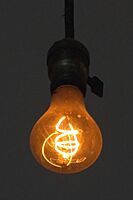
The Centennial Light is the longest-lasting light bulb in the world.
-
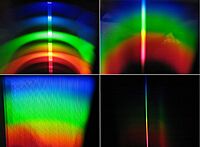
Various lighting spectra as viewed in a diffraction grating. Upper left: fluorescent lamp, upper right: incandescent bulb, lower left: white LED, lower right: candle flame.


See also
- 3-way lamp
- Flash (photography)
- Lampshade
- Light tube
- Lightbulb jokes
- List of light sources
- Longest-lasting light bulbs
- Light pollution
- Photometry (optics)
- Resistance wire
- Spectrometer
