
Thomas Edison facts for kids
Quick facts for kids
Thomas Alva Edison
|
|
|---|---|

"Genius is one percent inspiration, ninety-nine percent perspiration."
– Thomas Alva Edison, Harper's Monthly (September 1932) |
|
| Born | February 11, 1847 |
| Died | October 18, 1931 (aged 84) West Orange, New Jersey, United States
|
| Cause of death | Diabetes |
| Occupation | Inventor, scientist, businessman |
| Spouse(s) |
Mary Stilwell
(m. 1871–1884)Mina Edison
(m. 1886–1931) |
| Children | Marion Estelle Edison (1873–1965) Thomas Alva Edison Jr. (1876–1935) William Leslie Edison (1878–1937) Madeleine Edison (1888–1979) Charles Edison (1890–1969) Theodore Miller Edison (1898–1992) |
| Parent(s) | Samuel Ogden Edison, Jr. (1804–1896) Nancy Matthews Elliott (1810–1871) |
| Relatives | Lewis Miller (father-in-law) |
Thomas Edison (born February 11, 1847 – died October 18, 1931) was a famous American inventor and businessman. He created many important things that changed the world. While he didn't invent the first light bulb, he made one that worked much better. Edison received 1,093 patents for his inventions. This was more than any other inventor at that time. He also started the General Electric Company to make some of his inventions. He passed away from a disease called diabetes.
Contents
- Edison's Early Life and Learning
- Facing Challenges and Finding Work
- Edison's Amazing Career
- His amazing inventions
- West Orange and Fort Myers Labs
- Edison's Family Life
- Final Years and Legacy
- Famous Quotes by Thomas Edison
- Interesting Facts About Thomas Edison
- Timeline of Thomas Edison's Life
- Images for kids
- See also
Edison's Early Life and Learning

Thomas Alva Edison was born in Milan, Ohio. When he was seven, his family moved to Port Huron, Michigan. Thomas started school a bit late because he was sick. After only three months, he left school. He found it hard to pay attention to his teacher.
Luckily, his mother had been a teacher in Canada. She taught Thomas at home. His mother helped him love learning and exploring new ideas.
Facing Challenges and Finding Work
When Thomas was twelve, he got scarlet fever. This illness caused him to lose most of his hearing. He became completely deaf in his left ear and almost deaf in his right ear. When he was thirteen, he started working. He sold candy, newspapers, and vegetables on a train. He used the money he earned to buy things for his chemistry and electricity experiments.
One day, Edison saved a young boy from a runaway train. The boy's father was very thankful. He taught Edison how to be a telegraph operator. A telegraph operator sends messages using electric signals. When he was sixteen, Edison made his first invention. It was called an "automatic repeater." This machine helped send telegraph signals faster between stations.
Edison's Amazing Career
In 1868, Edison moved to Boston. He worked for the Western Union Company as a telegraph operator. He worked long hours, twelve hours a day, six days a week. Within six months, he got his first patent for an electric vote recorder. This machine made voting faster. However, he couldn't find anyone to buy it.
Then, Edison moved to New York. He started working for a company, fixing their machines. At night, he kept working on his own projects and ideas.
The Menlo Park Laboratory
In 1876, Edison used money from his inventions to open his own laboratory. It was in Menlo Park, New Jersey. Edison hired a team of "muckers"—scientists, mathematicians, and craftsmen from all over the world. They worked together as a team to solve problems. This was the birth of the modern Research and Development (R&D) lab. Menlo Park became very famous. In just over ten years, it grew to cover two city blocks. Many important inventions came from this lab.
Edison showed the world that you could "manufacture" inventions by having a dedicated space, a team of experts, and a lot of resources.
His amazing inventions
The Phonograph: The Birth of Recorded Sound

Before 1877, if you wanted to hear music, you had to be standing right next to someone playing an instrument. If you wanted to hear a speech, you had to be in the same room as the speaker. Once the sound was made, it vanished into the air forever. Thomas Edison changed that with the invention of the phonograph.
The phonograph was a mechanical marvel. It used a mouthpiece with a very thin membrane (a diaphragm) connected to a sharp needle. When Edison spoke into the mouthpiece, the sound waves from his voice made the membrane vibrate. These vibrations pushed the needle into a rotating cylinder covered in tinfoil. The needle etched tiny grooves into the foil that matched the vibrations of his voice. To play the sound back, a different needle would follow those grooves, vibrating the membrane and recreating the sound.
The very first thing ever recorded was Edison reciting the nursery rhyme "Mary Had a Little Lamb." When he played it back and heard his own voice, even he was surprised that it worked so well on the first try!
The phonograph is the "great-great-grandfather" of everything we use to listen to music today. Without this invention, we wouldn't have records, CDs, or even digital files like MP3s and streaming services like Spotify. Edison taught us how to "capture" sound and keep it forever.
The Practical Incandescent Light Bulb

A common myth is that Edison "invented" the light bulb. In reality, other scientists had been trying to make electric lights for decades. However, their bulbs were either too expensive, burned out in a few minutes, or were so bright they could only be used outdoors (like streetlights). Edison’s genius was making a light bulb that was practical for use inside a home.
The biggest challenge was the "filament"—the little wire inside the bulb that glows when electricity hits it. Edison needed a material that could glow for a long time without melting or breaking. He and his team tested over 6,000 different materials! They tried platinum, cork, paper, and even hair from a friend’s beard.
Finally, in 1879, they found that a carbonized cotton thread worked for about 13.5 hours. Later, they discovered that carbonized bamboo could last for over 1,200 hours!
Edison also realized that for a bulb to work, there couldn't be any oxygen inside it. If there were oxygen, the filament would just catch fire and burn up instantly. He used a vacuum pump to suck all the air out of the glass bulb, allowing the filament to glow (incandesce) without burning.
This invention literally changed the rhythm of human life. Before the light bulb, people went to bed when the sun went down because candles and oil lamps were dim and dangerous. With the light bulb, the "night" became a time for reading, working, and socializing.
The Electric Power Distribution System

Having a light bulb is great, but it’s useless if you don’t have a way to plug it in! Edison realized that to sell his bulbs, he had to build an entire system to deliver electricity to people’s homes. This was perhaps his most massive undertaking.
In 1882, Edison opened the Pearl Street Station in New York City. It was the world’s first central power plant. He designed the generators (which he called "dynamos"), the underground cables, the fuses, and even the electric meters to track how much power people used.
This led to a famous rivalry known as the "War of Currents." Edison used Direct Current (DC), which flowed in one direction. His rival, George Westinghouse (supported by the brilliant Nikola Tesla), promoted Alternating Current (AC). While AC eventually became the standard for long-distance power because it was more efficient, Edison’s work laid the foundation for the modern electrical grid that powers our computers, refrigerators, and phones today.
The Motion Picture Camera (Kinetograph)


If you love watching movies or YouTube videos, you have Edison to thank. In the late 1880s, Edison became interested in creating a device that would "do for the eye what the phonograph does for the ear."
Edison and his assistant, William Dickson, developed the Kinetograph, a heavy camera that could take a rapid series of photos on a long strip of film. To watch these "movies," people used a Kinetoscope—a wooden cabinet with a peephole at the top. You would drop a coin in, look through the hole, and see a short film of someone dancing, boxing, or even sneezing!
Edison built the world’s first film studio in West Orange, New Jersey. It was a small building covered in black tar paper, nicknamed the "Black Maria." The entire building was on a pivot so it could be rotated to follow the sun, ensuring there was always enough light for filming.
While Edison’s early movies were only about 30 seconds long and had no sound, they were the beginning of the multi-billion dollar film industry. He helped turn "moving pictures" from a scientific curiosity into a global form of entertainment.
The Carbon Transmitter

Alexander Graham Bell invented the telephone, but the early versions were very weak. You had to scream into them to be heard, and you couldn't talk to someone who was very far away.
In 1877 and 1878, Edison developed the carbon transmitter (also called a carbon microphone). He used a small container of compressed carbon granules. When you spoke, the sound waves pressed against the carbon, changing its electrical resistance. This created a much stronger electrical signal that could travel long distances over wires.
Edison’s carbon transmitter made the telephone a practical tool for business and personal use. In fact, variations of his carbon microphone were used in telephones all the way until the 1980s! It is also why we say "Hello" when we pick up the phone—Edison was the one who suggested that word as a standard greeting.
The Alkaline Storage Battery
Later in his life, Edison spent nearly ten years working on a better battery. At the time, lead-acid batteries (like the ones in cars today) were very heavy and used acid that could leak and damage things.
Edison wanted to create a battery for electric cars. Yes, electric cars were very popular in the early 1900s! He wanted a battery that was lighter, more durable, and more powerful.
After thousands of experiments, he created the alkaline storage battery. While gasoline-powered cars eventually became more popular than electric ones at that time, Edison’s alkaline batteries became incredibly successful. They were used in mining lamps, railroad signals, and even early submarines because they were so reliable.
West Orange and Fort Myers Labs
After his first wife, Mary, passed away, Edison bought a home called "Glenmont" in West Orange, New Jersey. This was a wedding gift for his second wife, Mina. The couple spent their winters at a home they bought in Fort Myers, Florida.
Edison kept working hard no matter where he lived. In Fort Myers, he focused on rubber. He and his friends, Henry Ford and Harvey Firestone, started a lab there. Edison wanted to grow plants that could make rubber. This way, America would not have to rely on other countries for it.
During World War I, Edison suggested creating a science and industry committee. This group would give advice and do research for the U.S. military. He led the Naval Consulting Board in 1915.
Edison's Family Life
Thomas Edison married Mary Stilwell in 1871. They had three children together:
- Marion Estelle Edison (nicknamed "Dot")
- Thomas Alva Edison, Jr. (nicknamed "Dash")
- William Leslie Edison
Mary Stilwell passed away in 1884 when she was twenty-nine years old.
When he was thirty-nine, Edison married his second wife, Mina Miller. She was nineteen at the time. They had three children:
- Madeleine Edison
- Charles Edison (who later became the Governor of New Jersey)
- Theodore Miller Edison
Final Years and Legacy
Edison stayed active in business even in his later years. He helped develop the Lackawanna Railroad. He was there when it started and even drove the train for its first mile.
Thomas Alva Edison passed away on October 18, 1931. He died from problems related to diabetes. He is buried behind his "Glenmont" home.
Famous Quotes by Thomas Edison
- "Opportunity is missed by most people because it is dressed in overalls and looks like work."
- "A genius is often merely a talented person who has done all of his or her homework."
- "If we all did the things we are really capable of doing, we would literally astound ourselves."
- "I have more respect for the fellow with a single idea who gets there than for the fellow with a thousand ideas who does nothing."
- "The world owes nothing to any man, but every man owes something to the world."
Interesting Facts About Thomas Edison
- Thomas's father, Samuel Ogden Edison, Jr., took part in a protest against British rule in North America. After the protest, he moved to America, where Thomas was born.
- Edison believed his poor hearing actually helped him focus better.
- As a child, Edison was called "Al."
- When Thomas was fifteen, he started printing a newspaper on the Grand Trunk Railway. It was called the Grand Trunk Herald.
- Edison's first two children had nicknames inspired by telegraph signals: "Dot" and "Dash."
- Nikola Tesla worked for Thomas Edison for a short time.
- Thomas Edison was sometimes called "The Wizard of Menlo Park."
- On December 31, 1879, the Menlo Park laboratory was lit up with electricity for the very first time.
- Edison enjoyed reading and reciting poetry.
- Edison even made a device to kill cockroaches using electricity.
- The Henry Ford Museum claims to have Thomas Edison's last breath in a test tube.
Timeline of Thomas Edison's Life
Here are some key dates in the life and work of Thomas Edison:
- 1847: Born on February 11 in Milan, Ohio.
- 1854: His family moves to Port Huron, Michigan.
- Around 1859: Starts working, selling newspapers and candy on trains.
- Early 1860s: Becomes a telegraph operator.
- 1869: Receives his first patent for the electric vote recorder. Moves to New York City.
- Early 1870s: Sets up workshops in Newark, New Jersey, working on improving telegraphs.
- 1876: Opens his famous laboratory in Menlo Park, New Jersey.
- 1877: Invents the phonograph, the first machine to record and play sound.
- 1878: Helps start the Edison Electric Light Company.
- 1879: Successfully shows a long-lasting incandescent light bulb (October 21).
- 1880: Gets a patent for his electric lighting system.
- 1882: Opens the Pearl Street Station in New York City. This was the world's first central electric power plant.
- 1887: Opens the larger West Orange Laboratory in New Jersey.
- Late 1880s - 1890s: Develops the Kinetograph (a camera) and Kinetoscope (a viewer) for motion pictures.
- 1892: The Edison General Electric Company joins with another company to form General Electric (GE).
- Early 1900s: Works on making a reliable rechargeable battery.
- 1914: His factory in West Orange is badly damaged by fire, but he quickly rebuilds it.
- 1914-1918: Works on defense projects for the U.S. Navy during World War I.
- 1931: Dies on October 18 in West Orange, New Jersey.
Images for kids
-
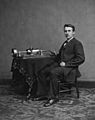
Photograph of Edison with his phonograph (2nd model), taken in Mathew Brady's Washington, DC studio in April 1878
-
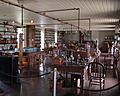
Edison's Menlo Park Laboratory, reconstructed at Greenfield Village at Henry Ford Museum in Dearborn, Michigan.
-
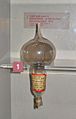
Thomas Edison's first successful light bulb model, used in public demonstration at Menlo Park, December 1879
-
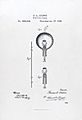
U.S. Patent#223898: Electric-Lamp. Issued January 27, 1880.
-
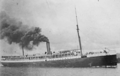
The Oregon Railroad and Navigation Company's new steamship, the Columbia, was the first ship to use Edison's incandescent light bulb in 1880.
-
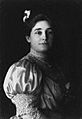
Edison's wife Mina in 1906
-
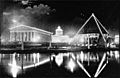
Extravagant displays of electric lights quickly became a feature of public events, as in this picture from the 1897 Tennessee Centennial Exposition.
-
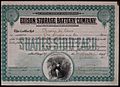
Share of the Edison Storage Battery Company, issued October 19, 1903
-
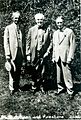
From Left to Right: Henry Ford, Thomas Edison, and Harvey Firestone, the three partners of the Edison Botanic Research Corporation
-
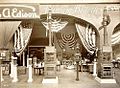
Thomas A. Edison Industries Exhibit, Primary Battery section, 1915
-
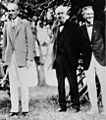
Henry Ford, Thomas Edison, and Harvey Firestone, respectively. Ft. Myers, Florida, February 11, 1929
-
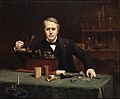
Portrait of Edison by Abraham Archibald Anderson (1890), National Portrait Gallery
-
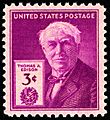
Thomas Edison commemorative stamp, issued in 1947, on the 100th anniversary of his birth
-
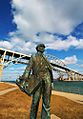
Statue of young Thomas Edison by the railroad tracks in Port Huron, Michigan
-
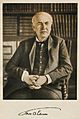
Edison in 1915


See also
 In Spanish: Thomas Alva Edison para niños
