
Isabella d'Este facts for kids
Quick facts for kids Isabella d'Este |
|
|---|---|

The only certain image of Isabella:
Medal by Giovanni Cristoforo Romano (c. 1495 – gold version c. 1505) |
|
| Marchioness consort of Mantua | |
| Reign | 12 February 1492 - 29 March 1519 |
| Born | 19 May 1474 Ferrara, Duchy of Ferrara |
| Died | 13 February 1539 (aged 64) Mantua, Duchy of Mantua |
| Spouse |
Francesco II Gonzaga, Marquess of Mantua
(m. 1492; died 1519) |
| Issue | Eleonor Gonzaga, Duchess of Urbino Margherita Gonzaga Federico II, Duke of Mantua Livia Gonzaga Ippolita Gonzaga Ercole Gonzaga Ferrante Gonzaga Livia Gonzaga |
| House | Este |
| Father | Ercole I d'Este |
| Mother | Eleanor of Naples |
Isabella d'Este (19 May 1474 – 13 February 1539) was a powerful noblewoman of the Italian Renaissance. She was the Marchioness of Mantua and was known for her intelligence, political skills, and support of the arts.
Isabella was a trendsetter in fashion and a patron of famous artists. Because of her influence and style, she was called "The First Lady of the World" by diplomats of her time. She ruled Mantua when her husband was away and later helped her son run the state. She wrote thousands of letters during her life, which helps historians understand what life was like in Italy over 500 years ago.
Contents
Early Life and Family
Childhood in Ferrara
Isabella was born on Tuesday, 19 May 1474, in the city of Ferrara, Italy. She was the daughter of Ercole I d'Este, the Duke of Ferrara, and Eleanor of Naples. She was the oldest child in a large family. Her siblings included her sister Beatrice d'Este and her brothers Alfonso, Ferrante, Ippolito, and Sigismondo.
Isabella was considered the favorite child. In 1477, she traveled to Naples with her mother. When they returned to Ferrara, Isabella went with them, but her sister Beatrice stayed in Naples for several years to be raised by their grandfather, the King of Naples.

Education
Isabella was a brilliant student. She received a "classical education," which meant she studied history, literature, and languages. She could speak and translate Latin and Greek. She often discussed serious topics with ambassadors and scholars.
She was also very artistic. Isabella learned to play the lute (a stringed instrument similar to a guitar) from a famous teacher named Giovanni Angelo Testagrossa. She was a talented singer and loved to dance. She even invented new dance steps with the help of her dance master, Ambrogio.
Marriage to Francesco Gonzaga
Betrothal and Wedding

In 1480, when Isabella was just six years old, she was betrothed (engaged) to Francesco II Gonzaga, Marquess of Mantua. He was the heir to the Marquess of Mantua and was eight years older than her. This was a political arrangement to connect their two powerful families.
Ten years later, on 11 February 1490, Isabella married Francesco. She was 15 years old. The wedding was a huge celebration. Isabella rode through the streets of Ferrara on a horse decorated with gold and gems. She brought a large dowry (money and goods brought to a marriage) of 3,000 ducats, along with jewelry and silver dishes.
Life as Marchioness
Isabella moved to Mantua to live with her husband. Francesco was a military leader and the captain general of the armies of the Republic of Venice. He was often away on military campaigns, leaving Isabella to manage the court.
Isabella and Francesco had a strong relationship in the beginning. She admired his bravery, and he sent her poems and letters. However, they were very different people. Isabella loved art and culture, while Francesco was more interested in horses and war. Over time, they had some disagreements about politics and family matters, but they remained married until his death.
Relationship with Her Sister

Isabella was close to her sister Beatrice d'Este, who married Ludovico Sforza, the Duke of Milan. They visited each other and wrote many letters. They were both very fashionable and sometimes competed to see who had the best clothes or the most brilliant court. Beatrice was known for being adventurous and sporty, while Isabella was more focused on art and music. Sadly, Beatrice died young in 1497, which was a great loss for Isabella.
A Powerful Leader
Defending Mantua
Isabella was not just a figurehead; she was a capable ruler. When her husband Francesco was captured in 1509 and held prisoner in Venice, Isabella took charge of Mantua's military defenses. She organized the army and protected the city from invaders until Francesco was released in 1512. She proved to be a stronger and more effective leader than many men of her time.
Ruling as Regent

After Francesco died in 1519, Isabella became the regent for her son, Federico, who was the new ruler. A regent is someone who rules when the actual monarch is too young or unable to do so.
During her time as regent, Isabella played a major role in Italian politics. She used her diplomatic skills to make Mantua a Duchy (a higher status than a Marquisate). She also helped her son Ercole Gonzaga become a Cardinal. She studied books on leadership, including works by Niccolò Machiavelli, to learn how to govern wisely. The people of Mantua respected and loved her for her dedication.
The Sack of Rome
In 1527, Isabella was in Rome when the city was attacked by imperial soldiers in an event known as the Sack of Rome. She turned her home, the Palazzo Colonna, into a safe shelter. About 2,000 people, including nobles and regular citizens, hid in her palace to escape the violence. Because her son Ferrante was a general in the attacking army, her house was one of the few safe places. She managed to get safe passage for herself and the refugees.
Patron of the Arts

Isabella d'Este is most famous today for her support of the arts. She was a major "patron," which means she paid artists to create paintings, sculptures, and music. She collected Roman statues and filled her personal study, called a Studiolo, with beautiful artworks.
Famous Artists
She knew and hired some of the greatest artists of the Renaissance, including:
- Leonardo da Vinci
- Michelangelo
- Raphael
- Titian
- Andrea Mantegna (who was her court painter)
She also supported writers and poets like Ludovico Ariosto and Baldassare Castiglione.
Fashion Icon
Isabella was a trendsetter. Women all over Italy and France copied her style. She invented a special headdress called a Balzo, which looked like a large, round turban. She also used perfumes and had unique clothing designs made from expensive fabrics.
Portraits and Appearance

Isabella was very particular about how she was painted. She wanted to look beautiful and dignified. As she got older, she preferred artists to paint her looking younger than she really was.
There is a famous drawing of her by Leonardo da Vinci. She wanted him to turn it into a colorful painting, but he never finished it. Titian painted a famous portrait of her wearing black (Isabella in Black) when she was over 60 years old, but in the painting, she looks like a young woman.
The Mona Lisa Connection

Some art historians believe that Isabella d'Este might be the subject of Leonardo da Vinci's famous painting, the Mona Lisa. While most people think the painting shows Lisa del Giocondo, there are similarities between Isabella's letters requesting a portrait and the final painting. However, this is just a theory.
Later Years and Legacy
After returning from Rome, Isabella made Mantua a center of culture. She opened a school for girls and turned her apartments into a museum for her art collection. She later ruled a small town called Solarolo until she passed away on 13 February 1539.
Isabella left a huge mark on history. She showed that a woman could be a powerful political leader and a major influence on art and culture.
Family and Children
Isabella and Francesco had eight children:
- Eleonora Gonzaga (Duchess of Urbino)
- Margherita Gonzaga (died as a baby)
- Federico II Gonzaga, Duke of Mantua (became the Duke of Mantua)
- Livia Gonzaga (died young)
- Ippolita Gonzaga (became a nun)
- Ercole Gonzaga (became a Cardinal)
- Ferrante Gonzaga (a soldier and general)
- Livia Gonzaga (became a nun, named after her sister who died)
Modern Media
Isabella d'Este appears in books and TV shows about the Renaissance.
- She is a character in the TV series Borgia (2011–2014).
- A novel titled The Marchesa by Sarah Dunant (2025) is based on Isabella's life and letters.
- She appears in the video game Vampire Therapist (2024).
Images for kids
-
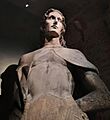
Probable portrait of Galeazzo Sanseverino
-
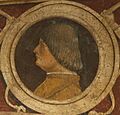
Ludovico Sforza, Isabella's brother-in-law
-
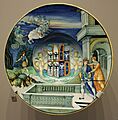
Maiolica plate with the arms of Isabella and her husband
-
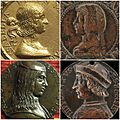
The Este siblings' medals
-
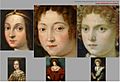
Colour portraits of Isabella d'Este
-
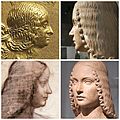
Comparison of Isabella's portraits
-
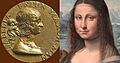
Matching hairstyle: Portrait medal and Prado Mona Lisa

_-_Foto_Giovanni_Dall%27Orto,_8-Jan-2012a.jpg)


-
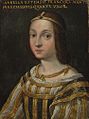
Miniature portrait, 16th century
-
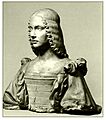
Bust by Giovanni Cristoforo Romano, c. 1500
-
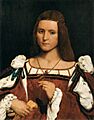
Female portrait by Giovanni Francesco Caroto, c. 1505–1510
-
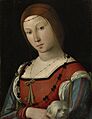
Portrait of a Lady with a Lapdog, Lorenzo Costa, c. 1500
-
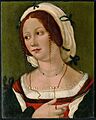
Female portrait by Francesco Francia, c. 1511
-
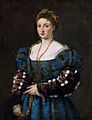
La Bella, ideal portrait by Titian, 1536
-
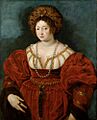
Isabella in Red copy by Rubens, c. 1605
-
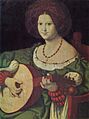
The Lute Player by Andrea Solario, c. 1510
-
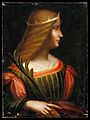
Anonymous painting after Leonardo da Vinci's drawing


See also
 In Spanish: Isabel de Este para niños
