
Lakota people facts for kids

Sitting Bull, a famous Hunkpapa Lakota leader and holy man
|
|
| Total population | |
|---|---|
| Over 170,000 | |
| Regions with significant populations | |
| United States (North Dakota, South Dakota, Nebraska, Montana) Canada (Manitoba and Saskatchewan) |
|
| Languages | |
| English, Lakota | |
| Religion | |
| Lakota religion, Traditional tribal beliefs, Christianity | |
| Related ethnic groups | |
| Other Sioux peoples (Dakota) |
| Lakota transl. 'ally' or 'friend' |
|
|---|---|
| People | Lakȟóta Oyáte |
| Language | Lakȟótiyapi Wíyutȟapi |
| Country | Lakȟóta Makóce, Očhéthi Šakówiŋ |
The Lakota (also pronounced Lakȟóta) are a well-known Native American tribe. They are the westernmost group of the great Sioux Nation. Today, most Lakota people live in North Dakota and South Dakota, as well as parts of Canada.
In their own language, the word Lakota translates to "allies" or "friends." Long ago, French explorers and traders called them the "Teton Sioux," which comes from their word Thítȟuŋwaŋ, meaning "prairie dwellers."
The Lakota are famous for their rich culture, artistic traditions, and incredible horsemanship. Historically, they lived across the northern Great Plains as buffalo hunters. Their homeland centered around the sacred Black Hills, which they hold dear to this day.
Contents
Who Are the Lakota People Today?
The Lakota belong to the larger alliance called the Očhéthi Šakówiŋ, or the Seven Council Fires. This grand alliance links together the Dakota and Lakota peoples. Within the Lakota nation itself, there are seven distinct bands or sub-tribes:
- Sičháŋǧu (Brulé or "Burned Thighs")
- Oglála ("They Scatter Their Own")
- Itázipčho (Sans Arc or "Without Bows")
- Húŋkpapȟa ("Camp at the End of the Camp Circle")
- Mnikȟówožu ("Planters by the Water")
- Sihásapa ("Blackfeet")
- Oóhenuŋpa ("Two Kettles")
Each of these bands has its own proud history, famous leaders, and unique stories. Together, they form a strong and resilient community of over 170,000 tribal members.
History of the Lakota Nation

The journey of the Lakota spans many centuries of movement, change, and deep connection to the land.
Traditional Origins and Winter Counts
Lakota history was passed down through spoken stories and painted historical records known as winter counts (Lakota: waníyetu wówapi). A winter count was a calendar painted on buffalo hide or paper. Each year, tribal historians selected one major event to paint as an image representing the whole year.
Lakota oral traditions tell of their emergence from Wind Cave in the Black Hills of South Dakota. In this story, the people emerged from beneath the earth to care for the plains.
Another central story is the gift of the Sacred Pipe by White Buffalo Calf Woman (Ptesáŋwiŋ). She visited the people long ago, presenting them with a sacred pipe made of red pipestone and wood. She taught the Lakota how to pray to the Great Spirit, known as Wakȟáŋ Tȟáŋka. This sacred tradition taught harmony and respect between humans, animals, and the earth.
Migration and the Horse Culture
Hundreds of years ago, the ancestors of the Lakota lived near the upper Mississippi River and the western Great Lakes. Over time, groups began moving west toward the open plains.
Around 1730, the Lakota acquired horses from neighboring tribes like the Cheyenne. The Lakota called the horse šuŋkawakaŋ, which means "sacred dog" or "wonder dog."
Horses completely changed life on the Great Plains:
- Hunting bison became much faster and more successful.
- Families could travel longer distances with larger tipi lodges.
- Communities could easily move together during different seasons.
During the summers, bands gathered into large circles of tipis called the "sacred hoop." In winter, smaller family groups camped in sheltered river valleys to stay warm.
Arrival in the Sacred Black Hills
By the 1770s, the Lakota had crossed the wide Missouri River and entered the Black Hills (Lakota: Pahá Sápa). They considered these pine-covered mountains the spiritual heart of the universe.
The Black Hills provided lumber, clean springs, shelter from storms, and plants for medicine. They also offered an abundance of wildlife. To the Lakota, this land was holy and irreplaceable.
Clashes and Treaties in the 1800s
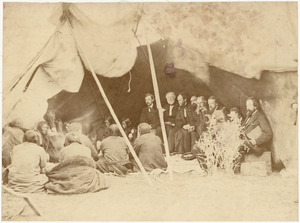
As the United States expanded westward during the 19th century, settlers and soldiers moved into Lakota hunting grounds. This led to councils, treaties, and conflicts.
First Contacts and the Oregon Trail
In September 1804, American explorers Meriwether Lewis and William Clark met Sicangu Lakota leaders near the Bad River. The meeting was tense, but leaders like Chief Black Buffalo avoided a fight and allowed the explorers to pass safely.
By the 1840s, thousands of American pioneers traveled along the Oregon Trail. Their livestock ate the prairie grass that buffalo needed, which pushed the wild herds away. This disrupted traditional hunting patterns and caused great hardship for Plains tribes.
The Fort Laramie Treaties
.png)
To reduce tensions along the trails, the U.S. government held a massive gathering in 1851.
- The 1851 Treaty of Fort Laramie recognized a vast area of the northern Plains as Lakota territory. In return, the Lakota agreed to allow roads and forts across specific areas.
- Misunderstandings quickly followed, as the government tried to enforce borders on nomadic hunters who followed wildlife across wide regions.
In the 1860s, gold was found in Montana, leading settlers to build the Bozeman Trail right through Lakota hunting lands. Chief Red Cloud (Maȟpíya Lúta) led an alliance of tribes in Red Cloud's War to defend their lands.
Red Cloud was a skilled military strategist. His fighters successfully forced the U.S. Army to abandon its forts along the trail. In 1868, the second Fort Laramie Treaty was signed:
- The Bozeman Trail was closed completely.
- The Great Sioux Reservation was established, encompassing all of western South Dakota.
- The Black Hills were promised to the Lakota forever.
Gold, Battles, and the Great Sioux War

In 1874, Lieutenant Colonel George Armstrong Custer led an expedition into the Black Hills and confirmed the presence of gold. Thousands of miners immediately rushed into Lakota territory, breaking the treaty agreement.
When the Lakota refused to sell their sacred land, the U.S. government ordered all bands to report to agencies. Many leaders, including Sitting Bull (Tȟatȟáŋka Íyotake) and Crazy Horse (Tȟašúŋke Witkó), refused to leave their traditional hunting camps.
This led to the Great Sioux War of 1876:
- Battle of the Rosebud (June 17, 1876): Lakota and Cheyenne forces turned back General George Crook's army.
- Battle of the Little Bighorn (June 25, 1876): Lieutenant Colonel Custer attacked a large allied camp along the Little Bighorn River in Montana. Sitting Bull inspired his people, while Crazy Horse led warriors into battle, completely defeating Custer's troops.
Even though the tribes won this historic battle, the U.S. Army sent thousands more soldiers onto the Plains. Facing harsh winters and the disappearance of the buffalo herds, the Lakota bands were gradually forced to surrender.
Loss of the Black Hills and Wounded Knee
In 1877, under intense military and political pressure, a small group of leaders signed an agreement ceding the Black Hills. Many Lakota argued this agreement was invalid under the terms of the 1868 treaty, which required three-fourths of all adult men to approve land sales.
By 1890, conditions on reservations were extremely difficult due to food shortages and drought. Many people turned to the Ghost Dance, a peaceful religious movement promising a return of the buffalo and an end to hardship.
Government officials misunderstood the peaceful dance as a call to rebellion:
- On December 15, 1890, Sitting Bull was killed during an attempt to arrest him.
- On December 29, 1890, soldiers surrounded a band led by Chief Spotted Elk (Big Foot) near Wounded Knee Creek. During an attempt to disarm the Lakota, gunfire broke out, resulting in the tragic deaths of roughly 250 Lakota men, women, and children.
Modern Government and Sovereignty

Today, the Lakota govern themselves as sovereign nations within the United States and Canada.
United States Tribal Governments
Lakota tribes are federally recognized sovereign nations. They have a "government-to-government" relationship with the United States federal government, rather than individual states.
Key aspects of modern Lakota government include:
- Tribal Councils: Each tribe elects its own council members, president, or chairperson.
- Tribal Laws: Tribes maintain their own court systems, police departments, and community regulations.
- Dual Citizenship: Lakota people are full citizens of their tribal nation as well as the United States. They vote in tribal elections and national elections.
Canadian Dakota and Lakota Bands
Several Dakota and Lakota communities live north of the border in Saskatchewan and Manitoba. Some descend from bands led by Sitting Bull that crossed into Canada following the 1876 wars.
For many years, Canadian officials considered these communities "refugees." In 2024, the Canadian government formally recognized them as Aboriginal peoples of Canada, opening doors for self-government agreements and treaty rights.
The Black Hills Legal Claim
The Lakota have never stopped fighting for their sacred Black Hills. In 1980, the U.S. Supreme Court ruled in United States v. Sioux Nation of Indians that the Black Hills had been taken unlawfully in 1877.
The court awarded the tribes over $100 million in monetary compensation. However, the Lakota tribes refused to accept the cash payout. Accepting the money would legally end their claim of ownership to the land.
The Lakota maintain that "the Black Hills are not for sale." The award money remains untouched in a federal account, growing with interest to over $1 billion, as tribal nations continue to seek the return of public lands in the Black Hills.
Traditional Culture and Way of Life
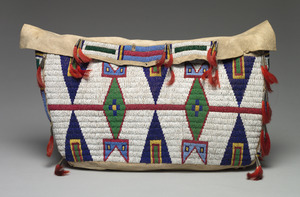

Lakota life was built upon deep respect for family, community, and nature.
The Buffalo and Daily Living
For generations, the American bison (buffalo) was the center of Lakota survival. The Lakota used every single part of the animal:
- Meat was eaten fresh or dried into jerky (tȟapȟéŋ) to last through long winters.
- Hides were tanned to make warm robes, moccasins, and coverings for tipis.
- Bones and horns were carved into soup spoons, needles, scrapers, and tools.
- Sinew (tendon) was used as tough bowstrings and sewing thread.
- Stiff rawhide was folded into sturdy luggage bags called parfleches.
Tipis were ideal homes for Plains life. Made of long wooden poles wrapped with buffalo hides, they were warm in winter, cool in summer, and could be packed up in minutes when following the herds.
Art and Craftsmanship
Lakota artisans are renowned for their incredible beadwork and quillwork:
- Early artists used dyed porcupine quills to create geometric patterns on shirts and bags.
- When European glass beads became available through trade, Lakota women developed complex, colorful beaded designs.
- Men painted pictures on buffalo robes and tipis, illustrating brave actions, hunting trips, and historical occurrences.
Kinship and Community Values
Lakota society was organized around the concept of thiyóšpaye (extended family). Grandparents, aunts, uncles, and cousins all lived and traveled together, helping raise children cooperatively.
Traditional Lakota culture emphasizes four core virtues:
- Wóksape (Wisdom)
- Wóohitika (Bravery)
- Wóčhaŋt’ognake (Generosity)
- Wóohola (Respect)
Generosity was valued above personal wealth. A leader was judged not by what he kept for himself, but by how much he gave away to widows, orphans, and families in need.
Language and Revival

The native language of the Lakota is Lakȟótiyapi, part of the larger Siouan language family. It uses distinct sounds that are not found in English, including nasalized vowels and glottal stops.
During the late 19th and 20th centuries, the U.S. government forced many Native children to attend boarding schools where speaking their native language was forbidden. As a result, the number of fluent speakers declined.
Today, there is an active movement to revitalize the Lakota language:
- Tribal schools, colleges, and immersion preschools teach the language to young students.
- The New Lakota Dictionary preserves tens of thousands of words using the Standard Lakota Orthography.
- Language learning apps, videos, and children's books help new generations learn to speak fluently at home.
Modern Lakota Reservations

Today, many Lakota people live on large reservations in the northern Great Plains, while others live in cities across the United States.
Major Lakota reservations in South Dakota include:
- Pine Ridge Indian Reservation: Home of the Oglala Lakota, located near the Badlands.
- Rosebud Indian Reservation: Home of the Sicangu (Upper Brulé) Lakota.
- Cheyenne River Indian Reservation: Home of the Miniconjou, Two Kettles, Sans Arc, and Blackfoot bands.
- Standing Rock Indian Reservation: Straddles North and South Dakota, home of the Hunkpapa Lakota and Dakota bands.
- Lower Brule Indian Reservation: Home of the Lower Sicangu band along the Missouri River.
Reservation communities manage schools, clinics, wildlife conservation areas, and community colleges. Annual powwows, rodeos, and cultural ceremonies bring families together from all over North America to celebrate their heritage and community.
Images for kids
-
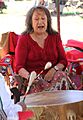
Mildred "Midge" Wagner, a Lakota woman, singing at a powwow in 2015

See also
 In Spanish: Lakota para niños
- Lakota mythology
- List of Lakota people
- Native American tribes in Nebraska
