
Nikolay Neprimerov facts for kids
Quick facts for kids
Nikolay Neprimerov
|
|
|---|---|
 |
|
| Born | 1 May 1921 Voronezh Region, Russia
|
| Died | 11 January 2017 (aged 95) Kazan, Russia
|
| Nationality | Russian |
| Scientific career | |
| Fields | physics |
| Institutions | Kazan State University |
Nikolay Neprimerov (born May 1, 1921 – died January 11, 2017) was a brilliant physics professor. He earned a special degree called "Doctor of Technical Sciences." He taught at Kazan State University in Russia.
For 32 years, Neprimerov led the Department of Radioelectronics at Kazan University. He wrote over 150 scientific papers and 9 big books. He even wrote a book about the daily lives of military pilots during World War II. He received many awards, including a special prize from the Russian government for his work in science and technology. For more than 40 years, Nikolay Neprimerov was famous worldwide for his research on how to get more oil out of the ground.
Contents
Life Story
Nikolay N. Neprimerov was born on May 1, 1921. His family lived in a small village in the Voronezh Region of Russia. His father was a forest ranger, and his mother was a schoolteacher. In 1926, his family moved to the city of Kazan.
After finishing School No. 83 with top honors in 1939, Nikolay joined the military service. He worked as an aircraft technician. He served for four years on the front lines during World War II. For his brave service, he received the Order of the Red Star and other medals.
In 1946, he started studying at the Faculty of Physics and Mathematics at Kazan State University. He stayed at this university for his entire career. He was a very good student and received a special scholarship. He graduated with honors in 1951. Then, he continued his studies to earn his PhD in 1954. Later, in 1963, he became a "Doctor of Technical Sciences."
During his studies, he helped create a new field called "magnetic radiospectroscopy." He also helped set up a laboratory for this new research. In 1960, he became the head of the Department of Radioelectronics. There, he started another new field called "Radiophysical Measurements."
Nikolay Neprimerov had a special way of doing scientific research. For his PhD, he built three different test setups. He studied how microwaves behave and how materials react to magnetic fields. His work helped link different physics ideas together.
In 1955, Neprimerov made history at Kazan State University. He was the first person to get a research contract with the Tatneft Petroleum Company. This was a big step for the university.
After this, Neprimerov began deep studies on how liquids move through porous rocks. He also looked at how oil changes and how to develop oil and gas fields. He studied hot water fields and the Earth's heat to understand what happens deep inside our planet. By the early 1980s, he had collected a lot of data from over 250 oil fields. He used special tools and basic research to create a new technology. This technology helped oil companies get more oil out of the ground. It also lowered the cost of production. This new method was used in many oil fields in Tatarstan, Russia.
In 1978, Neprimerov started a new faculty at Kazan State University. This faculty helped train oil workers. Over 200 specialists from all over Russia learned new skills there in 10 years.
In 1988, a new lab was created at the Department of Radioelectronics. It was called the Laboratory of Physical Dynamics of Heterogeneous Media. After stepping down as department head in 1992, Neprimerov became its Chief Researcher. He won the Kazan State University's First Prize for best research work three times (in 1957, 1962, and 1993).
Besides his research, Neprimerov also worked to improve teaching methods. About 650 students graduated from his department in the special fields he created. He also gave popular public science lectures on Sundays at Kazan University. Many people came to listen to him speak.
Throughout his long life, Nikolay Neprimerov was part of many scientific and technical groups. He was also a member of the USSR Academy of Sciences. He helped guide important decisions about science and technology.
For his 70th birthday, Nikolay Neprimerov published a very important book called The Universe. When he was 75, he prepared another big book, Physical Dynamics, for publishing. He also wrote Technicians, a book about the daily lives of military air service people during World War II.
Nikolay Neprimerov married Galina Anatolievna Neprimerova in 1959. He passed away on January 11, 2017, at the age of 95.
Scientific Discoveries
A Dedicated Scientist
Nikolay N. Neprimerov started his scientific journey over 60 years ago. This was in 1946, at Kazan University. He earned his PhD in 1954 and became a Doctor of Technical Sciences in 1963.
Nikolay Neprimerov was one of the amazing scientists who helped bring science and technology back to life in Russia after World War II.
For over 60 years, Neprimerov's work at Kazan State University followed a key idea. He believed that science and real life, and basic research and industry, should always be connected. From his very first projects, Neprimerov showed he was an excellent experimental physicist. He loved working in the field.
His trips for research covered huge areas of Russia. He went from Kaliningrad to Kamchatka and from Archangelsk to the Kara-Kum desert. He studied over 250 oil fields and tens of thousands of test spots. He used special tools for his research. By the early 1980s, his basic research helped him create a new way to develop oil fields. This new method helped get more oil out of the ground. It also made it possible to recover oil that was previously stuck.
Nikolay Neprimerov wrote many scientific papers. They showed his wide range of interests. He wrote about magnetic and dielectric radiospectroscopy, radioelectronics, Earth physics, biology, and oil and gas field development. He also wrote about pedagogy (the study of teaching). He even wrote 16 articles for newspapers and his autobiography, Technicians. This book was about military air service personnel during World War II. Neprimerov traveled to research centers in many countries around the world.
Nikolay Neprimerov believed that physics was more than just different subjects put together. Because of this idea, his work helped science in many ways. He contributed to:
- A plan for how knowledge should be passed on to new generations. He wrote about this in his books The Universe (1992) and Natural Science (2000).
- A physical model of how tiny particles behave. This model looked at five properties of particles: mass, size, charge, and mechanical and magnetic forces. He also described a law about how these forces change. He wrote about this in his book Physical Dynamics (1997).
Neprimerov was an innovator in many areas. Sometimes, his new ideas were not immediately accepted by other scientists. But his ideas always offered new ways to solve difficult scientific and industrial problems.
Along with his research, Neprimerov worked to make teaching better. About 650 students graduated from his department. He also gave public science lectures on Sundays at Kazan University. These lectures attracted many people.
Neprimerov created a special scientific group. It was informal and worked on many different research and industry projects. His popular workshops brought together scientists from all parts of Kazan University. Scientists from other parts of Russia and other countries also joined.
Understanding the Universe
Neprimerov's research in different sciences, like physics, gravitation theory, geology, and biology, made him think. He believed that all these sciences had common basic rules. This search led him to create a physical model of the universe in the early 1980s. This model described how tiny particles interact.
Neprimerov studied how atoms and molecules are built and how they interact. He saw the universe as a series of systems, each with different sizes and new qualities. In 1992, his many years of work were published in a book called The Universe. He later improved these ideas in his book Physical Dynamics (1997). This book described how energy, movement, and particles with mass behave. He also published two more books around the year 2000: Natural Science and The Structure of the Universe (2001).
These books covered the basics of many university subjects. These included microdynamics, electrodynamics, acoustic dynamics, thermodynamics, and fluid dynamics. He even created a new science called "homodynamics." This was about where humans fit in the Universe.
Future Ideas
Neprimerov strongly believed that the science of the 21st century would focus on a few key ideas. These included looking at things as a whole system, finding unchanging rules, and using a model where things are made of separate parts. Based on his five decades of work, Neprimerov thought that this century would be about understanding matter. He believed science would be shaped by three main things:
1. Moving away from old models that see things as continuous. Instead, using models that see things as separate particles. These models would focus on particle size, how particles interact, and how long these interactions take. 2. Looking at the Universe as a system with different levels. Each level has particles of different sizes, and new qualities appear as you move from one level to another. 3. Finding unchanging rules. These rules would not only explain events and phenomena but also connect different areas of science.
Neprimerov thought that several such unchanging rules might exist. For example:
- The idea that matter develops over time in a structured, step-by-step way.
- A general rule about how mass moves when particles are unevenly spread out. This movement also involves the transfer of energy.
- A mathematical relationship that shows how new qualities appear when systems change.
For the 21st century, Neprimerov predicted that scientists would figure out how biological interactions work. He also thought they would understand how thoughts are created and move in the neural network of the brain.
Images for kids
-
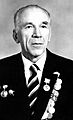
Nikolay Neprimerov
