
Seabed facts for kids

The seabed is simply the bottom of the ocean. You might also hear it called the seafloor or ocean floor. It's the vast, underwater land that lies beneath all the world's oceans.
The way the seabed is shaped is mostly due to something called plate tectonics. Imagine huge pieces of the Earth's crust slowly moving! This movement creates the amazing features we see on the seabed. Much of the ocean is incredibly deep, and these flat, deep areas are known as the abyssal plains. In the middle of the oceans, you'll find underwater mountain ranges called mid-ocean ridges. These are formed when new seafloor is created. As you move from the deep abyssal plain towards the land, the seabed gently slopes upwards. It goes from the continental rise, then the steeper continental slope, and finally the shallower continental shelf near the continents. The entire living environment of the seabed and the deep waters above it is called the "benthos".
Most of the seabed is covered in layers of marine sediments. These sediments come from different places, like land, living things, chemical reactions, and even space! They can be tiny particles like mud or larger pieces like sand and boulders.
The seabed is always changing. Sea currents move sediments around, especially in shallow areas where tides and waves are strong. Tiny living things in the seabed also change its chemistry. Many marine organisms create sediments too. For example, tiny ocean plants called phytoplankton have shells. When they die, their shells sink to the bottom and become part of the seabed.
Humans also have an impact on the seabed. We explore it, sometimes pollute it with plastic, and even mine it for valuable materials. Scientists use special sound technology to map the seabed. Submarines help researchers study unique places like hydrothermal vents. Sadly, a lot of plastic pollution ends up in the ocean, and some of it sinks to the seabed. Mining operations extract minerals, and dredging removes sand for construction or to replenish beaches.
Contents
How the Seabed is Formed


Most oceans share a similar structure, shaped by powerful forces like plate tectonics. Imagine the Earth's outer layer as a giant puzzle with moving pieces! This movement creates the amazing features we see on the seabed.
Starting from the continents, the ocean floor usually begins with a gently sloping area called the continental shelf. This is where the water is relatively shallow. Then, it drops steeply down the continental slope into the deeper ocean. At the bottom of this slope, you'll find the abyssal plain, which is a vast, flat area and the main part of the deep seabed. Sometimes, there's a gradual slope between the continental slope and the abyssal plain, called the continental rise. This rise is formed by sediments sliding down from the continent.
Right in the middle of many oceans, you'll discover huge underwater mountain ranges known as mid-ocean ridges. These ridges are where new ocean floor is constantly being created! Along the edges of these moving tectonic plates, there are often very deep valleys called oceanic trenches. These trenches are the deepest parts of the ocean.
Sometimes, volcanoes erupt on the seabed, creating volcanic islands or underwater mountains. In areas with volcanic activity and in the deep trenches, you can find incredible hydrothermal vents. These vents release super-hot water and chemicals, creating unique ecosystems in the freezing deep sea.
The deep ocean water itself is divided into different layers or zones based on depth. Each zone has its own typical saltiness, pressure, temperature, and marine life. The abyssal zone sits above the abyssal plain, going down to about 6,000 meters (20,000 feet). Even deeper are the hadal zones, which include the oceanic trenches. These zones can reach an astonishing 11,000 meters (36,000 feet) deep, making them the deepest places on Earth!
- Different seabeds in the world's oceans
-
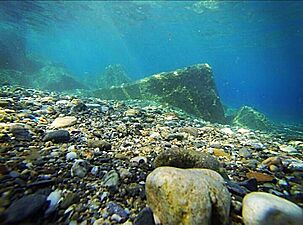
A gravel seabed in Italy.
-
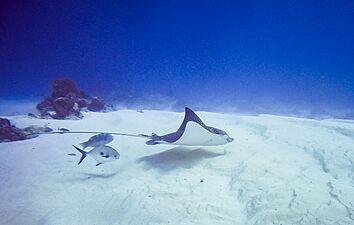
A white sand seabed in Mexico.
-
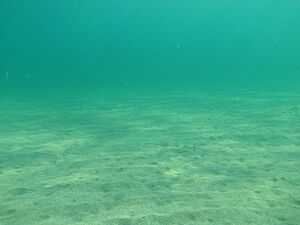
A sandy seabed in Greece.
-
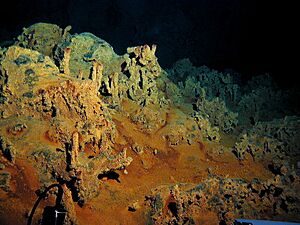
Amazing hydrothermal vents.

_in_Cozumel,_Mexico.jpg)

.jpg)
Different Types of Seabed Material
.jpg)
The sediments covering the seabed come from many places. They can be eroded bits of land carried by rivers or wind, remains of sea creatures, chemicals that form in the water, or even tiny pieces from outer space! There are four main types of seabed sediment:
- Terrigenous sediment comes from the land. This includes rocks eroded by rain, rivers, and glaciers, or dust and ash blown into the ocean by wind.
- Biogenous sediment is made from the hard parts of sea creatures, especially tiny plants called phytoplankton, that collect on the ocean floor.
- Hydrogenous sediment forms when chemicals in the ocean water react and settle, or when they come from hydrothermal vent systems.
- Cosmogenous sediment comes from sources outside Earth, like space dust.
Sediments from Land and Living Things

.jpg)
Terrigenous sediment is the most common type found on the seafloor. These sediments originate from the continents. Wind and water carry these materials, like clay, silt, mud, and volcanic ash, from land into the ocean.
Biogenous sediment is the next most common type. It's made by living creatures. When these sediments make up at least 30% of the seafloor material, they are called "oozes." There are two main kinds:
- Calcareous oozes are mostly made of calcium shells from phytoplankton (like coccolithophores) and zooplankton (like foraminiferans). These oozes are not found in the very deepest parts of the ocean because the calcium dissolves under high pressure.
- Siliceous oozes are mainly made of silica shells from phytoplankton (like diatoms) and zooplankton (like radiolarians). These shells build up slowly over thousands of years when the organisms die and sink.
Sediments from Chemicals and Space

Hydrogenous sediments are not very common. They form when ocean conditions, like temperature or pressure, change. They can also form near mid-ocean ridges when hot, chemical-rich water mixes with cold seawater, causing metals to settle out. These often form into round lumps called manganese nodules, which contain layers of metals like manganese, iron, nickel, and copper.
Cosmogenous sediments are the rarest type. They are tiny bits of space debris, like pieces of comets and asteroids, that have fallen to Earth and landed on the seabed.
How Sediment Size Matters

Sediments are also described by their size, from tiny clay particles (smaller than 1/4096 of a millimeter) to huge boulders (larger than 256 millimeters). The size tells us a lot about the environment where the sediment was formed.
Larger grains, like gravel and sand, sink quickly and need strong currents to move them. This means they are found in "high energy" areas where water moves fast. Smaller grains, like silt and clay (which make up mud), sink very slowly. They can stay suspended in the water with even slight movement and usually settle in "low energy" areas where the water is calm.
Life on the Seabed (Benthos)
Benthos refers to all the amazing plants and animals that live on, in, or near the bottom of a sea, lake, or river. These creatures are called benthic organisms. They can be found in shallow areas, like rock pools along the coast, or in the deepest parts of the ocean.
Benthic organisms are different from plankton, which are tiny living things that float or drift in the water above the bottom. Benthos are usually attached to the bottom, burrow into it, or crawl along it.The term "benthos" refers to all the amazing organisms that live on, in, or near the seabed. These creatures are called benthic organisms. They include everything from tiny bacteria and worms to crabs, starfish, and even some fish. They play a vital role in the ocean's ecosystem, often feeding on organic matter that sinks from the waters above.
The Shape of the Ocean Floor

Seabed topography describes the shape of the land underwater. Just like land above water has mountains and valleys, the ocean floor has its own incredible landscapes. These shapes are important because they affect how ocean currents flow and how much sunlight reaches different depths.
The ocean floor includes many different features:
- Near the coast, you find estuaries, shorelines, continental shelves, and coral reefs.
- In the open ocean, there are huge underwater mountains called seamounts, and the globe-spanning mid-ocean ridge system.
- You'll also find deep oceanic trenches, steep submarine canyons, flat oceanic plateaus, and vast abyssal plains.
The oceans hold about 1.35 quintillion (1,350,000,000,000,000,000) metric tons of water. They cover an area of about 361.8 million square kilometers, with an average depth of 3,682 meters. This means the total volume of ocean water is roughly 1.332 billion cubic kilometers.
Amazing Seabed Features

Each part of the seabed has its own special characteristics. These include the types of sediment, the shape of the land, the saltiness of the water above, and the unique marine life that lives there. Some of the most interesting features are the flat abyssal plains, the towering mid-ocean ridges, the super-deep trenches, and the mysterious hydrothermal vents.
Where the seabed is flat, like in the abyssal plains, it's usually covered by many layers of sediments. These sediments come from rivers, chemicals from hydrothermal vents, tiny microorganisms, and even sea currents that move material around.
In places where the seafloor is actively spreading, like in parts of the northern and eastern Atlantic Ocean, you can clearly see the "cracks" or "vents" from tectonic activity. These underwater mountain ranges are the mid-ocean ridges.
Other unique seabed environments include hydrothermal vents and cold seeps. Around black and white smokers (vents that release chemicals), scientists have found huge communities of marine life. These creatures get their energy not from sunlight, but from the extreme temperature differences and from chemosynthesis by special bacteria. Brine pools are another interesting feature, often linked to cold seeps. In shallow areas, the seabed is home to sediments created by corals, fish, algae, crabs, and marine plants.
Exploring and Protecting the Seabed
Exploring the Deep Sea
Humans have explored the seabed using special submersibles like Alvin and even scuba divers with advanced gear. Hydrothermal vents were first discovered in 1977 using an underwater camera. Today, satellites can measure the ocean surface to create detailed maps of the seabed, which are very helpful for studying the ocean floor.
Plastic Pollution
In 2020, scientists made an important estimate about microplastics on the Earth's seafloor. After studying deep areas off the Australian coast, they found that the amount of microplastic was related to the plastic found on the surface and the slope of the seafloor. They estimated that the Earth's seafloor contains about 14 million tons of microplastic. This is a huge amount, roughly double what was previously thought, and it shows how much plastic pollution ends up in our oceans.
Protecting Our Ocean Floor
The seabed holds many important archaeological sites, like ancient shipwrecks and sunken towns. These underwater cultural treasures are protected by the UNESCO Convention on the Protection of the Underwater Cultural Heritage. This agreement helps prevent looting and the loss of historical information, providing a legal framework to safeguard these sites for future generations.
See also
 In Spanish: Relieve oceánico para niños
- Bottom trawling
- Demersal fish
- Human outpost
- International waters
- Manganese nodule
- Methane clathrate
- Nepheloid layer
- Offshore geotechnical engineering
- Petrological Database of the Ocean Floor (PetBD)
- Plate tectonics
- Research vessel
- Riverbed
- Seabed characterization
- Seafloor mapping
- Seafloor massive sulfide deposits
- Sediment Profile Imagery (SPI)
