
Prehistoric art in Scotland facts for kids

Prehistoric art in Scotland means amazing artworks made or found in what we now call Scotland. This art was created before the Romans left Britain in the early 400s CE. This time is usually seen as the start of the Middle Ages. It can be tricky to define what counts as 'art' from so long ago, as we don't always know why things were made.
Some of the oldest artworks you can carry are special carved stone balls. These come from the Neolithic period, also known as the New Stone Age. They have cool patterns, similar to carvings found in Ireland and other parts of Scotland. Other items from this time include fancy carved maceheads. Figurines, like the famous Westray Wife from Links of Noltland, are also important. The Westray Wife is the oldest known picture of a human face from Scotland.
From the Bronze Age, we find more carvings. These include the first pictures of real objects. There are also many mysterious cup and ring marks. Pictures of an axe and a boat at Ri Cruin Cairn in Kilmartin Glen are very old. A boat carved into Wemyss Cave is also one of Scotland's earliest 2D pictures of real things. Fancy carved stone battle-axes might have shown power. Metal items that survived include gold lunula (necklaces) and jet bead necklaces. There are also cool weapons like bronze leaf swords and ceremonial shields.
During the Iron Age, we see even more patterned objects and gold work. The wider La Tène culture influenced Scotland. Examples include the Torrs Pony-cap and Horns. The Stirling torcs show styles found in Scotland and Ireland. They also show amazing craftsmanship from other parts of Europe. One of the most impressive items is a boar's head piece from a Deskford carnyx. This was a type of war-trumpet. From the 1st century CE, as the Romans arrived, we find Roman items like the Cramond Lioness. Roman styles also started to appear in local stone carvings.
Contents
What is Prehistoric Art?

Studying prehistoric art depends on what has survived over thousands of years. Art made from things like sand, bark, animal hides, or cloth usually disappeared. But art made from rock, stone, bone, ivory, pottery, and metal often lasts.
Scientists sometimes disagree about what counts as "art" from these ancient times. Some think even simple marks on rock are early human art. Others are more careful, saying that rare finds might not show a whole "artistic culture."
It's important not to judge ancient art using modern ideas. Today, we might separate artists from craftspeople. We also separate "art" from everyday "objects." But these ideas might not fit how people thought in prehistoric times. For example, the shape of a weapon might have been just as important as its decoration.
People have many ideas about why prehistoric art was made. It might have helped early humans feel more connected. Outdoor rock art might have been like signposts for animal paths. Cave art might have been part of special ceremonies. Small objects that could be carried might have been used for counting or keeping notes. Figures that looked like humans might have been part of religious rituals. But often, we only truly understand these items when we know their original purpose, which is often lost.
Stone Age Art in Scotland

Scotland was first settled by Mesolithic hunter-gatherers around 8500 BCE. These people moved around a lot and used boats. They made tools from bone, stone, and antlers. Later, Neolithic farming brought permanent homes. One example is a stone house at Knap of Howar from about 3500 BCE. These settlers also built chambered cairn tombs, like Maeshowe. They also set up many standing stones and circles, such as those at Standing Stones of Stenness in Orkney, from about 3100 BCE.
We don't have any art from the Mesolithic period in Scotland. This is probably because these mobile people made art on things that didn't last. The oldest surviving art you can carry from Scotland are carved stone balls, also called petrospheres. These are from the late Neolithic era. They are special to Scotland, with over 425 found! Most are from Aberdeenshire, but some are from places like Orkney, including five from the village of Skara Brae. People think these balls were important and valuable. Their making might have continued into the Iron Age. The complex spirals and circles on these balls are similar to carvings on a stone from Pierowall in Orkney. This suggests they were part of the same culture that made carvings at Newgrange in Ireland. Similarly, fancy carved maceheads are often found in burial sites. One from Airdens in Sutherland has a cool pattern of diamond shapes.
Pottery appeared in the Neolithic period when people started living in one place. Before that, hunter-gatherers needed light, portable containers. Beautifully made and decorated Unstan ware pottery survives from 4000-2000 BCE. It's named after the Unstan Chambered Cairn in Orkney. These are elegant, shallow bowls with a patterned band below the rim. This pattern was made by a "stab-and-drag" method. Another type has plain, round-bottomed bowls. Unstan ware is mostly found in tombs. It has also been found at the farmstead of Knap of Howar. Unstan ware might have led to the later grooved ware style. This style is linked to the builders of the Maeshowe tombs. Grooved ware pots are often highly decorated and flat-bottomed. Their patterns are similar to those on petrospheres and carved maceheads.
In 2009, the Westray Wife was found. This small, diamond-shaped figure is thought to be the earliest picture of a human face found in Scotland. It was discovered at a Neolithic village site at Links of Noltland in Westray. The figure has two dots for eyes, thick eyebrows, and a long nose. Patterns on its body might show clothing. Two more similar figures were found at the site in 2010 and 2012.
Bronze Age Discoveries

The Bronze Age began in Scotland around 2000 BCE. This is when new ways of working with metal arrived. People continued to build cairns and large stone monuments. There might have been fewer people living in Scotland during this time. We find evidence of round stone houses in Shetland. There are also wooden crannogs, which are roundhouses built on artificial islands in lakes. Like other parts of Europe, hill forts first appeared in Scotland during this period.
From the Bronze Age, we have many examples of rock art. These include cup and ring marks. These are central hollows carved into stone, surrounded by rings. They are common in other parts of Atlantic Europe. They are found on natural rocks and single stones across Scotland. The most detailed markings are in western Scotland, especially in the Kilmartin area. Pictures of an axe and a boat at Ri Cruin Cairn in Kilmartin are very old. A boat carved into Wemyss Cave is also one of Scotland's earliest 2D pictures of real objects. Similar carved spirals have been found on the stones covering burial cists in Lanarkshire and Kincardine.
There are also fancy carved stone battle-axes found in East Lothian, Aberdeenshire, and Lanarkshire. These axes show little sign of being used. So, they were probably not for fighting. Instead, they might have been symbols of power. At the site at Forteviot in Perthshire, a unique warrior burial was found under a huge sandstone slab. The slab has a spiral carved into it and an axehead on the underside. Underneath, there were valuable items like a copper dagger and a carved wooden bowl.
Surviving metal items include personal ornaments. These are gold lunula (necklaces) found at Auchentaggart and Southside, Lanarkshire. They date from about 2000 BCE. They are similar to many found in Ireland and other parts of Britain. Jet bead necklaces, shaped like a crescent moon, have been found at sites like Poltalloch and Melfort in Argyll.
Sophisticated pottery with pressed designs was also made in Scotland during the Bronze Age. One example is a decorated grave food vessel from about 1000 BCE. It was found with two bronze armlets in a grave in Kincardineshire.
Fancy weapons include bronze leaf swords and ceremonial shields made of sheet bronze. These were made in Scotland between 900 and 600 BCE. The Migdale Hoard is an early Bronze Age treasure found at Skibo Castle. It includes bronze axes, armlets, anklets, a necklace of bronze beads, and jet buttons. The "Ballachulish Goddess" or Ballachulish figure is a life-sized wooden figure from 700–500 BCE. It was found at Ballachulish, Argyll. It has quartz pebbles for eyes.
Iron Age Art and Craftsmanship

The Iron Age began in Scotland around 700 BCE. This is when the first iron objects were found in hoards. These hoards also contained items from the Bronze Age. There is also proof of ironworking at some settlements. Iron Age society in Scotland was similar to those in Southern Britain, Ireland, and parts of Europe. They had roundhouses and fortified settlements. But Scotland also developed its own unique styles.
From the early Iron Age, we have fewer metal items but more pottery. The collection of early Iron Age pottery from Atlantic Scotland is large compared to the rest of Britain. There are many different shapes and styles. Some look like those from southern Britain, especially those with carved geometric patterns.
By this time, Scotland was influenced by the wider La Tène culture. This culture is named after a site in Switzerland. The Torrs Pony-cap and Horns are perhaps the most impressive La Tène decorations found in Scotland. They show links with Ireland and southern Britain. The Stirling torcs, found in 2009, are four gold torcs (neck rings). They date from 300 BCE to 100 BCE. Two show common styles from Scotland and Ireland. But the other two show craftsmanship from what is now southern France, and even the Greek and Roman worlds.
Surviving items include ring-headed pins. These were probably made locally and were not imported. They seem to be a British and Irish type, not part of the La Tène culture. There are also spiral finger rings, glass beads, and long-handled combs. These are found across Britain but have local features. The bronze Stichill collar is a large, carved necklace. It fastens at the back with a pin. The Mortonhall scabbard, probably from the 1st century CE, has fancy trumpet curves and "S"-scrolls. Further north, massive bronze armlets are found. They often have colorful enamel decoration, like those from Culbin Sands. One of the most impressive items from this period is the boar's head piece from the Deskford carnyx. This was a war-trumpet from Deskford in Banffshire. Similar instruments are mentioned in Roman writings. They are also shown on the Gundestrup Cauldron found in Denmark.
In stone carving, there are simple stone heads from Scotland. One was found at Coupar Angus in Perthshire. These might be from the Iron Age. They are similar to heads found across Britain and Ireland. However, they are hard to date and might have been made much later.
Roman Influence on Art

The Romans started military trips into what is now Scotland around 71 CE. They built many forts. But by 87 CE, their control was limited to the Southern Uplands. By the end of the 1st century, the Roman border was a line between the Tyne and Solway Firth. The Romans eventually pulled back to a line in northern England. Here, they built Hadrian's Wall. Around 141 CE, they tried to reoccupy southern Scotland. They built a new border, called a limes, between the Firth of Forth and the Firth of Clyde. This was the Antonine Wall. The wall was taken over and abandoned soon after 160 CE. The Romans then went back to Hadrian's Wall. Roman power finally ended in the early 400s CE.
The Antonine Wall and its forts left behind direct sculptures in Scotland. There are 19 distance slabs along the wall. These slabs show the victories and marches of the Roman legions who built it. Other sculptures also survived. These include an altar dedicated to Diana and Apollo. There is a fountainhead from a bath-house shaped like a man's head with an open mouth. There is also a head from a statue, perhaps of the goddess Fortuna. Both were found at Bearsden Roman Fort. They show a mix of local Celtic and Roman styles.
Away from the wall, Roman sculptures include a marble head of a Roman emperor or general. It was broken from a larger statue. It was found at Hawkshaw in the late 1700s. It dates to the 2nd century CE. It might have been taken from a Roman monument further south. The Cramond Lioness is a sculpture, probably brought from elsewhere. It shows a lioness eating a tied-up prisoner. It was found near the Roman base of Cramond Roman Fort near Edinburgh. A relief (carved picture) of the goddess Brigantia was found near Birrens. It combines native Scottish and classical Roman art styles.
The Newstead Helmet, found at the Roman fort in Newstead, is one of many impressive Roman arms and armor finds. The Staffordshire Moorlands Pan is a 2nd-century Roman-British trulla (a small pan). It was decorated as a souvenir for a soldier who served on Hadrian's Wall. It was probably made locally. Many items were also found in the Sculptor's Cave in Morayshire. These include Roman pottery, rings, bracelets, needles, and coins. Some of these were reused as ornaments.
Images for kids
-
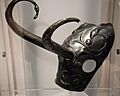
The Torrs Pony-cap and Horns, around 200 BCE, National Museum of Scotland, as displayed in 2011
-
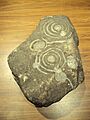
Cup and ring marks survive in large numbers from Scotland and have been suggested to have a variety of meanings
-
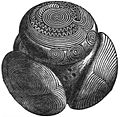
An example of a carved stone ball from Towie in Aberdeenshire, dated from 3200–2500 BCE
-
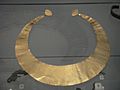
A gold lunula, one of two found at Southside in Lanarkshire, a high status ornament, worn sometime between 2300 and 2000 BCE
-
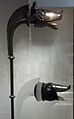
The Leichestown Deskford carnyx and reconstruction, probably dating from the first century CE
-
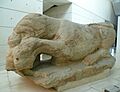
The Cramond Lioness found near the Roman base of Cramond Roman Fort near Edinburgh, which was occupied in the second century CE
