
Pro Bowl facts for kids
Quick facts for kids Pro Bowl / Pro Bowl GamesNFL All-Star Game (1939–1942)
Pro Bowl (1951–2022) Pro Bowl Games (2023–2026) |
|
|---|---|
 |
|
| Frequency | Annual |
| Location(s) | Varied |
| Inaugurated | 1939 |
| Most recent | February 3, 2026 (Moscone Center, San Francisco, California) |
| Participants | American Football Conference National Football Conference |
| Organized by | National Football League |
The Pro Bowl was an annual all-star sporting event run by the National Football League (NFL). It gathered the finest football players from across the league to compete in special showcase games and fun skill contests.
Throughout its long history, the event changed its structure multiple times to make competition safer and more exciting. From 1939 to 1942, the game featured the league champion playing against a team of top all-stars. In 1951, the NFL introduced the official Pro Bowl, putting the best players of two conferences against each other. For decades, it was known as the AFC–NFC Pro Bowl.
Later, the league introduced flag football games and interactive skill challenges called the Pro Bowl Games. Being chosen for a Pro Bowl roster remains one of the highest individual honors in professional football. In 2026, the NFL concluded the playing of annual all-star games while continuing to name an annual honor team.
Contents
- Complete History of the NFL All-Star Matchups
- How NFL Players Are Selected to the Pro Bowl
- Coaching Staff Selections and Player Rewards
- Unique Rules and Gameplay Modifications
- Uniform Designs and Team Colors
- Pro Bowl Game Results by Era
- All-Time Pro Bowl Selection Records
- Stadiums and Venues That Hosted the Event
- Television Broadcasts and Fan Viewership
- Images for kids
- See also
Complete History of the NFL All-Star Matchups
The Early Years and Championship Showdowns (1938–1942)
The very first professional all-star contest took place on January 15, 1939, in Los Angeles, California. The reigning league champions, the New York Giants, faced an all-star roster composed of top athletes from other teams.
Three players from independent local teams also joined the squad. The Giants won this first meeting with a score of 13 to 10. The game occurred again over the next few winters in Los Angeles, New York, and Philadelphia.
During these early years, the reigning NFL champions won four of the five matchups. The all-star team earned its only win in December 1942 against the Washington Redskins. The NFL paused the series after 1942 because travel restrictions during World War II made long trips difficult.
Birth of the Modern Pro Bowl (1950–1979)
The league revived the all-star concept in June 1950 under the new name of the "Pro Bowl." Instead of matching a single club champion against all-stars, the league split the stars into two conference squads.
This change stopped any confusion with the Chicago College All-Star Game, which pitted college stars against pro champions. The Los Angeles Memorial Coliseum hosted the first 21 modern Pro Bowls from 1951 through 1972.
The head coaches of the two conference champion teams led these all-star squads each winter. The event became a classic tradition for football fans following the conclusion of the regular season.
The Aloha Stadium Era in Hawaii (1980–2009)
In 1980, the NFL moved the Pro Bowl to Aloha Stadium in Halawa, Hawaii. The Hawaiian islands became the permanent tropical home of the Pro Bowl for thirty consecutive seasons.
Players considered a trip to Hawaii a fantastic reward for a great season of football. Families traveled together to enjoy the warm climate and celebrate athletic success. Fans in Hawaii welcomed top sports stars with sell-out crowds year after year.
During this era, the game was played on the weekend directly following the Super Bowl. This setup allowed every selected athlete, even Super Bowl participants, a chance to play.
Modern Format Changes and Skill Competitions
In 2010, the league scheduled the Pro Bowl for the Sunday before the Super Bowl. As a result, players competing in the Super Bowl sat out to avoid fatigue and injury.
Between 2014 and 2016, the league experimented with an "unconferenced" draft. Hall of Fame legends picked teams in a fantasy-style draft on live television. In 2017, the NFL returned to the traditional AFC versus NFC setup in Orlando, Florida.
The NFL also introduced the Pro Bowl Skills Showdown. In this event, players competed in dodgeball, precision passing, and catching competitions. These popular side contests highlighted player agility, throwing accuracy, and fun teamwork.
The Move to Flag Football and the Pro Bowl Games
Football is a physical game, and players wanted to avoid serious injuries during an exhibition game. In 2022, the NFL announced an exciting shift to non-contact flag football.
The league partnered with former quarterback Peyton Manning and his company to create the Pro Bowl Games. Instead of full tackling, athletes played seven-on-seven flag football matches. They also participated in multiple athletic challenges across the week to score team points.
In 2026, the league hosted its final all-star games in San Francisco, California. The NFL then retired the on-field exhibition game after 88 years of history. The league maintained the yearly voting process, continuing to name an official 88-player Pro Bowl team each season.
How NFL Players Are Selected to the Pro Bowl
The Three-Part Voting Process
Making a Pro Bowl roster is a major career milestone. The selection process uses an equal three-way voting system to ensure balanced results:
- NFL head coaches submit ballots for standout players across the league.
- Active NFL players vote for the toughest opponents they faced during the year.
- Football fans around the world vote online for their favorite stars.
Each of these three groups makes up exactly one-third (33.3%) of the final score. This system ensures that fan favorites, player opinions, and coach evaluations all carry equal weight.
Roster Rules and Alternate Invitations
When a voted player cannot play due to injury or playoff obligations, an alternate takes the spot. If an alternate accepts the invitation and attends, that player earns official Pro Bowl status.
Players who reach the Super Bowl are also credited as Pro Bowlers even if they skip the exhibition. Star athletes often include their total number of Pro Bowl honors when building Hall of Fame resumes.
Coaching Staff Selections and Player Rewards
Selecting the All-Star Coaching Staffs
Historically, the head coaches for the Pro Bowl were the coaches of the teams that lost in the conference championship games. This gave outstanding coaching staffs one more opportunity to coach on a national stage.
When the Pro Bowl changed to the flag football format in 2023, legends Peyton Manning and Eli Manning served as honorary head coaches. Peyton represented the AFC, while Eli led the NFC. In 2026, Hall of Famers Steve Young and Jerry Rice served as the head coaches.
Financial Payouts and Awards
Athletes who participated in the Pro Bowl received monetary compensation for their participation. The winning team always earned a higher payout than the losing squad.
| Years | Winning Team Payout | Losing Team Payout |
|---|---|---|
| 1951–2010 | $23,000 | $17,000 |
| 2011, 2013 | $50,000 | $25,000 |
| 2012 | $65,000 | $40,000 |
| 2014 | $53,000 | $26,000 |
| 2015–2016 | $55,000 | $28,000 |
| 2017 | $61,000 | $30,000 |
| 2018 | $64,000 | $32,000 |
| 2019 | $67,000 | $39,000 |
| 2020 | $74,000 | $37,000 |
| 2022–2023 | $84,000 | $42,000 |
| 2024 | $88,000 | $44,000 |
| 2025 | $92,000 | $46,000 |
| 2026 | $96,000 | $48,000 |
Unique Rules and Gameplay Modifications
Safety and Exhibition Rules for Tackle Games
To protect players from injuries, the NFL used special safety rules during full-contact Pro Bowls:
- No rushing the quarterback, punter, placekicker, or holder.
- Defenses had to run a standard 4–3 defense without using surprise blitz plays.
- Offenses could not use pre-snap player motion or shifts.
- Kickoffs were eliminated, placing the ball directly on the 25-yard line.
- Tackling was kept very light, similar to touch football.
- Intentional grounding by a quarterback was permitted without penalty.
Flag Football Tournament Guidelines
The flag football format used during the Pro Bowl Games introduced fast-paced, high-scoring action:
- Games were played on a compact 50-yard by 28-yard field.
- Teams had seven players on the field at a time.
- Matches consisted of two 10-minute halves.
- Touchdowns could be followed by a 1-point conversion try from the 5-yard line or a 2-point try from the 10-yard line.
- Points earned in skills challenges were added to the team totals.
Uniform Designs and Team Colors

Because athletes represented different franchises, special uniforms were designed for the Pro Bowl. Players always wore their normal team helmets to show off their home franchise logos.
The NFC traditionally wore royal blue jerseys, while the AFC wore bright red jerseys. When the game moved away from conferences between 2014 and 2016, teams wore high-visibility orange and volt green outfits.
During the flag football era, players wore lightweight athletic shirts, shorts, and caps instead of heavy pads.
Pro Bowl Game Results by Era
Early NFL All-Star Games (1938–1942)
| Season | Date | Score | Venue | Attendance |
|---|---|---|---|---|
| 1938 | January 15, 1939 | New York Giants 13, All-Stars 10 | Wrigley Field | 15,000 |
| 1939 | January 14, 1940 | Green Bay Packers 16, All-Stars 7 | Gilmore Stadium | 18,000 |
| 1940 | December 29, 1940 | Chicago Bears 28, All-Stars 14 | Gilmore Stadium | 21,624 |
| 1941 | January 4, 1942 | Chicago Bears 35, All-Stars 24 | Polo Grounds | 17,725 |
| 1942 | December 27, 1942 | All-Stars 17, Washington Redskins 14 | Shibe Park | 18,671 |
Conference Pro Bowls (1950–1969)
| Season | Date | Score | Most Valuable Player(s) | Venue |
|---|---|---|---|---|
| 1950 | January 14, 1951 | American 28, National 27 | Otto Graham, Cleveland Browns | Los Angeles Memorial Coliseum |
| 1951 | January 12, 1952 | National 30, American 13 | Dan Towler, Los Angeles Rams | Los Angeles Memorial Coliseum |
| 1952 | January 10, 1953 | National 27, American 7 | Don Doll, Detroit Lions | Los Angeles Memorial Coliseum |
| 1953 | January 17, 1954 | East 20, West 9 | Chuck Bednarik, Philadelphia Eagles | Los Angeles Memorial Coliseum |
| 1954 | January 16, 1955 | West 26, East 19 | Billy Wilson, San Francisco 49ers | Los Angeles Memorial Coliseum |
| 1955 | January 15, 1956 | East 31, West 30 | Ollie Matson, Chicago Cardinals | Los Angeles Memorial Coliseum |
| 1956 | January 13, 1957 | West 19, East 10 | Bert Rechichar / Ernie Stautner | Los Angeles Memorial Coliseum |
| 1957 | January 12, 1958 | West 26, East 7 | Hugh McElhenny / Gene Brito | Los Angeles Memorial Coliseum |
| 1958 | January 11, 1959 | East 28, West 21 | Frank Gifford / Doug Atkins | Los Angeles Memorial Coliseum |
| 1959 | January 17, 1960 | West 38, East 21 | Johnny Unitas / Eugene Lipscomb | Los Angeles Memorial Coliseum |
| 1960 | January 15, 1961 | West 35, East 31 | Johnny Unitas / Sam Huff | Los Angeles Memorial Coliseum |
| 1961 | January 14, 1962 | West 31, East 30 | Jim Brown / Henry Jordan | Los Angeles Memorial Coliseum |
| 1962 | January 13, 1963 | East 30, West 20 | Jim Brown / Eugene Lipscomb | Los Angeles Memorial Coliseum |
| 1963 | January 12, 1964 | West 31, East 17 | Johnny Unitas / Gino Marchetti | Los Angeles Memorial Coliseum |
| 1964 | January 10, 1965 | West 34, East 14 | Fran Tarkenton / Terry Barr | Los Angeles Memorial Coliseum |
| 1965 | January 16, 1966 | East 36, West 7 | Jim Brown / Dale Meinert | Los Angeles Memorial Coliseum |
| 1966 | January 22, 1967 | East 20, West 10 | Gale Sayers / Floyd Peters | Los Angeles Memorial Coliseum |
| 1967 | January 21, 1968 | West 38, East 20 | Gale Sayers / Dave Robinson | Los Angeles Memorial Coliseum |
| 1968 | January 19, 1969 | West 10, East 7 | Roman Gabriel / Merlin Olsen | Los Angeles Memorial Coliseum |
| 1969 | January 18, 1970 | West 16, East 13 | Gale Sayers / George Andrie | Los Angeles Memorial Coliseum |
Modern Pro Bowls and Pro Bowl Games (1970–2026)
| Season | Date | Score | Most Valuable Player(s) | Venue |
|---|---|---|---|---|
| 1970 | January 24, 1971 | NFC 27, AFC 6 | Fred Carr / Mel Renfro | Los Angeles Memorial Coliseum |
| 1971 | January 23, 1972 | AFC 26, NFC 13 | Willie Lanier / Jan Stenerud | Los Angeles Memorial Coliseum |
| 1972 | January 21, 1973 | AFC 33, NFC 28 | O. J. Simpson, Buffalo Bills | Texas Stadium |
| 1973 | January 20, 1974 | AFC 15, NFC 13 | Garo Yepremian, Miami Dolphins | Arrowhead Stadium |
| 1974 | January 20, 1975 | NFC 17, AFC 10 | James Harris, Los Angeles Rams | Miami Orange Bowl |
| 1975 | January 26, 1976 | NFC 23, AFC 20 | Billy Johnson, Houston Oilers | Louisiana Superdome |
| 1976 | January 17, 1977 | AFC 24, NFC 14 | Mel Blount, Pittsburgh Steelers | Kingdome |
| 1977 | January 23, 1978 | NFC 14, AFC 13 | Walter Payton, Chicago Bears | Tampa Stadium |
| 1978 | January 29, 1979 | NFC 13, AFC 7 | Ahmad Rashad, Minnesota Vikings | Los Angeles Memorial Coliseum |
| 1979 | January 27, 1980 | NFC 37, AFC 27 | Chuck Muncie, New Orleans Saints | Aloha Stadium |
| 1980 | February 1, 1981 | NFC 21, AFC 7 | Eddie Murray, Detroit Lions | Aloha Stadium |
| 1981 | January 31, 1982 | AFC 16, NFC 13 | Lee Roy Selmon / Kellen Winslow | Aloha Stadium |
| 1982 | February 6, 1983 | NFC 20, AFC 19 | Dan Fouts / John Jefferson | Aloha Stadium |
| 1983 | January 29, 1984 | NFC 45, AFC 3 | Joe Theismann, Washington Redskins | Aloha Stadium |
| 1984 | January 27, 1985 | AFC 22, NFC 14 | Mark Gastineau, New York Jets | Aloha Stadium |
| 1985 | February 2, 1986 | NFC 28, AFC 24 | Phil Simms, New York Giants | Aloha Stadium |
| 1986 | February 1, 1987 | AFC 10, NFC 6 | Reggie White, Philadelphia Eagles | Aloha Stadium |
| 1987 | February 7, 1988 | AFC 15, NFC 6 | Bruce Smith, Buffalo Bills | Aloha Stadium |
| 1988 | January 29, 1989 | NFC 34, AFC 3 | Randall Cunningham, Philadelphia Eagles | Aloha Stadium |
| 1989 | February 4, 1990 | NFC 27, AFC 21 | Jerry Gray, Los Angeles Rams | Aloha Stadium |
| 1990 | February 3, 1991 | AFC 23, NFC 21 | Jim Kelly, Buffalo Bills | Aloha Stadium |
| 1991 | February 2, 1992 | NFC 21, AFC 15 | Michael Irvin, Dallas Cowboys | Aloha Stadium |
| 1992 | February 7, 1993 | AFC 23, NFC 20 (OT) | Steve Tasker, Buffalo Bills | Aloha Stadium |
| 1993 | February 6, 1994 | NFC 17, AFC 3 | Andre Rison, Atlanta Falcons | Aloha Stadium |
| 1994 | February 5, 1995 | AFC 41, NFC 13 | Marshall Faulk, Indianapolis Colts | Aloha Stadium |
| 1995 | February 4, 1996 | NFC 20, AFC 13 | Jerry Rice, San Francisco 49ers | Aloha Stadium |
| 1996 | February 2, 1997 | AFC 26, NFC 23 (OT) | Mark Brunell, Jacksonville Jaguars | Aloha Stadium |
| 1997 | February 1, 1998 | AFC 29, NFC 24 | Warren Moon, Seattle Seahawks | Aloha Stadium |
| 1998 | February 7, 1999 | AFC 23, NFC 10 | Keyshawn Johnson / Ty Law | Aloha Stadium |
| 1999 | February 6, 2000 | NFC 51, AFC 31 | Randy Moss, Minnesota Vikings | Aloha Stadium |
| 2000 | February 4, 2001 | AFC 38, NFC 17 | Rich Gannon, Oakland Raiders | Aloha Stadium |
| 2001 | February 9, 2002 | AFC 38, NFC 30 | Rich Gannon, Oakland Raiders | Aloha Stadium |
| 2002 | February 2, 2003 | AFC 45, NFC 20 | Ricky Williams, Miami Dolphins | Aloha Stadium |
| 2003 | February 8, 2004 | NFC 55, AFC 52 | Marc Bulger, St. Louis Rams | Aloha Stadium |
| 2004 | February 13, 2005 | AFC 38, NFC 27 | Peyton Manning, Indianapolis Colts | Aloha Stadium |
| 2005 | February 12, 2006 | NFC 23, AFC 17 | Derrick Brooks, Tampa Bay Buccaneers | Aloha Stadium |
| 2006 | February 10, 2007 | AFC 31, NFC 28 | Carson Palmer, Cincinnati Bengals | Aloha Stadium |
| 2007 | February 10, 2008 | NFC 42, AFC 30 | Adrian Peterson, Minnesota Vikings | Aloha Stadium |
| 2008 | February 8, 2009 | NFC 30, AFC 21 | Larry Fitzgerald, Arizona Cardinals | Aloha Stadium |
| 2009 | January 31, 2010 | AFC 41, NFC 34 | Matt Schaub, Houston Texans | Sun Life Stadium |
| 2010 | January 30, 2011 | NFC 55, AFC 41 | DeAngelo Hall, Washington Redskins | Aloha Stadium |
| 2011 | January 29, 2012 | AFC 59, NFC 41 | Brandon Marshall, Miami Dolphins | Aloha Stadium |
| 2012 | January 27, 2013 | NFC 62, AFC 35 | Kyle Rudolph, Minnesota Vikings | Aloha Stadium |
| 2013 | January 26, 2014 | Team Rice 22, Team Sanders 21 | Nick Foles / Derrick Johnson | Aloha Stadium |
| 2014 | January 25, 2015 | Team Irvin 32, Team Carter 28 | Matthew Stafford / J. J. Watt | University of Phoenix Stadium |
| 2015 | January 31, 2016 | Team Irvin 49, Team Rice 27 | Russell Wilson / Michael Bennett | Aloha Stadium |
| 2016 | January 29, 2017 | AFC 20, NFC 13 | Travis Kelce / Lorenzo Alexander | Camping World Stadium |
| 2017 | January 28, 2018 | AFC 24, NFC 23 | Delanie Walker / Von Miller | Camping World Stadium |
| 2018 | January 27, 2019 | AFC 26, NFC 7 | Patrick Mahomes / Jamal Adams | Camping World Stadium |
| 2019 | January 26, 2020 | AFC 38, NFC 33 | Lamar Jackson / Calais Campbell | Camping World Stadium |
| 2020 | January 31, 2021 | NFC 32, AFC 12 | Kyler Murray, Arizona Cardinals | Virtual Event (Madden NFL 21) |
| 2021 | February 6, 2022 | AFC 41, NFC 35 | Justin Herbert / Maxx Crosby | Allegiant Stadium |
| 2022 | February 5, 2023 | NFC 35, AFC 33 | Skill Competition Format | Allegiant Stadium |
| 2023 | February 4, 2024 | NFC 64, AFC 59 | Baker Mayfield / Demario Davis | Camping World Stadium |
| 2024 | February 2, 2025 | NFC 76, AFC 63 | Jared Goff / Byron Murphy Jr | Camping World Stadium |
| 2025 | February 3, 2026 | NFC 66, AFC 52 | George Pickens / Antoine Winfield Jr. | Moscone Center |
All-Time Pro Bowl Selection Records

Legendary quarterback Tom Brady holds the NFL record with 15 career Pro Bowl selections. Four other historic players share second place with 14 selections each: tight end Tony Gonzalez, quarterback Peyton Manning, offensive lineman Bruce Matthews, and defensive tackle Merlin Olsen.
| Selections | Player | Position | Teams Represented |
|---|---|---|---|
| 15 | Tom Brady | Quarterback | New England Patriots, Tampa Bay Buccaneers |
| 14 | Tony Gonzalez | Tight end | Kansas City Chiefs, Atlanta Falcons |
| 14 | Peyton Manning | Quarterback | Indianapolis Colts, Denver Broncos |
| 14 | Bruce Matthews | Offensive guard | Houston / Tennessee Oilers / Titans |
| 14 | Merlin Olsen | Defensive tackle | Los Angeles Rams |
| 13 | Drew Brees | Quarterback | San Diego Chargers, New Orleans Saints |
| 13 | Ray Lewis | Linebacker | Baltimore Ravens |
| 13 | Jerry Rice | Wide receiver | San Francisco 49ers, Oakland Raiders, Seattle Seahawks |
| 13 | Reggie White | Defensive end | Philadelphia Eagles, Green Bay Packers, Carolina Panthers |
| 12 | Champ Bailey | Cornerback | Washington Redskins, Denver Broncos |
| 12 | Ken Houston | Safety | Houston Oilers, Washington Redskins |
| 12 | Randall McDaniel | Offensive guard | Minnesota Vikings, Tampa Bay Buccaneers |
| 12 | Jim Otto | Center | Oakland Raiders |
| 12 | Junior Seau | Linebacker | San Diego Chargers, Miami Dolphins, New England Patriots |
| 12 | Will Shields | Offensive guard | Kansas City Chiefs |
| 12 | Trent Williams | Offensive tackle | Washington Redskins, San Francisco 49ers |
Stadiums and Venues That Hosted the Event
- Wrigley Field in Los Angeles (1939)
- Gilmore Stadium in Los Angeles (1940)
- Polo Grounds in New York City (1942)
- Shibe Park in Philadelphia (1942)
- Los Angeles Memorial Coliseum in Los Angeles (1951–1972, 1979)
- Texas Stadium in Irving, Texas (1973)
- Arrowhead Stadium in Kansas City, Missouri (1974)
- Miami Orange Bowl in Miami, Florida (1975)
- Louisiana Superdome in New Orleans, Louisiana (1976)
- Kingdome in Seattle, Washington (1977)
- Tampa Stadium in Tampa, Florida (1978)
- Aloha Stadium in Halawa, Hawaii (1980–2009, 2011–2014, 2016)
- Sun Life Stadium in Miami Gardens, Florida (2010)
- University of Phoenix Stadium in Glendale, Arizona (2015)
- Camping World Stadium in Orlando, Florida (2017–2020, 2024–2025)
- Allegiant Stadium in Paradise, Nevada (2022–2023)
- Moscone Center in San Francisco, California (2026)
Television Broadcasts and Fan Viewership
The Pro Bowl was broadcast nationwide on television networks including ABC, CBS, NBC, and ESPN. In later years, the game was simulcast across multiple channels such as Disney XD to reach young sports fans.
Millions of viewers tuned in each year to see their favorite players share the field. The 2011 Pro Bowl set modern viewership records with 13.4 million viewers watching the NFC earn a 55–41 victory.
Announcers and players celebrated the weekend with fun charity events. A popular tradition included an annual charity bowling tournament pairing NFL athletes with the Professional Bowlers Association.
Images for kids
-
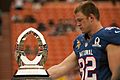
Kyle Rudolph holding his Pro Bowl MVP award trophy

See also
 In Spanish: Pro Bowl para niños
- American Football League All-Star games
- All-America Football Conference All-Star Game
- Chicago College All-Star Game – a series played between an NFL team and a college all-star team
- NFL Pro Bowl records
