
Skyline Drive facts for kids
Quick facts for kids
|
|
|---|---|
_map.svg)
Road map of Skyline Drive showing nearby major roads and cities in west-central and northwestern Virginia
|
|
| Route information | |
| Maintained by National Park Service | |
| Length | 105.5 mi (169.8 km) |
| Existed | 1939–present |
| Tourist routes |
 Skyline Drive Skyline Drive |
| Major junctions | |
| North end |  US 340 near Front Royal US 340 near Front Royal |
|
|
| South end |  US 250 in Rockfish Gap US 250 in Rockfish Gap |
| Location | |
| Counties: | Warren, Rappahannock, Page, Madison, Greene, Rockingham, Albemarle, Augusta |
| Highway system | |
|
Skyline Drive Historic District
|
|

|
|

 Location in Virginia

Location in the United States
|
|
| Nearest city | Front Royal, Virginia |
| Built | 1931 |
| MPS | Historic Park Landscapes in National and State Parks MPS |
| NRHP reference No. | 97000375 |
| Significant dates | |
| Added to NRHP | April 28, 1997 |
| Designated NHLD | October 6, 2008 |


Skyline Drive is a famous road that stretches for about 105 miles (169 kilometers) through Shenandoah National Park in Virginia. This beautiful road follows the top of the Blue Ridge Mountains, offering amazing views. It starts near Front Royal in the north and ends at Rockfish Gap in the south. There, it connects to another scenic road called the Blue Ridge Parkway.
As you drive along Skyline Drive, you'll find 75 special spots called overlooks. From these spots, you can see the wide Shenandoah Valley on one side and the rolling Piedmont hills on the other. The road is a great place for outdoor adventures! You can go cycling, horseback riding, or explore many hiking trails, including parts of the famous Appalachian Trail. Along the way, there are places to camp, visitor centers, and even resorts like Skyland Resort and Big Meadows. Many people love to visit in the fall when the leaves change into bright colors.
The idea for Skyline Drive began in 1924 when people wanted to create a national park in this area. President Herbert Hoover helped make the road a reality. Construction started in 1931, and different parts of the road opened over the next few years. The Civilian Conservation Corps, a group of young workers, played a big role in building this road. Skyline Drive is now recognized as a National Scenic Byway and a National Historic Landmark because of its importance and beauty.
Contents
Exploring Skyline Drive
Skyline Drive winds its way along the top of the Blue Ridge Mountains, making it the only public road that goes through Shenandoah National Park. It's a beautiful journey from Front Royal in the north to Rockfish Gap in the south.
How to Enter the Park
There are four main places where you can enter Skyline Drive:
- Near Front Royal, connecting with US 340.
- At Thornton Gap, connecting with US 211.
- At Swift Run Gap, connecting with US 33.
- At Rockfish Gap, connecting with US 250. This is also where Skyline Drive meets the Blue Ridge Parkway.
What to Expect on the Road
The road has mile markers from 0 (north) to 105 (south) to help you know where you are. Along the way, you'll find 75 overlooks. These are perfect spots to stop and enjoy the amazing views of the Shenandoah Valley to the west and the Piedmont to the east.
The speed limit on Skyline Drive is 35 miles per hour (about 56 km/h). Park rangers make sure everyone follows this rule to keep the park safe. You'll share the road with cars, bicycles, and even people walking. It's important to drive carefully because deer, black bears, turkeys, and other wildlife might cross the road without warning.
Fun Activities and Seasons
Skyline Drive is a gateway to many adventures. You can access lots of hiking trails, including parts of the famous Appalachian Trail. Biking and horseback riding are also popular activities here.
The drive is especially beautiful in the fall when the leaves change colors, creating a stunning display of reds, oranges, and yellows. This is often called "leaf peeping."
Sometimes, parts of Skyline Drive might close. For example, it closes from dusk to dawn between November and early January to help protect wildlife. It can also close temporarily after snow or ice storms to ensure everyone's safety.
Park Entrance Fees
To enter Skyline Drive, you need to pay a fee. This fee helps support Shenandoah National Park. It's not a toll just for driving on the road, but an entrance fee for the entire park. You can pay at any of the four entrance stations.
There are different types of passes:
- A standard pass for a car is valid for seven days.
- Passes are also available for motorcycles and individuals entering on foot or by bike.
- If you plan to visit often, you can buy an annual park pass.
- The America the Beautiful Pass series offers passes that work for many national parks, including Shenandoah. These include annual passes, passes for seniors, and free passes for people with disabilities or for military families.
- Fourth graders can even get a special pass that allows their whole family free entry for a year!
The Story of Skyline Drive
How the Idea Began
The story of Skyline Drive started in 1924. A group of people wanted to create a national park in the Blue Ridge Mountains of Virginia. They wanted a park that was easy for people from big cities like Washington, D.C. to visit. A key idea for this new park was a "sky-line drive" that would offer amazing views.
In 1929, President Herbert Hoover, who had a summer home nearby, supported the idea of building this road. It was first suggested to be named "Hoover Highway," but it became known as Skyline Drive instead.
Building the Road
Work on Skyline Drive officially began in 1931. The first parts of the road were built with help from the Federal Drought Relief Administration. This program gave jobs to local farmers and apple pickers who were struggling because of a big drought.
In 1933, the Civilian Conservation Corps (CCC) was formed. This group of young men played a huge role in building Skyline Drive. President Franklin D. Roosevelt was very impressed by the mountains and set up the first CCC camps in a national park right along Skyline Drive. These workers helped build the road, create stone walls and guardrails, make overlooks, and plant many trees and shrubs.
.jpg)
Different sections of Skyline Drive opened over several years.
- The section between Thornton Gap and Swift Run Gap opened in 1934. This part included the Marys Rock Tunnel, which was dug through Mary's Rock.
- The northern section, from Front Royal to Thornton Gap, was finished in 1936.
- The road continued to extend south, reaching Jarman Gap by 1939.
- The very southern part, from Jarman Gap to Rockfish Gap, was originally built as part of the Blue Ridge Parkway in 1939. It became part of Skyline Drive in 1961.
Protecting the Road's History
Over the years, the road has seen some updates. For example, the Marys Rock Tunnel was lined with concrete to prevent ice and water issues. Some of the original stone walls were also replaced with new ones that looked like the old ones.
Skyline Drive is recognized as a very important historical and natural site. It was added to the National Register of Historic Places in 1997. In 2005, it became a National Scenic Byway, and in 2008, it was named a National Historic Landmark. These honors show how special Skyline Drive is for its beauty and its role in the history of national parks in the eastern United States.

Images for kids
-
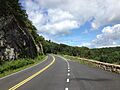
Skyline Drive northbound at the Indian Run Overlook
-
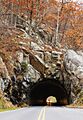
The Marys Rock Tunnel
-
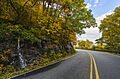
Skyline Drive in the fall
-
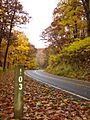
Fall colors near Milepost 103
-
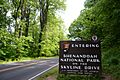
Sign at the south entrance to Skyline Drive
-
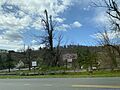
South end of Skyline Drive near Rockfish Gap
-

Mountain view along Skyline Drive

.jpg)
.jpg)


