
Taxodium facts for kids
Quick facts for kids Taxodium |
|
|---|---|
 |
|
| Bald cypress forest in a central Mississippi lake | |
Scientific classification  |
|
| Kingdom: | Plantae |
| Clade: | Tracheophytes |
| Division: | Pinophyta |
| Class: | Pinopsida |
| Order: | Pinales |
| Family: | Cupressaceae |
| Subfamily: | Taxodioideae |
| Genus: | Taxodium Rich. |
| Type species | |
| Taxodium distichum (L.) Rich.
|
|
| Species | |
|
|
| Synonyms | |
|
|
Taxodium is a special genus of giant trees that belong to the cypress family, Cupressaceae. These amazing conifers can easily survive in very wet places that suffer from a major flood. The scientific name comes from the Latin word taxus, meaning "yew", and the Greek word eidos, meaning "looks like". Within their plant family, they are close cousins to the Chinese swamp cypress and the sugi tree.
These massive trees naturally grow across the southern parts of North America. Trees living farther north are deciduous, which means they drop their needle-like leaves every autumn. Trees living in warmer southern areas can be semi-evergreen or completely evergreen all year long. A single tree can grow 100–150 ft (30–46 m) tall. Their thick trunks can reach 6.5–10 ft (2–3 m) across. Some super old giants have trunks measuring up to 36 ft or 11 m wide!
Contents
Amazing Features of Taxodium Trees

The tiny leaves look like soft needles and measure 0.2–0.8 in (0.5–2 cm) long. They grow spirally along every green shoot, but twist flat into two tidy rows.
Mystery Wooden Knees
When these swamp giants grow right beside water, they sprout strange wooden bumps called cypress knees. These knobby roots stick straight up out of the mud and soggy ground. Botanists still study them today to figure out their exact purpose. Some scientists believe they help pump air down to drowned roots. Others think they anchor the heavy tree against strong winds.
Reproduction and Life Cycle
Like other cone-bearing trees, Taxodium produces separate male and female cones on the same tree. Tiny male cones hang down in long clusters called racemes. In early spring, these male parts release tons of yellow pollen into the air.
Wind carries the pollen grains directly to the small female cones for pollination. The round female seed cones grow to about 0.8–1.4 in (2–3.5 cm) wide. Each cone contains between 10 and 25 protective scales. Inside every scale, you can find one or two tiny plant seeds. The cones take about seven to nine months to fully mature. Once ripe, the cones fall apart completely to let the seeds float away.
Types of Taxodium Trees

Scientists often debate whether these trees represent different species or just varieties of one taxon. Even though they can hybridise and mix together, they each prefer different homes in ecology.
Bald Cypress
The famous bald cypress, called Taxodium distichum, was named by botanist Rich. based on work by Linnaeus. It grows all across the Southeastern United States, from Delaware to Texas. It loves deep muddy rivers, especially across Louisiana and along the mighty Mississippi River toward Indiana. These wetlands are packed with rich river mud called silt.
Pond Cypress
The pond cypress, named Taxodium ascendens by scientist Brongn., likes quieter waters. You can find it from North Carolina down to Louisiana. It avoids muddy river floods and prefers shallow ponds and dark blackwater swamps.
Montezuma Cypress
The Montezuma cypress, or Taxodium mucronatum, was identified by Tenore. It lives along the warm Lower Rio Grande Valley south through Mexico into highland areas of Guatemala. Unlike its swamp-loving cousins, this tree is a riparian plant that hugs dry stream banks. The most famous tree in Santa María del Tule, Oaxaca, called the Árbol del Tule, is 43 m (141 ft) tall. It has the thickest trunk in the world, measuring 11.42 m (37.5 ft) across!
Human Uses and Prehistoric Evolution

People have used cypress wood for hundreds of years because it lasts a long time. The central heartwood fights off natural rot and hungry termites. A natural oil called cypressene builds up inside older trees and acts as a built-in preservative. Because of this, lumber from old-growth trees makes super strong roof shingles. Shredded tree bark is also sold as garden mulch to protect soil. However, an annoying fungus named Stereum taxodii can make older wild trunks hollow inside.
Long ago, cypress trees lived in many more places across the globe. Fossil records show the extinct cousin †Taxodium dubium lived during the ancient Late Cretaceous period in North America and Asia. Giant cypress trees grew happily in European forests until the cool Pliocene epoch ended about 2.5 million years ago.
Images for kids
-
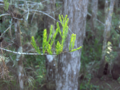
A tall bald cypress tree standing outdoors
-
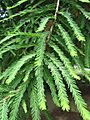
A giant Montezuma cypress growing beside water
.png)

See also
- Bükkábrány mummified forest
