
The Signing of Peace in the Hall of Mirrors facts for kids

The Signing of Peace in the Hall of Mirrors, Versailles, 28 June 1919 is a famous painting by Irish artist William Orpen. He finished it in 1919. This painting shows a very important moment: the signing of the peace treaty that ended World War I.
The painting was specially asked for to remember the Peace Conference held at the beautiful Palace of Versailles in 1919. Today, you can see this artwork at the Imperial War Museum in London.
Painting the End of a War
William Orpen was chosen as a war artist in 1917. This meant his job was to create art about the war. He was also the official painter at the peace conference. His task was to paint three large pictures to record what happened there.
This painting was the most expensive artwork ordered by the British government for World War I. Orpen was paid £3,000 for it. This was a lot of money at the time. For example, another famous artist, John Singer Sargent, got £300 for his much bigger painting called Gassed.
The painting shows the signing of the Treaty of Versailles. This treaty was signed by representatives from Germany on June 28, 1919. It officially ended World War I.
The painting is a group picture. It shows soldiers, diplomats, and politicians who were at the conference. They are signing the treaty in the fancy Hall of Mirrors at the Palace of Versailles. This palace was once home to the French king Louis XIV. High up on the wall, you can see words that say "Le Roy Gouverne par lui meme." This means "The King governs alone."
Orpen himself started to dislike the politicians at the conference. He thought they were too proud and cared only about themselves. In his painting, he shows them looking very small compared to the huge palace. This makes the palace seem more important than the people.
Who's in the Painting?
Many important people are shown in this painting. They were all part of the peace conference.
In the front row, you can see:
- Johannes Bell: A German politician. He is sitting in a chair and signing the treaty.
- Hermann Müller: A German politician. He is standing next to Bell, leaning over.
Sitting in the middle row, from left to right:
- General Tasker H. Bliss: An army officer from the United States.
- Edward M. House: An adviser to the US President, Woodrow Wilson.
- Henry White: A diplomat from the United States.
- Robert Lansing: The US Secretary of State.
- Woodrow Wilson: The President of the United States. He is holding some papers.
- Georges Clemenceau: The Prime Minister of France.
- David Lloyd George: The British Prime Minister.
- Bonar Law: A British politician.
- Arthur Balfour: The British Foreign Minister and a former Prime Minister.
- Alfred Milner, 1st Viscount Milner: The British Secretary of State for the Colonies.
- George Barnes: A British politician who represented workers.
- Marquis Saionji Kinmochi: A former Prime Minister of Japan.
Standing in the back row, from left to right:
- Eleftherios Venizelos: The Prime Minister of Greece.
- Afonso Costa: A former Prime Minister of Portugal.
- Sir George Riddell: A British journalist.
- Sir George Foster: A Canadian politician.
- Nikola Pašić: A former Prime Minister of Serbia and Prime Minister of Yugoslavia. He has a long white beard.
- Stéphen Pichon: The French Minister of Foreign Affairs. He is leaning against a pillar.
- Colonel Sir Maurice Hankey: A British government official. He is leaning over behind Clemenceau.
- Edwin Montagu: The British Secretary of State for India. He is behind the Maharajah of Bikaner.
- Ganga Singh: The Maharajah of Bikaner from India. He was one of only two non-European members of the Imperial War Cabinet. He is leaning against a pillar.
- Vittorio Emanuele Orlando: A former Prime Minister of Italy.
- Paul Hymans: The Belgian Minister for Foreign Affairs.
- General Louis Botha: The Prime Minister of South Africa.
- Billy Hughes: The Prime Minister of Australia.
Artist William Orpen himself appears twice in the painting. You can see his unclear reflection in the mirrors behind the main people.
Other Paintings by Orpen
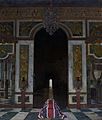
Orpen painted other pictures about the peace conference too. One shows early talks of a group called the "Council of Ten." This happened in the Hall of Clocks at the French Ministry of Foreign Affairs. Another painting shows a coffin lying in a marble hall, covered by a British flag.
-
To the Unknown British Soldier in France


