
The Stanley Hotel facts for kids
Quick facts for kids |
|
|
The Stanley Hotel
|
|
 |
|

 Location in Colorado

Location in the United States
|
|
| Location | 333 Wonderview Avenue, Estes Park, Colorado |
|---|---|
| Architect | Freelan Oscar Stanley, Thielman Robert Weiger, Henry Rogers; built 1907–10 |
| Architectural style | Colonial Revival |
| NRHP reference No. | 85001256 |
| Added to NRHP | May 26, 1977 (expanded June 20, 1985, and April 16, 1998) |

The Stanley Hotel is a beautiful 140-room hotel in Estes Park, Colorado, USA. It's located about 8 kilometers (5 miles) from the entrance to Rocky Mountain National Park. The hotel offers a restaurant, a spa, and a cozy bed-and-breakfast. Guests can enjoy amazing views of Lake Estes, the Rocky Mountains, and Longs Peak. In May 2025, a group called The Stanley Partnership for Art Culture and Education bought this historic hotel. This partnership helps support art, culture, and learning.
Contents
Discovering The Stanley Hotel
The Stanley Hotel was built by Freelan Oscar Stanley, who also helped create the Stanley Motor Carriage Company. It first opened its doors on July 4, 1909. At first, it was a special place for wealthy people from the East Coast to relax. It also served as a health retreat for people with serious lung illnesses. Today, the hotel and its nearby buildings are recognized on the National Register of Historic Places. This means they are important historical sites.
Many people know the Stanley Hotel because it inspired the famous "Overlook Hotel" in Stephen King's 1977 book, The Shining. This book later became a popular movie in 1980. The hotel was also used as a filming location for The Shining TV miniseries in 1997.
The Stanley Hotel's Story

In 1903, Freelan Oscar Stanley, who invented steam-powered cars, became very ill with a serious lung condition. Doctors at the time suggested fresh, dry air, lots of sunlight, and good food as the best treatment. So, like many others with lung problems, Stanley decided to visit the Rocky Mountains for its healing air.
He and his wife, Flora, came to Denver, Colorado, in March. Later, in June, a doctor suggested they move to Estes Park, Colorado, for the summer. Stanley's health got much better during that time. He loved the beautiful valley and was so thankful for his recovery that he decided to come back every year. He lived a long life, passing away at 91 in 1940.
By 1907, Stanley was completely healthy. He wanted to make Estes Park a more exciting place to visit. So, in 1907, he started building the Stanley Hotel. It was a large 48-room hotel designed for well-off city people and those looking for a healthy climate.

The land for the hotel was bought in 1908 from representatives of Windham Wyndham-Quin, 4th Earl of Dunraven and Mount-Earl. This nobleman had owned a large amount of land in the Estes Valley. He had tried to create a private hunting area, but it didn't work out. Local ranchers and farmers didn't like him very much. When Stanley thought about naming his new hotel "The Dunraven," many people asked him to name it after himself instead!
The main hotel and its concert hall were finished in 1909. The smaller Manor building was completed in 1910. To bring guests to the hotel, Stanley's car company made special steam-powered vehicles. These were called Mountain Wagons and could carry many passengers from the train station in Lyons, Colorado. Stanley ran the hotel mostly for fun, even saying he spent more money than he earned each summer.
In 1926, Stanley sold the hotel. But the new company didn't succeed, so Stanley bought it back in 1929. He then sold it again in 1930 to Roe Emery, another important person in the car and hotel business. Until 1983, the hotel was only open in the summer, closing every winter. The hotel and Stanley's efforts helped Estes Park, Colorado grow and led to the creation of Rocky Mountain National Park. The hotel was once part of "Historic Hotels of America," but it is not anymore as of 2022.
An Early Incident: The 1911 Gas Event
When it first opened, the Stanley Hotel was said to be one of the few hotels powered completely by electricity. But because there wasn't enough electricity, a backup gas lighting system was added in June 1911. On June 25, 1911, a day after the gas pipes were filled, an incident happened. A gas event caused damage to the building and injured a hotel employee. Newspaper reports from that time had slightly different details. One report mentioned that a maid, Elizabeth Wilson, was injured. Other local papers called her Elizabeth Lambert.
The Frozen Dead Guy: A Unique Attraction
In August 2023, a famous cryogenically frozen man named Bredo Morstøl was moved to the Stanley Hotel's ice house. He is the inspiration for Colorado's yearly Frozen Dead Guy Days festival. A foundation helped move his body and set up a new special chamber to keep him frozen. The hotel named the ice house the "International Cryonics Museum." They now offer tours where visitors can learn about it.
Photo Gallery of the Hotel
-
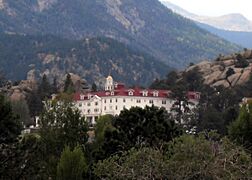
June 2008
-
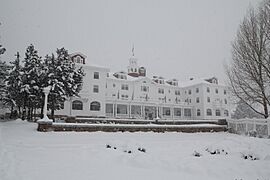
February 2011
-
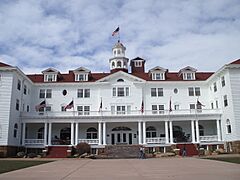
South elevation
-
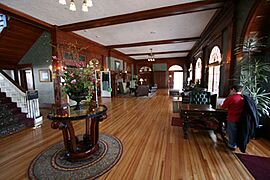
Lobby looking east
-
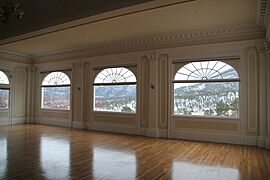
Music room looking south
-
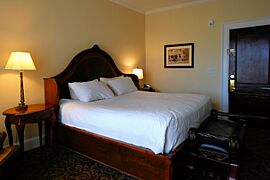
Interior of a guest room
-
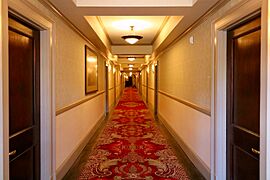
Corridor leading to guest rooms
-
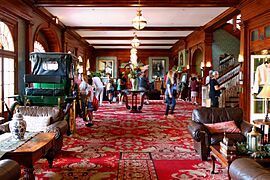
Hotel lobby
-
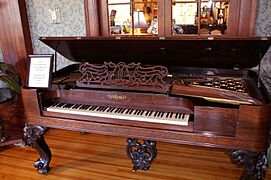
Antique Chickering Piano
-
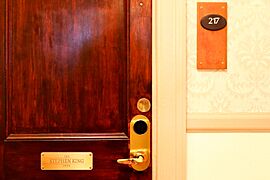
Door to the Stephen King suite


The Hotel's Amazing Architecture
The Stanley Hotel Historic District includes 11 important buildings. These are the main hotel, the concert hall, a carriage house, a manager's cottage, a gate house, and The Lodge. The Lodge is a smaller bed-and-breakfast, originally called The Manor House. F.O. Stanley designed the buildings with help from architects T. Robert Wieger and Henry "Lord Cornwallis" Rogers.
The location was chosen because it had great views of the Estes Valley and Long's Peak. The main building, concert hall, and Manor House have strong steel frames. Their foundations are made of granite, with wooden siding and asphalt shingle roofs. Stanley originally chose a yellow color for the outside of the buildings, with white details. The wood came from nearby areas and from lumberyards in Denver and Arkansas. The granite was taken from a local quarry. Materials that weren't local were brought by train to Lyons, Colorado, and then by mule-drawn wagons to Estes Park.
When it opened in 1909, the hotel was said to be one of the first in the country to use electricity for everything. To power his hotel, Stanley built the Fall River Hydroplant. This plant also brought electricity to the town of Estes Park for the first time. Every guest room had a telephone. Each pair of rooms shared a bathroom with running water from Black Canyon Creek. Around 1935, the hotel's outside was painted white, and many of the original light fixtures were changed.
The hotel's style looks like old New England architecture. But its design also included new ideas for cleanliness and comfort. Stanley was interested in healthy living. He might have been inspired by the Carolina Hotel in Pinehurst, North Carolina, which was also a health resort. The Stanley Hotel was designed to be a great place for lung health. It had large porches, good air flow, and tasty food, all recommended for health at the time.
The Stanley Hotel's style is called Colonial Revival. This means it uses classic design elements like symmetrical fronts, decorative cupolas, and columns. These features were common in American Georgian and Federal Styles. The wooden siding and carved details are typical of New England buildings. These features were updated for the early 1900s.
The hotel's style was very different from the more rustic hotels in Estes Park. The Colonial Revival style showed the historical roots of American culture. It also highlighted the modern comforts inside the hotel. This made the Stanley Hotel a symbol of elegance and a bright future for Estes Park as a respected resort town.
Exploring the Main Building
The main hotel's layout, finished in 1909, was planned for popular activities of the wealthy at that time. The music room, with its light-colored walls and classical plaster-work, was for writing letters during the day and listening to music at night. The smoking lounge (now the Piñon Room) and billiard room, with their dark wood and granite fireplace, were for male guests. Stanley himself didn't smoke or drink, but these were common activities for men back then. Billiards was one of Stanley's favorite hobbies.
The building had no central heating or air conditioning. It was designed to let air flow naturally. Large windows and French doors opened onto porches, creating cool breezes. Two curving staircases helped air move through the upper floors. Today, the main hotel is heated in winter, but guests still use natural air for cooling in summer. An elevator was added a few years after opening. Later, in 1916, more guest rooms were added to the east wing. Around 1935, the elevator was updated and extended to the fourth floor.
The Grand Concert Hall
The concert hall, located east of the hotel, was built by Stanley in 1909. It's said that F.O. Stanley built it as a gift for his wife, Flora. The inside looks similar to the music room in the main hotel. It also reminds some people of the Boston Symphony Hall. The stage has a trap door, which was used for special entrances and exits in plays. The lower level once had a two-lane bowling alley, but it was removed later. The hall was extensively repaired and updated in the 2000s.
The Cozy Lodge

This smaller hotel, once called The Manor House, is between the main building and the concert hall. It's like a smaller version of the main hotel. Unlike the main hotel, The Lodge was fully heated when it was finished in 1910. This might mean Stanley thought about using it as a winter resort. However, Estes Park didn't attract many winter visitors back then, so The Lodge was often empty. Today, it's called The Lodge and has a brunch restaurant. Guests can also stay there.
The Famous Hedge Maze
The area in front of the hotel was originally a driveway for the steam-powered Mountain Wagons. In 1983, it became a parking lot. Around 1995, it was turned into a lawn and event space. In 2015, a hedge maze was built there. This maze looks like the one in Stanley Kubrick's movie version of The Shining. Interestingly, Stephen King's book The Shining actually featured animal-shaped bushes, not a hedge maze.
The Stanley Hotel and The Shining
In 1974, the famous horror writer Stephen King and his wife, Tabitha, stayed one night at the Stanley Hotel. They were living in Boulder, Colorado, at the time. King has shared different stories about his visit. According to one account, the Kings checked into the hotel just as it was closing for the winter. They were the only guests.
King said he walked the empty halls and went to the hotel bar. Later, in his bathroom, he thought, "What if somebody died here?" At that moment, he knew he had an idea for a book. In another interview, King recalled eating dinner in an empty dining room with orchestral music playing. He felt like he was meant to be there to see and hear those things. By the time he went to bed, he had the whole book, The Shining, in his mind.
King also shared that he dreamed his three-year-old son was running through the corridors, screaming. He woke up suddenly, sweating. He then sat by the window, looking at the Rockies. By the time he finished a cigarette, he had the main ideas for The Shining clearly in his mind.
The Shining was published in 1977 and became a huge success. The story is set in an isolated Colorado resort called the Overlook Hotel, which closes for the winter. In the book, King mentioned that the hotel in his story was not based on any real hotel.
Room 217 at the Overlook Hotel is very important in The Shining. It is believed that Stephen King stayed in Room 217 at the Stanley Hotel during his 1974 visit. This is likely true, as the hotel was mostly empty then, and Room 217 is one of the best rooms.
Movies, Music, and Events at the Hotel
The Stanley Hotel was used as a filming location for the 1994 movie Dumb and Dumber. It stood in for a fictional hotel in Aspen, Colorado.
The Shining miniseries was written and produced by Stephen King. It was based on his 1977 novel, which was inspired by the Stanley Hotel. King was not happy with Stanley Kubrick's 1980 film version. So, unlike Kubrick's movie, the miniseries was filmed at the Stanley Hotel. It represented the fictional "Overlook Hotel" in the Colorado Rockies. Filming began in March 1996, and the first episode was released in March 1997.
From 2013 to 2015, the hotel hosted the Stanley Film Festival. This was a festival for independent horror films. It included screenings, discussions, student competitions, and awards. The festival was paused in 2016 and canceled for 2017.
Bravo's cooking show Top Chef also used the Stanley Hotel. It was a location for Episode 10 of Season 15, which took place in different parts of Colorado.
The indie rock band Murder by Death has performed annual winter concerts at the Stanley Hotel since 2014. Their 2020 event was their seventh concert there.
Ghost Stories and Haunted Tales
Even though its early history was peaceful, the Stanley Hotel has become known for paranormal activity in recent years. This is largely because of The Shining. Many paranormal investigators have visited the hotel. It has also appeared on TV shows like Ghost Hunters and Ghost Adventures.
The hotel also offers paid ghost tours. These tours take visitors to areas of the hotel where strange things are said to happen. Guides share ghost stories and show pictures that seem to capture ghostly figures.
Famous Visitors to the Stanley Hotel
The Stanley Hotel has welcomed many notable people:
- 1925, Wilhelm Backhaus, a German pianist
- 1934, Erich Fromm, a German psychoanalyst
- 1936, Governor Alf Landon (from Kansas) while running for president
- 1973, Judy Collins, Michael Nesmith, Shel Silverstein, Bobby Womack, and Joseph Banks Rhine at the Carnival of Knowledge
- 1974, Stephen King, the author who was inspired to write The Shining after staying in room 217
- 1976, Bob Dylan and Joan Baez, famous folk singers during the Rolling Thunder Revue tour
- 1987, Clive Cussler, Scott Carpenter, and Will Steger at The Explorers Club meeting
- 1994, Emperor Akihito of Japan, Empress Michiko, and Crown Prince Naruhito, during a visit to the U.S.
- 1994, Dumb and Dumber cast and crew, including Jim Carrey and Jeff Daniels
- 1996, The Shining miniseries cast and crew, including Rebecca De Mornay and Steven Weber
Who Owned the Stanley Hotel?
- 1908–1926, Freelan Oscar Stanley
- 1926–1929, The Stanley Corporation
- 1929–1930, Freelan Oscar Stanley
- 1930–1946, Roe Emery
- 1946–1966, Abbell Management Company (later Abbell Hotel Company)
- ?–1969, Stanley Properties, Inc.
- 1969–?, Richard R. Holechek, Charles F. Hanson, and Carol Hanson Pick
- ?–1974, Estes Park Trustees
- 1974–1995, Frank Normali (during a period of complete restoration)
- 1995–?, Grand Heritage Hotel Group
- 2025-present, The Stanley Partnership for Art Culture and Education
Learn More
- List of Historic Hotels of America
