
Tokay gecko facts for kids
Quick facts for kids Tokay gecko |
|
|---|---|
 |
|
| In Cambodia | |
| Conservation status | |
Scientific classification  |
|
| Kingdom: | Animalia |
| Phylum: | Chordata |
| Class: | Reptilia |
| Order: | Squamata |
| Family: | Gekkonidae |
| Genus: | Gekko |
| Species: |
G. gecko
|
| Binomial name | |
| Gekko gecko (Linnaeus, 1758)
|
|
| Script error: The function "autoWithCaption" does not exist. | |
| Synonyms | |
|
Lacerta gecko Linnaeus, 1758 |
|

Script error: No such module "Check for conflicting parameters".
The tokay gecko (Gekko gecko) is a fascinating gecko known for being active at night. This means it is nocturnal. It loves to live in trees, making it an arboreal animal. You can find tokay geckos in Asia and some Pacific Islands.
Contents
What's in a Name?
The word "tokay" sounds just like the call that male geckos of this species make! It's an onomatopoeia, which means a word that imitates the sound it describes. Both the common name "tokay" and the scientific name Gekko come from these unique sounds. For example, in Javanese, they say "ge'kok," and in Malay, it's "tokek."
Types of Tokay Geckos
Scientists recognize two main types, or subspecies, of the tokay gecko:
- G. g. gecko was first described by Carl Linnaeus in 1758. This type lives in tropical Asia, from northeastern India to eastern Indonesia.
- G. g. azhari was identified by Robert Mertens in 1955. This subspecies is found only in Bangladesh.
Where Tokay Geckos Live
These geckos live in many places across Asia. You can find them in northeast India, Bhutan, Nepal, and Bangladesh. They also live throughout Southeast Asia, including countries like Cambodia, Thailand, the Philippines, Malaysia, and Vietnam. They are also found in Indonesia and western New Guinea.
Their natural home is in rainforests, where they climb on trees and cliffs. Tokay geckos are very good at adapting! They often live near people's homes. They can be seen climbing on walls and ceilings at night, searching for insects to eat. Sometimes, they are introduced to new places outside their natural range. These places include Florida in the United States, Martinique, and the islands of Belize.
What Does a Tokay Gecko Look Like?

The tokay gecko is a large gecko. It can grow to be about 10 to 12 inches (25 to 30 cm) long, including its tail. Some can even reach up to 16 inches (40 cm)! It is thought to be the third-largest gecko species in the world.
Its body is somewhat round but also a bit flat. Its eyes have pupils that are vertical, like a slit. The skin feels soft and is usually blue-gray with bright red or orange spots. These geckos are amazing because they can change their skin color! This helps them blend in with their surroundings.
Males and females look a little different. This is called sexual dimorphism. Males usually have brighter colors and are slightly larger than females.
They are strong climbers with special foot pads. These pads can support their entire body weight on a vertical surface for a long time. Compared to other geckos, the tokay gecko has a strong build. It has a tail that can grip, a large head, and muscular jaws.
How Tokay Geckos Behave
Tokay geckos are generally protective of their territory. They can give a strong bite if they feel threatened. Even though they are sometimes kept as pets, their powerful bite means they are not ideal for new pet owners. The strength of their bite depends on the gecko's size. Larger geckos, usually males, can cause a painful bite.
Reproduction and Life Cycle
Female tokay geckos lay one or two eggs with hard shells. They guard their eggs until they hatch. Sometimes, several adult geckos have been seen guarding a group of about eleven eggs together. When they have babies, the parents often form temporary family groups. They care for their young. They can even recognize their mates and offspring by their smell!
Diet and Meals


The tokay gecko eats insects and small vertebrates. When kept as pets, they usually eat mealworms, cockroaches, crickets, and grasshoppers. In one study in Thailand, researchers found that males, females, and young geckos ate similar things. This was likely because there weren't many different insects available. In Southern Florida, their diet often includes roaches, caterpillars, spiders, and beetles.
Their Special Calls
The male's call to attract a mate is loud. People describe it as sounding like token, tuck-too, or tokay. Most of the time, this call is preceded by a quick "cackling" sound. This is similar to the chirping of house geckos, but much deeper. When a tokay gecko feels threatened, it usually "barks" while opening its mouth in a defensive way.
Light and temperature can affect their calls. They call most often in May, especially at dusk (evening) and dawn (morning). Their calls and behavior are strongly affected by the temperature around them.
Tokay Geckos and People
The tokay gecko is important in the cultures of many East Asian countries. Old stories in these regions have given the gecko special powers. In Southeast Asia, it is a symbol of good luck and new life. Some people even believe it is descended from dragons.
Unfortunately, because of these beliefs, some people illegally catch and sell tokay geckos. They are used in some traditional Chinese medicine practices, where they are known as Ge Jie. People believe they can help the body, but modern medical science does not support these claims. Because of this demand, these geckos are sometimes caught and traded illegally.
The tokay gecko is becoming a protected species in places like the Philippines. It is against the law to catch, move, or sell these geckos without a special permit. This helps protect them from being over-hunted.
The species is also protected by an international agreement called CITES (Appendix II). This means that any international trade of tokay geckos, or parts of them, needs special permits. This system helps ensure that trade is legal and does not harm their populations in the wild.
-
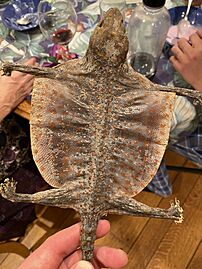
Dried tokay gecko (back view)
-
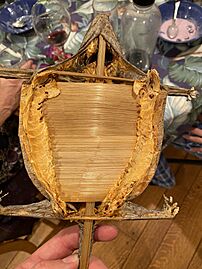
Dried tokay gecko (front view)
-
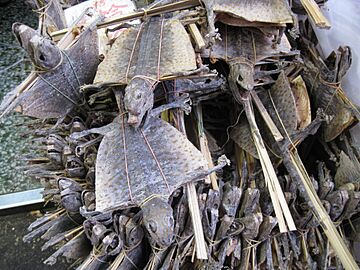
Dried tokay geckos, in Hong Kong
-
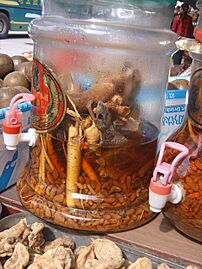
Medicinal liquor with tokay gecko, goji berry, and ginseng, for sale in Xi'an, China.

.jpg)

.JPG)
Tokay Geckos as Pets

Tokay geckos are becoming more popular as pets because of their striking colors and large size. Many of them are caught in the wild. However, more are now being bred in captivity. Wild-caught adult geckos can be challenging to handle because of their defensive nature and powerful bite. But, many hobbyists report that tokay geckos born and raised in captivity can be less aggressive.
When they are well cared for, tokay geckos can live for a long time. They can sometimes live up to 15 to 20 years.
Images for kids
-
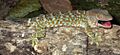
Adult male showing a brownish regenerated tail
-
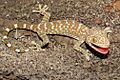
Older juvenile
-
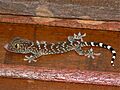
Young juvenile
-

Hatched eggs
-
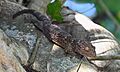
Appearance during the day, in Assam, India
-
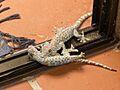
Adults fighting
-
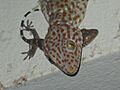
Juvenile underneath an adult
-

Female guarding eggs
_adult_male.jpg)
_juvenile.jpg)
_juvenile_(7846673724).jpg)


