
USS Uhlmann facts for kids
_underway_at_sea,_in_the_1960s.jpg) |
|
Quick facts for kids History |
|
|---|---|
 United States United States |
|
| Name | USS Uhlmann |
| Namesake | Robert W. Uhlmann |
| Builder | Bethlehem Mariners Harbor, Staten Island |
| Laid down | 6 March 1943 |
| Launched | 30 July 1943 |
| Commissioned |
|
| Stricken | 15 July 1972 |
| Fate | Sold 21 March 1974, scrapped |
| General characteristics | |
| Class and type | Fletcher-class destroyer |
| Displacement | 2,050 tons |
| Length | 376 ft 5 in (114.73 m) |
| Beam | 39 ft 7 in (12.07 m) |
| Draft | 17 ft 9 in (5.41 m) |
| Propulsion | 60,000 shp (45,000 kW); 2 propellers |
| Speed | 35 knots (65 km/h; 40 mph) |
| Complement | 329 |
| Armament |
|
The USS Uhlmann (DD-687) was a type of warship called a Fletcher-class destroyer. It served in the United States Navy for two periods: from 1943 to 1946, and again from 1950 to 1972. The ship was later taken apart for scrap in 1974.
Contents
- Who Was Robert W. Uhlmann?
- Building and First Service (1943-1944)
- World War II: Pacific Battles (1944-1945)
- Decommissioning and Recommissioning (1946-1950)
- Korean War Service (1951-1953)
- Later Deployments and Training (1953-1969)
- Vietnam War Service (1960s)
- Final Years and Decommissioning (1969-1974)
- Awards
- Images for kids
Who Was Robert W. Uhlmann?

The USS Uhlmann was named after Robert William Uhlmann. He was born in Pittsburgh, Pennsylvania, on August 16, 1919. He studied engineering at the University of Michigan.
In 1940, Robert joined the United States Naval Reserve. He became an ensign in 1941. He then joined Patrol Squadron 24, which was later renamed Patrol Squadron 12 (VP-12). This squadron was based at Naval Air Station Kaneohe Bay in Hawaii.
On December 7, 1941, during the Attack on Pearl Harbor, Japanese planes attacked Kaneohe Bay. Robert Uhlmann and his squadron fought back with rifles and machine guns. Sadly, Robert Uhlmann was killed during this attack. The USS Uhlmann was named in his honor.
Building and First Service (1943-1944)
The Uhlmann was built at Staten Island, New York, by the Bethlehem Steel Company. Its construction started on March 6, 1943. The ship was launched on July 30, 1943, and officially joined the Navy on November 22, 1943. Commander Selden G. Hooper was its first captain.
In early 1944, the destroyer trained near Bermuda. It then sailed through the Panama Canal to San Francisco, California. From there, it carried passengers to Hawaii and arrived at Pearl Harbor on February 23.
During April 1944, the Uhlmann practiced escorting aircraft carriers and firing its guns. On April 24, while training, another destroyer, the Benham, accidentally hit the Uhlmann. This caused a large hole in its side and flooded some of its rooms. The ship had to be towed back to Pearl Harbor for temporary repairs. It then sailed to San Francisco for two months of major repairs.
World War II: Pacific Battles (1944-1945)
Return to Duty and Typhoon (1944)
In August 1944, the Uhlmann returned to Pearl Harbor for more training. It then sailed to the Caroline Islands, joining the 3rd Fleet at Ulithi on September 30.
On October 3, a typhoon hit, and other destroyers bumped into the Uhlmann, causing more holes. Despite the damage, the ship left the lagoon to join Task Group 38.2. It returned to Ulithi for quick repairs and then met up with the Fast Carrier Force.
Strikes on Japanese Islands (1944)
On October 10, the carriers launched planes to attack Okinawa. This was to prepare for the planned landings on Leyte in the Philippines.
From October 12-13, the Uhlmann protected the carriers as they attacked Taiwan. Japanese planes tried to attack the fleet. The Uhlmann fired its guns, hitting and sinking several enemy planes. One plane was hit at close range and crashed just 100 yards from the ship.
Supporting Leyte Landings (1944)
On October 15, the fleet began strikes on Luzon. The Uhlmann provided protection for the carriers. On October 20, the fleet attacked Negros to support the landings on Leyte.
On October 24, the Uhlmann protected carriers launching attacks against Japanese forces in the Battle of the Sibuyan Sea. American planes sank the Japanese battleship Musashi.
After the Battle of Leyte Gulf, the Uhlmann continued to screen carriers as they attacked targets on Luzon. On October 29, the Uhlmann rescued three Navy pilots whose plane had crashed nearby.
More Typhoon Challenges (1944)
In November, the Uhlmann supported more strikes on Luzon. It returned to Ulithi for repairs. In December, the carriers attacked air bases and ships near Luzon to support landings on Mindoro.
On December 17-18, the fleet faced another strong typhoon. The Uhlmann experienced very high winds and large waves, with the typhoon's center passing very close. The storm caused damage and sank three other destroyers. The Uhlmann helped search for survivors before returning to Ulithi on December 24.
Final World War II Actions (1945)
In January 1945, the Uhlmann screened carriers during attacks on Formosa and Luzon. It then entered the South China Sea, where carriers launched strikes on French Indochina and Hong Kong.
On February 16, while supporting strikes on Tokyo, the Uhlmann came under attack from a Japanese fighter plane. The plane dropped a bomb near the ship, but the Uhlmann was not damaged.
On February 19, the Uhlmann protected carriers attacking Iwo Jima to support the landings there. Due to steering problems, the Uhlmann had to leave the task force for repairs at Ulithi.
Okinawa and Kamikazes (1945)
The Uhlmann returned to duty on March 16. The next day, carriers began strikes on Kyūshū. The Uhlmann protected the carriers from air and submarine attacks. It rescued three Navy pilots on March 18.
On March 19, a Japanese plane dropped a bomb very close to the Uhlmann, but it caused no damage. On March 22, the Uhlmann helped the Haggard find and sink a Japanese submarine. The Haggard was damaged in the process, and the Uhlmann escorted it back to Ulithi.
In April, Japan began using kamikaze attacks against American ships. On April 12, three Japanese "Zekes" (fighter planes) were shot down near the Uhlmann. On April 17, the Uhlmann helped shoot down two more enemy planes. That night, it also helped sink the Japanese submarine I-56.
On April 29, a kamikaze plane crashed into the Haggard, causing serious damage. The Uhlmann shot down another kamikaze that was attacking the Haggard and rescued two of its crew members. The Uhlmann then escorted the damaged ship to safety.
End of World War II (1945)
The Uhlmann continued its duties off Okinawa until May 11. It then returned to Ulithi. In late May, it went back to Okinawa.
In July, the carriers launched attacks on Japanese islands to prepare for a possible invasion. On July 25, the Uhlmann joined a special group to sweep for ships between Honshū and Shikoku. It also fired on a radio tower and airfields.
The Uhlmann continued to operate with the carrier force until Japan surrendered on August 15. On August 23, it joined a combined British-American force for the occupation of Japan. It arrived in Sagami Wan on August 27.
On August 30, the Uhlmann rescued a pilot who had jumped from an aircraft carrier. It then anchored in Tokyo Bay. Its duties included carrying mail, cargo, and passengers between Iwo Jima and Japanese ports.
In October, the Uhlmann took part in training exercises. On October 31, it left Japan and sailed to Bremerton in the United States, arriving in late November.
Decommissioning and Recommissioning (1946-1950)
After some changes, the Uhlmann sailed to San Diego, California, arriving on April 24, 1946. On June 14, 1946, it was taken out of active service and placed in reserve.
It was then used for the Naval Reserve Training Program. It trained reserve crews out of San Diego until 1950. On May 23, 1950, the Uhlmann was put back into active service. That summer, it visited ports in Central and South America. It returned to San Diego in July and became fully active on November 18.
Korean War Service (1951-1953)
_at_Terminal_Island,_California_(USA),_in_1950.jpg)
On January 27, 1951, the Uhlmann was assigned to duty in the Korean War. On June 16, it sailed from San Diego to Korea.
It joined Task Force 77, a fast carrier force in the Sea of Japan. The Uhlmann screened carriers and rescued pilots. It also joined Task Force 95, a blockade and escort force, and fired its guns at the Korean coast day and night.
Wonsan Harbor Incident (1951)
On August 20, while on patrol near Wonsan Harbor, the Uhlmann came under fire from seven enemy shore batteries. The ship quickly went to battle stations, increased speed, and began firing back. It damaged several enemy guns. Even though shells landed as close as 15 yards away, the Uhlmann only lost a radio antenna. Its captain, Commander Lilly, was recognized for his actions.
In the fall, the Uhlmann patrolled near Taiwan and trained in antisubmarine warfare. In November, it rejoined Task Force 77 and rescued more pilots. It left Japan on January 22, 1952.
Second Korean Deployment (1952-1953)
The Uhlmann returned to San Diego on February 6, 1952, for repairs and new weapons. On August 11, it sailed back to the Far East.
During this seven-month deployment, the Uhlmann worked with fast carrier forces and patrolled near Taiwan. It also fired its guns at the shore, destroying enemy gun positions, a factory, and storage buildings.
On November 3, while firing at a railroad in North Korea, the Uhlmann was attacked by shore guns, mortars, and machine guns. Shells landed close to the ship. The Uhlmann sped up, dodged the fire, and returned fire, hitting an enemy gun. It suffered minor damage and 13 crew members were injured. After a stop in Hong Kong, it left Japan on March 3, 1953, and arrived back in San Diego on March 19.
Later Deployments and Training (1953-1969)
After training, the Uhlmann was sent to the western Pacific again, arriving in Japan on November 20, 1953. It trained and operated with Task Force 77. In February 1954, it joined French and British ships for antisubmarine training.
In March, while patrolling the Taiwan Strait, the Uhlmann helped rescue crewmen from a Chinese merchant ship that was stuck on an island. During this rescue, the Uhlmann damaged its own propellers and rudder on shallow reefs. It had to be towed for repairs.
Over the next 15 years, the Uhlmann made 11 more trips to the western Pacific. In 1954, it helped evacuate people from the Tachen Islands during a tense time between China and Taiwan. In 1958, it again supported American interests in the Far East. Between these trips, the Uhlmann trained and performed goodwill missions from San Diego.
Vietnam War Service (1960s)
In the 1960s, the Uhlmann served three times off the coast of Vietnam. Its jobs included:
- Firing its guns to support troops on land.
- Illuminating areas at night with special shells.
- Searching boats for illegal goods.
- Acting as a plane guard for aircraft carriers in the Gulf of Tonkin.
In 1968, a year of heavy fighting in Vietnam, the Uhlmann fired 50 naval gunfire support missions near Huế.
Final Years and Decommissioning (1969-1974)
In 1969, the Uhlmann took part in fleet exercises in Hawaii. On October 1, it returned to the west coast and became a training ship for Naval Reserve members in Tacoma, Washington. For the next three years, it conducted training cruises and participated in exercises, including one with Canadian naval forces in 1970.
The Uhlmann was the oldest commissioned destroyer in the Navy. On November 24, 1971, it was found to be no longer fit for service. On July 15, 1972, the Uhlmann was officially taken out of service. It was the last Fletcher-class destroyer in the U.S. Navy. Its name was removed from the Navy List the same day. The ship was then sent to Bremerton to be taken apart. It was scrapped in 1974.
Awards
- Combat Action Ribbon with two stars
- Asiatic-Pacific Campaign Medal with seven battle stars
- World War II Victory Medal
- Navy Occupation Medal with "ASIA" clasp
- National Defense Service Medal with star
- Korean Service Medal with two battle stars
- Vietnam Service Medal with five battle stars
- Philippine Presidential Unit Citation
- Korean Presidential Unit Citation
- Philippine Liberation Medal with two stars
- United Nations Korea Medal
- Korean War Service Medal
- Republic of Vietnam Campaign Medal
Images for kids
-
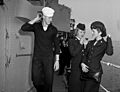
A male sailor and two WAVES on board USS Uhlmann in 1950
