
Zellij facts for kids
Zellij (pronounced "zel-leezh") is a beautiful type of mosaic art. It uses small, hand-cut pieces of tile. These pieces are often different colors. They fit together like a puzzle. This creates amazing patterns. Many patterns are based on Islamic geometric motifs. Think of stars and shapes like polygons.

This art is a key part of Moorish architecture. You can see it in buildings across Morocco, Algeria, and old sites in Tunisia. It's also in historical places in al-Andalus (Spain and Portugal). Since the 1300s, zellij has decorated walls, fountains, and floors. It also appears on tall towers called minarets.
After the 1400s, zellij became less common in many places. But in Morocco, it stayed popular. It is still made there today. You can find it in new buildings, like the Hassan II Mosque in Casablanca. Zellij patterns also inspired Spanish tiles during the Renaissance. Today, some modern tiles are painted to look like zellij.
Contents
The Name Behind the Tiles
The word zillīj (زليج) comes from an Arabic word. It means "to slide." This refers to the smooth, shiny surface of the tiles. The Spanish and Portuguese word azulejo also comes from zillīj. Azulejo describes painted tiles in those countries. In Spain, this mosaic style is also called alicatado. This Spanish word means "to cut" in Arabic.
A Journey Through Time: Zellij's History
Early Beginnings: 10th to 13th Centuries

The idea for mosaic tiles likely came from Byzantine mosaics. Muslim artists then made it their own. They used special faience tiles. Early examples of zellij from the 900s and 1000s were found in Tunisia. This suggests the art started there.
By the 1000s, zellij was very advanced. Beautiful tile floors were found in Qal'at Bani Hammad in Algeria. These palaces, built around 1068 to 1091, had many glazed ceramic decorations. This helped spread the style.
.jpg)
In the 1100s, green and white ceramic patterns appeared. They decorated the minarets of mosques in Marrakesh, Morocco. The Kutubiyya Mosque minaret, from the mid-1100s, shows the earliest zellij in Morocco. The tiles were large. This made the patterns easy to see from far away. They were attached with nails to a wooden frame. The Kasbah Mosque minaret, built later in the 1190s, also used this technique. Today, the tiles on both minarets are new versions of the old designs.
Spreading Across the Region: 14th to 15th Centuries

The more detailed zellij style we know today became popular in the 1300s. It spread across Morocco, Algeria, and al-Andalus. Because these regions shared a lot of culture, their zellij styles were very similar. In Tunisia, however, stone and marble became more popular than zellij.
Zellij tiles were often used for floors. They also covered the lower parts of walls inside buildings. Sometimes, they decorated the outside of minarets and entrance gates. Geometric designs were most common. They became more and more complex over time. Less often, artists used plant or flower patterns.

More colors were used during this time. These included yellow, blue, and dark brown. You can see this style in famous buildings. Examples include the Alhambra palaces in Spain and the madrasas (schools) of Fez. Even some Christian palaces in Spain used zellij. The Alcázar of Seville is a great example.
Some of the best zellij art is in the Alhambra. It features very fine Arabic writing made from tiny tile pieces. These letters are set against a white background. Some tile pieces are as small as 2 millimeters wide!
Craftsmen from Tlemcen (Algeria) developed a unique zellij style. It used bright colors and floral patterns. This style appeared in monuments in Tlemcen. It also showed up in the Marinid madrasa of Chellah. This suggests the same artists worked in different places.
.jpg)
Another technique called sgraffito was used for writing. In this method, square tiles were glazed black. Then, parts of the glaze were carefully scratched away. This left Arabic writing and designs in black against a lighter background. Sometimes, green glaze was used instead of black.
Modern Zellij: 16th Century and Beyond
In the 1500s, many parts of North Africa came under Ottoman rule. In Algeria, local zellij was mostly replaced. People started using small square tiles imported from Europe. In Tunisia, a different tile style called Qallaline tiles became popular. These were painted square panels, not mosaics.

In Spain, new ways of making tiles appeared. As demand for mosaic-like designs grew, artists found faster methods. By the late 1400s and early 1500s, Seville became a center for cuenca tiles. In this method, designs were pressed into unbaked tiles. This created ridges that kept colors from mixing during baking. These tiles copied old Islamic designs. They also mixed them with European styles.
.jpg)
In Morocco, traditional zellij continued to thrive. It is still made there today. In the 1500s and later, zellij was used even more. It covered more and more surfaces. During the rule of Sultan Moulay Isma'il (1672–1727), zellij decorated huge gates in Meknes.
Under the Saadi rulers, geometric patterns became even more complex. This was for grand buildings like the Badi Palace. The Saadian Tombs have some of the best examples. Here, artists used thinner tile pieces. The thin lines forming patterns were colored. The larger background pieces were white. This was a new way of coloring compared to older zellij.

Over time, the sgraffito technique became more common in Morocco. It was a simpler way to decorate than mosaics. These tiles often had simpler designs and fewer colors. For example, the Bab Bou Jeloud gate in Fez, built in 1913, has blue and green sgraffito tiles.
In later centuries, Moroccan artists created huge rosette-style patterns. New colors like red, bright yellow, and dark blue were added. Zellij decorated many parts of buildings. This included fountains, arched doorways, and walls. Even round pillars in houses were covered in tiles.
Today, zellij is a symbol of Moroccan culture. It is still used in modern Moroccan buildings. Fez is the most important city for making zellij. Other cities like Meknes and Marrakesh follow its style. However, Tétouan in northern Morocco has its own unique zellij technique.
How Zellij Tiles are Made
Zellij tiles start as glazed squares. They are usually about 10 cm (4 inches) on each side. Then, skilled artisans cut them by hand. They use a small hammer-like tool. They cut the squares into many different shapes. These shapes are needed to create the overall pattern.
The small, colorful shapes are then put together. They fit like a puzzle to form the mosaic. In Tétouan, tiles are cut into shapes *before* baking. This makes them harder and last longer. But the colors might not be as bright. Also, the pieces might not fit as tightly as those from Fez.
Once cut and baked, the tiles are laid face down on the ground. They are arranged into the planned pattern. The backs of the tile pieces are then covered with plaster. This plaster glues the pieces together into larger panels. These panels are then attached to walls using mortar. In older times, like on the minarets in Marrakesh, tiles were nailed to a wooden frame.
-
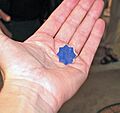
An eight-sided star tile after being cut, a key part of Islamic design
-
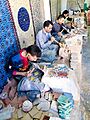
Artisan workers chipping zellij pieces in Fez, Morocco.
-
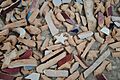
Loose tiles after chiseling the main glazed tile. Fez, Morocco.
-
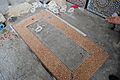
Zellij being assembled for an installation in Fez, Morocco.


Amazing Patterns and Designs

In traditional zellij, geometric patterns are the most common. Plant and flower patterns are also used, but less often. Geometric patterns are made using tessellation. This means covering a surface with shapes that fit perfectly. They don't overlap or leave gaps. These patterns can go on forever.
In Islamic art, these patterns often use regular polygons. This art style avoids showing living things. This is in line with Islamic traditions. Other parts of the Islamic world also had mosaic tiles. But in western zellij, yellow, green, black, and light brown were very common. Blue and turquoise also appeared. They were usually set against a white background.
.jpg)
Artists created many different geometric patterns. A common one used six-pointed and twelve-pointed stars. Eight-pointed stars were placed between them. Patterns based on four-sided symmetry were also popular. Artists made these patterns even more complex. They used larger repeating units and more polygonal shapes.
Patterns with five-sided symmetry were less common. But some amazing examples exist in the al-Attarine Madrasa and Bou Inania madrasas in Fez. Here, artists used large repeating units for more visual interest. They also used different colors to highlight various patterns within the same design.
Other simpler patterns were also used. Some mosaics were just colored squares. One variation used squares separated by white strips. These had eight-pointed stars where the strips crossed. In the Alhambra, some zellij patterns used interlocking ribbons. Another unique design there is the "Nasrid bird." It's a three-pointed star with curved arms.
An article about zellij explains: "An encyclopedia could not contain the full array of complex, often individually varied patterns and the individually shaped, hand-cut tesserae, or furmah, found in zillij work. Star-based patterns are identified by their number of points—'itnashari for 12, 'ishrini for 20, arba' wa 'ishrini for 24 and so on, but they are not necessarily named with exactitude. The so-called khamsini, for 50 points, and mi'ini, for 100, actually consist of 48 and 96 points respectively, because geometry requires that the number of points of any star in this sequence be divisible by six. (There are also sequences based on five and on eight.) Within a single star pattern, variations abound—by the mix of colors, the size of the furmah, and the complexity and size of interspacing elements such as strapping, braids, or "lanterns." And then there are all the non-star patterns— honeycombs, webs, steps and shoulders, and checkerboards."
- Examples of ''zellij'' across periods and styles
-
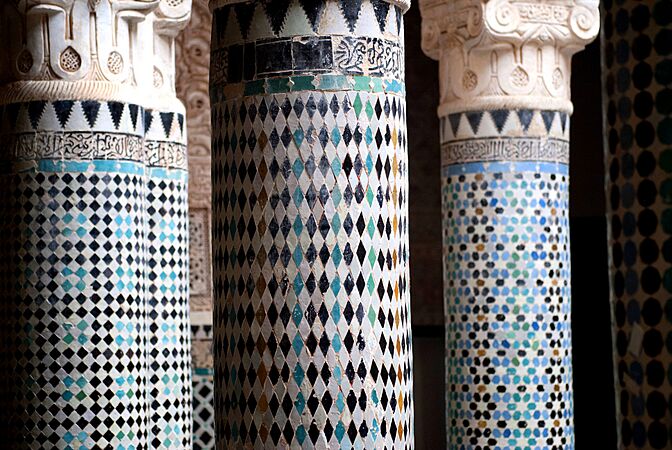
Zellij applied to curved surfaces in the Marinid Madrasa of Salé (14th century)
-
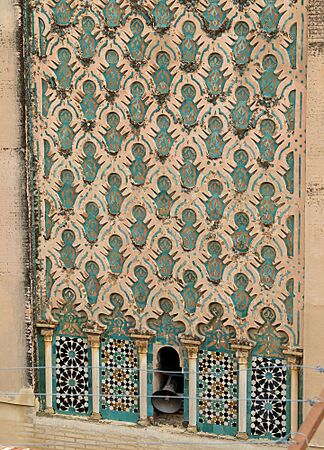
Zellij on the minaret of the Bou Inania Madrasa in Fez (14th century), with mosaic panels below and green sgraffito tiles above
-
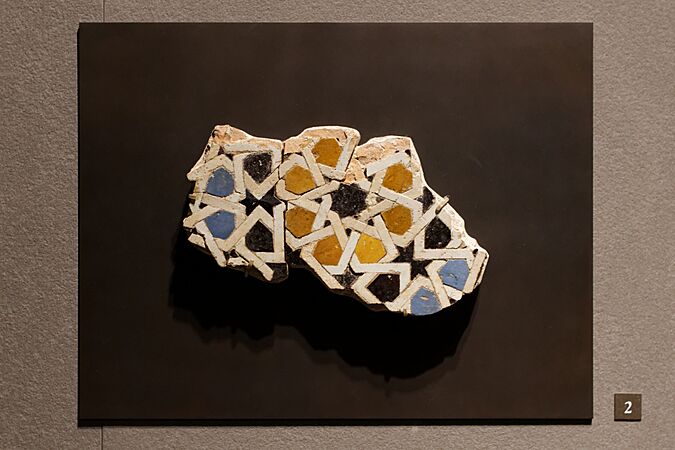
Zellij fragment from Tlemcen, Algeria, from the 14th century
-
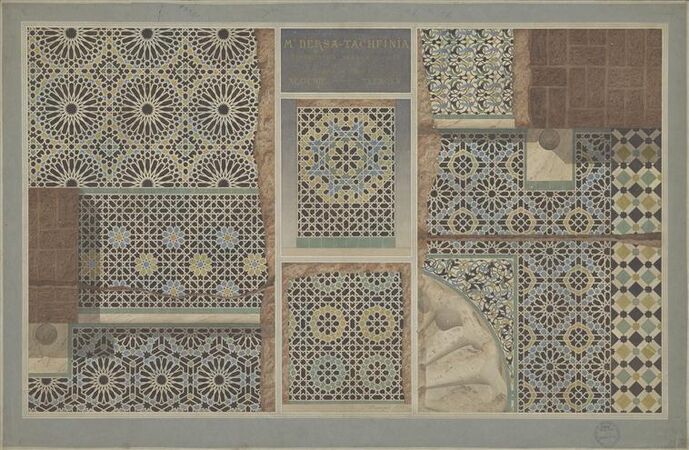
Watercolour drawing recording various zellij patterns in the 14th-century Tashfiniya Madrasa of Tlemcen, prior to its demolition in the 19th century
-
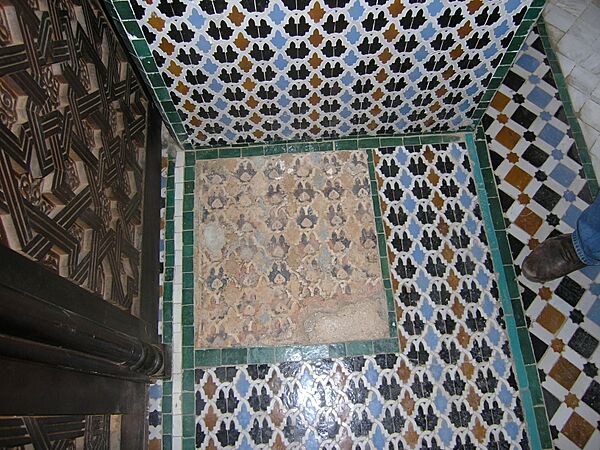
Remains of historical zellij paving (14th century or later), alongside more recent restoration work, in the Mechouar Palace of Tlemcen
-
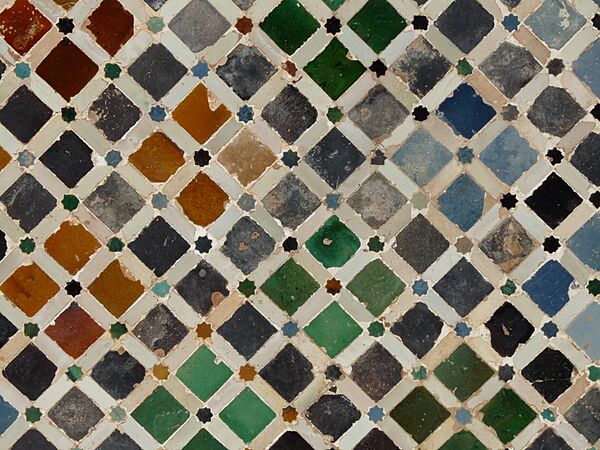
Zellij with checkerboard pattern with eight-pointed stars, in the Court of the Myrtles of the Alhambra
-
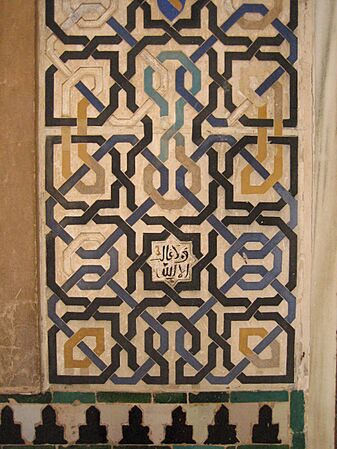
Zellij band with interlacing motif at the entrance of the Comares Palace of the Alhambra (14th century)
-
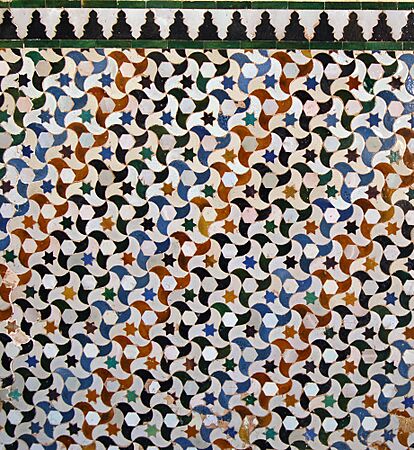
Zellij with so-called "Nasrid bird" motif in the Court of the Myrtles in the Alhambra (14th century)
-
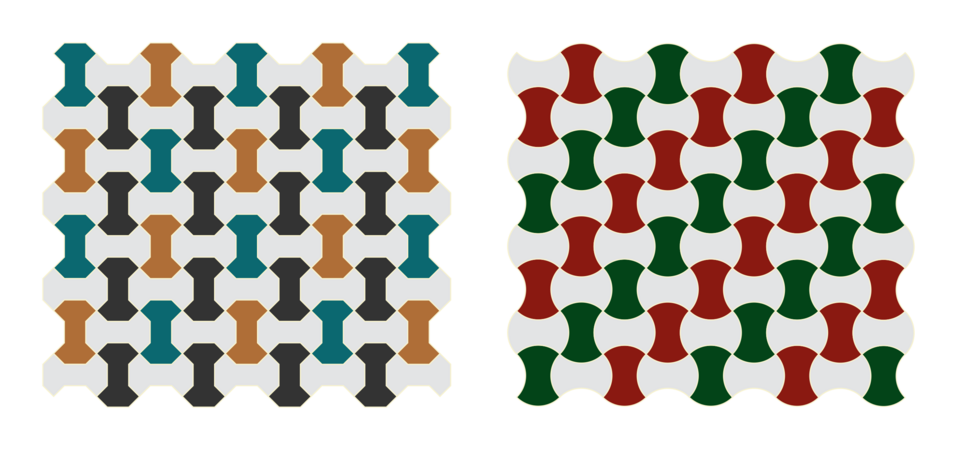
Digital recreation of the "bone" motif, including the straight-lined (left) and curvilinear (right) variants
-
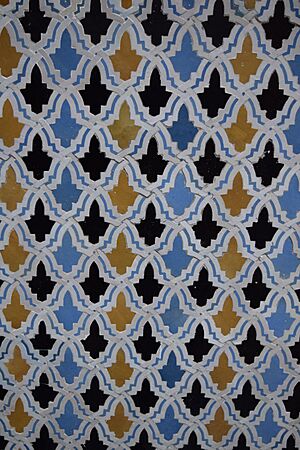
Zellij with darj-wa-ktaf motif in the al-Attarine Madrasa in Fez (14th century)
-
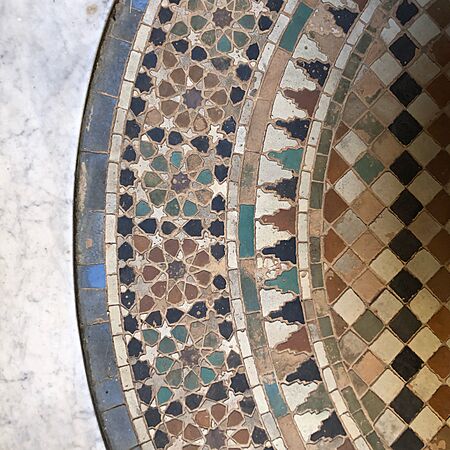
Zellij paving around the fountain of the al-Attarine Madrasa in Fez
-
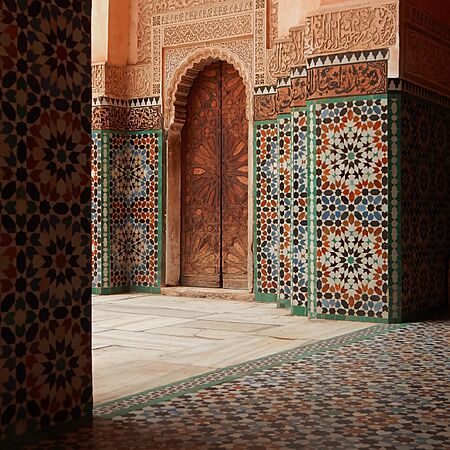
Ben Youssef Madrasa in Marrakesh (16th century)
-
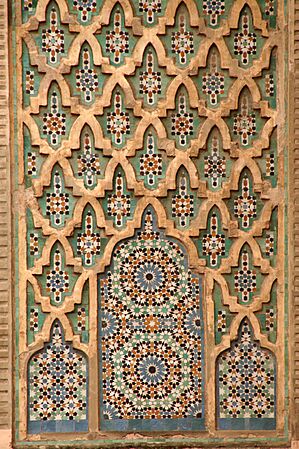
Detail of Bab al-Mansour in Meknes (early 18th century)
-
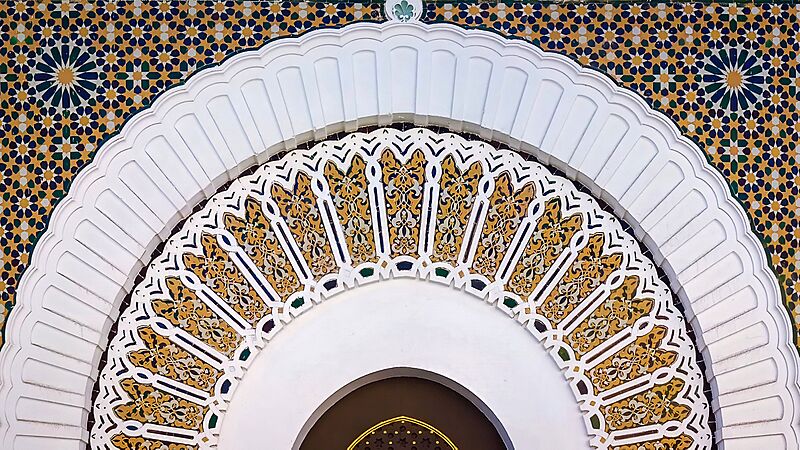
Zellij on the entrance portal of the Madrasa of Tlemcen (19th century)
-
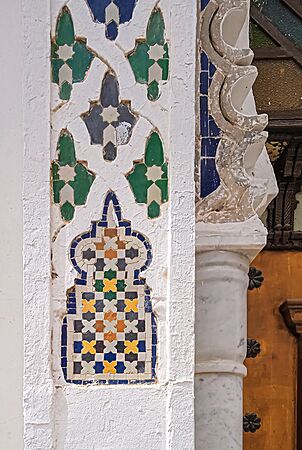
Zellij on the main entrance portal of the Dar al-Hadith, Tlemcen (20th century)
-
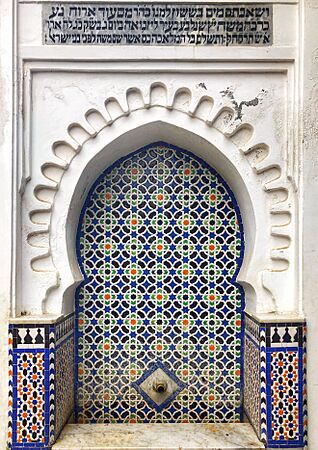
Example of zellij in Tétouan (on a fountain in the Mellah)
-
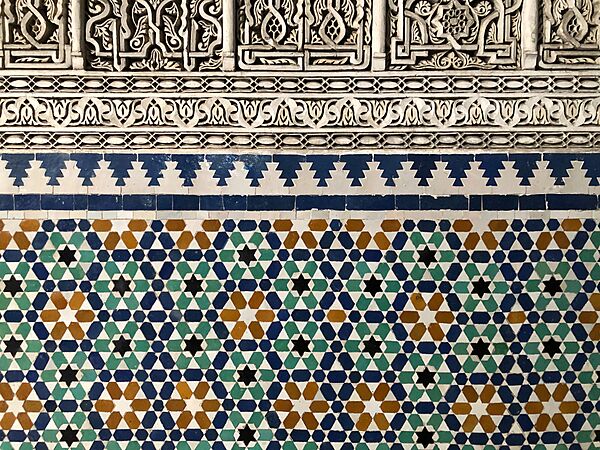
20th-century zellij in the Mahkamat al-Pasha in Casablanca, Morocco
-
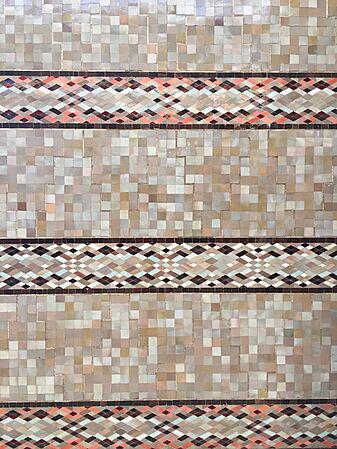
Edmond Brion's reinterpreted zellij at Bank Al-Maghrib in Casablanca


.JPG)

.jpg)
.jpg)
.jpg)

.jpg)


Islamic art had a big impact on Western art. Venetian merchants brought many goods to Italy from the 1300s. The zellij patterns in the Alhambra also inspired artist M. C. Escher. Today, mathematicians and artists study these mosaic patterns. They use computer science to understand them better.
The Art of Zellij Craftsmanship
Making zellīj is a true art form. This skill is passed down through generations. Master craftsmen, called ma'alems, teach younger students. Training usually starts when children are young. In Fez, apprentices begin learning between ages 6 and 14. It takes about ten years to learn the basics. Many more years are needed to become a master.
Today, young people learn zellīj making at artisan schools in Morocco. This helps keep the ancient craft alive.
See also
- Girih tiles
- Islamic architecture
- Qashani
- Tadelakt
