
Great Seal of the United States facts for kids
.svg)
.svg)
The Great Seal of the United States is the official symbol of the United States of America. It's used to make important documents official. The phrase "Great Seal" can mean the actual tool that makes the impression, which the Secretary of State keeps. It also refers to the design itself.
The front side of the Great Seal shows the national coat of arms of the United States, featuring an eagle. The back side has a pyramid with an Eye of Providence at the top. The year 1776, when the U.S. Declaration of Independence was signed, is written in Roman numerals at the pyramid's base. The seal includes three Latin phrases: E Pluribus Unum ("Out of many, one"), Annuit cœptis ("He has favored our undertakings"), and Novus ordo seclorum ("A new order of the ages").
Charles Thomson, who was the secretary of the Continental Congress, and William Barton largely designed the seal. It was first used in 1782. The seal helps make sure that certain documents from the federal government of the United States are real and official. Since 1935, you can see both sides of the Great Seal on the back of the one-dollar bill. The eagle side is also on official papers like United States passports, military badges, and flags. The President's seal uses many of the same ideas from the Great Seal.
The official designs used today by the Department of State are very similar to those from 1885. The current design for the back side was created in 1972.
Contents
What the Front Side Shows
Quick facts for kids Coat of arms of the United States |
|
|---|---|
 |
|
| Versions | |

Achievement
|
|
.svg)
Monochrome (hatched) reproduction
|
|
.svg)
Monochrome (hatched) reproduction of the achievement
|
|
| Armiger | United States of America |
| Adopted | 1782 |
| Crest | A glory Or, breaking through a cloud proper, surrounding an azure field bearing a constellation of thirteen stars argent |
| Blazon | officially: Paleways of 13 pieces, argent and gules; a chief, azure heraldically: Argent, 6 pales gules, a chief azure |
| Supporter | A bald eagle proper displayed, bearing in its dexter talon an olive branch, in its sinister talon thirteen arrows, and in its beak a scroll bearing the motto |
| Motto | E pluribus unum (Latin for 'Out of many, one') |
| Use | On treaties, commissions, letterheads, license plates, embassies, agency seals and passports |
The front side, also called the obverse, shows the complete design of the national coat of arms.


The Eagle and Its Symbols


The main part of the front side is a bald eagle with its wings spread wide. This eagle is a symbol of the United States. In its right claw, the eagle holds an olive branch, which stands for peace. In its left claw, it holds 13 arrows, which represent the country's readiness to defend itself. The olive branch usually has 13 leaves and 13 olives.
In its beak, the eagle holds a scroll with the motto E pluribus unum. This Latin phrase means "Out of Many, One." Above the eagle's head, there is a bright cloud with 13 stars on a blue background. These stars form a larger star shape.
The shield on the eagle's chest looks like the U.S. flag. It has 13 vertical stripes, alternating white and red. The top part of the shield is blue. The white stripes are on the outside to follow old rules of design.
Colors and Their Meanings
The number 13 appears many times on the seal. It reminds us of the 13 original states that formed the United States. The arrows and olive branch together show that the U.S. wants peace but is also ready for war. The motto E Pluribus Unum also has 13 letters. The eagle's head is turned towards the olive branch, showing a preference for peace.
Charles Thomson, one of the seal's designers, explained the symbols. He said the shield's stripes represent the states joining together. The blue top part represents the Congress uniting them. The motto refers to this union.
Thomson also explained the colors:
- White means purity and innocence.
- Red means strength and bravery.
- Blue (the color of the top part of the shield) means watchfulness, determination, and fairness.
The olive branch and arrows show that only Congress has the power to decide on peace or war. The stars above the eagle represent a new nation taking its place among other countries. The eagle standing alone shows that the United States should rely on its own strength.
How the Seal is Used
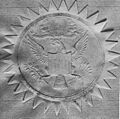
The colors of the coat of arms are either shown directly or by using special lines and patterns. These patterns are used when the seal is pressed onto paper.
The Official Seal Press
In the Department of State, the "Great Seal" is a special machine. It uses a metal die (a carved stamp) to press the seal onto official government documents. This machine includes the die, a counter-die, a press, and a cabinet. Several presses have been used since 1782, but the older ones are no longer around. The seal and its press were saved when Washington, D.C. was burned in 1814.
The press used today was made in 1903. Its cabinet is made of mahogany wood. Since 1955, the seal has been on public display in a glass case at the Department of State's main building. The case is always locked, even when the seal is being used.
Only an officer from the Department of State can use the seal, under the Secretary of State's permission. To seal a document, a blank paper wafer is glued onto it. The document is then placed between the die and counter-die. The press is pulled, stamping the seal onto the wafer. The seal is used about 2,000 to 3,000 times each year.
Important documents that need the seal include international agreements, appointments of ambassadors, and messages from the President to foreign leaders.
-
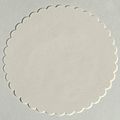
A seal wafer
-
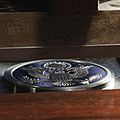
The wafer is positioned over the counterdie.
-
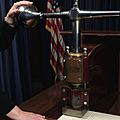
The seal is pressed down on the wafer.
-
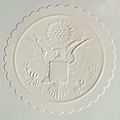
The imprinted seal


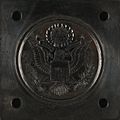
The metal die for the front side of the Great Seal creates the raised design on documents. These dies wear out over time and need to be replaced. The current die is the seventh one made, and the design has changed slightly over the years.
Changes Over Time
The design of the Great Seal has evolved since it was first created.
- The first die was made in 1782. It showed a somewhat simple eagle and was used for many years.
- In 1825, a larger seal was made for important international agreements, like treaties.
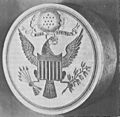
- A new die in 1841 accidentally showed only six arrows instead of the required thirteen.
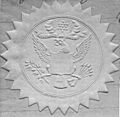
- Another die in 1877 copied this error.
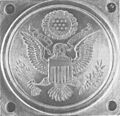
- In 1885, Tiffany & Co. created a new, much more formal design. This version corrected the arrow count and established the look we mostly see today. It made the eagle look stronger and more detailed.
- The 1904 die further refined the 1885 design, making the impressions sharper and fixing small design details.
- All dies made since then have followed this 1904 design. The current die is the seventh, created in 1986.
What the Back Side Shows
The 1782 resolution that created the seal describes the back side. It shows "A pyramid unfinished. In the zenith an eye in a triangle, surrounded by a glory, proper." The pyramid usually has 13 steps, representing the thirteen original states. At its base, the date MDCCLXXVI (1776) is written in Roman numerals.
The Pyramid and Eye
Where the top of the pyramid should be, the Eye of Providence watches over it. This eye is a symbol of God's watchful care. Two mottos appear on this side: Annuit cœptis means that Providence (God) has "approved of (our) undertakings." Novus ordo seclorum, taken from Virgil, means "a new order of the ages."
The back side of the seal has never been made into a physical stamp. However, you can see it on the back of the one-dollar bill.
Charles Thomson also explained the symbols on the back of the seal. He wrote that the pyramid means strength and how long the country will last. The Eye above it and the motto refer to how God helped the American cause many times. The date underneath is when the Declaration of Independence was signed. The words below it mean the start of a new American era from that date.
Clearing Up Misconceptions

Some people have suggested that the Great Seal shows a secret influence from Freemasonry when the United States was founded. These ideas often claim that the Eye of Providence is a Masonic symbol and that Freemasons created the Great Seal. However, these claims are not supported by facts.
While the Eye of Providence is a common Masonic symbol today, it was not widely used by Masons in the 1770s and 1780s. The Eye became a common Masonic symbol later, around 1797. Before that, the Eye of Providence was a well-known Christian symbol throughout history. It was used in churches in Europe and America during the 18th century. It represents the Holy Trinity (the triangle) and God's omniscience (the eye) surrounded by rays of light, showing God's power.
Also, most of the Great Seal's designers were not Freemasons. Benjamin Franklin was a Mason, but his ideas for the seal were not chosen. Of the four main people whose ideas were used, Charles Thomson, Pierre du Simitière, and William Barton were not Masons. There is no strong evidence that Francis Hopkinson had Masonic connections either.
How the Great Seal Was Created
On July 4, 1776, the same day the thirteen colonies declared independence from Great Britain, the Continental Congress formed a committee. Their job was to design a Great Seal, or national emblem, for the new country. Like other nations, the United States needed an official symbol to make international agreements and documents official. It took six years, three committees, and many ideas before Congress finally accepted a design in 1782.
Early Ideas and Committees


The first committee included Benjamin Franklin, Thomas Jefferson, and John Adams. They asked Pierre Eugene du Simitiere, an artist, for help. Each of these men suggested a design. Franklin suggested a scene from the Bible, with Moses parting the Red Sea. Jefferson suggested the Children of Israel in the wilderness. Adams chose a painting about Hercules choosing between easy and hard paths.


Du Simitière's design was more like a traditional coat of arms. It had a shield with symbols for different countries and the initials of the thirteen states. It also included the Eye of Providence and the motto E Pluribus Unum. The committee chose parts of du Simitière's design, but Congress did not approve it. However, the motto E Pluribus Unum and the Eye of Providence were later used in the final seal.

The motto E Pluribus Unum likely came from The Gentleman's Magazine, a popular magazine in the colonies. This magazine used the motto to show it was a collection of articles from many sources.


After three and a half years, a second committee was formed in 1780. They asked Francis Hopkinson, who designed the American flag, for help. Hopkinson made designs with themes of war and peace. His ideas included a shield with thirteen red and white stripes, a constellation of thirteen stars, an olive branch, and arrows. Congress did not approve this design either, but many of its elements were used later.


In 1782, a third committee was formed. They worked with William Barton, who quickly drew a complex design. He later suggested a pyramid with the Eye of Providence and mottos Deo Favente ("With God favoring") and Perennis (Everlasting). This design was also not approved by Congress.
The Final Design Comes Together
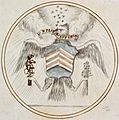
On June 13, 1782, Congress gave all the ideas from the previous committees to its secretary, Charles Thomson. Thomson, who was 53 and a Latin expert, combined elements from all three committees to create the final design.
Thomson used the bald eagle as the main symbol on the front. The shield had thirteen vertical stripes. The eagle held an olive branch and thirteen arrows. For the top, he used Hopkinson's constellation of thirteen stars. The motto E Pluribus Unum was on a scroll in the eagle's beak.
For the back, Thomson kept Barton's pyramid design. He added the triangle around the Eye of Providence and changed the mottos to Annuit Cœptis and Novus Ordo Seclorum. Thomson sent his designs back to Barton, who made a few final changes, like the vertical stripes on the shield and the eagle's wing position.
The final design was presented to Congress on June 20, 1782, and accepted the same day. Thomson included notes explaining the symbols. This design is still the official definition of the Great Seal today.

The first metal die was made between June and September 1782. It was first used on September 16, 1782, to approve a document for George Washington to negotiate prisoner exchanges.
Charles Thomson was in charge of the seal until 1789. Then, President Washington gave the seal to the Department of Foreign Affairs, which later became the Department of State. Since then, all Secretaries of State have been responsible for using the seal on important diplomatic documents.
Here's a summary of who contributed what to the final design:
- First committee
- E Pluribus Unum
- Eye of Providence in a triangle
- 1776 in Roman numerals
- Second committee
- Thirteen red and white stripes and blue top on shield
- Constellation of 13 stars, surrounded by clouds and glory
- War and peace theme, including olive branch and arrows
- Third committee
- Eagle (though not a bald eagle)
- Unfinished pyramid
- Overall design of the reverse
- Charles Thomson
- Overall design of the front side
- Bald eagle
- Annuit Cœptis
- Novus Ordo Seclorum
- William Barton
- Vertical stripes on shield
- Position of eagle's wings
Notable Depictions

The Great Seal quickly became a popular symbol for the country. It inspired the flag of North Dakota and the flag of the U.S. Virgin Islands. Over the years, many different artistic versions of the seal appeared. However, the detailed 1885 design helped standardize how the seal looks.
The Great Seal symbol is also used by former presidents after they leave office. For example, in February 2021, the seal was part of the logos for the offices of Barack and Michelle Obama, and George W. Bush.
Images for kids
-
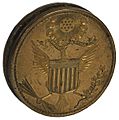
The first die from 1782
-
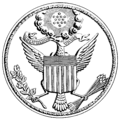
Drawing of the 1782 die design
-

Coloring of the 1782 die design
-
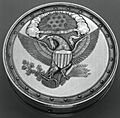
A skippet (metal box) for a treaty seal, 1825
-
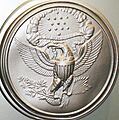
Impression from the 1825 treaty seal
-
The 1841 die
-
Impression from the 1841 die
-
Impression from the 1877 die
-
The 1885 die
-

Lithograph of the 1885 design
-
The 1904 die
-

1904 die design impression
-
Thomson's drawing, the basis for the final seal
-

Great Seal by Thomson


.svg)


See also
 In Spanish: Gran sello de los Estados Unidos para niños
- Great Seal
- "National Emblem March", by E. E. Bagley
- Seal of the Confederate States
- Seal of the president of the United States
- Seal of the United States Senate
- Great Seal bug ("The Thing")
- Seal of the president of the Continental Congress
