
Kumamoto facts for kids
Quick facts for kids
Kumamoto
熊本市
|
|||||||||||||
|---|---|---|---|---|---|---|---|---|---|---|---|---|---|
|
Prefecture capital and Designated city
|
|||||||||||||
| Kumamoto City | |||||||||||||
|
Skyline view of Kumamoto City from Kumamoto Castle
Kumamoto Castle
Kumamoto Shintoshin Plaza
Fujisaki Hachimangū
Shimotori-Shintengai of Kumamoto City
Suizenji Park
Kumamoto Sakuramachi Bus Terminal
|
|||||||||||||
|
|||||||||||||
| Nickname(s):
The Heart of Kyushu
|
|||||||||||||

Location of Kumamoto in Kumamoto Prefecture
|
|||||||||||||

 Kumamoto
Location in Japan
|
|||||||||||||
| Country | Japan | ||||||||||||
| Region | Kyushu | ||||||||||||
| Prefecture | Kumamoto Prefecture | ||||||||||||
| First official recorded | 558 AD | ||||||||||||
| City Settled | April 1, 1889 | ||||||||||||
| Area | |||||||||||||
| • Total | 390.32 km2 (150.70 sq mi) | ||||||||||||
| Population
(January 1, 2025)
|
|||||||||||||
| • Total | 737,543 | ||||||||||||
| • Density | 1,889.585/km2 (4,894.00/sq mi) | ||||||||||||
| Time zone | UTC+09:00 (JST) | ||||||||||||
| Climate | Cfa | ||||||||||||
|
|||||||||||||
_1.jpg)


.jpg)


Kumamoto is a vibrant city in Japan. It is the capital of Kumamoto Prefecture. You can find it on the island of Kyushu. As of early 2025, about 737,543 people call Kumamoto home. The city covers an area of 390.32 square kilometers. Kumamoto is often called "The Heart of Kyushu." It is a special city, officially recognized by the government since April 1, 2012.
Contents
A Look at Kumamoto's Past
Kumamoto has a long and interesting history. Many important events shaped it into the city it is today.
Building Kumamoto Castle
Around 1588, a powerful leader named Katō Kiyomasa became the ruler of part of the Higo region. He decided to build Kumamoto Castle. This castle was very strong and had many clever defenses. People thought it was impossible to conquer. Kiyomasa became famous as one of Japan's best castle builders.
The Edo Period and Famous Figures
After Kiyomasa passed away in 1611, the Hosokawa clan took over. Hosokawa Tadatoshi was a lord of Kumamoto. He was a supporter of the famous artist and swordsman Miyamoto Musashi. Musashi spent his final years living in Kumamoto.
-
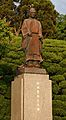
Statue of Hosokawa Tadatoshi within Suizen-ji Jōju-en
-

Emblem of Miyamoto Musashi


Modern Times Begin
The modern city government of Kumamoto started on April 1, 1889. This was during the Meiji period in Japan.
Kumamoto After World War II
Near the end of World War II, in July 1945, Kumamoto was bombed. A large part of the city was damaged. After the war, a Japanese Buddhist monk named Nichidatsu Fujii wanted to promote peace. He built a Peace Pagoda on Mount Hanaoka in 1954. This was the first of many such pagodas built worldwide. They remind people of those lost in wars and encourage peace.
Recent Events: Mergers and Earthquakes
Over the years, several smaller towns joined Kumamoto. This helped the city grow larger. For example, towns like Akita and Kawachi merged with Kumamoto in 1991. More towns like Jōnan and Ueki joined in 2010.
Kumamoto has also experienced natural events. A series of earthquakes struck the area in April 2016. Another significant earthquake, the 2026 Kumamoto earthquake, also affected the region. The city has worked hard to recover and rebuild after these events.
Exploring Kumamoto's Geography
Kumamoto is located in a beautiful part of Japan. It has interesting natural features.
Kumamoto's Climate
Kumamoto has a humid subtropical climate. This means it has hot, humid summers and cool winters. There is a lot of rain throughout the year, especially in June and July. The average yearly temperature is about 17.2 degrees Celsius. August is usually the warmest month, and January is the coldest.
| Climate data for Kumamoto (1991−2020 normals, extremes 1890−present) | |||||||||||||
|---|---|---|---|---|---|---|---|---|---|---|---|---|---|
| Month | Jan | Feb | Mar | Apr | May | Jun | Jul | Aug | Sep | Oct | Nov | Dec | Year |
| Record high °C (°F) | 22.5 (72.5) |
26.4 (79.5) |
27.4 (81.3) |
30.7 (87.3) |
34.4 (93.9) |
36.1 (97.0) |
38.8 (101.8) |
38.8 (101.8) |
37.0 (98.6) |
33.7 (92.7) |
28.9 (84.0) |
24.6 (76.3) |
38.8 (101.8) |
| Mean daily maximum °C (°F) | 10.7 (51.3) |
12.4 (54.3) |
16.1 (61.0) |
21.4 (70.5) |
26.0 (78.8) |
28.1 (82.6) |
31.8 (89.2) |
33.3 (91.9) |
30.1 (86.2) |
25.0 (77.0) |
18.8 (65.8) |
12.9 (55.2) |
22.2 (72.0) |
| Daily mean °C (°F) | 6.0 (42.8) |
7.4 (45.3) |
10.9 (51.6) |
15.8 (60.4) |
20.5 (68.9) |
23.7 (74.7) |
27.5 (81.5) |
28.4 (83.1) |
25.2 (77.4) |
19.6 (67.3) |
13.5 (56.3) |
8.0 (46.4) |
17.2 (63.0) |
| Mean daily minimum °C (°F) | 1.6 (34.9) |
2.6 (36.7) |
5.9 (42.6) |
10.6 (51.1) |
15.6 (60.1) |
20.2 (68.4) |
24.2 (75.6) |
24.8 (76.6) |
21.2 (70.2) |
14.9 (58.8) |
8.8 (47.8) |
3.4 (38.1) |
12.8 (55.0) |
| Record low °C (°F) | −9.2 (15.4) |
−9.2 (15.4) |
−6.9 (19.6) |
−2.5 (27.5) |
1.3 (34.3) |
7.1 (44.8) |
14.3 (57.7) |
15.3 (59.5) |
6.7 (44.1) |
0.5 (32.9) |
−3.8 (25.2) |
−7.9 (17.8) |
−9.2 (15.4) |
| Average precipitation mm (inches) | 57.2 (2.25) |
83.2 (3.28) |
124.8 (4.91) |
144.9 (5.70) |
160.9 (6.33) |
448.5 (17.66) |
386.8 (15.23) |
195.4 (7.69) |
172.6 (6.80) |
87.1 (3.43) |
84.4 (3.32) |
61.2 (2.41) |
2,007 (79.02) |
| Average snowfall cm (inches) | 1 (0.4) |
0 (0) |
0 (0) |
0 (0) |
0 (0) |
0 (0) |
0 (0) |
0 (0) |
0 (0) |
0 (0) |
0 (0) |
0 (0) |
1 (0.4) |
| Average precipitation days (≥ 0.5 mm) | 8.1 | 9.0 | 11.4 | 10.7 | 10.4 | 15.2 | 13.3 | 11.3 | 10.4 | 7.2 | 8.3 | 8.3 | 123.5 |
| Average relative humidity (%) | 70 | 67 | 66 | 65 | 67 | 76 | 76 | 72 | 71 | 69 | 72 | 71 | 70 |
| Mean monthly sunshine hours | 133.0 | 141.1 | 169.6 | 184.0 | 194.3 | 130.8 | 176.7 | 206.0 | 176.4 | 187.1 | 153.7 | 143.4 | 1,996.1 |
| Source: Japan Meteorological Agency | |||||||||||||

How Kumamoto is Divided
Since April 1, 2012, Kumamoto has been divided into five main areas called wards (ku). Each ward helps manage different parts of the city.
| Wards of Kumamoto | ||||
|---|---|---|---|---|
| Place Name | Map of Kumamoto | |||
| Rōmaji | Kanji | Color | ||
| 1 | Kita-ku | 北区 | Blue |
|
| 2 | Nishi-ku | 西区 | Yellow | |
| 3 | Chuo-ku | 中央区 (administrative center) |
Purple | |
| 4 | Higashi-ku | 東区 | Red | |
| 5 | Minami-ku | 南区 | Green | |

Neighboring Towns and Cities
Kumamoto is surrounded by several other towns and cities. These include:
- Gyokuto
- Kashima
- Kikuchi
- Kikuyō
- Kōsa
- Kōshi
- Mashiki
- Mifune
- Tamana
- Uki
- Uto
- Yamaga
Kumamoto's Population Story

The number of people living in Kumamoto has grown over many years. In 2020, the population was 738,865 people. The city has been keeping track of its population since 1920.
| Historical population | ||||||||||||||||||||||||||||||||||||||||||||||||||||||||||||||||||||||
|---|---|---|---|---|---|---|---|---|---|---|---|---|---|---|---|---|---|---|---|---|---|---|---|---|---|---|---|---|---|---|---|---|---|---|---|---|---|---|---|---|---|---|---|---|---|---|---|---|---|---|---|---|---|---|---|---|---|---|---|---|---|---|---|---|---|---|---|---|---|---|
|
|
|||||||||||||||||||||||||||||||||||||||||||||||||||||||||||||||||||||
| Kumamoto population statistics | ||||||||||||||||||||||||||||||||||||||||||||||||||||||||||||||||||||||
How Kumamoto is Governed
The city of Kumamoto is led by its mayor. Kazufumi Ōnishi has been the mayor since December 2014. He helps make important decisions for the city.
Getting Around Kumamoto
Kumamoto has many ways to travel, both within the city and to other places.
Flying In and Out

The main airport for the city is Kumamoto Airport. It is located in a nearby town called Mashiki.
Train Travel

Japan's famous high-speed bullet train, the Kyushu Shinkansen, connects Kumamoto to other major cities. This includes a direct link to Tokyo via Fukuoka's Hakata station. This high-speed network was completed on March 12, 2011.
The Kumamoto station is also a hub for regular trains. These trains connect to many parts of Japan.
- Kagoshima Main Line: Connects various stations including Kumamoto.
- Hōhi Main Line: Also serves Kumamoto and other local stops.
- Kumamoto Electric Railway
- Kikuchi Line: Runs from Kami-Kumamoto to Horikawa.
- Fujisaki Line: Connects Kita-Kumamoto to Fujisakigū-mae.
Trams and Buses


Trams are a fun way to travel in some parts of downtown Kumamoto. The Kumamoto City Transportation Bureau manages local public transport.

A large bus station, called the Kotsu Centre, helps people travel. You can catch buses to places within the city or to other cities.
Roads and Highways

Major roads and highways connect Kumamoto to the rest of Japan.
 Kyushu Expressway
 Japan National Route 3
 Japan National Route 57
- And many other national routes.


Sea Travel

Kumamoto also has a seaport. You can take ferries from the Port of Kumamoto to nearby islands like Shimabara. There are even international ferry routes, like to Busan in South Korea.
Learning in Kumamoto
Kumamoto is home to several universities. These institutions offer many learning opportunities for students.
- Kumamoto Gakuen University
- Kumamoto University
- Kyūshū Lutheran College
- Prefectural University of Kumamoto
- Shokei College
- Shokei Gakuin University
- Sojo University
- Tokai University
Famous Places to Visit
Kumamoto has many interesting landmarks and beautiful spots.
The Mighty Kumamoto Castle

The most famous landmark is Kumamoto Castle. It is a large and historic Japanese castle. The main tower was rebuilt in the 1970s. However, many original wooden buildings still stand. Inside the castle grounds, you can find the Hosokawa Gyobu-tei. This was once the home of a powerful lord and has a lovely Japanese garden.
A local food called basashi (raw horse meat) is popular in Kumamoto. It became a tradition after a long siege at the castle. Today, it is considered a special treat.
Places of Peace and Worship
The first peace pagoda in the world was built in Kumamoto. It stands on Mount Hanaoka. This pagoda was built to remember those lost in wars and to promote peace. Kumamoto also has important shrines like Takahashi Inari Shrine and Fujisaki Hachimangū.
Suizenji Garden and Park

Suizen-ji Jōju-en is a beautiful traditional garden. It is near Suizenji Temple, not far from Kumamoto Castle. Suizenji Park also has a stadium. The city's football team, Roasso Kumamoto, used to play there. Now they use a larger stadium.
Other Interesting Spots
The famous swordsman Miyamoto Musashi spent his last years in Kumamoto. You can visit his tomb and the cave where he lived. This cave is called Reigandō, or "spirit rock cave." He wrote his famous book, The Book of Five Rings, while living there.
Downtown Kumamoto has busy shopping areas. The Shimotori and Kamitori arcades are full of shops, restaurants, and cafes. Many local festivals happen in these lively areas. For art and performances, you can visit the Kumamoto Prefectural Museum of Art and the Kumamoto Prefectural Theater.
Kumamoto's Culture and Sports
Kumamoto is a city that loves sports and has a rich culture.
Local Sports Teams
Kumamoto has several professional sports teams:
- The Hinokuni Salamanders play in the Kyusyu Asia League.
- Roasso Kumamoto is the local football club, playing in the J.League.
- The Kumamoto Volters are the city's basketball team in the B.League.
- Forest Leaves Kumamoto plays in the V.League (V2).
-
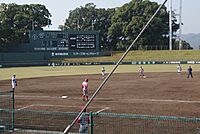
Kumamoto Fujisakidai Baseball Stadium
-
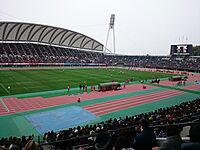
Egao Kenko Stadium
-
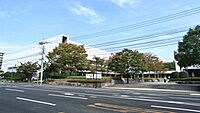
Kumamoto Prefectural Gymnasium
-
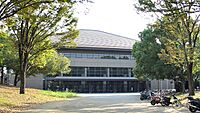
Kumamoto City Synthesis Gymnasium


Exciting Sports Events
The Kumamoto Castle Marathon is a yearly running event. It started in 2012 to celebrate Kumamoto becoming a special designated city. The city has also hosted big international events. These include the 1997 World Men's Handball Championship and the 2019 World Women's Handball Championship.
Friends Around the World
Kumamoto has special partnerships with cities in other countries. These are called sister cities.
 Billings, Montana, United States
 Bristol, England, United Kingdom
 Guilin, Guangxi, People's Republic of China
 Heidelberg, Baden-Württemberg, Germany, since 1992
- Helena, Montana, United States
- Rome, Georgia, United States, since 1995
- San Antonio, Texas, United States, since 1987
 Ulsan, South Korea, since 2010
 Kaohsiung, Taiwan, since 2017
Famous People from Kumamoto
Many talented people have come from Kumamoto or lived there.
- Aimer, a pop singer and lyricist.
- Yuki Fukushima, a Japanese badminton player.
- Lafcadio Hearn, a writer who lived in Kumamoto for three years.
- Sayaka Hirota, a Japanese badminton player.
- Sayuri Ishikawa, a famous enka singer.
- Masahiko Kimura, a judoka (judo expert).
- Kobato Miku, a musician and creator of the band BAND-MAID.
- Rie Kugimiya, a voice actress.
- Miyamoto Musashi, the legendary swordsman, lived and died here.
- Eiichiro Oda, the manga artist who created One Piece.
- Soseki Natsume, a writer who lived in Kumamoto.
- Sean Michael Wilson, a Scottish manga writer living in Kumamoto.
See also
 In Spanish: Kumamoto para niños
