
Massachusett writing systems facts for kids
Massachusett is an Algonquian language that was once spoken by several Native American groups in New England. These groups included the Massachusett people near Boston, Massachusetts, the Wampanoag on Cape Cod, the Nauset, Coweset, and Pawtucket tribes. It was also used as a common second language by many other people across New England.
A missionary named John Eliot learned the language in the 1600s. He used the Latin alphabet to write it down. Eliot translated parts of the Bible into Massachusett, making it the first Bible printed in any language in the Americas. Many Native Americans learned to read these books. Sadly, as Native Americans lost their lands and faced pressure to change their ways, the language slowly faded. The last speakers passed away in the late 1800s.
But the story didn't end there! In 1993, Jessie Little Doe Baird helped start the Wôpanâak Language Reclamation Project. Their goal is to bring the Massachusett language back to her people. Jessie studied how languages work at MIT. She created a new, easier way to write the language. This new system makes it simple to match sounds to spellings.
Contents
How People Communicated Before Writing
Before missionaries introduced writing, the Massachusett-speaking people shared their culture and history through spoken words. Elders passed down songs, stories, and traditions to younger generations. When people from different tribes met, they sometimes used a simpler version of Massachusett. If spoken language didn't work, they used sign language. We don't know much about the sign language used by Eastern Woodlands tribes, but it was important. Even American Sign Language might have been influenced by the sign language of the Wampanoag people on Martha's Vineyard.
Symbols Carved in Trees and Rocks
Native Americans also used symbols to communicate. They carved dendroglyphs, which are symbols carved into trees and logs. These carvings could mark tribal boundaries or thank spirits after a successful hunt. They also recorded where people had been. For example, the Abenaki people in northern New England carved symbols on trees to mark paths or show their trapping areas.

People also carved pictures into rocks, called pictographs. The most famous example is Dighton Rock in the Taunton River. These rock carvings date back thousands of years. They show hands, the sun, the moon, people, animals, and symbols that look like letters. Some carvings made after Europeans arrived even show ships. Many of these carvings are near water, suggesting they were sacred places or marked important agreements.
Even after English settlers arrived, Native Americans continued to mark rocks and trees. One large boulder in Massachusetts has carvings from 3,000 years ago, showing homes (called wetus) and later, ships. A Wampanoag family lived there until the early 1900s. As late as the 1920s, Nipmuc women made traditional baskets with woven or painted symbols. These symbols represented the landscape, like homes (domes) and people (dots).
Writing the Massachusett Language
When John Eliot first wrote down Massachusett around 1650, he used the English way of spelling words. This became known as the colonial writing system.
Old Colonial Writing System

In the colonial system, vowels sometimes had special marks above them, like an acute accent (´) or a circumflex (ˆ). These marks could show stress or a different sound. For example, the mark over an 'o' (ô) often meant a nasal sound, like saying 'on' through your nose. However, these marks were not always used consistently.
The colonial system also kept some old English spelling rules that are not used today. For instance, the letter 's' sometimes looked like a long 'ſ'. Also, the letter 'j' was often used for sounds like 'ch' or 'ty'.
New Modern Writing System
The modern writing system was created by Jessie Little Doe Baird in 2000. It is used by the Wôpanâak Language Reclamation Project. This new system is much simpler and more consistent. Each sound has only one way to be spelled.
One big change is using the number '8' instead of the old 'ꝏ' symbol for a specific 'oo' sound. This makes it easier to type and print. The modern system also uses 'â' and 'ô' as their own letters, each representing a specific sound.
The new alphabet doesn't use letters like 'F', 'L', 'V', and 'R' for native words. These letters were only used in the past for words borrowed from English. It also doesn't use 'B', 'C', 'D', 'G', 'J', and 'Z' for native words. However, these letters are still used for proper names and some English words, since everyone learning the language today also speaks English.
The modern system avoids confusing spellings and silent letters. For example, the letter 'Q' is always used for a 'kw' sound before vowels and a 'k' sound elsewhere. This helps keep the spelling consistent even when word endings are added.
The letters 'TE' and 'TY' make similar sounds, but they come from different origins in the language. 'TE' is used when a 'j' sound is inserted after certain vowels. 'TY' is used when a 'k' sound changes to a 'ch' sound.
The old 'ꝏ' symbol could represent several sounds. In the modern system, these sounds are clearly separated into '8', 'wu', and 'uw'. This makes the language much easier to learn and read for new speakers.
Images for kids
-
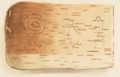
Ojibwe wiigwaasabak. Similar symbols were likely used by Native Americans in New England.
-
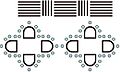
Designs like these were painted or woven into Nipmuc baskets until the 1920s. The lines represent fields, and the domes represent wetus (homes) with dots for people.


