
Oppenheimer (film) facts for kids
Quick facts for kids Oppenheimer (film) |
|
|---|---|
.jpg)
Theatrical release poster
|
|
| Directed by | Christopher Nolan |
| Produced by |
|
| Screenplay by | Christopher Nolan |
| Starring | |
| Music by | Ludwig Göransson |
| Cinematography | Hoyte van Hoytema |
| Editing by | Jennifer Lame |
| Studio |
|
| Distributed by | Universal Pictures |
| Release date(s) | July 11, 2023 (Le Grand Rex) July 21, 2023 (United States and United Kingdom) |
| Running time | 180 minutes |
| Country |
|
| Language | English |
| Budget | $100 million |
| Money made | $976.8 million |
Oppenheimer is a 2023 biographical thriller film that tells the true story of J. Robert Oppenheimer, a brilliant American scientist. He was a key figure in developing the first atomic bombs during World War II. Written and directed by Christopher Nolan, this movie explores Oppenheimer's life, his leadership at the Los Alamos Laboratory, and the challenges he faced later on. Cillian Murphy plays Oppenheimer, with a talented cast including Robert Downey Jr., Emily Blunt, and Matt Damon.
The film is based on the 2005 biography American Prometheus by Kai Bird and Martin J. Sherwin. Oppenheimer was a huge success, earning widespread praise from critics and grossing over $976 million worldwide. It became one of the highest-grossing films of 2023. The movie received many awards, including seven Academy Awards in 2024. These awards included Best Picture, Best Director for Nolan, Best Actor for Murphy, and Best Supporting Actor for Downey Jr.
Contents
The Story of Oppenheimer
The story of Oppenheimer jumps between different times in the scientist's life. One part shows a government committee in 1959 questioning Lewis Strauss, a former official. They are looking into his actions during a time when Oppenheimer's role as a government advisor was questioned. Strauss, who hoped for a new government job, suggested that Oppenheimer had been under suspicion for a long time. He denied trying to harm Oppenheimer's career, even though they often disagreed.
In the 1930s, Oppenheimer taught physics at universities after studying in Europe. He had friends who were involved in political groups. When World War II began, a scientist named Ernest Lawrence warned Oppenheimer about these connections. Soon after, General Leslie Groves asked Oppenheimer to lead a top-secret project called the Manhattan Project. Their goal was to build an atomic bomb before Nazi Germany could. Oppenheimer suggested building a new laboratory in Los Alamos, New Mexico. There, scientists like Edward Teller worked on the bomb. Teller initially worried about a huge chain reaction, but his fears were proven wrong.
After the war, other countries also started developing powerful weapons. Oppenheimer believed in talking with other nations about controlling these weapons. This idea upset Strauss, who wanted to build even stronger bombs. During these discussions, questions about Oppenheimer's past friendships and choices were brought up. These questions were later used against him in a special hearing. The hearing aimed to decide if Oppenheimer could continue his important government work.
Strauss claimed that Oppenheimer had turned other scientists against him. In July 1945, the first atomic bomb test, called Trinity, was successful. Soon after, two atomic bombs were used in Japan. Oppenheimer became known as the "father of the atomic bomb." However, he later spoke out about the dangers of nuclear weapons. Strauss, feeling challenged by Oppenheimer, worked to start the 1954 hearing. This hearing questioned Oppenheimer's loyalty to the United States. Many scientists supported Oppenheimer, but Strauss's actions led to him losing his chance at a new government position. A flashback reveals that Oppenheimer's conversation with Albert Einstein was different from what Strauss thought. Oppenheimer felt a heavy burden for creating such powerful weapons. He shared his worries with Einstein about the future of the world.
Main Characters

.jpg)
The film features a large and talented cast:
- Cillian Murphy as J. Robert Oppenheimer, a brilliant physicist and the leader of the Los Alamos Laboratory.
- Emily Blunt as Katherine "Kitty" Oppenheimer, Robert Oppenheimer's wife, who had past political connections.
- Matt Damon as Gen. Leslie Groves, a US Army officer who directed the Manhattan Project.
- Robert Downey Jr. as Rear Admiral Lewis Strauss, a high-ranking member of the US Atomic Energy Commission (AEC).
- Florence Pugh as Jean Tatlock, a psychiatrist and a close friend of Robert Oppenheimer.
- Josh Hartnett as Ernest Lawrence, a Nobel-winning physicist who worked with Oppenheimer.
- Casey Affleck as Boris Pash, a US Army intelligence officer.
- Rami Malek as David L. Hill, a nuclear physicist.
- Kenneth Branagh as Niels Bohr, a Nobel-winning Danish physicist and Oppenheimer's idol.
- Benny Safdie as Edward Teller, a physicist known as the "father of the hydrogen bomb".
- Tom Conti as Albert Einstein, the famous Nobel-winning German theoretical physicist.
- Gary Oldman as Harry S. Truman, the 33rd President of the United States.
Making the Movie
How the Film Was Developed

The film Oppenheimer is based on the 2005 book American Prometheus by Kai Bird and Martin J. Sherwin. Many filmmakers were interested in making a movie from the book over the years. Eventually, producer Charles Roven shared the book with director Christopher Nolan. Nolan had wanted to make a film about Oppenheimer for a long time.
Nolan was inspired by Oppenheimer's speeches, which showed the scientist thinking deeply about the impact of his work. Nolan wanted to show what it felt like to be Oppenheimer during those important times. Nolan had worked with Warner Bros. Pictures for many years. However, due to disagreements about how movies should be released, Nolan decided to work with a different studio for Oppenheimer. In September 2021, it was announced that Nolan would write and direct the film, with Cillian Murphy in talks to play Oppenheimer. Nolan spoke with several major film studios about the project. Nolan chose Universal Pictures because they shared his vision for how films should be shown in theaters. Universal agreed to fund and distribute the movie, with filming starting in early 2022.
Writing the Script


.jpg)
Nolan first learned about Oppenheimer from a song when he was young. He grew up with concerns about nuclear weapons, and he felt that these concerns were still important today. Nolan wanted to tell Oppenheimer's story in a way that felt like a thrilling drama.
Nolan wrote the script from Oppenheimer's point of view, which was a new approach for him. He wanted to show how Oppenheimer's personal life connected with major historical events. Nolan hoped the film would serve as a warning about the power of science. He also chose to use both color and black-and-white scenes to show different perspectives of the story. Color scenes often show Oppenheimer's personal view, while black-and-white scenes offer a more objective look.
Nolan wanted to explore Oppenheimer's complex feelings about his actions. He also wanted to show the important relationship between Oppenheimer and Lewis Strauss. Nolan aimed to quickly shift the film's mood after the atomic bombings, from triumph to deep reflection. The ending was made to encourage viewers to think about the film's themes themselves.
Choosing the Actors
Oppenheimer is the sixth time Nolan and Cillian Murphy have worked together, but the first time Murphy played the main role. To prepare, Murphy read a lot about Oppenheimer's life. Nolan also arranged for Murphy to speak with a Nobel Prize winner, Kip Thorne, who had met Oppenheimer.
The casting process was very secret. Some actors did not know which role they would play until they agreed to be in the film. Robert Downey Jr., Matt Damon, and Emily Blunt all took lower salaries to work on the movie because they wanted to be part of Nolan's project.
Filming the Movie

Filming began on February 28, 2022, in New Mexico, and lasted for 57 days. The cinematographer, Hoyte van Hoytema, used special IMAX 65 mm and 65 mm large-format film cameras. This was the first film to use IMAX black-and-white film for some scenes, which was specially created for the movie.
Nolan is known for using many practical effects instead of computer-generated ones. For the Trinity nuclear test scene, the filmmakers used real explosives to create a massive effect, not computer graphics. They built a special set in Belen, New Mexico, using gasoline, propane, and other materials to create the explosion. They also used large miniature models, making them look even bigger with clever camera tricks.
The production team built a detailed replica of 1940s Los Alamos at Ghost Ranch, as the real town had changed too much. They also filmed at the University of California, Berkeley and the Institute for Advanced Study in Princeton, New Jersey. Filming finished in May 2022.
Music and Editing
.jpg)
Jennifer Lame edited the film, working closely with Nolan to make sure all characters and story points were clear. DNEG handled the visual effects, creating over 100 shots using mostly "in-camera" special effects. This means many effects were created during filming rather than added later by computers.
Ludwig Göransson composed the film's score, which is a very important part of the movie. Nolan suggested using a solo violin for Oppenheimer's main musical theme. Göransson felt the violin could express a wide range of emotions, from beautiful to intense.
Release and Reception
Movie Release

Oppenheimer premiered in Paris on July 11, 2023, and was released in theaters in the United States and the United Kingdom on July 21, 2023. It was shown in various formats, including IMAX 70 mm.
The film was released on the same day as Barbie, a fantasy comedy. This led to a fun internet trend called "Barbenheimer", where many people encouraged audiences to see both films as a double feature. Cillian Murphy even supported the idea, saying it was good for cinema.
The film's release in Japan was delayed until March 2024, about eight months after its global debut. This was due to the sensitive historical context of the atomic bombings of Hiroshima and Nagasaki. When it finally opened in Japan, it became the highest-grossing foreign film in the country during its first weekend.
Age Ratings and Content
In the United States, Oppenheimer received an R-rating, meaning it was intended for mature audiences due to its themes and some content. In other countries, like Australia and the United Kingdom, it also received higher age certificates. In India, some scenes were adjusted for local audiences to meet specific content guidelines.
Home Viewing
Oppenheimer became available on Ultra HD Blu-ray, Blu-ray, DVD, and digital platforms on November 21, 2023. Director Christopher Nolan emphasized the importance of physical media, like Blu-rays, for preserving films. The movie later became available for streaming on Peacock in the US and Amazon Prime Video in Canada in February 2024. It was released on Netflix in the UK and Ireland on July 12, 2025.
How Accurate Is the Film?
The movie takes many details directly from the book it's based on and real-life events. However, some small changes or embellishments were made for the film. For example, Oppenheimer was not as excited about his discovery of black holes as shown in the movie. The film accurately shows that his study was released on the same day Germany invaded Poland.
During the Trinity test, a scientist named Donald Hornig was very close to the kill switch, ready to react quickly. The film shows the American flag with 50 stars, but during World War II, the flag only had 48 stars because Hawaii and Alaska were not yet states.
While Oppenheimer and Einstein were friends, some of the specific conversations shown in the film did not happen exactly as portrayed. Oppenheimer discussed his concerns about a chain reaction with another physicist, not Einstein. The film also focuses on Oppenheimer's later concerns about nuclear weapons.
The movie does not show all the efforts made at other Manhattan Project sites, such as Hanford and Oak Ridge. These sites were crucial for producing the radioactive materials needed for the bombs. The film also did not include the 30 Native American families who were forced to leave Los Alamos in 1942 to make way for the project.
The film accurately shows the challenges of producing plutonium, which was essential for the atomic bombs. It highlights the great effort and breakthroughs needed to succeed.
A scene in the film shows Secretary of War Henry L. Stimson ordering the removal of Kyoto from the list of bomb targets. The movie suggests this was because Kyoto was a favorite honeymoon spot for him. However, historians say Stimson's objection was mainly strategic, as Kyoto was a city of great historical and religious importance in Japan.
Awards and Recognition
Oppenheimer received many honors and awards. It earned 13 nominations at the 96th Academy Awards, making it Nolan's most Oscar-nominated film. At the ceremony, the film won seven awards: Best Picture, Best Director for Nolan, Best Actor for Murphy, Best Supporting Actor for Downey Jr., Best Cinematography, Best Film Editing, and Best Original Score. Many of these were first-time Oscar wins for the recipients, including Nolan and Murphy. Murphy became the first Irish-born performer to win the Academy Award for Best Actor.
The film also won five Golden Globe Awards, including Best Motion Picture – Drama and Best Director. It won seven British Academy Film Awards, including Best Film. Both the National Board of Review and the American Film Institute named Oppenheimer one of the top ten films of 2023.
See also
- List of films about nuclear issues
- List of World War II films since 1990
- Oppenheimer, a 1980 TV series about Oppenheimer
- Fat Man and Little Boy, 1989 film about the Manhattan Project
- Day One, 1989 TV film about the Manhattan Project
- Doctor Atomic, a 2005 opera about Oppenheimer
- Nuclear Secrets, 2007 TV mini-series with episodes on the Manhattan Project
- Manhattan, 2014-15 television series set at the Manhattan Project
Images for kids
-

Cinematographer Hoyte van Hoytema won several awards for his work on Oppenheimer, including an Academy Award for Best Cinematography.
-
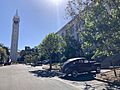
Period car at UC Berkeley campus for the filming of the 2022 movie Oppenheimer.
-

President Truman's portrait of the Argentine leader José de San Martín did not arrive at the White House until 1946, more than a year after his meeting with Oppenheimer.


See also
 In Spanish: Oppenheimer (película) para niños
