
Augustine of Hippo facts for kids
Quick facts for kids SaintAugustine of Hippo |
|
|---|---|

Saint Augustin by Philippe de Champaigne, c. 1645
|
|
| Bishop of Hippo Regius Church Father Doctor of the Church Blessed |
|
| Born | Aurelius Augustinus 13 November 354 Thagaste, Numidia Cirtensis, Roman Empire (present-day Souk Ahras, Algeria) |
| Died | 28 August 430 (aged 75) Hippo Regius, Numidia Cirtensis, Western Roman Empire (present-day Annaba, Algeria) |
| Resting place | Pavia, Italy |
| Venerated in | All Christian denominations which venerate saints |
| Major shrine | San Pietro in Ciel d'Oro, Pavia, Italy |
| Feast |
|
| Attributes | Crozier, mitre, young child, book, small church, flaming or pierced heart |
| Patronage |
|
Augustine of Hippo (13 November 354 – 28 August 430), also known as Saint Augustine, was a famous Christian theologian and philosopher. He lived in North Africa and served as the Bishop of Hippo Regius. Today, historians consider him one of the most important Church Fathers from the early Christian era. His deep writings on faith, knowledge, and history helped shape thinkers for over a thousand years.
He wrote many books that people still study today. His most famous books include an autobiography called the Confessions and a long study named The City of God. Augustine is honored as a saint in the Catholic Church, the Eastern Orthodox Church, and the Anglican Communion.
Contents
The Life of Saint Augustine

Augustine was born in the town of Thagaste, located in the Roman province of Numidia in modern-day Algeria. His mother was named Monica, and she was a deeply devoted Christian. His father, Patricius, was a pagan government official who later embraced Christianity near the end of his life. Augustine and his family belonged to the Berbers, an indigenous people of North Africa, but they spoke Latin at home.
School Days and the Stolen Pears
When he turned 11, Augustine went to school in the nearby town of Madaurus. There he studied Latin literature and Roman public speaking. He showed great intellectual talent, but he did not like learning Greek because his teacher was very harsh.
While in school, Augustine got into trouble with his friends. One night, they sneaked into a neighbor's garden and stole fruit from a pear tree. They were not even hungry and had plenty of better fruit at home. They just threw the pears to some pigs. Later in his life, Augustine wrote about this event in his book Confessions. He wondered why he chose to do something wrong simply because it was forbidden. He decided that peer pressure and bad companionship had led him astray.
College Life in Carthage

At age 17, Augustine traveled to the famous city of Carthage to study rhetoric, which is the art of persuasive speech. While there, he read a book by the Roman writer Cicero named Hortensius. This book sparked a deep love of wisdom and truth in his heart.
Instead of following his mother's Christian faith, Augustine joined a group known as the Manichaeans. They taught a belief that the universe was trapped in an eternal battle between pure light and pure dark. He stayed with this group for about ten years while he worked as a teacher in Carthage and Rome.
Teaching in Milan and a Big Change
In 384, Augustine traveled north to work as a professor of public speech in Milan, Italy. There he met a very wise leader named Ambrose, the bishop of the city. Ambrose was a brilliant public speaker, and Augustine began listening to his lectures. Augustine began to explore Neoplatonism, a branch of Hellenistic philosophy, which made him question his old beliefs.
In the summer of 386, Augustine was sitting in a garden feeling completely torn about his life choices. Suddenly, he heard the voice of a child singing out, "Take up and read!" He picked up a copy of the Bible and opened it to a letter written by Paul the Apostle. The words convinced him to change his path completely. Ambrose baptized Augustine on Easter Vigil in 387. Shortly after this joyful moment, Augustine chose to return home to Africa to dedicate his life to God.
Serving as Bishop of Hippo

Augustine gave away his inherited family lands and started a small monastic community with his close friends. In 391, he was ordained as a priest in the coastal town of Hippo Regius. Just a few years later, in 395, he became the full bishop of the city.
Augustine worked tirelessly for his people. He delivered thousands of sermons, using clever analogies, word pictures, and rhymes to explain the Bible simply. He also listened to legal disputes, visited sick citizens, and defended the church against rival groups like the Donatists.
The Final Siege and Death

In 430, a Germanic tribe called the Vandals crossed into Africa and attacked the region. They surrounded the city of Hippo in a long military siege. Augustine fell terribly ill during the siege.
To keep his thoughts on God, he asked his helpers to write the Psalms on the walls around his bed. Augustine died peacefully on 28 August 430 at the age of 75. After the siege ended, the invaders burned the town, but they left Augustine's large cathedral and book library untouched. Today, his remains rest in the church of San Pietro in Ciel d'Oro in Pavia, Italy.
What Did Saint Augustine Teach?

Augustine was one of the most prolific writers of ancient times. He thought deeply about many big questions that still puzzle human beings today.
Free Will and Divine Grace
Augustine spent many years writing about human choice and free will. He taught that God gave humans the wonderful ability to make real moral choices. However, he also argued that people naturally struggle to do good on their own because human nature was damaged by original sin. Because of this weakness, people need the free gift of God's help, which theologians call divine grace.
The Nature of Time and Memory
In his Confessions, Augustine wondered about how time works. He realized that the past is gone, the future is not here yet, and the present lasts for only an instant. He suggested that human beings can understand the flow of time mainly through the mind and the power of memory. He used vivid word pictures to explain this idea, comparing memory to a gigantic palace filled with stored treasures and images.
The Two Cities

When the Visigoths conquered and carried out the sack of Rome in 410, many citizens were terrified that the world was ending. Augustine answered their fears by writing a giant book called The City of God.
In this work, he divided the history of the world into two invisible groups:
- The City of Man, which is made of earthly kingdoms that will eventually rise and crumble away.
- The City of God, which is a spiritual kingdom founded on love, justice, and truth that lasts forever.
He reminded people that while earthly governments fail, the spiritual community of believers remains completely safe.
Just War and Natural Law
Augustine was among the first thinkers to explain the rules of just war theory. He taught that people should always seek peaceful answers first. However, he argued that sometimes leaders have a moral duty to use force to defend innocent people from violent attackers. He taught that fighting must only be done to stop an ongoing wrong and restore true peace.
He also wrote about natural law, arguing that genuine rules of right and wrong come from reason and divine wisdom. He famously insisted that "an unjust law is no law at all," meaning that rulers must never force people to break the rules of justice.
Learning and Education
Augustine had spent many years working as a teacher, so he wrote carefully about how young people learn best. In his book De Magistro ("On the Teacher"), he said that good learning happens through lively question-and-answer talks, not just quiet memorization. He encouraged teachers to be very patient with beginners, and he urged advanced learners to stay humble even when they knew a great deal.
Images for kids
-

The vision of St. Augustine by Ascanio Luciano
-

Augustine's arm bones, Saint Augustin Basilica, Annaba, Algeria
-
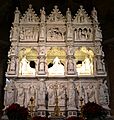
Tomb of St Augustine in Pavia
-
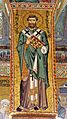
Mosaic of Augustine from Palermo, Italy
-

St. Augustine by Carlo Crivelli
-

Painting of Augustine by Tomás Giner
-

St. Augustine in His Study by Vittore Carpaccio
-

Saint Augustine in the Nuremberg Chronicle
-

Saint Augustine in His Study by Sandro Botticelli
-
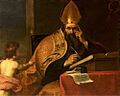
Saint Augustine of Hippo by Gerard Seghers
-
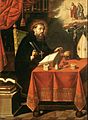
Saint Augustine, painting by Antonio Rodríguez
-
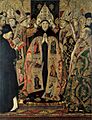
The Consecration of Saint Augustine by Jaume Huguet


Related Pages
- Doctor of the Church
- Ambrose
- Saint Monica
- The City of God
See Also
 In Spanish: Agustín de Hipona para niños
