
Troy facts for kids
Quick facts for kids Troy |
|
|---|---|
.jpg) Walls of Late Bronze Age Troy
|
|
| Location | Çanakkale District, Çanakkale Province, Turkey |
| Type | Cultural |
| Designated | 1998 (22nd session) |
| Reference no. | 849 |
| UNESCO Region | Europe and North America |
Troy was a famous ancient city located in northwest Turkey in Çanakkale. It is best known as the setting of stories from Greek mythology, especially the Trojan War. The real archaeological site is called Hisarlık. It is a popular park and is listed as a UNESCO World Heritage site.
People lived in Troy for around 4,000 years. During that long time, the city was rebuilt many times. Archaeologists study its archaeological layers using Roman numerals from Troy I to Troy IX. In ancient times, the city grew from an Early Bronze Age town into an important center during the Late Bronze Age. Later, it became a historic city visited by Greeks and people from Ancient Rome.
Contents
Exploring the Legendary City of Troy

The ancient Greek poet Homer wrote about the city in his famous epic poem called the Iliad. In this story, the Greek warriors called the Achaeans sail across the sea to fight King Priam of Troy. The story describes tall gates, wide streets, and strong stone walls protecting the hill. Homer also wrote about the city in the Odyssey, and the Roman writer Virgil told the story in the Aeneid. Famous legends tell of heroes like Achilles and a giant Trojan Horse used to sneak inside the gates.
In ancient times, leaders believed these stories were true history. For example, the great ruler Alexander the Great visited the area on the Troad peninsula in 334 BC. He left offerings at tombs meant to honor Achilles and his friend Patroclus.
How Archaeologists Discovered the Real Site
_b_713.jpg)
For many years, modern explorers wondered where the real city was located. Early visitors thought it was at Alexandria Troas or near the village of Pınarbaşı, Ezine. In 1822, a Scottish writer named Charles Maclaren suggested that Hisarlık was the true place. Later, an English landowner named Frank Calvert made surveys at Hisarlık. He realized the hill held the remains of the ancient city.
A German businessman named Heinrich Schliemann teamed up with Calvert in 1868. Schliemann began digging deep into the mound, creating a path called Schliemann's Trench. Under the earth, he found many ancient layers. Schliemann also uncovered gold cups and jewelry that he named Priam's Treasure. Today, these treasures are kept in museums such as the Pushkin Museum in Moscow. Later, an archaeologist named Wilhelm Dörpfeld helped study the upper levels. Other scientists, including Carl Blegen from the University of Cincinnati, proved there were at least nine layers of cities built on top of each other.
The Layers of the Ancient City

The hill of Hisarlık is a mound made of earth and stone layers left by humans. Scientists use tools like radiocarbon dating and relative dating to find the age of each layer.
The Early Settlements (Troy I to Troy V)
.jpg)
The very earliest signs of settlement date back before the Bronze Age to a period called Troy 0. Troy I started around 3000 BC as a small fortified citadel. People lived in mudbrick houses with a large room called a megaron. They made pottery by hand and traded with nearby islands such as Poliochni on Lemnos and Thermi on Lesbos. A stone stele carving shows an ancient warrior.
Troy II was built around 2550 BC and was twice as large. Builders added stone ramp entrances, strong walls, and an outer palisade fence made of wood. People used a potter's wheel to make smooth pots. They imported luxury goods like amber from the Baltic region, red carnelian from India, and blue lapis from Afghanistan.
Later layers, known as Troy III, Troy IV, and Troy V, show how the town changed during the Middle Bronze Age. Builders made domed cooking ovens and traded with neighbors like the Minoan culture from Crete.
The Great Fortress of Troy VI and Troy VII
,_Turkey_(7446656654).jpg)
Troy VI and VII existed during the Late Bronze Age, from about 1750 BC to 950 BC. This city had a high citadel surrounded by massive walls of cut ashlar stone. The walls sloped inward, just like the walls at the ancient capital of Hattusa. Five main gates led into streets paved with cobblestones.
In the 1980s, archaeologist Manfred Korfmann discovered a large lower city south of the fortress. This discovery proved the city covered a huge area of about 200,000 square meters. The people used horses, made gray pottery, and collected murex shells to make rare purple dye. Some scholars think the people may have spoken the Luwian language, because a seal written in ancient hieroglyphs was found in the dirt.
Troy VI was damaged by an earthquake around 1300 BC. The survivors quickly rebuilt the town as Troy VIIa. They kept large food storage jars called pithoi in their floors. This city was burned around 1180 BC during the Late Bronze Age collapse, showing clear signs of enemy attack. Later, during Troy VIIb, new settlers arrived and made pottery before another fire hit the town around 950 BC.
Greek and Roman Times (Troy VIII and Troy IX)
Greek settlers arrived around 700 BC during the Archaic period and built Troy VIII. They built a grand sanctuary to honor the goddess Athena. Later, during Roman times, the city was rebuilt as Troy IX and was called Ilium. Roman leaders loved the city because stories said that Aeneas, a hero of Troy, was an ancestor of Rome. The famous general Julius Caesar and Emperor Augustus gave money to restore its bouleuterion meeting hall and great outdoor theater.
What Ancient Records Tell Us About Troy
Troy is mentioned in ancient clay tablets written in the Hittite language. These Hittite records speak of a kingdom named Wilusa and another name called Taruisa. These names match the ancient Greek names for Troy and Ilion. Wilusa was part of an alliance called the Assuwa Confederation and later signed treaties with the Hittite Empire. Tablets also mention kings named Kukkunni and Alaksandu. While these old letters prove that powerful kingdoms traded and fought in this region, historians still look for clear evidence of the Trojan War battles from the poems.
Visiting the Park and Museum Today
Today, the ruins are part of the Historical National Park of Troia. Visitors can walk on wooden paths to look at the ancient stone gates, deep trenches, and old house walls. Outside the gate, there is a giant wooden horse that visitors can explore. Nearby, in the village of Tevfikiye, visitors can see the modern Troy Museum. The museum holds thousands of ancient items, including pottery, tools, and statues discovered at the site.
Images for kids
-
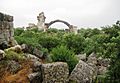
The baths at Alexandria Troas
-
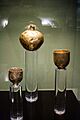
Golden cups from Priam's Treasure
-
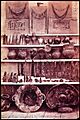
Artifacts found during early digs
-
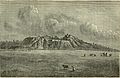
Hisarlık hill in 1880 showing the deep trench
-
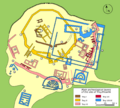
Map of the site layers
-
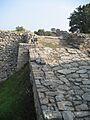
Southwest ramp of Troy II
-
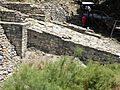
Side view of the ramp
-
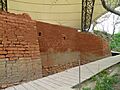
Walls of Troy II
-
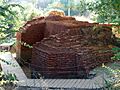
Fortifications of Troy II
-
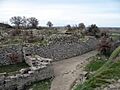
East Gate of Troy VI
-
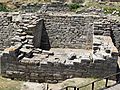
Tower at the East Gate
-
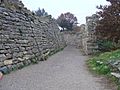
Walls from Troy VII and Troy IX
-
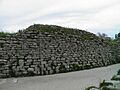
Wall segment near the gate
-
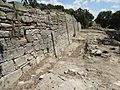
Side view of stone wall
-
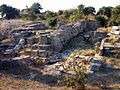
The South Gate of the city
-
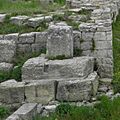
Stone pillar at the South Gate
-
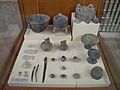
Anatolian Grey Ware pottery
-
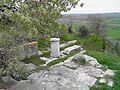
Remains of the Temple of Athena
-
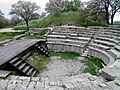
Roman odeon building in Troy IX
-
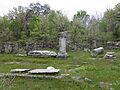
Ruins of a Roman bath
-
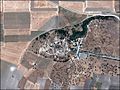
The landscape of Troy Ridge
-
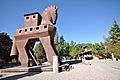
Wooden horse monument at the entrance
-
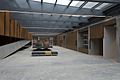
Interior of the Troy Museum
-
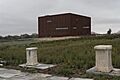
The Troy Museum building


.jpg)
.jpg)


,_Turkey_(7446526244).jpg)
.jpg)


,_Turkey_(7446473680).jpg)

.jpg)

,_Turkey_(7446237818).jpg)
,_Turkey_(7446501008).jpg)
,_Turkey.jpg)
,_Turkey_(7446699076).jpg)

_(8709942456).jpg)


See also
 In Spanish: Troya para niños
- Ancient settlements in Turkey
- Cities of the ancient Near East
- Dardanians (Trojan)
- The Golden Bough (mythology)
- Luwians
- Seha River Land
- Stratigraphy
- Trojan War in popular culture
