
United States government security breaches facts for kids
This page shares stories about times when secret information from the United States government was accidentally lost or purposely stolen. These events are called "security lapses." They are important because they show how hard it is to keep national secrets safe. This article focuses on these events, not on how to fix computer weaknesses.
Contents
Spy Stories: Security Lapses in the US Government
The 1940s: Early Spy Rings
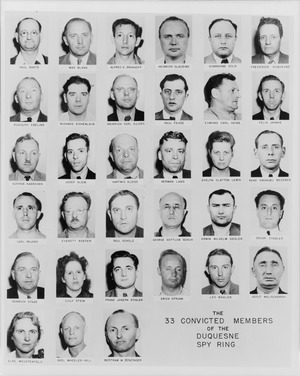
- June 1941 – A man named Fritz Joubert Duquesne was arrested by the Federal Bureau of Investigation (FBI). He and his friends were accused of sending secret information about Allied weapons and ship movements to Nazi Germany during World War II. On January 2, 1942, 33 members of the Duquesne Spy Ring were found guilty. This was the biggest spy ring ever caught in the United States. They were sentenced to over 300 years in prison together. A double agent, William G. Sebold, helped the FBI catch them. One German spy leader later said their spy efforts in the US were completely stopped after this.
The 1950s: Atomic Secrets
- July 1950 – Alfred Sarant and Joel Barr were recruited by Julius Rosenberg to spy for the Soviet Union. They worked at the United States Army Signal Corps laboratories. Both men later escaped to countries in Eastern Europe.
- March 1950 – Klaus Fuchs was found guilty in the United Kingdom of spying for the Soviet Union. He had worked on atomic bomb projects in the United States at Los Alamos National Laboratory and later in England.
- Around 1950 – David Greenglass confessed to spying. He was recruited by his in-laws, Julius and Ethel Rosenberg, to share secrets from Los Alamos National Laboratory between 1944 and 1946.
- 1951 – Theodore Hall was questioned by the FBI about giving atomic weapon secrets to the Soviet Union. He was not charged then, but he later admitted to doing it.
The 1970s: Satellite Secrets
- January 1977 – Christopher John Boyce was found guilty of spying for the Soviet Union. He was arrested for selling US spy satellite secrets. Boyce was sentenced to 40 years in prison. He escaped in 1980 and robbed 17 banks while on the run. He was caught again in August 1981.
The 1980s: More Spies Caught
- October 1980 – David Henry Barnett, a retired CIA officer, admitted to selling CIA secrets to the Soviets. He was sentenced to 18 years in prison.
- May 1985 – John Anthony Walker, a retired United States Navy officer, was arrested. He had been selling secret encryption information and other documents to the Soviet Union since 1967. He was found guilty of espionage and died in prison.
- June 1986 – Jonathan Jay Pollard, a civilian intelligence analyst for the US Navy, was found guilty of spying for Israel. He received a life sentence.
- August 1988 – Clyde Lee Conrad, a member of the United States Armed Forces, was arrested. He had been selling NATO defense plans to Hungary from 1974 to 1988. A German court found him guilty of treason and espionage, and he died in prison.
The 1990s: Many Cases
- June 1990 – Ronald Hoffman was arrested for exporting special software he developed for the United States Air Force to foreign companies. He was found guilty of breaking export laws.
- February 1991 – Charles Lee Francis Anzalone, a United States Marine Corps corporal, was arrested for trying to spy. He gave documents and a security badge to an FBI agent pretending to be a KGB officer. He was sentenced to 15 years in prison.
- April 1991 – Jeffrey Carney was arrested for giving secret documents to the Stasi (East German secret police) between 1982 and 1984. He had been stationed in West Berlin with the United States Air Force. He admitted to espionage and desertion and was sentenced to 38 years, but was released after 11 years.
- March 1991 – Albert T. Sombolay was arrested. He admitted to giving military information about the Gulf War deployment, military IDs, and chemical weapons equipment to Jordan while in Germany. He was sentenced to 34 years of hard labor.
- May 1992 – Virginia Jean Baynes was found guilty of passing secret documents to the Philippines. She was a secretary with the Central Intelligence Agency in Manila.
- February 1993 – Frederick Christopher Hamilton admitted to passing secret intelligence reports about Peru to Ecuador in 1991. He was with the Defense Intelligence Agency in Peru. He was sentenced to 37 months in prison.
- August 1993 – Geneva Jones was accused of stealing government property and sharing defense information. As a secretary with the United States Department of State, she passed secret documents to a journalist, who then gave some to rebels in Liberia. She was sentenced to 37 months in prison.
- May 1993 – Steven John Lalas was charged with passing sensitive military information to Greece between 1991 and 1993 while working for the United States Department of State. He passed hundreds of highly secret documents. He admitted to conspiracy to commit espionage and was sentenced to 14 years in prison.
- February 1994 – Aldrich Hazen Ames was charged with giving highly secret information to the Soviet Union and later Russia since 1985. The information he shared led to the deaths of at least 9 US agents in Russia. He and his wife admitted guilt and he was sentenced to life in prison.
- May 1995 – John Douglas Charlton was arrested for trying to sell secret United States Navy documents in 1993. He took the documents from Lockheed Corporation before he retired. He was sentenced to two years in prison.
- May 1995 – Michael Stephen Schwartz was charged with espionage. He passed secret information to Saudi Arabia between 1992 and 1994 while stationed in Riyadh with the United States Navy. He received a less than honorable discharge.
- February 1996 – Robert Lipka was charged with spying while working at the National Security Agency from 1964 to 1967. He passed top secret information to the Soviet Union. He admitted guilt and was sentenced to 18 years in prison.
- April 1996 – Kurt G. Lessenthien, a petty officer in the United States Navy, was charged with trying to spy. He offered top secret submarine information to the Soviet Union. He was sentenced to 27 years in military prison.
- August 1996 – Phillip Tyler Seldon admitted to passing secret documents to El Salvador while a captain in the United States Army. He was sentenced to two years in prison.
- September 1996 – Robert Chaegun Kim, a civilian at the Office of Naval Intelligence, was charged with passing secret information to South Korea, his home country. He admitted to conspiracy to commit espionage and was sentenced to 9 years in prison.
- November 1996 – Harold James Nicholson was arrested trying to take top secret documents out of the country. He had been spying for Russia since 1994 and was a high-ranking Central Intelligence Agency officer. He admitted guilt and was sentenced to over 23 years in prison.
- December 1996 – Earl Edwin Pitts was charged with giving top secret documents to the Soviet Union and then Russia from 1987 to 1992. He admitted guilt and was sentenced to 27 years in prison.
- December 1996 – After John M. Deutch left his job as Director of Central Intelligence, secret information was found on his home computer, which was not supposed to have classified data. He had knowingly processed top secret information on unclassified computers connected to the Internet. The Attorney General decided not to prosecute him.
- December 1997 – Peter H. Lee turned himself in and admitted to sharing secret information about hohlraums (a part of nuclear weapons) during a visit to People's Republic of China. He worked for Los Alamos National Laboratory.
- April 1998 – The FBI arrested former CIA employee Douglas Frederick Groat for espionage. After being fired, he supposedly gave secret information to foreign governments. He later admitted to attempted extortion.
- October 1998 – David Sheldon Boone was charged with selling top secret documents to the Soviet Union from 1988 to 1991. He had access to these as a member of the United States Army working for the National Security Agency in Germany. He later admitted to conspiracy to commit espionage.
- December 1999 – Wen Ho Lee was accused of espionage at Los Alamos National Laboratory. He later admitted to improperly handling secret restricted data and was sentenced to time served.
The 2000s: New Challenges
- February 2000 – Mariano Faget, who worked for the Immigration and Naturalization Service, was arrested for passing secret information to Cuba. He was sentenced to 5 years in prison.
- April 2000 – Timothy Steven Smith was charged with espionage after being caught stealing disks and secret documents from a ship in the United States Pacific Fleet. He admitted to stealing government property and was sentenced to prison.
- June 2000 – George Trofimoff, a naturalized citizen with Russian parents, was arrested for spying for the Soviet Union and Russia since 1969. He was a retired colonel in the United States Army Reserve, making him the highest-ranking military officer ever accused of spying. He was found guilty and sentenced to life in prison.
- February 2001 – Robert Philip Hanssen was arrested for spying for the Soviet Union and Russia for most of his 27 years with the Federal Bureau of Investigation. He passed thousands of pages of secret documents and revealed three US agents in Russia, two of whom were executed. He admitted guilt and was sentenced to life in prison.
- August 2001 – Brian Patrick Regan, a contractor working at the National Reconnaissance Office, was arrested for trying to sell top secret information to foreign governments. He was found guilty of trying to sell secret information to Iraq and China and was sentenced to life in prison without parole.
- September 2001 – Ana Belen Montes, a senior intelligence analyst with the Defense Intelligence Agency, passed secret military and intelligence information to Cuba for at least 16 years. She admitted guilt and was sentenced to 25 years in prison.
- March 2003 – Eighteen-year-old Adil Yahya Zakaria Shakour broke into the computer network at Sandia National Laboratories and changed a web site for Eglin Air Force Base. He admitted to computer and credit card fraud.
- February 2004 – Ryan Gilbert Anderson, a member of the Washington National Guard, was charged with trying to help and provide information to Al-Qaeda. A military court sentenced him to life in prison.
- October 2006 – Investigators found secret documents and a USB drive with secret information from Los Alamos National Laboratory at the home of Jessica Quintana, a former subcontractor.
- December 2006 – Petty Officer Ariel Weinmann of the United States Navy admitted to espionage and other charges. His case is unusual because the Navy and court officials kept basic information about it secret.
- February 2007 – A report stated that over 44 months, the FBI reported 160 weapons and 160 laptop computers as lost or stolen.
The 2020s: Recent Breaches
- 2020 – Suspected foreign attackers broke into the computer systems of the Treasury and the Department of Commerce.
|

All content from Kiddle encyclopedia articles (including the article images and facts) can be freely used under Attribution-ShareAlike license, unless stated otherwise. Cite this article:
United States government security breaches Facts for Kids. Kiddle Encyclopedia.