
World Trade Organization facts for kids
 |
|

Members Members, dually represented by the European Union (EU) Observers Non-participant states Not applicable
|
|
| Script error: The function "autoWithCaption" does not exist. | |
| Abbreviation | WTO |
|---|---|
| Formation | 1 January 1995 |
| Type | Intergovernmental organization |
| Purpose | Making international buying and selling easier by lowering trade barriers |
| Headquarters | Centre William Rappard, Geneva, Switzerland |
|
Region served
|
Worldwide |
| Members | 166 members |
|
Official languages
|
English, French, Spanish |
|
Director-General
|
Ngozi Okonjo-Iweala |
Script error: No such module "Check for conflicting parameters".
The World Trade Organization (often called the WTO) is an important international organization that helps countries trade together. Trade simply means buying, selling, or exchanging items. People trade food, toys, clothes, computer games, and even helpful services across borders. When nations sell goods to each other, it is called international trade. The WTO makes clear ground rules so countries can do business fairly and peacefully.
The WTO was officially created on 1 January 1995 by an agreement called the Marrakesh Agreement. Before the WTO existed, countries followed another deal called the General Agreement on Tariffs and Trade, or GATT. Today, the organization has 166 member nations. Together, these countries represent over 98% of all global trade and global GDP. The main office is located in the city of Geneva, Switzerland.
The leader of the WTO is called the Director-General. Since 2021, this leader has been Ngozi Okonjo-Iweala from Nigeria. The organization helps countries talk about fair trade rules, lower taxes on foreign items, and resolve trade arguments. By encouraging friendly commerce, the WTO tries to make the world economy run smoothly and help families everywhere get the items they need.
Contents
- What Is the World Trade Organization and How Does It Work?
- History of the World Trade Organization
- How the WTO Is Organized
- How the Dispute Settlement System Solves Arguments
- Joining the World Trade Organization
- Major Agreements Covered by the WTO
- Benefits and Criticisms of the WTO
- Annual Reports and Publications
- Images for kids
- See also
What Is the World Trade Organization and How Does It Work?

The WTO works like a giant town hall for the whole planet. In this special hall, governments sit down to talk about how goods and services move across borders. When companies sell things to another country, they must follow rules set by both governments. Sometimes, governments add extra taxes to foreign products to make them cost more. These extra taxes are known as tariffs. Other times, governments set rules that make it very hard for outside companies to bring items into their land. These rules are called trade barriers.
The main goal of the WTO is to help open up trade safely and lower these barriers. Lower barriers allow trucks, trains, airplanes, and cargo ships to carry products quickly between countries. When goods move easily across borders, people can buy delicious foods, clothes, and tools that are not made in their own home country. It also helps local businesses find new customers in other parts of the world.
To keep everything fair, the WTO provides a court-like system to settle disagreements between nations. If one country feels that another country broke an agreed-upon rule, it can ask the WTO for assistance. Instead of arguing or starting trade wars, the countries let a panel of experts examine the facts. The experts review the contracts and find a peaceful solution that follows international agreements.
The organization also helps developing nations and poorer places build strong economies. Many low-income countries need better roads, modern ports, and skilled workers to join global commerce. Through special training and financial aid programs, the WTO supports these nations so they can export their crops, crafts, and manufactured items to richer markets.
Five Core Principles of Global Trade
The WTO is built on five big ideas that guide how member nations should act toward one another:
- Non-discrimination: This means treating everyone fairly. It contains two main parts: most-favoured-nation status and national treatment. Under the most-favoured-nation rule, if a country gives a special low tax to one partner, it must give that same benefit to all other WTO members. The national treatment rule means that once a foreign product arrives inside a country, the government cannot treat it worse than a locally made item.
- Reciprocity: This is the idea of mutual teamwork. If one country agrees to lower its taxes on imported toys, the other country should lower taxes on imported fruits in return. This balanced cooperation avoids the problem of one side taking advantage without helping out.
- Binding commitments: When a country promises to keep a tax low, it writes that promise into a legal list called a schedule. It cannot suddenly raise those taxes without talking to its partners first. This keeps business steady and predictable.
- Transparency: Governments must be completely open and honest about their laws. They must publish all their trade rules clearly so everyone can read them. They also participate in regular checks called the Trade Policy Review Mechanism.
- Safety valves: In special cases, countries can place temporary limits on trade. They are allowed to do this to protect the environment, preserve national security, or stop the spread of plant and animal diseases.
History of the World Trade Organization

Long before the WTO was born, countries often charged very high taxes on imported goods. During hard economic times, governments thought high taxes would protect their local factories. Unfortunately, when one country raised taxes, other countries raised theirs too. This hurt global commerce, made products expensive, and caused factory workers to lose their jobs.
After the end of World War II, world leaders realized they needed to cooperate closely to prevent future conflicts. In 1944, experts met at the Bretton Woods Conference in New Hampshire. Famous thinkers like John Maynard Keynes and Harry Dexter White helped design groups like the World Bank and the International Monetary Fund. They also wanted an International Trade Organization to oversee commerce, but countries could not agree on its final charter.
Instead, 23 countries decided to sign a temporary deal in 1947 called the General Agreement on Tariffs and Trade (GATT). Even though it was supposed to be a short-term agreement, GATT worked very well. It encouraged nations to reduce their import taxes step by step. Over the next forty years, dozens of new nations joined GATT, and trade grew rapidly across the globe.
Governments met in large meetings called negotiation rounds to update the GATT rules. The Kennedy Round in the 1960s created rules against unfair cheap pricing. The Tokyo Round in the 1970s worked hard on reducing non-tariff barriers to trade. As technology changed and computers became popular, countries realized that trade was no longer just about physical goods like grain and steel. People were now trading computer software, banking services, and scientific inventions. Leaders needed a modern, permanent organization to handle everything.
The Uruguay Round and the Birth of the WTO
In 1986, trade ministers gathered in Punta del Este, a coastal city in Uruguay, to start the biggest trade talks ever held. This massive meeting was known as the Uruguay Round. It lasted for more than seven years because governments argued over difficult topics like farming and textile manufacturing.
The diplomats finally reached a historic agreement in April 1994 in Marrakesh, Morocco. This document was named the Marrakesh Agreement. It officially established the World Trade Organization on 1 January 1995. The old GATT rules were updated and included inside the new WTO system, where they still govern the trade of physical merchandise.
The Uruguay Round also created brand-new agreements for modern commerce. These included rules for the services industry, such as finance, communication, and tourism. It also set up protections for intellectual property, which includes patents, trademarks, and copyrights. By creating a single organization with clear legal systems, the world gained a steady foundation for global commerce.
The Doha Development Round
In November 2001, WTO leaders met in Doha, the capital city of Qatar, to launch a new set of negotiations called the Doha Development Round. The main goal of this round was to help poor nations participate in the global economy and fight world poverty. Many poorer countries wanted wealthy nations to stop giving large amounts of money, known as an agricultural subsidy, to their own domestic farmers.
When wealthy nations pay big subsidies to local farmers, those farmers can sell food much cheaper than farmers in poor countries can. Developing nations argued that this was unfair and hurt their ability to sell crops like cotton and sugar. At the same time, wealthier nations wanted developing countries to lower their taxes on manufactured goods and open up their markets to foreign companies.
Because these issues were so complicated, the Doha Round faced many delays and disagreements. Countries could not agree on how to balance farming and industrial goods. However, leaders did make some progress on cutting red tape at borders. In 2013, WTO members signed an agreement called the Bali Package, which made customs checks faster and easier for shipping containers traveling between nations.
How the WTO Is Organized

The WTO is run by its member governments, not by outside leaders or private companies. Every decision is made together by consensus, meaning that all countries must agree or at least accept the outcome. This ensures that every country, whether large or small, has a voice in discussions.
The organization has several important leadership bodies:
- Ministerial Conference: This is the highest decision-making group in the WTO. It brings together trade ministers from every single member nation. It meets roughly every two years to decide big policies, welcome new member nations, and sign major trade deals.
- General Council: In between ministerial conferences, ambassadors and officials meet regularly in Geneva as the General Council. They handle day-to-day work, oversee committees, and manage the organization's business.
- Dispute Settlement Body: When countries have legal disagreements over trade rules, the General Council meets under this special name. It appoints judges and panels to hear cases and approve official rulings.
- Trade Policy Review Body: This group conducts deep inspections of each member's national laws to ensure they match WTO promises.
- Specialized Councils: The WTO has councils for trade in goods, trade in services, and trade-related aspects of ideas and inventions. These groups look into specific topics such as environmental safety, technology, and farming.
Important Ministerial Conferences Through the Years
The Ministerial Conference has met in many famous cities around the globe:
- Singapore (1996): The very first ministerial conference, where leaders discussed investment, competition, and transparent rules known as the Singapore issues.
- Geneva (1998): Ministers celebrated fifty years of the multilateral trading system and looked toward the digital age.
- Seattle (1999): This meeting saw huge street protests by groups concerned about workers' rights and the environment.
- Doha (2001): Approved the membership of China and launched the major Doha Development Round.
- Cancún (2003): Talks ended early after intense debates between developed and developing nations over farm subsidies.
- Hong Kong (2005): Leaders agreed to phase out farming export aid and supported the Aid for Trade program.
- Geneva (2022): Ministers gathered to address trade challenges during the COVID-19 pandemic and set limits on harmful fishing subsidies.
- Abu Dhabi (2024): Welcomed new island nations and discussed digital trade rules.
- Yaoundé (2026): Met in Cameroon under chairperson Luc Magloire Atangana Mbarga to discuss deep reforms and update the trading system for future needs.
The Secretariat and Director-General
The WTO employs a team of experts known as the Secretariat, which works in the historic Centre William Rappard on the shores of Lake Geneva. The Secretariat has roughly 630 staff members from all over the world, including economists, lawyers, and translators. Because the WTO uses three official languages—English, French, and Spanish—documents must be translated accurately for everyone to read.
The head of the Secretariat is the Director-General. This leader does not make the laws, because only member countries can vote on rules. Instead, the Director-General serves as an honest guide, helping countries find common ground and keeping the administrative office running smoothly.
| Name | Home Country | Years in Office |
|---|---|---|
| Peter Sutherland | Ireland | 1995 |
| Renato Ruggiero | Italy | 1995–1999 |
| Mike Moore | New Zealand | 1999–2002 |
| Supachai Panitchpakdi | Thailand | 2002–2005 |
| Pascal Lamy | France | 2005–2013 |
| Roberto Azevêdo | Brazil | 2013–2021 |
| Ngozi Okonjo-Iweala | Nigeria | 2021–present |
How the Dispute Settlement System Solves Arguments
One of the most important jobs of the WTO is resolving disagreements between nations. In the past, if a country believed another nation broke a trade promise, it might respond by putting sudden, heavy taxes on goods. This often led to painful economic fights. Under WTO rules, countries promise not to take unilateral action on their own. Instead, they use a fair, step-by-step legal system to solve problems peacefully.
First, the two countries must sit down and hold private talks called consultations. Many times, diplomats can fix the misunderstanding during these friendly meetings. If they cannot agree after sixty days, the complaining nation can ask the Dispute Settlement Body to appoint an independent panel of experts.
The panel listens to arguments from both sides, studies trade contracts, and issues a detailed written report. If the panel decides that a country's law breaks an international agreement, it recommends that the government change that law. The process normally takes about a year.
In the past, countries could appeal a panel's decision to a higher group called the Appellate Body. However, during the first presidential term of Donald Trump, the United States stopped approving new judges for the Appellate Body. The United States argued that the judges had taken too much power and made unfair rulings. Because of this, the Appellate Body became unable to hear new cases. To keep things moving, several nations, including the European Union, created an interim group called the Multiparty Interim Appeal Arbitration Arrangement to resolve their trade disputes fairly.
Joining the World Trade Organization

Becoming a member of the WTO is not quick or easy. When a country applies to join, the process is called accession. On average, it takes about five years of hard work, but for some countries, it takes much longer.
To join, an applicant country submits a detailed paper called a memorandum that explains all of its commercial laws, banking systems, and agricultural policies. A special working party of WTO members studies this document carefully. Members check for any areas where the country's local laws do not match international standards.
Next, the applicant must hold one-on-one talks with each member country. During these talks, the applicant promises to lower certain tariffs and open its doors to foreign products. For example, when Armenia joined, it agreed to place clear limits on its import taxes, called a bound tariff rate. This helped Armenia build a stable, modern market after difficult financial periods like the 2008 financial crisis.
Some countries finish their talks very quickly. The Kyrgyz Republic finished its accession in just a few years. Other nations took much longer due to complicated negotiations. Kazakhstan took nearly twenty years to finish its entry talks, while Vietnam negotiated for eleven years before joining in 2007. Russia spent almost nineteen years discussing trade rules before becoming an official member in August 2012. The island nation of Vanuatu began talks in 1995 and finally joined in 2012.
Today, there are 166 members in the WTO. Members include big industrial giants like the United States, China, Japan, and Germany, as well as small island nations. Places like Hong Kong and Taiwan (participating as the Separate Customs Territory of Taiwan, Penghu, Kinmen and Matsu) are members because they run their own independent trade systems. The most recent countries to join were the island nations of Comoros and Timor-Leste in early 2024.
Major Agreements Covered by the WTO
The WTO oversees around 60 different legal agreements that shape global business. When a country joins the WTO, it must sign and follow every single one of these multilateral treaties. Here are some of the most influential agreements:
Agreement on Agriculture (AoA)
Farming is vital because everyone needs food to eat. The Agreement on Agriculture came into force in 1995 to make farm trade fairer. It focuses on three important parts, often called "pillars":
- Domestic support: Setting clear limits on how much money governments give to local farmers so they do not outprice foreign growers unfairly.
- Market access: Replacing hidden trade barriers with clear, visible tariffs and cutting those taxes over time.
- Export subsidies: Stopping governments from paying food producers to sell extra grain and meat at artificially low prices abroad.
General Agreement on Trade in Services (GATS)
Trade is not just about physical boxes loaded on ships; it also includes helpful services. The General Agreement on Trade in Services covers banking, hotel management, telecommunications, and engineering. Under this treaty, countries promise to treat foreign service providers fairly when they set up offices or offer skills across borders.
Trade-Related Aspects of Intellectual Property Rights (TRIPS)
When an author writes a book, an inventor builds a new gadget, or a scientist discovers a life-saving medicine, that creative work is called intellectual property. The TRIPS Agreement ensures that creative ideas, brand names, and computer programs are protected from copying and piracy around the world. It gives creators legal rights while ensuring that developing countries can still access necessary medicines during health emergencies.
Food Safety and Product Standards (SPS and TBT)
Governments want to make sure the food their citizens eat and the electronics they buy are safe. Two agreements help balance safety with fair commerce:
- The Agreement on the Application of Sanitary and Phytosanitary Measures (SPS) sets guidelines for food safety, animal health, and plant hygiene. It ensures that countries do not use fake health scares just to block safe foreign fruit, vegetables, or meats.
- The Agreement on Technical Barriers to Trade ensures that safety regulations, testing rules, and packaging labels are honest and do not create unnecessary headaches for businesses.
Benefits and Criticisms of the WTO

Like any major international institution, the World Trade Organization has both strong supporters and outspoken critics. Many economists believe the WTO has been a huge success. By lowering trade barriers, it has helped free trade blossom across every continent. Research shows that without the WTO, import taxes around the world would be much higher, making everyday items like shoes, electronics, and fruit far more expensive for ordinary families.
The WTO also helps bring stability to global business. When companies know that governments will not suddenly raise taxes or ban products overnight, they feel confident investing money, opening factories, and hiring workers. Furthermore, by giving small countries a safe place to settle arguments with large superpowers, the WTO prevents economic bullying.
However, many people criticize how the organization functions:
- Unequal gains: Some critics argue that wealthy, industrialized countries have benefited far more from global commerce than poor nations. They worry that smaller countries do not have enough skilled lawyers or resources to negotiate fair deals against economic giants.
- Environmental worries: Some green organizations worry that expanding global commerce encourages factories to pollute more, promotes overfishing, and increases fuel use by cargo ships. They argue that trade rules sometimes make it hard for governments to pass strict environmental protections.
- Job changes: When countries open up their borders to foreign factories, some domestic factories cannot compete and are forced to close down. While trade creates new jobs in tech and shipping, it can cause difficulties for local manufacturing workers who lose their careers. Economists note that modern productivity gains and machines also cause job shifts.
- Slow progress: Because every single WTO decision requires consensus, it takes a very long time to pass new rules. When one country disagrees, the entire process can come to a complete halt, creating frustration among members.
To address these concerns, the WTO works with the United Nations on Sustainable Development Goal 8, which aims to create safe working conditions and strong economic growth for all people. Programs like Aid for Trade provide special funding so poorer countries can build better roads, ports, and power grids, helping everyone enjoy the benefits of international business.
Annual Reports and Publications
To keep the public and world leaders informed, the WTO publishes several authoritative annual reports every year:
- World Trade Report: An extensive yearly book that studies a specific topic in depth, such as the future of digital commerce, environmental challenges, or artificial intelligence in shipping.
- WTO Annual Report: A complete overview of everything the organization did during the year, including updates on budget spending, committee meetings, and membership talks.
- World Trade Statistical Review: A giant collection of facts, numbers, and graphs detailing global exports, imports, and market trends across every region.
Images for kids
-
The official logo and emblem of the World Trade Organization.
-
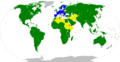
A world map showing member nations, observers, and customs territories of the WTO.
-
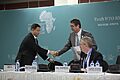
Delegates discussing trade policies and cooperation at a major international conference.
-
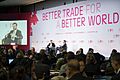
A presentation where economists shared findings from the annual trade publication.
-
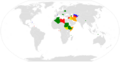
A diagram showing the different stages countries go through when applying to join the WTO.
-
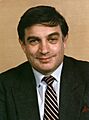
Peter Sutherland, the first Director-General of the World Trade Organization.
-

Renato Ruggiero, who served as Director-General from 1995 to 1999.
-
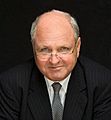
Mike Moore, former Director-General from New Zealand.
-

Supachai Panitchpakdi, former Director-General from Thailand.
-

Pascal Lamy, former Director-General from France who served two full terms.
-
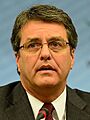
Roberto Azevêdo, former Director-General from Brazil.
-
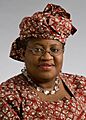
Ngozi Okonjo-Iweala, the current Director-General of the WTO.


See also
 In Spanish: Organización Mundial del Comercio para niños
- Agreement on Trade Related Investment Measures
- Anti-globalization movement
- China and the World Trade Organization
- Criticism of the World Trade Organization
- Dispute settlement in the World Trade Organization
- Foreign Affiliate Trade Statistics
- Geographical Indications of Goods (Registration and Protection) Act, 1999
- Global administrative law
- Information Technology Agreement
- International Trade Centre
- Labour standards in the World Trade Organization
- Non-tariff barriers to trade
- North American Free Trade Agreement
- Swiss Formula
- Trade bloc
- UNIDROIT
- United Nations Commission on International Trade Law (UNCITRAL)
- Washington Consensus
- World Trade Organization Ministerial Conference of 1999 protest activity
- World Trade Report
