
Papier-mâché facts for kids

Papier-mâché is a fun and creative craft made from paper and paste. The name comes from the French words meaning "chewed paper." People mix paper pieces or paper mash with glue or starch paste. When this wet mix dries, it turns into a very hard and solid shell. This handy composite material lets artists build strong, light, and inexpensive objects in almost any shape. People have used it for centuries to make toys, carnival masks, sculptures, and furniture. It is also an exciting craft project that children enjoy making at school and home.
Contents
How to make papier-mâché step by step


Crafters make papier-mâché using two main methods. The first method uses strips of paper glued together in layers. The second method uses boiled paper mashed into a soft pulp.
The layered paper strips method
In the strip method, crafters tear old newspapers or paper sheets into long, thin pieces. Tearing works better than cutting because torn edges lie flatter. Next, crafters dip the paper into an adhesive paste until it is soaked. A classic paste uses simple kitchen ingredients like wheat flour mixed with water. People mix it until it looks like thick cream. Others prefer polyvinyl acetate craft glue, which is also known as PVA wood glue. Adding a pinch of salt or oil of cloves stops the wet glue from growing mold. Another option is methyl cellulose, which is safe, non-toxic, and naturally mold-free.
The wet strips go onto a temporary frame called an armature. This frame gives the sculpture its shape. Builders often use twisted wire, lightweight cardboard, chicken wire, or simple inflated balloons. A thin coat of cooking oil helps the paper lift off the mold later. Crafters smooth down several overlapping layers of wet paper. They must let each layer dry out fully. If trapped water stays inside the model, smelly mold will grow and ruin the project. Once dry, the hard shell can be trimmed, sanded smooth, and decorated with paint. Adding a clear waterproof varnish protects the finished craft from moisture.
The paper pulp modeling method
The pulp method works more like sculpting with soft clay. Crafters tear waste paper into tiny bits and soak them in warm water overnight. Sometimes they boil the mixture until the paper fibers completely break down. After draining out extra water, they stir in glue to create a thick dough. Artists can squeeze, shape, and sculpt this paper clay directly with their hands. For extra strength, workers sometimes blend mineral powder, chalk, or clay into the pulp. This stone-like mixture is known as carton-pierre, a sturdy building material. Other recipes use boiled cardboard or plant fibers to build extra durable objects.
The fascinating history of papier-mâché
People around the world have crafted items from paper paste for thousands of years. It helped people build useful tools, sacred statues, and beautiful home decorations.
Ancient beginnings in China and Egypt

Papier-mâché began in ancient China during the Han dynasty around 200 CE. Chinese inventors had just learned how to make paper sheets from plant fibers. Craftsmen soon discovered that paper layers glued together dried into tough armor. Chinese soldiers wore strong helmets made of layered paper to protect their heads in battle. Artisans also used it to shape ceremonial masks, lightweight pots, and mirror cases.
In ancient Egypt, people crafted items using a similar technique called cartonnage. Egyptian embalmers glued layers of linen cloth or papyrus reeds together with sticky animal glue. Then they spread smooth white plaster over the top. They painted these cases with bright colors to decorate death masks and protect sacred mummy cases.
Art in the Middle East and Asia
Paper crafting spread quickly across Asia through trade routes. In ancient Persia, artists built pencil cases, writing boxes, and trays from hardened paper. In the 16th century, Persian bookmakers favored papier-mâché book covers because painted pictures stuck better to paper than leather. Painters decorated these smooth book jackets with delicate birds, blooming flowers, and gleaming gold patterns. Builders even used it to decorate palaces. In the city of Samarkand, builders covered the inside ceiling of the tomb of Timur with golden papier-mâché patterns.
In Japan, artisans created decorative elements for warrior shields and body armor. Japanese crafters in Sendai also created special round dolls called Daruma dolls. They formed paper over wooden blocks to make figures of tigers and rabbits. People gifted these bright toys to bring good fortune and protect children. In the Philippines, this folk art is called taka. Craftsmen in the town of Paete press paper into hand-carved wooden molds to shape horses and decorative figures.
In northern India, a Sufi traveler named Mir Sayyid Ali Hamadani brought paper crafts to Kashmir. Later, a royal ruler named Zayn al-Abidin the Great invited master paper sculptors from Central Asia. They created a famous style called Kashmir papier-mâché. Workers formed paper pulp into shiny bowls, vases, and jewelry boxes. They painted tiny flowers and birds onto each piece using fine brushes. In the city of Srinagar, the Hamdan Mosque displays ceilings decorated with papier-mâché. The famous royal garden named Shalimar Bagh, Srinagar, built by Emperor Jahangir, also features a paper ceiling that has survived for centuries. Nearby in Ladakh, monks make sacred religious masks by mixing paper pulp, clay, and glue for monastery celebrations.
Italian church statues and globes

Papier-mâché arrived in Europe during the 15th century. Italian artists called the craft cartapesta. Sculptors such as Lorenzo Ghiberti, Donatello, and Jacopo Sansovino shaped lovely church panels called bas-reliefs. Workshops reproduced popular religious sculptures, like the Madonna del Latte by Benedetto da Maiano, so small churches could afford them. Artists like Giuseppe Maria Mazza and Angelo Piò shaped detailed statues that felt light to carry. In Lecce, the craft became a world-famous industry, and the town opened a dedicated museum inside the Castle of Charles V.
Italian craftsmen also made globes for schools and scientists. Geographers printed paper maps, glued them onto round hollow spheres, and varnished them. In 1800, church leaders crowned Pope Pius VII in Venice with a lightweight papier-mâché papal hat called a tiara. By the late 19th century, Italian companies made classroom models of human bodies and colorful flowers so science students could study biology easily.
British furniture and paper architecture
In 1772, an English inventor named Henry Clay found a way to make papier-mâché waterproof. He soaked glued sheets of paper in hot linseed oil and baked them in ovens. The panels became as tough as wood planks. Clay claimed his boards could be sawed, planed, and nailed like real timber. He used them to build panels for coaches, carriage doors, and sedan chairs. Later, a firm run by Jennens and Bettridge patented a method to steam and press paper sheets into furniture. Workers made tea trays, chair backs, and doll heads with moving eyes. They finished items with glossy black japan lacquer and shiny slices of natural mother of pearl.
British builders used papier-mâché as a cheap, lightweight replacement for heavy carved wood or carved stone plaster. In the 1750s, nobleman Francis Dashwood, 11th Baron le Despencer hired Italian artists to decorate his estate at West Wycombe Park and the nearby St Lawrence's Church, West Wycombe. Architect Robert Adam covered grand ceilings with delicate paper molding. The decorative ceiling inside Strawberry Hill House used paper cast over plaster. In London, a craftsman named George Jackson sold paper ceiling ornaments. Another inventor, Charles Frederick Bielefeld, made papier-mâché panels for St James's Palace and the famous Theatre Royal, Drury Lane. Designers used his panels as interior walls for ship cabins and train carriages. He even used paper to remodel parts of Dublin Castle with architect Jacob Owen. In the 1920s, designer Martin Travers crafted altars and decorative screens for churches like St Mary's, Bourne Street and St Augustine's, Queen's Gate.
The paper church of Norway
In 1796, a builder named Werner Christie constructed an entire octagonal church on his estate in Norway. He mixed waste paper with lime to form hard slabs that looked like polished marble. The main supports were stone, but the exterior walls and roof were covered in papier-mâché. Inside the building, even the heating stoves were built out of hardened paper paste. Sadly, wet, rainy weather damaged the paper structure, and local workers pulled the church down in 1830.
German toys and palace walls

German craft workshops made papier-mâché items as early as the 15th century. In 1763, Georg Heinrich Stobwasser opened a large factory making lacquered paper items in the town of Braunschweig. His shop made snuffboxes, painted trays, and sturdy household furniture. Many painters, including Friedrich Georg Weitsch, painted tiny landscapes on the lids of these paper boxes. In Ludwigslust, Duke Frederick II, Duke of Mecklenburg-Schwerin hired craftsman Johann Georg Bachmann to decorate his new royal home. Bachmann covered the walls, chandeliers, and picture frames of the Golden Hall in Ludwigslust Palace with molded paper.
Germany also became the toy capital of the world. In the toy towns of Sonneberg and Nuremberg, toy makers built rocking horses, toy barking dogs, and puppet heads from paper. Doll makers like Armand Marseille and Ernst Heubach attached smooth porcelain doll heads to tough papier-mâché bodies. A German toy maker named Ludwig Greiner moved to the United States in 1840, where he patented popular papier-mâché doll heads molded in two halves.
French factories and scientific models
In France, artists under King Louis XIV used paper to craft clock holders, mirror frames, and boxes finished with glossy vernis Martin lacquer. Marie-Antoinette watched plays in a theater at the Petit Trianon that was decorated with papier-mâché ornaments. A French company owned by the Adt family started making paper boxes in the 1700s. Eventually, they operated massive factories in towns like Forbach and Pont-à-Mousson. They employed thousands of workers and manufactured over six million paper items every year, including buttons, trays, and furniture.
French doctors used papier-mâché to teach medicine. Doctor Louis Thomas Jérôme Auzoux built life-sized models of human bodies and farm animals out of paper paste. Medical students could lift away separate paper muscles, nerves, and organs to see how bodies worked inside. Another scientist, Jean-François Ameline, made similar study models. In Paris, small toy shops made carnival heads, party horns, streamers, and fake fish for April Fools' Day games.
Mexican cartonería traditions
In Mexico, shaping papier-mâché is an honored art tradition called Cartonería. Mexican artists call the hardened mix carton piedra, which means "stone cardboard." During holiday festivals, families build colorful pinatas filled with sweets and treats. For the autumn holiday called the Day of the Dead, artisans craft smiling skeletons, decorated skulls, and elegant tall figures called La Calavera Catrina. Famous artist Pedro Linares became world-famous for inventing alebrijes. Alebrijes are fantastical dream figures that combine different animals, like a dragon with rooster feet or a winged donkey. Modern painters Diego Rivera and Frida Kahlo collected these bright sculptures to decorate their studios.
Surprising uses of papier-mâché
People have used paper paste for far more than simple masks and small toys. Because it is light and strong, engineers have tested it in big construction projects.
Watercraft and astronomical domes


During the late 19th century, an American boat shop named Waters & Sons built racing boats from paper. Long continuous sheets of damp paper were glued over a wooden boat mold. Workers reinforced the paper with cloth and stiff wooden strips along the keel and the gunwale. Once dried and painted with waterproof sealant, the paper canoe was seamless, very smooth, and faster in the water than a wooden boat. In 1874, an explorer named Nathaniel Holmes Bishop paddled a paper boat from New York to Florida and wrote a book about his adventure.
The same factory built giant revolving domes for astronomical observatories. Stargazers needed giant rounded roofs to shelter their refractor telescopes. Heavy metal domes were difficult to spin around by hand. Lightweight papier-mâché domes rotated smoothly on iron wheels, allowing astronomers to point their telescopes toward any star in the night sky.
Parades, theater, and big festivals
Today, papier-mâché remains a superstar material for giant parade structures. Every year, designers make enormous rolling sculptures for Carnival and New Orleans Mardi Gras parades. Builders assemble a giant wooden skeleton and stretch poultry netting over the frame. Then they cover the netting with layers of wet paper strips. Talented artists sand down the dry paper and paint cheerful expressions on giant faces. Some parade floats have mechanical levers inside that allow puppeteers to move the character's eyes, ears, and arms. In the theater world, groups like the Bread and Puppet Theater use paper masks and tall giant puppets to entertain crowds in parks and streets.
Military uses in history
During past wars, engineers found unusual jobs for hard paper pulp. In the 19th century, gun makers used paper rings called sabots inside artillery cannons and firearms like the Dreyse needle gun. The paper expanded to seal hot gas inside the barrel and launch the metal projectile smoothly.
During World War I, British soldiers built hollow decoy figures out of papier-mâché. These fake soldier heads looked very realistic from far away. When enemy troops fired at the fake heads, officers used the bullet holes to calculate exactly where the enemy was hiding. During World War II, factories built lightweight airplane fuel tanks out of glued paper layers. Fighters like the Republic P-47 Thunderbolt and the North American P-51 Mustang carried these tanks under their wings to fly extra miles across the ocean.
Modern art and simple crafting fun
In modern times, plastic and fiberglass replaced paper for building airplanes, boats, and commercial furniture. However, artists still love working with papier-mâché. Famous modern sculptors like Claes Oldenburg, Kiki Smith, and Mirka Mora have built whimsical paper sculptures shown in fine art museums around the world. Because it is cheap, eco-friendly, and simple to mix, it remains one of the best ways for kids and craft lovers to turn old newspapers into amazing works of art.
Gallery
-
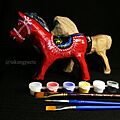
Handmade taka paper horse craft kit from the Philippines
-
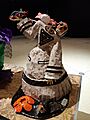
A colorful Catrina skeleton figure displayed in Mexico
-
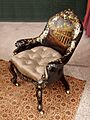
An antique chair decorated with painted lacquer and shiny pearl shell
-
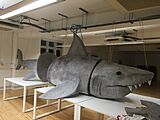
A handmade papier-mâché shark hanging on display
-
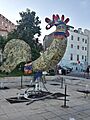
A giant colorful papier-mâché rooster sculpture
-
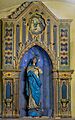
An Italian cartapesta statue inside a church in Brescia
.jpg)


See also
- Decoupage
- Gemma Taccogna
- Hanji (Korean paper art)
- Japanning
- Papier-mâché binding
- Papier-mâché Tiara
- Russian lacquer art
- Slavic paper cutting
- Wet-folding
