
Green card facts for kids
Quick facts for kids United States permanent resident card |
|
|---|---|
 |
|

A sample of a Permanent Resident Card (often called a "green card") of the United States (2023)
|
|
| Type | Personal identification document |
| Issued by |  United States Citizenship and Immigration Services United States Citizenship and Immigration Services |
| Purpose | Identification |
| Expiration | 10 years (standard) 2 years (conditional) |
A green card, officially called a permanent resident card, is an identity document. It shows that a person has the right to live permanently in the United States. People who hold a green card are known as lawful permanent residents (LPRs). As of 2024, about 12.8 million people have green cards. Almost 9 million of them can apply to become U.S. citizens. Around 18,700 green card holders serve in the U.S. Armed Forces.
Green card holders can apply for U.S. citizenship after living in the United States for one to five years. They must also show they are good people. Young people under 18 automatically become U.S. citizens if they have at least one U.S. citizen parent.
The card is called a "green card" because it used to be greenish in color. In the past, it had other names like "certificate of alien registration." Green card holders must carry their card with them at all times.
The United States Citizenship and Immigration Services (USCIS) decides who gets a green card. Sometimes, a judge might grant permanent residency. Green card holders must follow all U.S. laws. If they commit serious crimes, they could lose their green card and be asked to leave the country.
Contents
History of the Green Card

The Immigration and Naturalization Service (INS) was created in 1933. It later moved under the Department of Justice in 1940. During the 1940s, the card was called the "Alien Registration Receipt Card." It showed "Perm.Res" on the back, meaning "Permanent Resident."
In 1952, the U.S. Congress passed a law that defined an "alien" as anyone who is not a U.S. citizen.


A green card holder can apply to become a U.S. citizen after living in the U.S. for five years. This time can be shorter, like three years, if they are married to a U.S. citizen. It can also be one year if they serve in the U.S. armed forces. Applicants must show they are good people. They also need to pass an English test and a civics test. They must show they support the U.S. Constitution.
Like U.S. citizens, green card holders can help certain family members move to the United States. However, there is a limit to how many family members can come each year. This can sometimes cause long waiting times.
How People Get Green Cards
People from other countries can get a green card to live permanently in the United States in several ways:
- Being sponsored by a family member who is a U.S. citizen or green card holder.
- Through a job offer from a U.S. employer.
- As a special immigrant, like a religious worker.
- Through a special program called the Diversity Visa Lottery.
- For certain people who have lived in the U.S. continuously since before January 1, 1972.
Applying for a Green Card
The process to get a green card can take several years. It depends on the type of immigration and the person's home country. Usually, there are three main steps:
- Immigrant petition – First, a family member, an employer, or sometimes the applicant themselves, asks USCIS to approve their request. For example, a U.S. citizen might file a petition for their parent.
- Immigrant visa availability – Next, a visa number must be available. The number of immigrant visas given out each year is limited by law. This means many people are placed on waiting lists. However, immediate family members of U.S. citizens (spouses, children under 21, and parents) do not have to wait for a visa number.
- Immigrant visa decision – Once a visa number is available, the applicant either adjusts their status if they are already in the U.S. or applies for a visa at a U.S. consulate in their home country.
- Adjusting Status – This is for people already in the United States who entered legally. They apply to change their current status to permanent resident status. USCIS does background checks, including fingerprints. If approved, the person becomes a green card holder.
- Consular Processing – This is for people outside the United States. They apply for an immigrant visa at a U.S. embassy or consulate. If approved, they get a visa to travel to the U.S. Once they arrive, they become a permanent resident.
While waiting for a decision, applicants in the U.S. can sometimes get two temporary permits:
- A temporary work permit, called an Employment Authorization Document (EAD). This allows them to work legally.
- A temporary travel document, called advance parole. This allows them to leave and re-enter the United States.

Applying for a Family-Sponsored Visa
U.S. citizens can sponsor these relatives for a green card:
- Spouses and unmarried children under 21.
- Parents (if the U.S. citizen is at least 21 years old).
- Unmarried children over 21.
- Married children.
- Brothers and sisters (if the U.S. citizen is at least 21 years old).
U.S. green card holders can sponsor these relatives:
- Spouses and unmarried children under 21.
- Unmarried children over 21.
The U.S. Department of State publishes a "Visa Bulletin" each month. This bulletin shows the waiting times for different family categories. There is no waiting period for spouses, unmarried children under 21, and parents of U.S. citizens. However, other family categories can have long waiting times.
The process starts with filing a form called I-130, "Petition for Alien Relative." Later, applicants need to provide more personal information and have a medical exam.
Applying for an Employment-Based Visa
Many people get green cards through their jobs. Usually, an employer "sponsors" the person. This means the employer asks USCIS to approve the immigrant based on a future job.
The process often involves these steps:
- Job Certification – The employer must show that they need to hire someone from another country for a specific job. They must also prove that no qualified U.S. citizen or green card holder is available for that job. This involves advertising the job and showing the required skills.
- Immigrant Petition – The employer then files a form called I-140, "Immigrant Petition for Alien Workers," with USCIS. There are different job-based categories, some with shorter waiting times for highly skilled workers.
- Visa Availability – After the petition is approved, the case goes to the National Visa Center. A visa becomes available when the applicant's "priority date" is reached on the Visa Bulletin. Because there are limits on how many job-based visas are given each year, there can be long waiting lists.
- Visa Decision – Once a visa is available, the applicant completes the process either by adjusting their status in the U.S. or by applying at a U.S. consulate abroad. Before the final decision, applicants usually need a medical exam from a special doctor.
Green Card Lottery
Each year, up to 55,000 immigrant visas are given out through the Diversity Visa (DV) program. This is also known as the Green Card Lottery. It is for people born in countries that have sent fewer than 50,000 immigrants to the U.S. in the past five years.
If someone is chosen in this lottery, they get the chance to apply for permanent residence. They can also apply for their spouse and any unmarried children under 21. If permanent residence is granted, the winner receives an immigrant visa. This visa must be used to enter the U.S. within six months. Once in the U.S., they become a permanent resident. The actual green card usually arrives by mail a few months later.
Green Card Lottery Scams
Be careful of fake green card lottery scams! Some people pretend to be official agents and ask for money to submit applications. They might promise to increase your chances of winning, but this is not true. They might also promise free airline tickets or other benefits, which are usually false.
Always use only official U.S. government websites. These websites will always end in "`.gov`".
Green Card Lottery Email Fraud
Watch out for scam emails! Some emails pretend to be from the U.S. government. They ask you to send money online as a "processing fee." These emails are designed to steal money. They often use fake email addresses and logos. A real government email address will always end with "`.gov`". If an email asks you to wire money to an individual, especially to a foreign address, it is likely a scam. The USCIS has warned people about these types of scams.
Rights and Responsibilities of a Green Card Holder
Green card holders have certain rights and duties, just like U.S. citizens.
Green card holders can work in many types of jobs in the U.S. They can own property and live anywhere in the country. They can also start businesses.
Green card holders must also follow certain rules. For example, male green card holders between 18 and 25 years old must register with the Selective Service System. They must also pay taxes on all their income, no matter where it comes from. Green card holders cannot vote in federal elections. They also cannot be elected to federal office. However, they may be able to vote in some local elections.
Rights
- Live permanently in the United States, as long as they follow the laws.
- Join and serve in the United States Armed Forces and many law enforcement agencies.
- Work anywhere in the United States (except for some federal jobs that need special security checks).
- Be protected by the laws of the United States, their state, and local areas.
- Travel outside the United States for up to one year as a tourist.
- Sponsor certain family members (like spouses and unmarried children) to immigrate to the United States.
Responsibilities
- Obey all laws of the United States, including state and local laws.
- File income tax returns and report all income to the U.S. Internal Revenue Service (IRS) and state tax offices.
- Register with the Selective Service System (if male and between 18 and 25 years old).
Conditional Permanent Residents
Some people get a green card on a conditional basis for two years. This usually happens if they got their green card through a recent marriage to a U.S. citizen or as an investor. If a U.S. citizen sponsors a spouse and their marriage is already more than two years old, the green card is usually issued for 10 years right away.
When the two-year conditional period is almost over, the person must apply to have the conditions removed. This is done by filing a form with USCIS. For a marriage-based green card, both spouses usually need to sign the form. They must show proof that their marriage was real and not just to get a green card. This might include birth certificates of children, joint bank statements, and letters from friends.
Once the conditions are removed, the person gets a new green card that is valid for 10 years. This new card replaces the old two-year conditional card. The permanent resident status is now for an unlimited time, as long as they continue to meet the requirements.
Differences Between Permanent and Conditional Permanent Residents
Conditional permanent residents have all the same rights and duties as other green card holders. The only difference is that they must meet certain conditions (like proving their marriage is real) before the two-year period ends.
Losing a Green Card
A green card holder can choose to give up their permanent residence by filing a form at a U.S. Embassy.
However, a person can also lose their green card without wanting to. This can happen if they:
- Commit a serious crime.
- Move to another country to live there permanently.
- Stay outside the U.S. for more than one year without a special permit.
- Do not file their U.S. income tax returns.
- It is found that they got their green card through fraud.
If a person loses their green card, they must leave the United States. They might also be banned from entering the country again for a certain period.
Visa-Free Travel for U.S. Permanent Residents
Green card holders can travel to certain countries and territories without needing a separate visa for tourism. Here are some examples:
 Albania: 90 days within 180 days
 Anguilla: 90 days
 Antigua and Barbuda: 30 days
 Bahamas: 30 days
 Belize: Can get a visa on arrival with prior approval (fee applies).
 Bermuda
 Bosnia and Herzegovina: 90 days within 180 days
 British Virgin Islands: 1 month
 Canada: 6 months
 Cayman Islands: 30 days
 Costa Rica: 30 days
 Dominica: 6 months
 Dominican Republic: 30 days
 Dutch Caribbean (Aruba, Curaçao, Sint Maarten, Caribbean Netherlands): 30 days
 Georgia: 90 days within 180 days
 Guatemala: 90 days
 Honduras: 90 days
 Jamaica: 90 days
 Kosovo: 15 days
 Mexico: 180 days
 Montenegro: 30 days
 Nicaragua: 3 months
 Panama: 90 days
 Serbia: 90 days
 Turks and Caicos Islands: 30 days
Images for kids
-
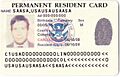
A pre-2008 Permanent Resident Card.

See also
 In Spanish: Green Card para niños
- Blue Card (European Union)
- Canada Permanent Resident Card (PR Card), a similar document in Canada
- Chinese Foreign Permanent Resident Identity Card
- Indefinite leave to remain in the United Kingdom
- Permanent residency
- Green card marriage
