
United States men's national ice hockey team facts for kids
 |
|
| Nickname(s) | Team USA |
|---|---|
| Association | USA Hockey |
| General Manager | Bill Guerin |
| Head coach | Mike Sullivan |
| Assistants | John Hynes David Quinn John Tortorella |
| Captain | Auston Matthews |
| Most games | Mark Johnson |
| Most points | Mark Johnson (146) |
| IIHF code | USA |
| IIHF ranking | 4  (May 28, 2023) (May 28, 2023) |
| Highest IIHF ranking | 1 (2025) |
| Lowest IIHF ranking | 7 (2003, 2006–07, 2012) |
| Team colors | |
 |
|
| First international | |
United States  29–0 29–0 .svg) Switzerland Switzerland(Antwerp, Belgium; April 24, 1920) |
|
| Biggest win | |
United States 31–1  Italy Italy(St. Moritz, Switzerland; February 1, 1948) |
|
| Biggest defeat | |
Sweden  17–2 17–2  United States United States(Stockholm, Sweden; March 12, 1963) Soviet Union  17–2 United States 17–2 United States(Stockholm, Sweden; March 15, 1969) |
|
| IIHF World Championships | |
| Appearances | 76 (first in 1920) |
| Best result |  Gold: 3 (1933, 1960, 2025) Gold: 3 (1933, 1960, 2025) |
| Canada Cup / World Cup | |
| Appearances | 8 (first in 1976) |
| Best result |  Winner: (1996) Winner: (1996) |
| Olympics | |
| Appearances | 25 (first in 1920) |
| Medals |  Gold: 3 (1960, 1980, 2026) Gold: 3 (1960, 1980, 2026) Silver: 8 (1920, 1924, 1932, 1952, 1956, 1972, 2002, 2010) Silver: 8 (1920, 1924, 1932, 1952, 1956, 1972, 2002, 2010) Bronze: 1 (1936) Bronze: 1 (1936) |
| International record (W–L–T) | |
| 580–500–87 | |
| Medal record | ||
|---|---|---|
| Olympic Games | ||
 |
1960 Squaw Valley | Team |
|
1980 Lake Placid | Team |
|
2026 Milano-Cortina | Team |
 |
1920 Antwerp | Team |
|
1924 Chamonix | Team |
|
1932 Lake Placid | Team |
|
1952 Oslo | Team |
|
1956 Cortina d'Ampezzo | Team |
|
1972 Sapporo | Team |
|
2002 Salt Lake City | Team |
|
2010 Vancouver | Team |
 |
1936 Garmisch-Partenkirchen | Team |
| World Championships | ||
|
1933 Czechoslovakia | |
|
1960 United States | Team |
|
2025 Sweden–Denmark | |
|
1920 Belgium | Team |
|
1924 France | Team |
|
1931 Poland | |
|
1932 United States | Team |
|
1934 Italy | |
|
1939 Switzerland | |
|
1950 Great Britain | |
|
1952 Norway | Team |
|
1956 Italy | Team |
|
1936 Germany | Team |
|
1949 Sweden | |
|
1962 United States | |
|
1996 Austria | |
|
2004 Czech Republic | |
|
2013 Sweden & Finland | |
|
2015 Czech Republic | |
|
2018 Denmark | |
|
2021 Latvia | |
| Canada Cup / World Cup | ||
|
1996 Montreal | |
|
1991 Hamilton | |
| Four Nations Face-Off | ||
|
2025 Boston | |
The United States men's national ice hockey team, often called Team USA, plays for the United States in international ice hockey games. USA Hockey manages the team, overseeing ice hockey in the US. As of May 2025, Team USA was ranked number one in the world by the International Ice Hockey Federation.
Team USA has won gold medals at the 1960, 1980, and 2026 Winter Olympics. They also earned silver medals in 2002 and 2010. The team also won the 1996 World Cup of Hockey, beating their rivals Canada in the final. In 2025, they won a historic gold medal at the World Championships. This was their first World Championship win since 1933 (not counting the 1960 Olympics, which also counted as a World Championship). For a long time, the US often sent younger players to the World Championships instead of their top NHL stars. This gave new players valuable experience. However, this approach changed in the 2020s. Overall, Team USA has won many medals. They have three Olympic gold medals and 21 World Championship medals (including the 1960 Olympic gold). They also won the Canada Cup/World Cup once.
Team USA is one of the best ice hockey teams globally. They are part of the "Big Six" nations. These are the six strongest men's ice hockey teams. The other teams are Canada, the Czech Republic, Finland, Russia, and Sweden.
Contents
The Story of Team USA Hockey
Team USA first played international ice hockey at the 1920 Summer Olympics in Antwerp, Belgium. Ice hockey was a new Olympic sport then. They won a silver medal, coming in second to Canada. Throughout the 1920s and early 1930s, American teams played very well. They won silver medals at the 1924 and 1932 Winter Olympics. They also earned silver at the 1931 World Championships. Back then, the US teams were usually made up of amateur players. These players came from college teams or top American clubs. It wasn't a permanent national team like today.

In 1933, the United States won its first World Championship. A team called the Massachusetts Rangers (also known as Boston Olympics) beat Canada in Prague. Sherman Forbes scored early in the game. The score was tied until John Garrison scored the winning goal in overtime. The US team, coached by Walter A. Brown, won gold. Goaltender Gerry Cosby helped them beat Canada, a very strong team. About 12,000 fans watched this exciting win.
After their big win in 1933, the US team kept playing well. They were always a strong competitor. But they often just missed winning the top prize. They won silver medals at the World Championships in 1934, 1939, and 1950. They also won silver at the 1952 and 1956 Winter Olympics. Many of these teams featured great amateur and college players. For example, John Mayasich from the University of Minnesota was a star. He led the US in scoring at the 1956 Olympics.
The United States won gold again at the 1960 Winter Olympics in Squaw Valley, California. They beat many strong teams to win. These included the Soviet Union, Canada, Czechoslovakia, and Sweden. This win is sometimes called the "Forgotten Miracle." This is because the 1980 victory became more famous.


The most famous success for American ice hockey was the "Miracle on Ice" in 1980. At the Winter Olympics in Lake Placid, New York, a team of American college players did something amazing. They beat the very strong Soviet Union team. The Soviet team had many experienced professional players. This win helped the US team earn a gold medal. Even though ice hockey isn't the biggest sport everywhere in the US, the "Miracle" is a legendary moment. Many people consider it one of America's greatest sports achievements. The US team won the gold medal by beating Finland in the final game. Coach Herb Brooks led the team. Mark Johnson was the top scorer. Goaltender Jim Craig made the most saves. He also had the best save percentage. This incredible victory later inspired the movie Miracle in 2004. The film shared the "Miracle on Ice" story with new fans.
In the 1980s and 1990s, American ice hockey talent grew a lot. Many future NHL stars emerged. Some of these players later joined the Hockey Hall of Fame. They included Tony Amonte, Chris Chelios, Brett Hull, Pat LaFontaine, Brian Leetch, and Mike Modano. From 1981 to 1994, the US team didn't finish higher than fourth in major tournaments. This was because they used amateur players. Other countries often used professionals. This long wait prepared them for a big win later on. After finishing second in the 1991 Canada Cup, the US team had a huge victory. They won the 1996 World Cup of Hockey. This was the first time this tournament was held, replacing the Canada Cup.
Coach Ron Wilson led Team USA. They surprised everyone by beating a very strong Canadian team. Canada was a favorite to win. The US lost the first game. But they came back to win two games in a row in Canada. The final game was a thrilling 5–2 victory in Montreal. Goaltender Mike Richter played incredibly well. He stopped many shots and was named the tournament's best player. Brett Hull led the team with seven goals. Tony Amonte scored the winning goal in Game 3. Captain Chris Chelios and Brian Leetch were strong defensemen. Forwards like Keith Tkachuk, John LeClair, and Mike Modano added speed and many goals. This win was the first major title for the US men's team. It showed that American hockey had grown up. It proved the US could beat Canada and other top teams.
Six years later, the International Olympic Committee and NHL worked together. They allowed NHL players to play in the Olympics. The US team won a silver medal at the 2002 Winter Olympics. Their team included NHL stars like Adam Deadmarsh, Chris Drury, Brian Rafalski, and Brian Rolston. By the 2006 Olympics, many of those NHL players were older or had retired. The 2006 team finished 8th, which was not what they hoped for. But it was a team with many young NHL players. These included Rick DiPietro, John-Michael Liles, and Jordan Leopold.

The 2010 US Olympic team was much younger and faster. It included players like David Backes, Patrick Kane, Phil Kessel, and Zach Parise. The team also had experienced stars. Goalie Ryan Miller and captain Jamie Langenbrunner were key players. The US team beat Canada 5–3 in the first round. This made them the top seed for the knockout games. After beating Finland 6–1, the US reached the gold medal game. They lost to Canada 3–2 in overtime, earning a silver medal. Over 27 million US homes watched this final game. It was the most-watched hockey game in America since the 1980 "Miracle on Ice."
At the 2014 Winter Olympics, the United States finished fourth. They lost to Finland in the bronze medal game. In a game against Russia, T. J. Oshie became famous. The game was tied after regular time and overtime. Coach Dan Bylsma kept sending Oshie out for the shootout. Oshie took five shots in a row. He scored four of his six total attempts. His final goal won the game 3–2 for the US.
For the 2018 Olympics, the NHL did not allow its players to participate. This was due to disagreements about insurance and marketing rules. This put the American team at a disadvantage. Many NHL players are American. So, the US team had to quickly put together a team. It included players from European leagues, minor leagues, and colleges. The team did not do well. They lost to Slovenia and the Olympic Athletes from Russia. They were eliminated by the Czechs in the quarterfinals. The Russian team, however, benefited from the NHL's absence. They won the tournament with many players from their own KHL league. These included former NHL stars like Pavel Datsyuk and Ilya Kovalchuk.
The NHL also pulled out of the 2022 Winter Olympics at the last minute. This was due to scheduling problems caused by the COVID-19 pandemic. The United States finished fifth. They had a surprising shootout loss to Slovakia. This meant they did not win a medal for the third Olympics in a row. Even though they had mostly college players, the team played well in the first round. They even beat rival Canada. But they lost in the quarterfinals.
In February 2024, Bill Guerin was named general manager for Team USA. He would lead the team for the Four Nations Face-Off and 2026 Winter Olympics. In May, Mike Sullivan became the head coach for both events. The Four Nations Face-Off was the first major international tournament with top players since 2016. The NHL had not allowed players in the Olympics for a long time. Also, top stars often missed the World Championships. Russia was not allowed to play in this tournament. The opening game against Canada was very intense. Three fights broke out in the first nine seconds. Brothers Matthew and Brady Tkachuk were involved. Team USA won that game 3–1. But they lost to Canada 3–2 in overtime in the championship game. Despite the loss, the US showed they are a top team. They are ready for the next Winter Olympics, which will again feature NHL players.
_by_Sandro_Halank%E2%80%93027.jpg)
In 2025, the United States won its first World Championship since 1933. They beat Switzerland in the gold-medal game. This ended a 92-year wait for a standalone World Championship title. The 1960 Olympic gold also counted as a World Championship. But the 2025 win was their first at a separate World Championship tournament since 1933. Tage Thompson scored the winning goal in overtime against Switzerland. This secured the historic victory.
Team USA's Competitive Record
Olympic Games Results
| Games | GP | W | L | T | GF | GA | Coach | Captain | Round | Position |
|---|---|---|---|---|---|---|---|---|---|---|
 1920 Antwerp 1920 Antwerp |
4 | 3 | 1 | 0 | 52 | 2 | Cornelius Fellowes Roy Schooley |
Joe McCormick | Silver medal round |  Silver Silver
|
 1924 Chamonix 1924 Chamonix |
5 | 4 | 1 | 0 | 73 | 6 | William S. Haddock | Irving Small | Final round | Silver
|
 1928 St. Moritz 1928 St. Moritz |
Did not participate | |||||||||
| 1932 Lake Placid |
6 | 4 | 1 | 1 | 27 | 5 | Alfred Winsor | John Chase | Final round | Silver
|
 1936 Garmisch-Partenkirchen 1936 Garmisch-Partenkirchen |
8 | 5 | 2 | 1 | 10 | 4 | Albert Prettyman | John Garrison | Final round |  Bronze Bronze |
| 1948 St. Moritz |
8 | 5 | 3 | 0 | 86 | 33 | John Garrison | Goodwin Harding | Round-robin | 4th, DSQ |
 1952 Oslo 1952 Oslo |
8 | 6 | 1 | 1 | 43 | 21 | Connie Pleban | Allen Van | Round-robin | Silver
|
 1956 Cortina d'Ampezzo 1956 Cortina d'Ampezzo |
7 | 5 | 2 | 0 | 33 | 16 | John Mariucci | Gene Campbell | Final round | Silver
|
 1960 Squaw Valley 1960 Squaw Valley |
7 | 7 | 0 | 0 | 48 | 17 | Jack Riley | Jack Kirrane | Final round |  Gold Gold
|
 1964 Innsbruck 1964 Innsbruck |
7 | 2 | 5 | 0 | 29 | 33 | Eddie Jeremiah | Herb Brooks Bill Reichart |
Round-robin | 5th |
| 1968 Grenoble |
7 | 2 | 4 | 1 | 23 | 28 | Murray Williamson | Lou Nanne | Round-robin | 6th |
 1972 Sapporo 1972 Sapporo |
6 | 4 | 2 | 0 | 23 | 18 | Tim Sheehy | Round-robin | Silver
|
|
| 1976 Innsbruck |
6 | 3 | 3 | 0 | 23 | 25 | Bob Johnson | John Taft | Round-robin | 5th |
 1980 Lake Placid 1980 Lake Placid |
7 | 6 | 0 | 1 | 33 | 15 | Herb Brooks | Mike Eruzione | Final round | Gold
|
 1984 Sarajevo 1984 Sarajevo |
6 | 2 | 2 | 2 | 23 | 21 | Lou Vairo | Phil Verchota | 7th place game | 7th |
 1988 Calgary 1988 Calgary |
6 | 3 | 3 | 0 | 35 | 31 | Dave Peterson | Brian Leetch | 7th place game | 7th |
| 1992 Albertville |
8 | 5 | 2 | 1 | 25 | 19 | Clark Donatelli | Bronze medal game | 4th | |
| 1994 Lillehammer |
8 | 1 | 4 | 3 | 28 | 32 | Tim Taylor | Peter Laviolette | 7th place game | 8th |
 1998 Nagano 1998 Nagano |
4 | 1 | 3 | 0 | 9 | 14 | Ron Wilson | Chris Chelios | Quarter-finals | 6th |
| 2002 Salt Lake City |
6 | 4 | 1 | 1 | 26 | 10 | Herb Brooks | Gold medal game | Silver
|
|
| 2006 Turin |
6 | 1 | 4 | 1 | 16 | 17 | Peter Laviolette | Quarter-finals | 8th | |
| 2010 Vancouver |
6 | 5 | 1 | — | 24 | 9 | Ron Wilson | Jamie Langenbrunner | Gold medal game | Silver
|
 2014 Sochi 2014 Sochi |
6 | 4 | 2 | — | 20 | 12 | Dan Bylsma | Zach Parise | Bronze medal game | 4th |
 2018 Pyeongchang 2018 Pyeongchang |
5 | 2 | 3 | — | 11 | 12 | Tony Granato | Brian Gionta | Quarter-finals | 7th |
 2022 Beijing 2022 Beijing |
4 | 3 | 1 | — | 17 | 7 | David Quinn | Andy Miele | Quarter-finals | 5th |
| 2026 Milan / Cortina d'Ampezzo |
— | Mike Sullivan | Auston Matthews | Gold medal game | Gold
|
|||||
| 2030 French Alps |
Future event | |||||||||
Results Against "Big Six" Teams
| Opponents | Played | Won | Tied | Lost | Biggest victory | Biggest defeat |
|---|---|---|---|---|---|---|
.svg) Canada Canada |
19 | 4 | 3 | 12 | 4–1 | 3–12 |
 Czechoslovakia/ Czech Republic Czechoslovakia/ Czech Republic |
21 | 10 | 0 | 11 | 16–0 | 1–7 |
 Finland Finland |
13 | 7 | 2 | 4 | 8–2, 6–0 | 1–6, 0–5 |
 Soviet Union/ Soviet Union/ CIS/ CIS/ Russia Russia |
14 | 4 | 1 | 9 | 4–3, 3–2 (x3) | 2–10 |
 Sweden Sweden |
15 | 6 | 2 | 7 | 20–0 | 1–5 |
| Total | 81 | 30 | 8 | 43 | 20–0 | 3–12 |
World Championships Results
- Note: Between 1920 and 1968, the Olympic ice hockey tournament was also considered the World Championship for that year.
- Note: World War II forced cancellation of all tournaments from 1940 to 1946.
- Note: In 1972, a separate tournament was held both for the World Championships and the Winter Olympics for the first time.
- Note: No World Championships were held during the Olympic years 1980, 1984, and 1988.
- Note: The 2020 tournament was cancelled due to the COVID-19 pandemic.
- 1920 – Silver
- 1924 – Silver
- 1928 – did not participate
- 1930 – did not participate
- 1931 – Silver
- 1932 – Silver
- 1933 – Gold
- 1934 – Silver
- 1935 – did not participate
- 1936 – Bronze
- 1937 – did not participate
- 1938 – 7th place
- 1939 – Silver
- 1947 – 5th place
- 1948 – 4th place
- 1949 – Bronze
- 1950 – Silver
- 1951 – 6th place
- 1952 – Silver
- 1953 – did not participate
- 1954 – did not participate
- 1955 – 4th place
- 1956 – Silver
- 1957 – did not participate
- 1958 – 5th place
- 1959 – 4th place
- 1960 – Gold
- 1961 – 6th place
- 1962 – Bronze
- 1963 – 8th place
- 1964 – 5th place
- 1965 – 6th place
- 1966 – 6th place
- 1967 – 5th place
- 1968 – 6th place
- 1969 – 6th place (relegated to Group B)
- 1970 – 7th place (1st in Group B, promoted to Group A)
- 1971 – 6th place (relegated to Group B)
- 1972 – 8th place (2nd in Group B)
- 1973 – 8th place (2nd in Group B)
- 1974 – 7th place (1st in Group B, promoted to Group A)
- 1975 – 6th place
- 1976 – 4th place
- 1977 – 6th place
- 1978 – 6th place
- 1979 – 7th place
- 1981 – 5th place
- 1982 – 8th place (relegated to Group B)
- 1983 – 9th place (1st in Group B, promoted to Group A)
- 1985 – 4th place
- 1986 – 6th place
- 1987 – 7th place
- 1989 – 6th place
- 1990 – 5th place
- 1991 – 4th place
- 1992 – 7th place
- 1993 – 6th place
- 1994 – 4th place
- 1995 – 6th place
- 1996 – Bronze
- 1997 – 6th place
- 1998 – 12th place
- 1999 – 6th place
- 2000 – 5th place
- 2001 – 4th place
- 2002 – 7th place
- 2003 – 13th place
- 2004 – Bronze
- 2005 – 6th place
- 2006 – 7th place
- 2007 – 5th place
- 2008 – 6th place
- 2009 – 4th place
- 2010 – 13th place
- 2011 – 8th place
- 2012 – 7th place
- 2013 – Bronze
- 2014 – 6th place
- 2015 – Bronze
- 2016 – 4th place
- 2017 – 5th place
- 2018 – Bronze
- 2019 – 7th place
- 2021 – Bronze
- 2022 – 4th place
- 2023 – 4th place
- 2024 – 5th place
- 2025 – Gold
- 2026 –
Canada Cup / World Cup of Hockey Results
| Games | GP | W | L | T | GF | GA | Coach | Captain | Round | Position |
|---|---|---|---|---|---|---|---|---|---|---|
| 1976 | 5 | 1 | 3 | 1 | 14 | 21 | Bob Pulford | Bill Nyrop | Group stage | 5th |
| 1981 | 6 | 2 | 3 | 1 | 18 | 23 | Bob Johnson | Robbie Ftorek | Semi-finals | 4th |
| 1984 | 6 | 3 | 2 | 1 | 23 | 22 | Bob Johnson | Rod Langway | Semi-finals | 4th |
| 1987 | 5 | 2 | 3 | 0 | 13 | 14 | Bob Johnson | Rod Langway | Group stage | 5th |
| 1991 | 8 | 5 | 3 | 0 | 29 | 26 | Bob Johnson | Joel Otto | Finals | Silver
|
| 1996 | 7 | 6 | 1 | 0 | 37 | 18 | Ron Wilson | Brian Leetch | Finals | Gold
|
| 2004 | 5 | 2 | 3 | 0 | 11 | 11 | Ron Wilson | Chris Chelios | Semi-finals | 4th |
| 2016 | 3 | 0 | 3 | — | 5 | 11 | John Tortorella | Joe Pavelski | Group stage | 7th |
Results Against "Big Six" Teams (Canada Cup / World Cup)
| Opponents | Played | Won | Tied | Lost | Biggest victory | Biggest defeat |
|---|---|---|---|---|---|---|
| Canada |
14 | 3 | 1 | 10 | 5–2 (x2) | 3–8 |
| Czechoslovakia/ Czech Republic |
6 | 3 | 1 | 2 | 6–2 | 1–3 |
| Finland |
6 | 4 | 1 | 1 | 7–3 | 1–2 |
| Soviet Union/ CIS/ Russia |
9 | 4 | 0 | 5 | 5–2 (x2) | 0–5 |
| Sweden |
6 | 4 | 0 | 2 | 7–1 | 2–9 |
| Total | 41 | 18 | 3 | 20 | 7–1 | 2–9 |
4 Nations Face-Off Results
| Games | GP | W | L | GF | GA | Coach | Captain | Position |
|---|---|---|---|---|---|---|---|---|
| 2025 | 4 | 2 | 2 | 12 | 7 | Mike Sullivan | Auston Matthews | Silver
|
Team Roster for the 2026 Winter Olympics
The first six players for the United States' team were announced on June 16, 2025. The rest of the team was revealed on January 2, 2026. On January 21, defenseman Seth Jones was unable to play due to an injury. Jackson LaCombe took his place. On February 8, Auston Matthews was named captain. Charlie McAvoy and Matthew Tkachuk were chosen as alternate captains.
Head coach: Mike Sullivan
| No. | Pos. | Name | Height | Weight | Birthdate | Team |
|---|---|---|---|---|---|---|
| 1 | G | Jeremy Swayman | 1.91 m (6 ft 3 in) | 88 kg (194 lb) | 24 November 1998 (aged 27) | Boston Bruins |
| 2 | D | Jackson LaCombe | 1.88 m (6 ft 2 in) | 93 kg (205 lb) | 9 January 2001 (aged 25) | Anaheim Ducks |
| 7 | F | Brady Tkachuk | 1.93 m (6 ft 4 in) | 102 kg (225 lb) | 16 September 1999 (aged 26) | Ottawa Senators |
| 8 | D | Zach Werenski | 1.88 m (6 ft 2 in) | 98 kg (216 lb) | 19 July 1997 (aged 28) | Columbus Blue Jackets |
| 9 | F | Jack Eichel | 1.88 m (6 ft 2 in) | 94 kg (207 lb) | 28 October 1996 (aged 29) | Vegas Golden Knights |
| 10 | F | J. T. Miller | 1.85 m (6 ft 1 in) | 95 kg (209 lb) | 14 March 1993 (aged 32) | New York Rangers |
| 12 | F | Matt Boldy | 1.88 m (6 ft 2 in) | 91 kg (201 lb) | 5 April 2001 (aged 24) | Minnesota Wild |
| 14 | D | Brock Faber | 1.85 m (6 ft 1 in) | 91 kg (201 lb) | 22 August 2002 (aged 23) | Minnesota Wild |
| 15 | D | Noah Hanifin | 1.91 m (6 ft 3 in) | 93 kg (205 lb) | 25 January 1997 (aged 29) | Vegas Golden Knights |
| 16 | F | Vincent Trocheck | 1.80 m (5 ft 11 in) | 85 kg (187 lb) | 11 July 1993 (aged 32) | New York Rangers |
| 19 | F | Matthew Tkachuk – A | 1.88 m (6 ft 2 in) | 91 kg (201 lb) | 11 December 1997 (aged 28) | Florida Panthers |
| 21 | F | Dylan Larkin | 1.85 m (6 ft 1 in) | 93 kg (205 lb) | 30 July 1996 (aged 29) | Detroit Red Wings |
| 25 | D | Charlie McAvoy – A | 1.85 m (6 ft 1 in) | 95 kg (209 lb) | 21 December 1997 (aged 28) | Boston Bruins |
| 29 | F | Brock Nelson | 1.93 m (6 ft 4 in) | 93 kg (205 lb) | 15 October 1991 (aged 34) | Colorado Avalanche |
| 30 | G | Jake Oettinger | 1.98 m (6 ft 6 in) | 102 kg (225 lb) | 18 December 1998 (aged 27) | Dallas Stars |
| 34 | F | Auston Matthews – C | 1.91 m (6 ft 3 in) | 98 kg (216 lb) | 17 September 1997 (aged 28) | Toronto Maple Leafs |
| 37 | G | Connor Hellebuyck | 1.93 m (6 ft 4 in) | 94 kg (207 lb) | 19 May 1993 (aged 32) | Winnipeg Jets |
| 43 | D | Quinn Hughes | 1.78 m (5 ft 10 in) | 82 kg (181 lb) | 14 October 1999 (aged 26) | Minnesota Wild |
| 59 | F | Jake Guentzel | 1.80 m (5 ft 11 in) | 82 kg (181 lb) | 6 October 1994 (aged 31) | Tampa Bay Lightning |
| 72 | F | Tage Thompson | 1.98 m (6 ft 6 in) | 100 kg (220 lb) | 30 October 1997 (aged 28) | Buffalo Sabres |
| 74 | D | Jaccob Slavin | 1.91 m (6 ft 3 in) | 94 kg (207 lb) | 1 May 1994 (aged 31) | Carolina Hurricanes |
| 81 | F | Kyle Connor | 1.85 m (6 ft 1 in) | 83 kg (183 lb) | 9 December 1996 (aged 29) | Winnipeg Jets |
| 85 | D | Jake Sanderson | 1.88 m (6 ft 2 in) | 92 kg (203 lb) | 8 July 2002 (aged 23) | Ottawa Senators |
| 86 | F | Jack Hughes | 1.80 m (5 ft 11 in) | 80 kg (176 lb) | 14 May 2001 (aged 24) | New Jersey Devils |
| 91 | F | Clayton Keller | 1.78 m (5 ft 10 in) | 79 kg (174 lb) | 29 July 1998 (aged 27) | Utah Mammoth |
IIHF World Championship Awards
The IIHF gives awards to the best players at each World Championship. These awards are for the top goalie, defenseman, and forward. They also give an award for the most valuable player (MVP). Here are the American players who have won these awards:
- 1955 – Don Rigazio (goalie)
- 1956 – Willard Ikola (goalie)
- 1959 – Bill Cleary (forward)
- 1960 – Jack McCartan (goalie)
- 1962 – John Mayasich (defenseman)
- 1967 – Carl Wetzel (goalie)
- 2004 – Ty Conklin (goalie)
- 2014 – Seth Jones (defenseman)
- 2018 – Patrick Kane (MVP)
- 2021 – Cal Petersen (goalie)
- 2025 – Zach Werenski (defenseman)
Team Uniforms Over Time
- National team uniforms
-
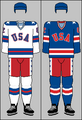
1980 Olympic uniforms
-
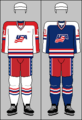
1988 Olympic uniforms
-
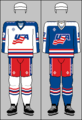
1989–1992 uniforms
-
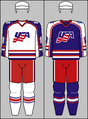
1994 Olympic uniforms
-
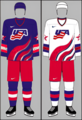
1996 WCH uniforms
-
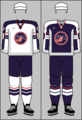
1998 Olympic uniforms, later used at IIHF tournaments in 1998–2000
-
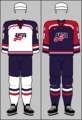
2001–2004 uniforms
-
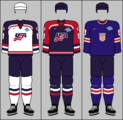
2004 WCH uniforms
-
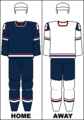
2013 IIHF uniforms (no USA Hockey logo)
-
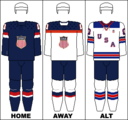
2014 Olympic uniforms
-
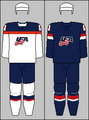
IIHF uniforms 2014–2017
-
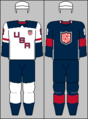
2016 WCH uniforms
-
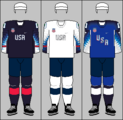
2018 Olympic uniforms
-
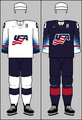
IIHF uniforms 2018–2021
-
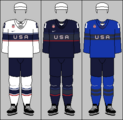
2022 Olympic uniforms
-
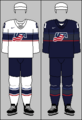
IIHF uniforms 2022–2024
-
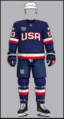
Four Nations Face-Off uniforms
-
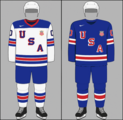
IIHF uniforms 2025–present
-
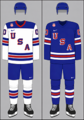
2026 Olympic uniforms
.png)
.png)
.png)
.png)


.png)
.png)

.png)


See also
 In Spanish: Selección de hockey sobre hielo de Estados Unidos para niños
