
Animal husbandry facts for kids

Animal husbandry is the branch of agriculture that deals with raising domesticated animals. People take care of farm animals to harvest valuable animal products. These products include meat, milk, eggs, and wool. People also care for animals to use them as working companions. Farmers manage daily feeding, health care, and selective breeding to raise strong, healthy herds.
The most familiar farm animals are mammals like cattle, sheep, goats, horses, and pigs. Farmers also raise poultry birds like chickens, ducks, and geese. People even practice animal husbandry with aquatic life through aquaculture, and with insects through beekeeping.
Contents
How Did Animal Husbandry Begin in History?

Human beings began domesticating animals thousands of years ago. The earliest animal kept by humans was the dog. Dogs were tamed more than 17,500 years ago to help hunter-gatherers track prey. During the Neolithic Revolution, people learned to grow crops and settle in permanent villages.
Prey animals like sheep, goats, and pigs were tamed between 8,500 and 8000 BC in the Near East. Cattle were domesticated from wild aurochs around the same time. These animals provided milk, meat, and skins. Strong animals were also trained to pull a heavy plough across fields.
Ancient Civilizations and Their Animals

In ancient Egypt, cattle were the most respected farm animals. Farmers kept geese, ducks, sheep, and goats along the fertile Nile River. They also raised honey bees in clay hives for wax and sweet honey.
In ancient Rome, farmers raised rabbits inside special walled gardens. The Romans also trained the ferret to hunt pests inside burrows. Meanwhile, riders in Central Asia began the domestication of horses around 3,000 BC for travel and trade.
The Columbian Exchange and Modern Breeding

During the Columbian exchange, explorers brought Old World livestock like cattle, pigs, and sheep to the New World. In return, crops like maize and potatoes moved back across the Atlantic Ocean.
In the 18th century, the British Agricultural Revolution transformed farming methods. A British agriculturalist named Robert Bakewell used scientific selective breeding. He carefully chose parent animals with the best traits. Bakewell developed the Lincoln Longwool sheep and the famous Dishley Longhorn cattle.
How Do Modern Farm Systems Work?

Farmers choose different housing systems based on their land and resources. Traditional subsistence farming produces just enough food for one family. Modern agriculture often uses larger systems to feed whole cities.
Extensive Farming on Open Land
In extensive farming systems, animals roam freely over large pastures. A ranch in the Western United States lets cattle graze across giant grassy fields. In hilly regions like the United Kingdom, sheep graze on mountain fells all summer.
Intensive Indoor Farming

In developed regions, farmers often choose intensive animal farming. Dairy cows may live inside large barns where workers deliver fresh fodder every day. Beef cattle often spend their final months in specialized open enclosures called feedlots.
Poultry can be raised in climate-controlled indoor houses. This protects the birds from bad weather and hungry predators. Automatic feeders supply the birds with grain, vitamins, and fresh water.
What Do Farm Animals Eat?

Most livestock species are herbivores that eat plant material. Cattle, sheep, and goats are special plant-eaters called ruminants. They chew their food twice through a process called chewing the cud. This allows them to digest tough cellulose in green pasture plants.

During winter months when grass stops growing, farmers feed ruminants dried hay or fermented green grass called silage. Unlike cows, pigs and chickens are omnivores. They cannot digest plain grass and require balanced diets of cereal grains and protein meal.
Keeping Farm Animals Healthy

Good sanitation, fresh water, and balanced diets keep animals strong. When livestock get sick, farmers work with a trained veterinarian. Vets administer vaccines to stop dangerous contagions like foot-and-mouth disease.
Scientists also watch out for zoonoses, which are illnesses that can pass between animals and humans. Strict biosecurity rules help keep wild diseases away from farm herds.
Special Branches of Animal Husbandry
Different branches of agriculture focus on particular groups of animals.
Raising Fish and Water Animals

Aquaculture is the practice of raising aquatic creatures in tanks, ponds, or protected ocean bays. Specialized facilities called fish hatcheries raise baby salmon, tilapia, and shrimp. Shellfish like oysters and clams grow on underwater ropes or nets.
Raising Insects

People also farm insects for materials and nutrition. Sericulture is the care of silkworms to harvest valuable silk thread. In parts of Asia, farmers raise crickets inside clean boxes as protein-packed food.
Caring for the Environment and Welfare

Animal husbandry uses huge natural resources. Large cattle herds produce significant greenhouse gas emissions, including planet-warming methane emissions. Clearing land for grazing has also caused deforestation in the Amazon region. Today, agricultural scientists are developing cleaner methods to reduce erosion, conserve fresh water, and protect wild habitats.
People also pay close attention to animal welfare. Modern farmers work hard to ensure captive creatures live without fear, pain, or discomfort. Well-cared-for livestock live healthier, happier lives.
Images for kids
-
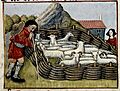
A medieval shepherd watching his flock in France.
-
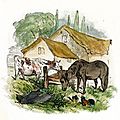
A 19th-century farmyard drawing showing cows, pigs, and horses.
-

Shearing wool from a Merino sheep.
-
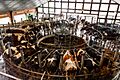
A modern rotary milking parlor for dairy cows in Germany.
-

A hardy Hereford beef bull standing in a pasture.
-

Hens raised inside an indoor poultry facility.
-

An 18th-century cartoon of John Bull.
-

Beatrix Potter illustration from The Tale of Pigling Bland.


Related Pages
See also
 In Spanish: Ganadería para niños