
Pearl hunting facts for kids

Pearl hunting, also known as pearl fishing or pearling, is the practice of searching for pearls in the wild. People look for them inside wild water animals known as molluscs. These animals are usually sea oysters or river mussels. Pearl hunting has taken place for thousands of years in ancient India and Japan. In Australia, pearling off the coast of Western Australia started during the 1850s. It also spread quickly to the Torres Strait Islands during the 1860s. In these areas, workers also searched for shiny nacre, which people call mother-of-pearl. This valuable layer lines the inside of pearl shells.
Most pearl-bearing mollusc creatures live deep underwater. Humans cannot simply pick them up from the water surface. Divers must swim down or use special tools to reach them. Long ago, people retrieved them through freediving. A freediver swims down to the ocean floor on one breath of air. The invention of the diving mask made seeing underwater much easier. Later, engineers created surface-supplied diving helmets for dangerous underwater work. This invention helped workers gather shells to produce clothing buttons, furniture inlays, and shiny decorations. The heavy diving helmet allowed people to stay underwater longer. However, it also brought new health dangers, including barotrauma of ascent and painful decompression sickness.
Contents
What is the history of pearl diving?
Before the 20th century, people gathered natural pearls only by hand. Swimmers collected huge piles of wild oysters and mussels from seabeds and river bottoms. Workers brought these shelled bivalve animals up to boats, opened them, and searched their tissues. Harvesters often checked more than a ton of shells just to find three or four gems.
To gather enough shells, freedivers regularly dove over 100 feet deep on a single breath. They faced dangerous sea predators, rough ocean waves, cold water, and serious risks of drowning. Divers sometimes passed out on the way back up due to shallow water blackout. Finding natural pearls was very rare and unpredictable. Because of these challenges, fine pearls remained extremely rare and costly treasures throughout world history.
How did people hunt pearls across the Americas?
Native Americans gathered shiny freshwater pearls from inland waterways long before European explorers arrived. They collected them from large waterways like the Ohio River, the Tennessee River, and the wide Mississippi River. Other native groups gathered saltwater pearls from warm waters across the Caribbean and along the coasts of Central America and South America.
During colonial times in northern South America, European leaders forced workers to dive near modern Colombia and Venezuela. Diving was dangerous because these warm coastal waters contained many sharks. Workers faced severe weather and hungry predators every day. Sometimes, a lucky worker who discovered a remarkably huge pearl could buy his freedom.
During the 1930s, the economic slowdown called the Great Depression caused shell prices to drop significantly. Natural pearls discovered in wild oysters were rare bonuses for hard-working boat crews. Many beautiful gems were brought ashore over the decades. However, over-harvesting quickly damaged the natural oyster reefs. The United States government began protecting waterways to keep oysters from disappearing completely. The Mexican government banned all pearl harvesting between 1942 and 1963 to let wildlife recover.
Freshwater pearling on the Ohio River and Tennessee River still exists today under strict wildlife regulations.
How did pearling develop in colonial Latin America?
In the early 1500s, Spanish explorers found rich oyster beds off the Venezuelan coast, especially around Margarita Island. Early settlers forced local native people to dive for pearls because laws had not yet stopped the practice. To control pearl trade routes, local leaders developed a ransoming trade known as the rescate system.
Spanish ships discovered additional oyster reefs along South American shores, including beds near Riohacha on Colombia's Guajira Peninsula. Soon, overfishing and harsh treatment caused the regional pearl supply to collapse. By 1540, many coastal settlements stood empty as merchants moved elsewhere. In the late sixteenth century, Spanish traders revived pearling by bringing forced laborers through the Atlantic slave trade.
Pearl harvesting methods remained similar along these coasts. Operations depended on ocean depth, local geography, and the commands of boat captains.
What happened on Margarita Island and Cubagua?
On Margarita Island, divers swam down in designated zones using breath-holding techniques. When an area ran out of oysters, the boat moved to a new reef. Boats held about twelve divers, along with a navigator, diving chief, oarsmen, and a supervisor. Divers carried collection bags tied to the boat. On deep dives, swimmers held heavy stones as weights to sink faster, dropping them before resurfacing. Crews worked from morning until sunset, handing their catch to the supervisor before opening shells.
Living conditions on the island were harsh. Spanish supervisors locked divers into small quarters every night, mistakenly believing this preserved their diving stamina. Workers faced punishments if they did not find enough oysters. Divers spent whole days in chilly saltwater, risking shark encounters and lung injuries. To survive, some workers secretly hid pearls to trade for clothes and food.
On nearby Cubagua Island, settlers also forced native divers into the water. Divers brought from the Lucayan islands in the Bahamas were famous for swimming skills. Later, workers from Africa were forced to dive under a royal decree issued in 1558. Authorities marked divers on Cubagua with iron markings showing the letter "C."
Crews on Cubagua worked in pairs from small boats. Divers wore neck pouches to gather oysters from the seafloor. Tropical heat on the island helped open the shells faster. Workers faced dangerous illnesses, ear damage, and shark attacks while searching the seabed.
How did pearl hunting work in Panama?
Pearl hunting groups in Panama were larger than those on Margarita Island, often holding eighteen to twenty divers. Instead of using large bags, divers swam up holding shells under their arms or in their mouths. They deposited their harvest into cloth bags kept on the ship. Each diver made repeated dives until he grew exhausted or met a daily quota.
Once bags were filled, crews opened shells on the deck under the watch of a supervisor. Leaders recorded every perfect pearl and imperfect gem found during the day. Divers who gathered extra pearls could sell them to boat owners. If divers fell short of their quota, they owed pearls for the next day. Panamanian divers carried small blades to protect themselves against sharks.
How did Asian pearl hunters explore the sea?

In Asia, some oyster beds lay in shallow water only 5–7 feet (1.5–2.1 meters) deep. More often, divers swam down 40 feet (12 meters) or even 125 feet (38 meters) to discover healthy beds. These deep dives were difficult and dangerous. Nineteenth-century divers used simple gear to help them survive. They rubbed oil on their skin to stay warm in cold water. They placed oiled cotton in their ears and wore nose clips made of turtle shell. Divers held heavy stones to drop quickly to the seafloor, saving their breath. They carried wide baskets to collect as many oysters as possible before swimming up.
For thousands of years, the Indian Ocean was the world center for harvesting saltwater pearls. Rich beds thrived across the Persian Gulf, the Red Sea, and the shallow Gulf of Mannar between Sri Lanka and India. An ancient travel guide by Isidore of Charax was preserved by author Athenaeus in his book Sophists at Dinner. This historic record described ancient freediving around islands in the Persian Gulf.

Pearl divers near the Philippines discovered magnificent pearls, particularly throughout the Sulu Archipelago. Waters here were famous for producing some of the world's finest and largest pearls. Strong tides and crystal-clear depths created healthy conditions for giant oysters. By law, the largest gems belonged to the local ruler, the sultan. Selling these royal gems without permission carried severe penalties. Still, traders carried many rare gems abroad to royal courts across Europe. Pearling was also important in Qatar, Bahrain, Kuwait, Japan, and India. Across the Atlantic, the Gulf of Mexico became known for pearling after explorations by early Spanish navigators.
Why was pearling important in Eastern Arabia and the Persian Gulf?

Pearl hunting formed the foundation of the economy in Eastern Arabia. It was the primary source of wealth and international trade across coastal communities. The industry shaped everyday society, village leadership, and family life.
The warm, shallow waters of the Persian Gulf produced millions of fine pearls. The pearling industry thrived across Kuwait, the United Arab Emirates, and Qatar, while Bahrain exported the most pearls. In the lower Gulf, pearls were used directly as currency to purchase everyday goods. Traders exchanged pearls for sweet dates, rice, Persian nuts, and fine textiles from India. Merchants often faced financial struggles due to changing pearl prices on the global market.
Gathering pearls took months of preparation, requiring boat owners to take out large loans. Merchants frequently kept most profits to repay these debts. Divers had to work second jobs, such as catching fish or moving cargo, to support their families.
Financial risks were high because market prices rose and fell unpredictably during the 19th and early 20th centuries. A severe trade depression in 1908 left many diving families without enough money for food. High interest rates made paying back seasonal loans very difficult. Overfishing, regional conflicts, bad storms, and debt harmed the industry. Ship captains known as nakhudas, rope pullers, and divers argued over falling wages long before the global Great Depression in 1929.
Pearl prices rose during the nineteenth century as international buyers sought luxury items. Gulf pearls were traded in major merchant hubs like Aleppo and Istanbul. Merchants regularly sailed to commercial ports in India, especially Bombay, to sell their treasures. By the 1930s, top traders traveled to jewelry markets in Paris. During this era, roughly one-quarter of the coastal population worked in the pearl trade. Pearl fleets relied heavily on forced labor until slavery was abolished across Gulf states between 1937 and 1971.

The Gulf pearling trade reached its height around 1912, a boom period called the "Year of Superabundance." In difficult seasons, coastal communities ate dried, salted oyster meat to survive food shortages. By the 1950s, the discovery of oil changed the region completely, replacing pearling as the main economic industry.
Pearl diving boats ran using a strict crew system:
- Divers (ghaws): The athletes who dove repeatedly to the seafloor to gather oysters.
- Captains (nakhuda): The leaders who steered ships, managed crews, and sold pearls.
- Haulers (seeb) and helpers (radheef, tabab): Crewmen who pulled divers up safely with ropes.
- Specialized crew: Singers (naham) who kept rhythm, cooks (tabbakh), teachers (mutuwa’a), clerks (kuttab), shell openers (jallas), and helmsmen (mujaddami).
On large ships, crew members had single jobs, while small boats required men to share tasks. Young apprentices joined ships as early as age seven, learning maritime skills over years of service. Crews shared earnings after voyages according to established rules.
-
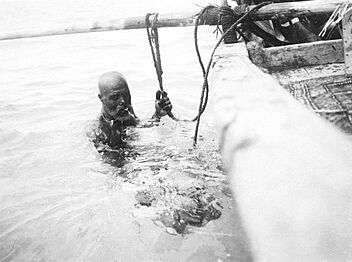
Pearl Hunter in Bahrain, 1911.
-
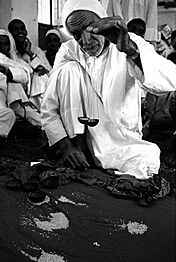
A merchant weighs pearls in Qatif, 1970s.
-
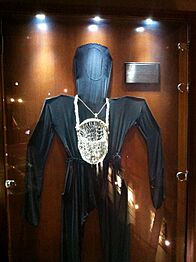
A piece of clothing used by Kuwaiti divers searching for pearls from the Maritime Museum in Kuwait City, Kuwait
-
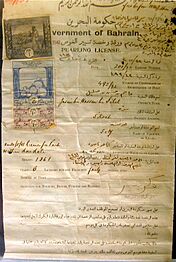
A pearling license in Bahrain from 1942.


How did pearl hunting change in Australia?

Indigenous Aboriginal Australians gathered sea shells for tools, trade, and ceremonies for thousands of years. Commercial pearling began along the northern coast of Western Australia during the 1850s. The industry expanded rapidly until World War I, when plastic materials replaced natural mother-of-pearl for manufacturing buttons.
In the 1870s, commercial pearling operations spread across the Torres Strait near Far North Queensland. Pearling became the biggest regional trade by the 1890s, altering life for Aboriginal Australians and Torres Strait Islander communities. Because diving was dangerous, companies hired Asian, Pacific, and Indigenous Australians as primary divers. Fleets focused on gathering large shells to supply overseas factories with mother-of-pearl for shiny decorative buttons. As shallow beds ran out, crews dove into deeper waters. Divers adopted metal helmets with a corselet collar rather than wearing full heavy canvas suits. Early air-hose units tested in 1922 proved too weak for swift currents. Later Scuba tanks could not supply enough breathing air for the long hours required at deep depths.
How did Europeans harvest freshwater pearls?
Scotland contains roughly half of the world's wild freshwater pearl mussels. People have gathered pearls in Scotland since the era of Scotland during the Roman Empire. The ancient Roman historian Suetonius wrote that Julius Caesar's invasions of Britain were partly inspired by British freshwater pearls. In 1621, a finder discovered the famous Kellie Pearl in Aberdeenshire along the River Ythan. The finder gave it to King James VI, who placed it directly into the Crown of Scotland.
Centuries of heavy fishing caused mussel numbers across Scottish streams to decrease dramatically. Warm summer water temperatures also stressed freshwater mussel colonies. William Abernethy became famous as Scotland's last professional pearl hunter. In 1967, he found the famous Abernethy pearl inside the River Tay. In 1998, the government passed strict conservation laws banning the gathering and sale of wild Scottish pearls. Today, scientists protect over sixty breeding streams across the country.
How are pearls produced in modern times?
Today, wild pearl hunting has been replaced by cultured pearl farming. This farming technique was invented and popularized in Japan by Kōkichi Mikimoto. Pearl farmers carefully insert a tiny bead inside an oyster to stimulate pearl development over several years. This technique makes pearl production predictable and safe for workers. Modern pearl farms produce billions of beautiful pearls every year. Traditional Japanese Ama divers still dive today, mainly demonstrating historic techniques for interested tourists.
Images for kids
-
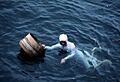
An ama pearl diver in Japan
-
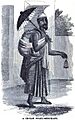
A Ceylon Pearl Merchant (p.108, 1849)
-
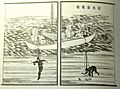
Woodblock illustration of a Chinese pearl-diving boat from the 1637 Tiangong Kaiwu
-
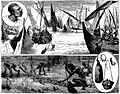
The Pearl Fishery in the Persian Gulf, 1881
-
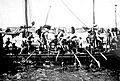
Pearl divers in the Persian Gulf at the beginning of 20th century
-
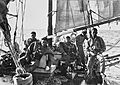
Pearl divers, Australia, 23 March 1939
Related pages
- Ama (diving)
- Blackbirding
- Fijiri
- Culture of Eastern Arabia
- Paravar
- Pearl farming industry in China
- Pearling in Western Australia
- Zubarah
