
Louvre facts for kids
 |
|
.jpg)
The Louvre Pyramid with the museum buildings in the background
|
|
| Established | 10 August 1793 |
|---|---|
| Location | Musée du Louvre, 75001, Paris, France |
| Type | Art museum and historic site |
| Collection size | 615,797 (35,000 on display) |
| Visitors | 8.7 million (2024)
|
| Public transit access |
|


The Louvre (or the Louvre Museum) is a famous national art museum in Paris, France. It is the most visited museum in the world. The museum is located on the Right Bank of the Seine river. It is home to some of the most famous works of art in history, including the Mona Lisa and the Venus de Milo.
The building was originally a fortress built in the 12th century. Later, it became a palace for the Kings of France. In 1793, during the French Revolution, it opened as a museum so that everyone could see the nation's art treasures. Today, the Louvre displays about 35,000 objects, ranging from ancient civilizations to the mid-19th century.
Contents
History of the Louvre
From Fortress to Royal Palace

The Louvre began as a fortress built by King Philip II in the late 12th century. He built it to protect the city of Paris from attacks. If you visit the museum today, you can still see the remains of this old castle in the basement.
Over time, the city grew, and the fortress was no longer needed for defense. In 1546, King Francis I decided to turn it into a beautiful residence for the French kings. Many kings after him added new wings and decorations to the building.
In 1682, Louis XIV (the Sun King) moved his court to the Palace of Versailles. The Louvre was left to house the royal art collection. Artists and sculptors were allowed to live and work there.
Becoming a Public Museum
During the French Revolution, the government decided that the Louvre should be a museum for the people, not just the king. On 10 August 1793, the museum opened its doors. At first, it displayed 537 paintings.
When Napoleon came to power, the collection grew very quickly because his armies brought back art from the countries they conquered. The museum was even renamed the Musée Napoléon for a while. After Napoleon was defeated in 1815, many of these stolen works were returned to their original owners.

.jpg)
.jpg)

Despite this, the Louvre's collection continued to expand. During the reigns of Louis XVIII and Charles X, new pieces were added. The Egyptian Antiquities department was created in 1826. It was based on collections bought by Jean-François Champollion, who had translated the Rosetta Stone. Other departments, like the Naval Museum, also found homes in the Louvre.
- Rooms of the Musée Charles X
-
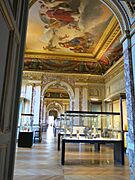
First room
-
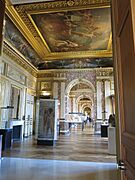
Room 27
-
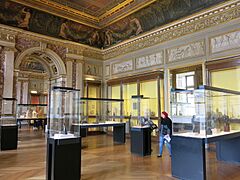
Room 29
-
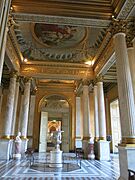
Salle des Colonnes
-
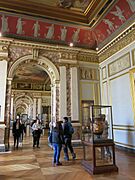
Room 35
-
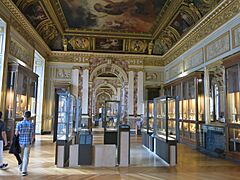
Room 36
-
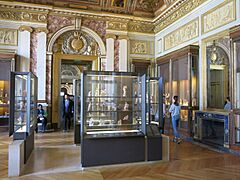
Room 38
.jpg)


The mid-19th century saw more growth. Napoleon III greatly expanded the building and the museum's collections. Between 1852 and 1870, 20,000 new artworks were added.
The Louvre faced danger during the Paris Commune in 1871. The nearby Tuileries Palace was set on fire, and the flames spread to parts of the museum. However, brave Parisian firefighters and museum staff saved most of the building and its treasures.
During the Third French Republic, the Louvre continued to grow through donations and archaeological finds. Famous pieces like the Winged Victory of Samothrace were put on display. Over time, some non-Western art collections were moved to other specialized museums in Paris. This helped the Louvre focus on French, Western, and Near Eastern art.
During World War II, the museum took great care to protect its art. Many important artworks, including the Mona Lisa, were moved to safe locations like castles across France. By early 1945, after France was liberated, the art began to return to the Louvre.
The Modern Louvre
In the 1980s, the museum underwent a huge renovation called the "Grand Louvre" project. The President of France, François Mitterrand, hired the architect I. M. Pei to design a new entrance. Pei created a large glass pyramid in the main courtyard. It opened in 1989 and is now one of the most famous symbols of Paris.
Recent Events
In the 21st century, the Louvre has continued to change. In 2012, a new department for Islamic Art was opened.
The year 2025 was a busy and difficult year for the museum. In January, plans were announced to renovate the museum and build a special room just for the Mona Lisa. In June, staff members went on strike to ask for better working conditions because the museum was so crowded.
In October 2025, a robbery took place at the museum. Thieves broke in through a window and stole valuable jewelry. The police investigated quickly and arrested several suspects. Later in November 2025, a water pipe burst and damaged some old books in the museum's collection.
The Museum Building

The museum is housed in the Louvre Palace. It is shaped like a U and has three main wings:
- Richelieu Wing (to the north)
- Sully Wing (to the east, the oldest part)
- Denon Wing (to the south, by the river Seine)
The main entrance is through the Louvre Pyramid. It is made of glass and metal. Visitors go down under the pyramid to reach the lobby, where they can choose which wing to visit.
Collections
The Louvre has a massive collection of over 615,000 objects, but only about 35,000 are on display at one time. The collection is divided into eight main departments.
Egyptian Antiquities
This department is one of the largest in the world. It shows objects from Ancient Egypt, dating from 4,000 BC to the 4th century AD.
- Famous items: The Great Sphinx of Tanis, the Seated Scribe, and many mummies and sarcophagi (coffins).
- What to look for: Scrolls made of papyrus, jewelry, games, and musical instruments that show how ancient Egyptians lived.
-

The Seated Scribe, a famous painted limestone statue
-
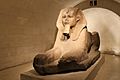
The Great Sphinx of Tanis


Near Eastern Antiquities
This section covers ancient civilizations from the Near East (places like modern-day Iran, Iraq, and Syria) before the arrival of Islam.
- Famous items: The Code of Hammurabi. This is a huge black stone pillar with laws written on it. It is one of the oldest lists of laws in human history.
- What to look for: Giant winged bulls with human heads (called lamassu) that used to guard the palaces of Assyrian kings.
-
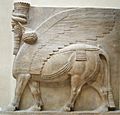
A giant Assyrian winged bull (lamassu)
-
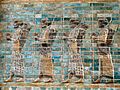
Frieze of Archers from the Palace of Darius


Greek, Etruscan, and Roman Antiquities
.JPG)
This is one of the oldest departments in the museum. It houses art from the Mediterranean region.
- Famous items:
- Venus de Milo: A beautiful Greek statue of the goddess Aphrodite. It is famous for missing its arms.
- Winged Victory of Samothrace: A statue of the goddess Nike standing on the prow of a ship. It looks like the wind is blowing her clothes.
- What to look for: Roman portraits, Greek pottery, and marble statues of gods and heroes.
Islamic Art
This is the newest department, created in 2003. It displays art from Islamic lands spanning thirteen centuries and three continents.
- What to look for: Beautiful carpets, glass, ceramics, and metalwork.
- Famous item: The Baptistery of Saint Louis, a brass basin inlaid with gold and silver.
Sculptures
This department contains European sculptures from the Middle Ages up to 1850. (Sculptures made after 1850 are usually found in the Musée d'Orsay across the river).
- Famous items: Psyche Revived by Cupid's Kiss by Antonio Canova and the Dying Slave by Michelangelo.
- What to look for: The Cour Marly and Cour Puget are large glass-roofed courtyards filled with white marble statues. They look like outdoor gardens.

Paintings
The Louvre has more than 7,500 paintings. The collection focuses on works created before 1848.
- The Mona Lisa: This is the most famous painting in the world. It was painted by Leonardo da Vinci. It is quite small and is protected by bulletproof glass. Millions of people come to see her mysterious smile every year.
- Other Masterpieces:
- The Coronation of Napoleon by Jacques-Louis David (a huge painting showing Napoleon becoming Emperor).
- Liberty Leading the People by Eugène Delacroix (a symbol of the French Revolution).
- The Wedding at Cana by Veronese (the largest painting in the Louvre).
-
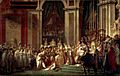
The Coronation of Napoleon
-
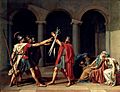
Oath of the Horatii


Decorative Arts
This section displays objects like jewelry, clocks, furniture, and tapestries. It shows how rich and powerful people lived in the past.
- Highlight: The French Crown Jewels are on display here. You can also walk through the apartments of Napoleon III, which are decorated with gold and red velvet.
Visiting the Museum

The Louvre is located in the center of Paris, next to the Tuileries Gardens. It is very easy to get there by the Paris Metro.
Because the museum is so big, it is impossible to see everything in one day. Many visitors plan their trip to see the "big three": the Mona Lisa, the Venus de Milo, and the Winged Victory of Samothrace.
In 2012, the museum started using Nintendo 3DS game consoles as audio guides to help visitors find their way around. These were used until September 2025.
See also
 In Spanish: Museo del Louvre para niños
- Center for Research and Restoration of Museums of France
- Hôtel du Louvre
- List of museums in Paris
- Musée de la mode et le textile
- List of tourist attractions in Paris
- List of largest art museums
Images for kids
-
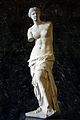
The Venus de Milo was added to the Louvre's collection during the reign of Louis XVIII.
-
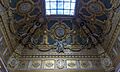
Ceiling decorations designed by Félix Duban in the Salon Carré (left)
-
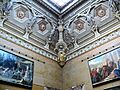
Ceiling decorations designed by Félix Duban in the Salle des Sept-Cheminées (right), late 1840s
-
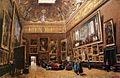
The display in the Salon Carré, painted by Giuseppe Castiglione in 1861 following its repurposing of the late 1840s
-
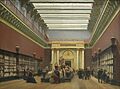
Entrance to a section of the Musée Napoléon III from the salle des séances, then a double-height space
-
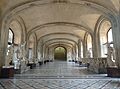
Galerie Daru, part of the New Louvre building program under Napoleon III
-
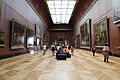
Salle Daru above the galerie Daru, also created under Napoleon III
-
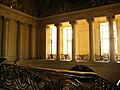
Escalier Mollien in the New Louvre
-
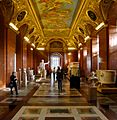
Salle des Empereurs
-
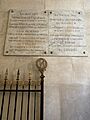
Memorial plaques honoring the Louvre's defenders in May 1871
-
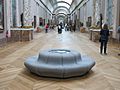
Seating designed by Pierre Paulin in the late 1960s, Grande Galerie
-
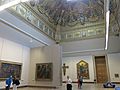
Marc Saltet's 1972 museography for the Salon Carré, with "dos-à-dos" seat designed in 1967 by Pierre Paulin
-
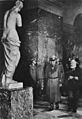
Generalfeldmarschall Gerd von Rundstedt is seen with a plaster model of the Venus de Milo, while visiting the Louvre with the curator Alfred Merlin on 7 October 1940.
-
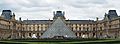
The Louvre Palace and the pyramid (by day)
-
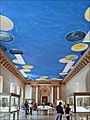
Ceiling by Cy Twombly installed in 2010 in the Salle des Bronzes, before the room's redesign in 2021
-
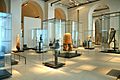
The Pavillon des Sessions's display of non-Western art from the Musée du Quai Branly, opened in 2000
-
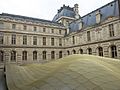
The Cour Visconti's ground floor covered to host the new Islamic Art Department in 2012
-
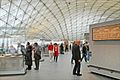
Islamic art display in the covered Cour Visconti, 2012
-
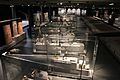
Underground display of the Islamic Art Department, 2012
-
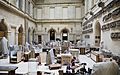
Restoration workshops in the Louvre
-
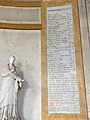
List of excavations that benefited the Louvre (Rotonde d'Apollon)
-
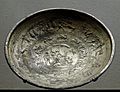
Phoenician metal bowls from Cyprus
-
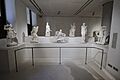
Statues from the Sidon Mithraeum
-
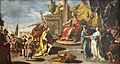
The Continence of Scipio; by Giambattista Pittoni; 1733; oil on panel; 96 × 56 cm
-
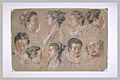
Studies of Women's Heads and a Man's Head; by Antoine Watteau; first half of the 18th century; sanguine, black chalk and white chalk on gray paper; 28 × 38.1 cm
-
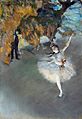
Danseuse sur la scène; by Edgar Degas; pastel; 58 × 42 cm
-
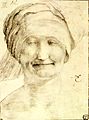
Portrait of elderly woman, by Matthias Grünewald
-

Portrait of a young woman, by Hans Holbein
-
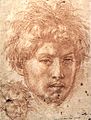
Head of a man, by Andrea del Sarto
-
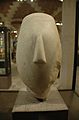
Cycladic head of a woman; 27th century BC; marble; height: 27 cm
-
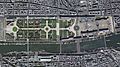
Aerial view of the Louvre Palace and Tuileries Park
-
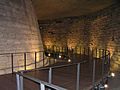
Below-ground portions of the medieval Louvre are still visible.
-
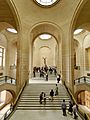
The Louvre's monumental Escalier Daru, topped by the Winged Victory of Samothrace, took its current appearance in the early 1930s.]]
-
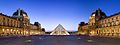
The Napoleon Courtyard and Ieoh Ming Pei's pyramid in its center, at dusk.
-
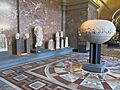
Greek antiquities in Room 11
-
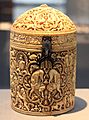
The Pyxis of al-Mughira; 10th century (maybe 968); ivory; 15 x 8 cm
-
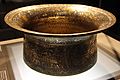
The Baptistère de Saint Louis; by Muhammad ibn al-Zayn; 1320–1340; hammering, engraving, inlay in brass, gold, and silver; 50.2 x 22.2 cm
-
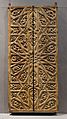
Door; 15th-16th century; sculpted, painted and gilded walnut wood
-
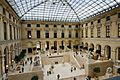
The Cour Marly of the Louvre, where many French sculptures are exhibited
-
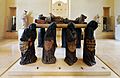
The Tomb of Philippe Pot; 1477 and 1483; limestone, paint, gold and lead; height: 181 cm, width: 260 cm, depth: 167 cm
-
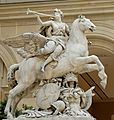
The King's Fame Riding Pegasus; by Antoine Coysevox; 1701–1702; Carrara marble; height: 3.15 m, width: 2.91 m, depth: 1.28 m
-
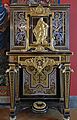
Louis XIV style cabinet on stand; by André Charles Boulle; c. 1690–1710; oak frame, resinous wood and walnut, ebony veneer, tortoiseshell, brass and pewter marquetry, and ormolu
-

The Money Changer and His Wife; by Quentin Massys; 1514; oil on panel; 70.5 × 67 cm
-

Spring; by Giuseppe Arcimboldo; 1573; oil on canvas; 76 × 64 cm
-
Oath of the Horatii; by Jacques-Louis David; 1784; oil on canvas; height: 330 cm, width: 425 cm
-
The Coronation of Napoleon by Jacques-Louis David
-
The Napoleon Courtyard and Ieoh Ming Pei's pyramid in its center, at dusk.


.jpg)
.jpg)


_D201512a.jpg)
.jpg)


.jpg)


.jpg)


