
Thomas Aquinas facts for kids
Quick facts for kids SaintThomas Aquinas OP |
|
|---|---|

Panel of a 15th-century altarpiece
|
|
| Confessor Doctor of the Church |
|
| Born | Tommaso d'Aquino 1225 Roccasecca, Kingdom of Sicily |
| Died | 7 March 1274 (aged 48–49) Fossanova, Papal States |
| Venerated in | Catholic Church Anglican Communion Lutheranism |
| Canonized | 18 July 1323, Avignon, Papal States by Pope John XXII |
| Major shrine | Church of the Jacobins, Toulouse, France |
| Feast | 28 January, 7 March (pre-1969 Roman calendar/traditional Dominican calendar) |
| Attributes | The Summa Theologiae, a model church, the sun on the chest of a Dominican friar |
| Patronage | Academics; against storms; against lightning; apologists; Aquino, Italy; Belcastro, Italy; booksellers; Catholic academies, schools, and universities; chastity; Falena, Italy; learning; pencil makers; philosophers; Saint Philip Neri Seminary; publishers; scholars; students; University of Santo Tomas; Sto. Tomas, Batangas; Mangaldan, Pangasinan; theologians |
Saint Thomas Aquinas (born around 1225 – died March 7, 1274) was an Italian Dominican friar. He was also a priest, a theologian, and a philosopher. He is known as one of the most important thinkers in the history of Catholic theology and Western philosophy.
Thomas Aquinas believed that God is the source of both natural reason and faith. He combined ideas from the ancient Greek philosopher Aristotle with Christian beliefs. Many people consider him the most important thinker of the medieval period. His ideas still influence modern virtue ethics, aesthetics, and how we understand how people think.
His most famous works include the Summa Theologica and the Summa contra Gentiles. He also wrote many commentaries on the Bible and Aristotle's writings. He is also famous for his beautiful hymns, which are still sung in churches today.
As a Doctor of the Church, Thomas is seen as one of the Catholic Church's greatest teachers. He is often called the "Angelic Doctor" or the "Universal Doctor." In 1999, Pope John Paul II also called him the "Doctor of Humanity."
Contents
Biography: The Life of Thomas Aquinas
Early Life and Education (1225–1244)
Thomas Aquinas was born around 1225 in the castle of Roccasecca, Italy. His family was powerful and wealthy. His father was Landulf VI of Aquino, a knight. His mother was Theodora Galluccio. Thomas was the youngest of four sons. His family hoped he would become an abbot, a leader of a monastery, like his uncle.
At age five, Thomas started his education at the Monte Cassino monastery. Later, he studied at the University of Naples. There, he learned about arithmetic, geometry, astronomy, and music. He was also introduced to the ideas of Aristotle, a famous Greek philosopher.

When he was 19, Thomas decided to join the Dominican Order, a group of friars. His family did not like this choice. They tried to stop him. His brothers even captured him and held him prisoner in their castles for about a year. They tried many ways to make him change his mind, even trying to tempt him away from his chosen path. But Thomas remained strong in his decision, believing he was given a special gift of purity from God.

In 1244, his mother realized she could not change his mind. She helped him escape secretly. Thomas then went to Naples and Rome to join the Dominicans.
Studies in Paris and Cologne (1245–1259)
In 1245, Thomas went to study at the University of Paris. There, he likely met Albertus Magnus, a famous Dominican scholar. Thomas followed Albertus to Cologne in 1248 to continue his studies.
Thomas was a quiet student and did not speak much. Some of his classmates thought he was slow. But Albertus Magnus famously said, "You call him the dumb ox, but in his teaching, he will one day produce such a bellowing that it will be heard throughout the world."
Thomas taught in Cologne as an apprentice professor. In 1252, he returned to Paris to earn his master's degree in theology. He wrote many important works during this time. These included Quaestiones Disputatae de Veritate (Disputed Questions on Truth) and began his famous Summa contra Gentiles.

Teaching in Italy (1259–1268)
In 1259, Thomas finished his first teaching period in Paris. He returned to Naples and then to Orvieto. In Orvieto, he finished Summa contra Gentiles. He also wrote works for Pope Urban IV, including hymns for the new feast of Corpus Christi. Some of these hymns, like Pange lingua, are still sung today.
In 1265, Pope Clement IV asked Thomas to be a papal theologian in Rome. Thomas also taught at a special school for Dominicans in Rome called the studium provinciale at Santa Sabina. It was here that he started his most famous work, the Summa Theologica. He wrote it to help beginners understand Christian religion.
Return to Paris and Debates (1269–1272)
In 1268, Thomas was asked to return to the University of Paris for a second time. This was partly because new ideas, called "Averroism," were becoming popular. These ideas mixed Aristotle's philosophy with other views. Many people worried these ideas might go against Christian teachings. Thomas wrote works to explain how his views were different and in line with Christian faith.

He also had disagreements with some Franciscans, another group of friars. In 1270, the Bishop of Paris condemned some of these new philosophical ideas as wrong. Thomas continued to teach and defend Christian thought during this time.
Later Years and Passing (1272–1274)
In 1272, Thomas left Paris to start a new school in Naples. He continued working on the third part of his Summa Theologica. He also gave popular lectures in Naples during Lent of 1273.
_-_stained_glass,_St._Thomas_Aquinas,_detail.jpg)
It is said that Thomas had many deep spiritual experiences. On December 6, 1273, he had a very long spiritual experience during Mass. After this, he stopped writing. When his secretary, Reginald, asked him to continue, Thomas replied, "Reginald, I cannot, because all that I have written seems like straw to me." This meant his writings felt small compared to what he had experienced. Because of this, the Summa Theologica was never finished.
In 1274, Pope Gregory X asked Thomas to attend an important meeting in Lyon, France. On his way, Thomas became very ill. He died on March 7, 1274, at Fossanova Abbey. He was giving a commentary on the Song of Songs when he passed away.
Thomas Aquinas's Teachings
Understanding Theology
Thomas Aquinas saw theology as a special kind of science. He believed that people could learn about God through their own efforts and through God's revelations. He thought that both faith and reason were important tools to understand God. He believed that studying nature also helps us understand God, because God created nature.
Faith and Reason Working Together
Thomas believed that faith and reason do not go against each other. Instead, they work together to show us the same truth. If there seems to be a disagreement, it means we might be misunderstanding something. Faith can show us divine mysteries that reason alone cannot grasp. Reason can help us understand when we might be misinterpreting religious texts.
The Nature of God
Thomas believed that God's existence is clear in itself, even if it's not always clear to us. He offered five ways to show that God exists:
- Motion: Everything that moves is moved by something else. This chain cannot go on forever, so there must be a First Mover, which is God.
- Causes: Everything has a cause. This chain of causes cannot go on forever, so there must be a First Cause, which is God.
- Existence: Some things exist but don't have to. If everything were like this, nothing would exist. So, there must be something that exists necessarily, and this is God.
- Gradation: We see different levels of goodness, truth, and nobility in the world. There must be a perfect source of these qualities, which is God.
- Order in Nature: Natural things, without thinking, act in an ordered way towards a goal. This shows they are guided by something intelligent, which is God.
Thomas also believed that we can understand God better by thinking about what God is not. He said God is simple (not made of parts), perfect (lacking nothing), infinite (without limits), unchanging, and one (unique).
Creation of the World
Thomas believed that God created everything, both visible and invisible. He thought that God created the world "from nothing," meaning God didn't use any existing materials. He also believed that while reason can show that God is the creator, only faith tells us that the world had a beginning and is not eternal.
The Nature of Jesus Christ
Thomas taught that Jesus Christ came to Earth to fix the problems caused by original sin. He believed that God became human in Jesus to save humanity. Thomas explained that Jesus had both a truly divine nature and a truly human nature, existing together in one person.
The Goal of Human Life
Thomas Aquinas believed that the main goal of human life is to be united with God forever. This happens through the "beatific vision," where a person experiences perfect happiness by seeing God's essence after death. To reach this goal, people should live good lives, filled with charity, peace, and holiness.
Respecting Religious Freedom
Thomas believed that people should not be forced to believe in something against their will. He argued that it would be wrong to baptize children against their parents' wishes, especially if the children were too young to understand. He felt it was important to respect the natural rights of parents in raising their children.
Magic and God's Power
Thomas believed that only God can perform true miracles and create things. He thought that angels and demons could do amazing things, but these were not true miracles. They simply used natural things in ways humans couldn't. He taught that any power claimed by magicians came from evil spirits, not from special words or objects.
Afterlife and Resurrection
Thomas believed that the human soul continues to exist after the body dies. He taught that humans are a combination of body and soul. After death, the soul lives on, and eventually, the body will be resurrected and reunited with the soul. This reunion is important because humans are meant to be both spiritual and physical. He believed that in the afterlife, people would experience rewards or punishments based on how they lived their lives on Earth.
Thomas Aquinas's Philosophy
Learning from Aristotle
Thomas Aquinas was a theologian first, but his ideas greatly influenced philosophy. He respected Aristotle so much that he often called him "the Philosopher." However, Thomas always made sure that Aristotle's ideas fit with Christian beliefs, changing them if they didn't.
How We Gain Knowledge
Thomas believed that to know any truth, people need God's help. But he also thought that humans have a natural ability to learn many things without special divine messages. We can learn about the world through our senses and our reason.
Ethics and Good Living
Thomas believed that there is a "natural law" that guides human actions. This law is based on the idea that "good is to be done and pursued, and evil avoided." Reason helps us know what is good. He said that basic goods include self-preservation, having children and raising them, living in a community, and seeking the truth about God.
He described four main "cardinal virtues" that everyone should practice:
- Prudence: Making wise choices.
- Temperance: Having self-control.
- Justice: Being fair to everyone.
- Fortitude: Having courage and strength.
He also spoke of three "theological virtues" that come from God:
- Faith: Believing in God.
- Hope: Trusting in God's promises.
- Charity: Loving God and others.
Thomas also explained four kinds of law:
- Eternal Law: God's plan for all creation.
- Natural Law: How humans understand God's eternal law through reason.
- Human Law: Laws made by governments based on natural law.
- Divine Law: Laws revealed by God in the scriptures.
Treating Animals
Thomas believed that humans do not have a direct duty of charity to animals because animals are not persons. However, he also taught that people should still be kind to animals. He warned that being cruel to animals could lead to being cruel to other humans.
Economic Ideas
Thomas Aquinas thought about economic questions in terms of justice. He believed in a "just price" for goods. This price should be fair to both the buyer and the seller. It should cover the seller's costs and reflect the item's true worth. He thought it was wrong for sellers to raise prices unfairly just because someone was in great need.
He also discussed "social justice," which is about how individuals contribute to the common good of society. He believed that common goods should be shared fairly among people, based on their contributions to the community.
Thomas also spoke against "usury," which was the practice of lending money with interest. He believed it was unfair to charge extra for money that was only used up when spent.
Political Order
Thomas saw humans as social beings who live in communities. He believed that monarchy, where one virtuous ruler leads, could be the best form of government. However, he also warned that if a monarch became a tyrant, it could be the worst kind of government. He thought a ruler's power should be limited to prevent tyranny.
He believed that kings were God's representatives, but the Church, led by the Pope, had authority over kings in matters of faith and morals. Thomas also taught that all people are equal in God's eyes, which set limits on political power.
Just War Principles
Thomas Aquinas, following earlier thinkers, outlined conditions for a war to be considered "just":
- Just Cause: The war must be for a good and fair reason, not for wealth or power.
- Right Authority: The war must be started by a proper authority, like a government.
- Right Intention: The main goal of the war must be to achieve peace, even amidst violence.
Understanding Humans
Thomas believed that a human being is a single physical substance made of both a body and an immaterial soul. The soul gives life and form to the body. He thought that the soul can exist without the body after death, but a complete human being includes both.
Major Works
Even though he wrote for only about 20 years, Thomas Aquinas wrote a huge amount, over eight million words! His most famous works are the Summa Theologiae and the Summa contra Gentiles. He also wrote many commentaries on philosophical and biblical texts.
His complete works have been collected into many volumes. The most important edition is called the Leonine Edition, which was started by Pope Leo XIII.
Thomas Aquinas Quotes
- "There is nothing on this earth more to be prized than true friendship."
- "Three things are necessary for the salvation of man: to know what he ought to believe; to know what he ought to desire; and to know what he ought to do."
- "Love takes up where knowledge leaves off."
- "The things that we love tell us what we are."
- "Friendship is the source of the greatest pleasures, and without friends even the most agreeable pursuits become tedious."
- "All the efforts of the human mind cannot exhaust the essence of a single fly."
- "Wonder is the desire for knowledge."
- "Distinctions drawn by the mind are not necessarily equivalent to distinctions in reality."
Works
His most well-known books are:
- the Disputed Questions on Truth (1256–1259)
- the Summa contra Gentiles (1259–1265)
- and the unfinished Summa Theologica, or Summa Theologiae (1265–1274)
He also wrote comments on Scripture (holy texts) and on the writings of Aristotle.
Interesting Facts about Thomas Aquinas
- Thomas wrote hymns (religious songs) that are still used in church services today.
- Today, studying his works is a main part of the training for people who want to become priests or deacons. It's also important for students of other religious subjects like philosophy and church history.
- Because Thomas was quiet and didn't talk much, some of his classmates thought he was slow.
- People have traditionally said that Thomas could levitate, which means float in the air.
Images for kids
-
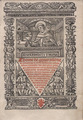
A page from Super libros de generatione et corruptione
-
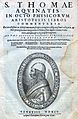
A page from Super Physicam Aristotelis, 1595

See also
 In Spanish: Tomás de Aquino para niños
