
USS Constellation (CV-64) facts for kids
_off_Perth,_Australia,_on_29_April_2003.jpg)
USS Constellation in April 2003
|
|
| History | |
|---|---|
 United States United States |
|
| Name | Constellation |
| Namesake | USS Constellation |
| Awarded | 1 July 1956 |
| Builder | Brooklyn Navy Yard |
| Cost | US$264.5 million |
| Laid down | 14 September 1957 |
| Launched | 8 October 1960 |
| Acquired | 1 October 1961 |
| Commissioned | 27 October 1961 |
| Decommissioned | 6 August 2003 |
| Reclassified | CV-64, 30 June 1975 |
| Stricken | 2 December 2003 |
| Identification |
|
| Nickname(s) | Connie, "America's Flagship" |
| Fate | Scrapped, 10 May 2017 |
| Badge | _insignia_1961.png) |
| __1B0X_5H1P__ | career |
| General characteristics | |
| Class & type | Kitty Hawk-class aircraft carrier |
| Displacement |
|
| Length |
|
| Beam |
|
| Draft | 39 ft (12 m) |
| Propulsion | eight boilers, four steam turbine engines, totaling 280,000 shp (210 MW) |
| Speed | 34 knots (63 km/h; 39 mph) |
| Complement | 3,150 – Air Wing: 2,480 |
| Armament |
|
| Aircraft carried | 72 (approx) |
| __1B0X_5H1P__ | characteristics |


The USS Constellation (hull number CVA-64/CV-64) was a powerful aircraft carrier known as a supercarrier. It was the third ship in the United States Navy to be named after the "new constellation of stars" on the flag of the United States. This ship was one of the fastest in the Navy. Its crew affectionately called it "Connie" and it was officially known as "America's Flagship."
The Navy ordered the Constellation on 1 July 1956. Workers started building it on 14 September 1957 at the New York Naval Shipyard. The ship was launched on 8 October 1960. Mary Herter, wife of the Secretary of State, sponsored the ship. The Constellation joined the Navy on 1 October 1961 and was officially put into service on 27 October 1961. Captain T. J. Walker was its first commander. Building the ship cost about US$264.5 million at that time. The Constellation was later taken apart for scrap in Brownsville, Texas, between 2015 and 2017.
History of the USS Constellation
The construction of the Constellation began at the New York Naval Shipyard in 1957.
Fire During Construction

The USS Constellation suffered serious damage from a fire on 19 December 1960. This happened while the carrier was still being built. The ship was in its final stages of construction at the Brooklyn Navy Yard in Brooklyn, New York.
The fire started when a forklift on the hangar deck accidentally hit a steel plate. The plate then broke a fuel tank, spilling diesel fuel. This fuel spread to lower parts of the ship. A cutting torch might have ignited the fuel, which then spread to wooden scaffolding. Flames quickly filled the ship's passageways with smoke.
Firefighters worked for 17 hours to put out the fire. Sadly, 50 shipyard workers lost their lives. The extensive damage cost $75 million to repair. This delayed the ship's official commissioning by seven months.
Early Years and Deployments (1960–1969)
_underway_1964-65.jpg)
,_naval_cover.jpg)
The Constellation was launched on 8 October 1960. It was delivered to the Navy on 1 October 1961. The ship was officially put into service on 27 October 1961. Captain T. J. Walker was in command. Another fire happened on board on 7 November 1961 during sea tests. Four people died and nine others were injured.
After getting ready, Constellation left Norfolk, Virginia, on 7 February 1962. It began its first air operations off the Virginia Capes. The ship completed its first catapult launch and arrested landing that same day. After local operations, Connie went on a two-month training cruise in the Caribbean Sea.
In summer 1962, Constellation moved to the U.S. Pacific Fleet. It sailed around Cape Horn to its new home port in San Diego, California. In November, Constellation began training for its first deployment. This trip to the western Pacific as part of the U.S. Seventh Fleet was smooth. It took place from February to September 1963.
Constellation began its second deployment on 5 May 1964. It took over duties in the Gulf of Tonkin off Vietnam on 8 June. The ship's aircraft flew armed photo reconnaissance missions over Laos. After a stop in the Philippines, Constellation visited Hong Kong. However, it was soon called back into action.
During the Gulf of Tonkin Incident on 2 August 1964, Constellation headed back to the Gulf of Tonkin. On 4 August, its planes helped provide air cover for destroyers. On 5 August, both Constellation and another carrier launched air strikes. These attacks targeted a North Vietnamese oil facility and naval vessels. During these operations, two aircraft from Constellation were lost. Lieutenant (junior grade) Richard C. Sather was killed, and Lieutenant (junior grade) Everett Alvarez Jr. became one of the first American prisoners of war. Constellation returned to San Diego on 1 February 1965. The ship and its air wing received a Navy Unit Commendation for their actions.
After a period in the shipyard, Constellation began its first major combat deployment in May 1966. Its aircraft attacked roads, bridges, and other targets. They tried to slow down the movement of supplies. On 13 July, an F-4B aircrew shot down a MiG-17 fighter jet. This was the ship's first MiG kill of the war. Constellation returned to San Diego in December. Sadly, 16 aircrew members and 15 aircraft were lost during this seven-month cruise. Both the ship and its air wing received another Navy Unit Commendation.
Constellation began its third combat deployment in April 1967. Its aircraft operated first off South Vietnam and then off North Vietnam. F-4Bs from two squadrons shot down four MiG jets. The eight-month deployment ended in December. During this time, 16 aircraft were lost. Twenty personnel were lost, including seven killed and eight captured. The carrier and its air wing received a Navy Unit Commendation.
The ship's fourth deployment to the western Pacific and Vietnam started on 29 May 1968. During this time, Constellation aircraft were limited to strikes below the 20th parallel of North Vietnam. On 1 November, all bombing of North Vietnam was stopped. Constellation returned home on 31 January 1969. It had flown over 11,000 missions. Fifteen aircraft were destroyed, nine by enemy action. Six aircrew members died, and three were captured.
By August, Constellation was back in Vietnam for its fifth combat deployment. It supported strikes in South Vietnam and Laos. Then, it sailed to Defender Station in the Sea of Japan. This was due to increased tensions near the Korean Peninsula. On 2 October 1969, a helicopter accident occurred. Sadly, nine men were lost with the chopper. On 1 November, an F-4J aircrew completed the ship's 100,000th arrested landing. On 28 March 1970, another F-4 crew shot down a North Vietnamese MiG-21 jet fighter. The nine-month deployment ended in May. Seven aircraft were lost, five due to enemy action. One aircrew member was captured, but no lives were lost.
Operations in the 1970s
_underway_1971-72.JPEG)
After returning, Constellation underwent a nine-month major overhaul. This was its second since being commissioned. In spring 1971, it received a new air wing. The ship left San Diego on 1 October for another combat deployment. Air operations began with strikes against supply targets in Laos. Reconnaissance missions over North Vietnam continued into 1972. On 19 January, an F-4 Phantom crew scored a kill against a MiG-21. This was the first for a Navy aircraft in a long time. The carrier's tour was extended due to a major North Vietnamese attack called the Easter Offensive.
Initial air strikes supported ground troops. These were followed by more intense air strikes against major targets in North Vietnam. On 8 May, the same F-4 crew scored another kill against a MiG-17. Then, on 10 May, they shot down three more MiG-17s. This made them the first aces of the Vietnam War. Three more MiG-17s were shot down by other crews. Another crew shot down a MiG-21. In total, Constellation pilots shot down seven MiGs on 10 May. The nine-month deployment ended on 1 July. The carrier spent 154 days off Vietnam. Seven aircraft were lost, and four aircrew members were either killed or captured. The Constellation and its air wing received the Presidential Unit Citation for their efforts.
End of the Vietnam War
In January 1973, Constellation returned to Southeast Asia. The Paris Peace Accords took effect on 28 January. However, aircraft continued to strike targets in Laos until a cease-fire on 21 February. So, Connie was on station at the beginning and end of combat operations in Vietnam. The rest of the nine-month deployment involved flights supporting mine-clearing operations in North Vietnam.
After returning in October 1973, Constellation prepared for its first peacetime deployment in 10 years. It departed in June 1974. On 23 November, it became the first carrier to enter the Persian Gulf since 1949. The six-month cruise ended on 24 December 1974.
_near_the_Aleutian_Islands.jpg)
A 14-month major overhaul and upgrade began in February 1975. This happened at Puget Sound Naval Shipyard, Washington. Constellation was changed to handle new roles for carriers. These included air, surface, and antisubmarine warfare. It was reclassified as a CV (multi-purpose carrier) on 30 June 1975. After the overhaul, Connie could operate the new S-3A Viking and F-14A Tomcat aircraft. The ship participated in Rim of the Pacific (RIMPAC) multinational exercises. An uneventful deployment to the Far East followed from April to November 1977.
Constellation's next deployment, from September 1978 to May 1979, was extended. This was due to a situation in Yemen. After a short break, it was underway again in February 1980. After RIMPAC exercises, Constellation sailed to the Arabian Sea. This area was important after the American Embassy in Tehran, Iran, was taken over in November 1979. Connie reached the eastern Indian Ocean when an unsuccessful raid to free American hostages took place. It then took over duties in the area. This time at sea lasted a record-setting 110 days. The crew received the Navy Expeditionary Medal for their service. The deployment ended in mid-October.
The 1980s: "America's Flagship"

During training in 1981, President Ronald Reagan visited Constellation on 20 August 1981. He called the carrier "America's Flagship." He presented the crew a presidential flag. He told the crew that America had the strength to back up its words. Constellation sailed to the western Pacific and Indian Ocean from October 1981 to May 1982.
In January 1983, Constellation entered the Puget Sound Naval Shipyard for a major overhaul. This lasted 13 months. During this time, its missile system was updated. New Phalanx guns were added. The ship was also changed to operate the new F/A-18A Hornet strike aircraft.
Connie deployed from February to August 1985. This was the first deployment for the F/A-18. During this trip, Constellation and its escort ships visited Mombasa in Kenya. It was during this deployment that Constellation got its motto, "Go Ahead Make My Day." This was a quote from President Ronald Reagan. It was in response to threats made against the ship during an American hostage crisis. For their work in 1985, the crew earned the Meritorious Unit Citation. The ship also received an award for environmental protection.
_aerial_Battle_E.jpg)
As preparations for a 1987 deployment continued, Constellation earned the Pacific Fleet Battle Efficiency Award. This award recognized it as the best carrier. During a deployment from April to October 1987, Connie supported Operation Earnest Will. This operation involved escorting Kuwaiti oil tankers in the Persian Gulf. This was to protect them from attacks. The crew received the Armed Forces Expeditionary Medal for their service.
On 2 August 1988, a serious fire broke out on Connie. A fuel leak in the ship's ventilation system caused it. The fire spread throughout the ship. Three explosions shook the ship. The crew went into General Quarters (a battle alert). Brave volunteers from the crew entered dangerous areas to put out the fires. They worked to save the ship. The main fires were put out around 9 PM. However, the fires reignited, and the crew had to fight them again.
_underway_bow_view.jpg)
The crew battled the blaze into the next day. There were no deaths, but some crew members had serious injuries. These included broken bones and smoke inhalation. The investigation showed a problem with a fuel pipe that was not properly inspected. About 20,000 gallons of fuel had leaked.
Repairs were made quickly by the crew and civilian workers. The ship was ready for deployment on schedule. The Constellation team deployed on 1 December 1988 for the Indian Ocean. Four days into the trip, an aircraft and its four crew members were lost at sea. On 13 December, during an exercise, a missile accidentally hit a merchant ship. Sadly, one sailor on that ship died. The missile had an inert dummy warhead. The merchant ship had strayed into the test area. The deployment ended six months later on 1 June 1989.
The 1990s: Modernization and Operations
_in_Seattle.jpg)
With its air wing, Connie left San Diego on 12 February 1990 for the East Coast. After exercises with South American air forces, Constellation entered Philadelphia Naval Shipyard in July. It began an $800-million Service Life Extension Program (SLEP). This three-year project was like a major rebuild. It was designed to add 15 years to the carrier's operational life. Its main steam turbines were replaced. Constellation completed its post-SLEP tests. It then moored at Mayport, Florida, on 8 April.
With a new air wing, Connie left Mayport on 29 May. It conducted exercises with various South American air forces. It arrived in San Diego on 22 July 1993. This was one of the first times women served on board. They helped test how women would live and work on combat ships.
During May–June 1994, Connie participated in RIMPAC exercises. On 10 November, it left San Diego for an extended deployment. Exercises off Okinawa were followed by exercises off Korea. This was due to concerns that North Korea was trying to develop nuclear weapons. On 11 January 1995, the Constellation battle group entered the Persian Gulf. It supported Operation Southern Watch (OSW). This operation enforced a no-fly zone over southern Iraq. The six-month deployment ended on 10 May. On 1 October 1995, Constellation was assigned to Cruiser-Destroyer Group 1. Its next deployment, from 1 April to 1 October 1997, included another trip to the Persian Gulf for Southern Watch. Its air wing flew over 4,400 missions in the Gulf.
As Connie prepared for its 1999 deployment, tensions rose again on the Korean Peninsula. Constellation left San Diego on 18 June 1999 to monitor the situation. On 28 August, it entered the Persian Gulf. In ten weeks, it conducted over 5,000 missions. This included air strikes against two Iraqi radar stations. On 14 September, an attempt was made to engage an Iraqi jet with a long-range missile. The air wing carried out nine air strikes in the Persian Gulf. The battle group left the Persian Gulf on 5 November. The ship arrived home on 17 December. At the end of the year, Constellation received its second Battle Efficiency E award. This recognized it as the Pacific Fleet's best carrier.
The Final Years (2000 Onwards)
_Sydney_Australia_2001.jpg)
Constellation's 20th deployment began on 16 March 2001. It entered the Persian Gulf on 30 April. It immediately began supporting OSW missions. On 13 May, Captain John W. Miller became Connie's 30th and final skipper. It stopped OSW operations on 4 August. It had conducted many air strikes in response to Iraqi violations of the no-fly zone. Connie left Pearl Harbor, Hawaii, on 9 September. It had family members on board for a traditional "Tiger Cruise" home. On 11 September, Constellation was almost halfway between Pearl Harbor and San Diego. News arrived of the terrorist attacks in New York and the Pentagon. Despite discussions about turning back, the carrier completed its scheduled deployment. Connie arrived in San Diego on 14 September. It celebrated its 40th birthday the next month.
_begins_its_transit_from_Naval_Air_Station_North_Island_to_Puget_Sound_Naval_Shipyard.jpg)
After a short break, Constellation prepared for its final deployment. It would join the global fight against terrorism. It departed on 2 November 2002. It soon supported Operation Enduring Freedom. On 17 December, it entered the Persian Gulf to begin OSW missions. On 19 March 2003, Operation Iraqi Freedom began. Connie was a night carrier and stayed on station during the main ground combat. It launched over 1,500 missions. Its aircraft delivered over 1.7 million pounds of weapons. One aircraft was lost in an accident, but no lives were lost.
Connie left the Gulf on 17 April and sailed for San Diego for the last time. On 1 June, an S-3B Viking crew recorded Constellation's 395,710th and final arrested landing. Its 21st and final deployment ended the next day.
The Constellation was replaced by the USS Ronald Reagan.
Decommissioning and Scrapping

After 41 years of service, the USS Constellation was officially taken out of service. This happened at the Naval Air Station North Island in San Diego on 7 August 2003. The ship was towed on 12 September 2003. It went to the ghost fleet at the Naval Inactive Ship Maintenance Facility, Bremerton, Washington. On 2 December 2003, the ship was removed from the Naval Vessel Register. This meant it would no longer be maintained. Constellation was placed in Reserve Category X. This meant it received no maintenance. Only security against fire, flooding, and theft was provided. Ships in this category are waiting to be scrapped, sold, used as targets, or donated.
In February 2008, news reports stated that Constellation was scheduled to be taken apart for scrap. This process began in early 2015 in Brownsville, Texas. The ship was towed around Cape Horn on its final journey. NASA's Operation IceBridge even captured a photo of the ship being towed. The carrier arrived in Brownsville on 16 January 2015. The scrapping was completed on 10 May 2017.
See also
 In Spanish: USS Constellation (CV-64) para niños
- List of aircraft carriers
- List of aircraft carriers of the United States Navy
Images for kids
-
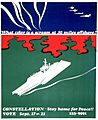
Poster used for the Constellation Vote

