
Castle facts for kids


A castle is a strong, fortified building from the Middle Ages. Kings, queens, and powerful nobles built them. Castles were private homes that also served as fortresses. They are different from palaces or mansions, which were mainly for comfort, not defence.
Castles came in many shapes and sizes. Common features included strong outer walls, narrow openings for archers, and heavy gates. European castles first appeared in the 9th and 10th centuries. They helped lords control their lands and offered protection from enemies. Castles were also important centres for managing land and showing power. Some were in cities to control people and trade routes. Others were in the countryside, near important places like farms or water sources.
Many early castles in northern Europe were made of earth and wood. Later, builders replaced these with strong stone. These first castles often used natural hills for defence. They might not have had many towers or arrowslits. By the late 12th and early 13th centuries, castle design became more advanced. Builders added many towers for better defence. They also created "concentric castles" with several layers of walls. This made them very hard to attack.
Over time, some parts of castles, like moats, became symbols of power. They were not just for defence. Even after gunpowder arrived in Europe in the 14th century, castles were still built. But by the 15th century, cannons became powerful enough to break stone walls. This made traditional castles less useful for defence. They were replaced by new types of forts or large country homes. Later, in the 18th century, people started building "mock castles" for their beauty, not for war.
Contents
What is a Castle?
Where the Word "Castle" Comes From

The word "castle" comes from the Latin word castellum. This means "fortified place." Many languages have similar words, like castillo in Spanish. The word came to England just before the Norman Conquest in 1066. It described a new type of strong building.
Key Features of a Castle
A castle is mainly a private, fortified home. This means it was built for a lord or noble to live in and defend. It was not a public defence like a city wall. Castles were owned by powerful local lords or their kings. These lords often granted land to people called vassals in exchange for military service and loyalty. This system was known as feudalism.


Castles had many uses. They were military bases, administrative centres, and homes. They could be used to attack enemies or to defend against them. For example, William the Conqueror built many castles in England after 1066. These helped him control the land and prevent rebellions. Warwick Castle was one such example.
As time went on, especially with the invention of powerful cannons, castles became less important for war. They became more about showing off wealth and power. Lords wanted their castles to look grand and impressive. They also made them more comfortable to live in. While castles still offered some protection, large country houses eventually replaced them as the main homes for the wealthy.
Different Kinds of Fortifications
Sometimes, people use "castle" to describe any old fort. But technically, a castle is a specific type of medieval building. For example, Maiden Castle is an Iron Age hill fort, not a medieval castle. It had a very different purpose.

Castles first appeared in Europe and then spread to parts of the Middle East. They shared similar designs and ways of fighting. However, other parts of the world had their own unique fortified structures. For instance, Japanese shiro were also called castles. But they developed differently and were mostly made of wood until the 16th century. European castles, by contrast, were mostly stone by the 12th century.
Common Castle Features
Motte: The Castle Hill

A motte was a large, flat-topped mound of earth. It was often man-made. Digging out the earth for the motte created a ditch around it, known as a moat. Mottes often had a fortified structure, like a keep, on top. A wooden fence, called a palisade, usually surrounded the top of the motte. Bridges often crossed the moat to reach the motte.
Bailey: The Castle Courtyard

A bailey was a fortified area, like a courtyard, inside the castle walls. Most castles had at least one. The lord lived in the keep, but the bailey housed the rest of the castle's people. It contained barracks for soldiers, stables, workshops, and storage. A well or cistern provided water. Over time, important buildings like the lord's chambers moved into the bailey. Some castles had several baileys, but only one main defensive enclosure, called an enceinte.
Keep: The Main Tower

The keep was the main tower or building in a castle. It served as the lord's living quarters and the strongest point of defence. The word "keep" was not used in medieval times; they called it a "donjon." A "dungeon" is a dark prison, which is a changed form of "donjon." Keeps were often the last refuge if attackers broke through other defences. They were also used as homes for the lord and his guests.
Curtain Wall: The Outer Defence

Curtain walls were the strong defensive walls that enclosed the bailey. They needed to be tall enough to stop attackers from climbing over. They also had to be thick enough to resist attacks from siege engines. A typical wall might be 3 meters (10 feet) thick and 12 meters (40 feet) tall. Walkways on top allowed defenders to shoot at enemies. Battlements, with their gaps and solid blocks, gave extra protection. Towers along the walls allowed archers to shoot along the wall's length.
Gatehouse: The Castle Entrance

The entrance was often the weakest part of a castle's defences. To make it stronger, builders created the gatehouse. This allowed those inside to control who came and went. Gatehouses often had projecting towers on each side, like those used by the Romans. They also had several defences, such as portcullises. These were heavy metal-reinforced wooden grilles that could block the passage. Narrow arrowslits allowed defenders to shoot at enemies. The passage through the gatehouse was often long. This forced attackers to spend more time under fire.
It's a common myth that holes in the gatehouse ceiling were used to pour boiling oil. This was usually not practical. They were more likely used to drop stones or pour water on fires. Later, a barbican was added in front of the gatehouse. This was an extra rampart, ditch, and sometimes a tower. It provided another layer of defence and guided attackers to a specific entry point.
Moat: The Watery Ditch

A moat was a ditch around a castle. It could be dry or filled with water. Moats helped stop siege towers from reaching the walls. They also made it harder for enemies to dig tunnels under the walls. Water moats were common in low-lying areas. They were usually crossed by a drawbridge, which could be raised.
Battlements: Wall-Top Protection
Battlements were found on top of curtain walls and gatehouses. They included crenellations, hoardings, and machicolations. Crenellations are the alternating gaps (crenels) and solid blocks (merlons) on a wall. Hoardings were wooden structures that stuck out from the wall. They let defenders shoot or drop things on attackers below safely. Machicolations were stone versions of hoardings, with openings to drop objects.
Arrowslits: Archer's Windows
Arrowslits were narrow vertical openings in defensive walls. They allowed archers to shoot arrows or crossbow bolts at attackers. The narrow shape protected the defender. Sometimes, a small horizontal opening was added for better aiming. A sally port was a secret door that allowed the castle garrison to leave and attack besiegers. Latrines (toilets) often emptied down the outside walls into the surrounding ditch.
Postern: The Secret Door
A postern was a hidden secondary door or gate. It was usually in a secret spot within the castle's fortifications.
Great Hall: The Lord's Centre

The great hall was a large, fancy room where the lord welcomed guests. It showed off the lord's power and wealth. Important events like feasts, meetings, and trials happened here. Sometimes, the great hall was a separate building, called a hall-house.
Castle History and Development
Early Fortifications


The very first fortifications were large walls protecting early settlements. These appeared in places like the Middle East, Europe, and China. In Northern Europe, hill forts were built in the Bronze Age. These often used earthworks and wooden fences. The Romans built their own forts, called castra. These were usually rectangular with rounded corners. Castles in the medieval period were influenced by these older designs. They combined military strength with living spaces for a household.
How Castles Began (9th and 10th Centuries)
Castles started appearing in Europe in the 9th and 10th centuries. This happened after the Carolingian Empire broke apart. Local lords took control of their areas. They built castles to protect themselves and their lands. Castles helped them launch attacks and defend against enemies. They also served as centres for local government and symbols of power.
Early castles often started as fortified homes. To protect against fire, which was a big threat to wooden buildings, lords built earthworks or stone walls. They also raised their homes on artificial mounds called mottes. This made them harder to attack. The Château de Doué-la-Fontaine in France, from around 950, is one of Europe's oldest standing castles.
Castles in the 11th Century
From the year 1000, more and more castles were built across Europe. This shows that warfare was common between local lords. The motte and keep design was very popular. This involved an artificial mound (motte) with a wooden fence and tower (keep) on top. While many places used timber, Spain often used stone or mud-brick. This was due to the Muslim influence and a lack of timber.

Castles were introduced to England just before the Norman Conquest in 1066. In Denmark, castles became common later, in response to pirate attacks. In the 12th century, castle architecture became more advanced. Keeps, the central towers, grew larger and more decorative. They became symbols of a lord's power.
New Designs and Scientific Defence (12th Century)
By the late 12th century, fewer new castles were built. Stone castles were expensive, but they were more durable than wood and earth. Castle designs also changed. Earlier castles had few towers and simple gateways. By the early 13th century, new castles were often polygonal. They had towers at the corners for better defence. These towers stuck out from the walls and had arrowslits on each level.
.jpg)
These later castles sometimes did not have a central keep. The larger towers provided living space instead. Gateways became much stronger, often with two half-round towers and multiple portcullises. A unique feature in Muslim castles in Spain was the Albarrana tower. These detached towers provided extra defence and were connected by removable wooden bridges.

Historians once thought that Crusaders learned new fortification ideas from the Middle East. However, it is now believed that European builders were also inspired by old Roman forts. These Roman designs often featured round towers and strong entrances. For example, the city wall of Ávila in Spain, built in 1091, copied Roman architecture.
The 13th to 15th Centuries
In the early 13th century, military groups like the Knights Hospitaller built many Crusader castles. These often used "concentric defences." This meant having multiple rings of defensive walls, one inside the other. The inner wall was taller, allowing defenders to shoot over the outer wall. If attackers breached the first wall, they would be trapped between the two.

Concentric castles were copied across Europe. Edward I of England, who had been on a Crusade, built several such castles in Wales. However, some Crusader features, like bent entrances, were rarely used in Europe. The Crusades also brought machicolations to Western architecture. These stone projections allowed defenders to drop objects on enemies below.

The 11th to 13th centuries were a major period for castle building in Spain. Conflict between Christians and Muslims led to shared architectural ideas. By the 15th century, castle building in England and Wales slowed down. French castle architecture, however, became very advanced. Castles continued to be built in places like Germany and Scotland into the 16th century.
The Age of Gunpowder


Gunpowder artillery arrived in Europe in the 1320s. Castles were adapted to use small cannons. Gunports were often keyhole-shaped, with a round hole for the gun and a slit for aiming. These ports are found in castles across Europe and beyond. As cannons became more powerful in the 15th century, they replaced older siege weapons like the trebuchet.
To defend against cannons, builders made walls thicker and preferred round towers. Curved surfaces were better at deflecting cannonballs. Older castles were sometimes modified. Their towers might be lowered and filled with rubble to create platforms for guns. Another defence was to build separate earth or stone bulwarks outside the castle walls.
Bastions and Star Forts (16th Century)

Around 1500, the angled bastion was invented in Italy. This led to the development of star forts, which were designed to withstand cannon fire. These new forts took over the military role of castles. While some true castles were still built, many wealthy people chose comfort over defence. They built grand country houses instead.
It is estimated that between 75,000 and 100,000 castles were built in Western Europe during the medieval period. Some castles were even built in the Americas by Spanish and French colonists. For example, Fort Longueuil in Canada, built in the late 17th century, looked very much like a medieval fortified manor house.
Many old castles continued to be used for local administration or as family homes. Windsor Castle in England, founded in the 11th century, is still a home for the British monarch. Tower houses, which are smaller fortified towers, were also built from the 14th to 17th centuries. They offered protection against smaller threats.
Later Use and Revival Castles


Even after their military use declined, castles remained important. During conflicts like the English Civil War (1641–1651), many castles were re-fortified. Some country homes were built to look like castles, with turrets and small windows, to appear more imposing.
In the 19th century, there was a renewed interest in castles. This was part of a Romantic movement and the Gothic Revival. People built "mock castles" or "revival castles" for their beauty, not for war. Famous examples include Neuschwanstein Castle in Germany and Chapultepec Castle in Mexico. These new castles looked medieval on the outside but had modern comforts inside.
Artificial ruins and follies were also built. These structures looked like old castle remnants but had no military purpose. They were purely for decoration in grand landscapes. Today, toy castles are popular attractions in parks for children.
Castle Construction

Choosing a castle site involved balancing defence with access to resources. Building with earth and timber was cheaper and faster than stone. Local workers, who already knew how to cut trees and dig, likely built these. A medium-sized motte might take 50 people about 40 days to build.
Stone castles were much more expensive. A small stone tower could cost around £200. Larger castles, like Dover Castle, cost thousands of pounds. Building a large stone castle could take a decade or more. This was a huge financial undertaking for a lord. For example, Edward I of England spent £80,000 on castles in Wales between 1277 and 1304.
Maintaining stone castles was also costly. They contained a lot of wood that needed regular upkeep. Medieval machines like the treadwheel crane helped with construction. Builders often used stone from nearby quarries. Some castles, like Château de Chinon, even quarried stone on site.
Many countries had both timber and stone castles. Denmark, with few quarries, mostly built earth and timber castles, or later, brick ones. Brick castles were not necessarily weaker than stone. In England, brick was sometimes chosen for its look or because it was fashionable. Tattershall Castle, built in the 1400s, used about 700,000 bricks. Most Spanish castles were stone, while Eastern European castles were often timber.
Castles as Social Centres

A castle was the centre of a lord's lands. It was where he managed his estates and held court. Lords needed the support of their powerful tenants to maintain their influence. Since lords could not visit all their properties, they appointed deputies. Kings, who owned land in different countries, also used this system.
A lord's household of servants took care of daily tasks, like preparing food. The chamberlain ran the household, and a treasurer handled records. Castle kitchens were busy places, preparing large meals when the lord was present. When the lord was away, a castle would be quieter, with only a few people maintaining it.
Castles were also important for showing off wealth and status. Builders used symbols to create a sense of chivalry. Castles were seen as architectural achievements, much like cathedrals. Some even had ornamental gardens. The right to build battlements, often granted by the monarch, was a sign of prestige and royal favour.
"The castle, as a large and imposing architectural structure in the landscape, would have evoked emotions and attachments and created a legacy for those who built it, worked in it, and lived in and around it, as well as those who simply passed it on a daily basis."
Women played an important role in medieval castle households. While generally not involved in military service, a woman could manage a castle. This might be for her husband or if she was a widow. Women often influenced castle design, adding a refined touch to these long-term residences.
Castle Locations and Landscapes

Castles were built in many different places to serve their various functions. Builders considered defence, but also access to resources. Many castles were near Roman roads, which were important travel routes. They also often used existing natural defences, like hills or old forts. A visible location also made a castle a powerful symbol.
_jeste_lepe.jpg)
Urban castles were important for controlling towns and trade. After the Norman Conquest of England, many royal castles were built in or near towns. The terrain also influenced castle placement. Hill castles were common in Germany, while lowland castles were more frequent in England.
Castles had a big impact on the surrounding land. A toll castle by a road or river ensured the lord collected money from merchants. Rural castles were often near mills and farms, showing the lord's control over resources. Fish ponds, a luxury for the wealthy, were often found near castles. They provided food and were a status symbol.
Sometimes, building a castle meant destroying a village. But more often, villages grew around castles. The castle offered safety and was an economic centre. When the 13th-century Safad Castle was built in the Holy Land, nearby villages benefited from increased freedom of movement. Roads might even be moved for the lord's convenience.

In England, after the Norman Conquest, castles were built in important towns to control the people. This sometimes meant demolishing existing buildings. For example, 166 houses were destroyed in Lincoln to make space for the castle.
The location of castles near important features, like fish ponds or the parish church, showed the lord's power. Even defensive features could be for show. The water defences of Kenilworth Castle in England forced visitors to take a long, impressive route. Bodiam Castle, built in the 14th century, had a shallow moat. This was likely more for appearance than for strong defence. Its long approach ensured visitors saw the castle's grandeur.

Castle Warfare
Castles were strong, but armies could often bypass them. Their weapons had a short range. However, leaving an enemy castle behind could disrupt communications and allow raids. Castle garrisons (soldiers) were expensive, so they were often small. In peacetime, a castle might only have a few watchmen. Even in war, garrisons were not always large, as too many people would strain supplies during a long siege. In 1403, 37 archers successfully defended Caernarfon Castle against two attacks during a long siege.
Early on, manning a castle was a duty for vassals. Later, paid soldiers took over. A constable usually commanded the garrison. Knights served as officers, and archers defended the walls.
If an army needed to take a castle, they could either attack directly or lay siege. Starving out the garrison was often more effective than a direct assault. Without outside help, defenders would eventually surrender. Sieges could last for weeks, months, or even years. A long siege could slow down an attacking army. Sometimes, besiegers built their own temporary castles to protect themselves.

Attackers had many options. For wooden castles, fire was a big threat. Projectile weapons like the mangonel and petraria were used. The trebuchet, developed in the 13th century, was the most effective siege weapon before cannons. These large machines were vulnerable to fire from the castle. However, trebuchets could also be fired from inside the castle walls.
Ballistas or springalds were like giant crossbows. They shot bolts or javelins with great accuracy. These were often used against soldiers rather than the castle buildings. Eventually, cannons became powerful enough to be the main siege weapon.
Walls could be undermined by digging tunnels, called saps. Once under the wall, wooden supports in the tunnel would be burned. This caused the tunnel to collapse, bringing down the wall above. Building on rock or having a deep moat helped prevent this. Defenders could also dig counter-mines to meet the attackers' tunnels. Battering rams were used to break down gates or, less effectively, walls.
Instead of breaching walls, attackers might try an escalade. This involved climbing ladders to capture the walls. Attackers were very vulnerable to arrows during this. A safer option was a siege tower, also called a belfry. These movable wooden towers could be pushed against the curtain wall. They protected attackers and allowed archers to shoot into the castle from a high position.
Images for kids
-
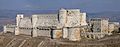
Krak des Chevaliers in Syria is a concentric castle with both rectangular and rounded towers. It is a well-preserved Crusader castle.
-
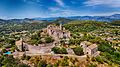
A hilltop château overlooking the Provençal countryside.
-
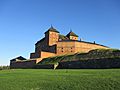
Tavastia Castle in Finland, one of Europe's northernmost castles, built near Lake Vanajavesi in the late 13th century.
-
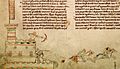
An early 13th-century drawing by Matthew Paris shows medieval warfare, including Lincoln Castle, crossbowmen, and mounted knights.
-
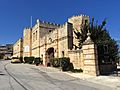
Castello Dei Baroni in Malta is a 20th-century home with castle-like features.


See also
 In Spanish: Castillo para niños
- Transition from the Medieval Castle to the Early Modern Fortress
Types of castles:
- Alcázar
- Burgstall
- Cave castle
- Concentric castle
- Fortified house
- Hill castle
- Hillside castle
- Island castle
- Lowland castle
- Ordensburg
- Ridge castle
- Spur castle
- Toll castle
- Water castle
Similar structures:
- African castles
- Dzong architecture
- Forts in India
- Fortified church
- Gusuku
- Japanese castle
- Tower house
