
Czechs facts for kids
| Czech: Češi | |
|---|---|
 |
|
| Total population | |
| c. 10–12 million (including Moravians and Czech Silesians) |
|
| Regions with significant populations | |
 Czech Republic 6,732,104-9,246,784 out of a total population of around 10,900,000. Czech Republic’s total population is 99.6% European (white) and 0.4% other minorities. (2026) Czech Republic 6,732,104-9,246,784 out of a total population of around 10,900,000. Czech Republic’s total population is 99.6% European (white) and 0.4% other minorities. (2026) |
|
| Significant diasporic populations in: | |
 United States United States |
1,462,000 |
 Germany Germany |
210,000 |
 Canada Canada |
104,580 |
 Slovakia Slovakia |
45,711–89,000 |
 Austria Austria |
65,000 |
 United Kingdom United Kingdom |
45,000 |
 Argentina Argentina |
40,000 |
 Australia Australia |
23,000 |
 Switzerland Switzerland |
16,000 |
 France France |
15,000 |
 Russia Russia |
11,000 |
 Italy Italy |
11,000 |
 Israel Israel |
8,000 |
 Poland Poland |
7,818 |
 Brazil Brazil |
5,000 |
 Romania Romania |
2,477 |
 Portugal Portugal |
736 |
 South Korea South Korea |
518 |
 Turkey Turkey |
354–2,000 |
 Ukraine Ukraine |
5,917-11,000 |
| Languages | |
| Czech | |
| Religion | |
| Traditionally Christian (Majority Roman Catholic, minority Protestant and Eastern Orthodox) Predominantly irreligious (particularly Atheist and Agnostic) |
|
| Related ethnic groups | |
| Other West Slavs (Moravians, Poles, Chodové, Slovaks, Silesians and Sorbs) |
|
The Czechs (pronounced CHEHSH), also known as the Czech people, are a West Slavic group of people. They are native to the Czech Republic in Central Europe. Czechs share a common ancestry, culture, history, and the Czech language.
For a long time, people in English called ethnic Czechs "Bohemians." This name came from their country's old name, Bohemia. Bohemia itself got its name from an ancient Celtic tribe called the Boii. During a time of big movements of people, called the migration period, West Slavs settled in the area. They mixed with the people already living there. This led to the creation of a principality, which became the Duchy of Bohemia and later the Kingdom of Bohemia. These were the early forms of the modern Czech Republic.
Many Czech people live outside the Czech Republic today. Large groups can be found in the United States, Germany, Canada, Slovakia, Austria, and the United Kingdom. Other communities live in Argentina, Australia, Switzerland, France, Russia, Italy, Israel, Brazil, and Romania.
Contents
Who are the Czechs?
The Czech people belong to the West Slavic family, which is a larger group of people who speak similar languages. The West Slavs originally came from early Slavic tribes. These tribes settled in Central Europe after other groups moved away during the migration period. The Czech tribe settled in the area known as Bohemia. They blended with the Celtic and Germanic people who were already living there.
In the 9th century, the Duchy of Bohemia was formed under the Přemyslid dynasty. This duchy was once part of a larger state called Great Moravia. According to old stories, the first leader of the Czech people was Forefather Čech. Legend says he led his tribe to their homeland.
Czechs are very closely related to their neighbors, the Slovaks. They even shared a country, Czechoslovakia, for many years. The Czech–Slovak languages are so similar that they are like different versions of the same language. Czech culture has had a strong influence on Slovak culture. Czech people have also lived alongside Germanic people for a long time. In the 17th century, German became more common in government. Wealthier families in Bohemia and Moravia started to adopt German ways. However, the Czech identity stayed strong among everyday people. The Czech National Revival in the 18th and 19th centuries helped bring back the Czech language, culture, and national pride. Czechs were also important in starting the idea of Pan-Slavism, which promoted unity among Slavic peoples.
The name "Czech" comes from a Slavic tribe in central Bohemia. This tribe became powerful in the late 9th century and created the Czech state. The exact meaning of the name "Čech" is not fully known. Many believe it relates to a word meaning "member of the people" or "kinsman."
A Look at Czech History

The people of the Czech Republic have ancestors from different groups. These include Slavic, Celtic, and Germanic origins. West Slavs were present in the Czech lands by the 6th century during the Migration Period. They settled in Bohemia, Moravia, and Austria. They blended with the Celtic and Germanic people who were already there. A popular story says the Slavs arrived with Forefather Čech and settled near the Říp Mountain.
Early Beginnings
In the 7th century, a Frankish merchant named Samo helped the Slavs fight against the Avars. He became the ruler of the first known Slavic state in Central Europe, called Samo's Empire. Later, in the 8th century, the principality of Great Moravia grew powerful. It reached its peak in the 9th century under Svatopluk I of Moravia. This state was Christianized, with a key role played by the Byzantine missionaries Cyril and Methodius.
The Duchy of Bohemia began in the late 9th century. In 880, Prague Castle was built by Prince Bořivoj. He was the founder of the Přemyslid dynasty, and the city of Prague started to grow around it. Vratislav II became the first Czech king in 1085. The duchy became a hereditary kingdom under Ottokar I in 1198.
Kingdoms and Empires
During the 13th century, many German people moved into the Czech lands. This led to many Czechs today having some German ancestry. The Habsburg Monarchy, a powerful European family, often fought religious wars. In the 16th century, Czech nobles rebelled against the Habsburgs but were defeated.

A famous event called the Defenestrations of Prague in 1618 started a big revolt against the Habsburgs. This event also marked the beginning of the Thirty Years' War. After a major battle in 1620, the Czech lands became the property of the Habsburg family. German became an official language alongside Czech.
Many Czech writers call the period from 1620 to the late 18th century the "Dark Age." This time saw a lot of destruction from wars. There was also a strong effort to make Czech people adopt German culture and language. The economy and political power of the Czech lands declined. It is thought that the population of the Czech lands decreased significantly during this time.
The 18th and 19th centuries brought the Czech National Revival. This movement focused on bringing back Czech culture, language, and national identity.
The Road to Independence
During World War I, Czechoslovak Legions fought against the Central Powers. In 1918, the independent state of Czechoslovakia was created. Czechs played a leading role in this new country, which formed from parts of the Austrian-Hungarian Monarchy.
After 1933, Czechoslovakia was one of the few democracies in Central and Eastern Europe. However, in 1938, the Munich Agreement forced Czechoslovakia to give up a region called the Sudetenland. This area had many Czech people living in it. In 1939, German Nazi rule established the Protectorate of Bohemia and Moravia. This was for the remaining Czech state. The Nazi regime only allowed pro-Nazi Czech groups. They tried to emphasize ties between Czechs and Germans to encourage assimilation. In places like Lidice, Ležáky, and Javoříčko, Nazi authorities committed terrible acts against the local Czech population.
On May 2, 1945, the Prague Uprising reached its peak. After the war, many Germans were expelled from Czechoslovakia. Czechs, along with Slovaks and Romani people, settled in the lands where the Sudeten Germans had lived.
Modern Times
The Warsaw Pact invasion of Czechoslovakia in 1968 led to many people leaving the country. This wave of emigration included many highly skilled individuals.
Since the 1990s, the Czech Republic has worked to help ethnic Czechs living in countries like Romania and Kazakhstan return home.
Famous Czech People

Many Czechs have become famous throughout history and in modern times.
Leaders and Thinkers
Some of the most important early Czech kings were the last five Přemyslids. These included Ottokar I of Bohemia and Wenceslaus I of Bohemia. The most successful Czech king was Charles IV. He was also a Holy Roman Emperor. His time was a golden age for the Czech state.
Many people are seen as national heroes. Jan Hus was a religious reformer in the 15th century. He inspired the Hussite Movement. Jan Žižka and Prokop the Great were leaders of the Hussite army. George of Poděbrady was a Hussite king. Jan Amos Komenský, known as the "teacher of nations," is also a very important figure. Josef Jungmann helped develop the modern Czech language. František Palacký was a famous historian, often called the "father of the nation."
In modern politics, Tomáš Garrigue Masaryk and Edvard Beneš were key figures in founding Czechoslovakia. Václav Havel was the last President of Czechoslovakia and the first President of the Czech Republic. Other important politicians include Miloš Zeman, the first directly elected president. Madeleine Albright, a diplomat, had Czech origins.
Czechs have also made big contributions to science. Jaroslav Heyrovský won a Nobel Prize in Chemistry. Johann Gregor Mendel is known as the founder of genetics. Jan Evangelista Purkyně was a famous biologist. Kurt Gödel was a brilliant mathematician.
Sports Stars
Czechs have excelled in many sports, especially tennis, football, hockey, and athletics.
- Tennis: Martina Navrátilová, Ivan Lendl, Petra Kvitová, Tomáš Berdych
- Football: Josef Masopust, Pavel Nedvěd, Petr Čech
- Hockey: Jaromír Jágr, Dominik Hašek, David Pastrňák
- Athletics: Emil Zátopek, Dana Zátopková, Jan Železný, Barbora Špotáková
- Gymnastics: Věra Čáslavská
- Chess: Wilhelm Steinitz, Věra Menčíková
- Others: Martina Sáblíková (speed skating), Ester Ledecká (snowboarding and skiing)
Artists and Musicians

Czech music has a long history, with important pieces from the 11th century. Great Czech composers often used elements of folk music. This can be heard in the works of Jan Dismas Zelenka and Josef Mysliveček in the Baroque era. Later, Bedřich Smetana and Antonín Dvořák were famous during Romanticism. Leoš Janáček and Bohuslav Martinů contributed to modern classical music.
Czech musicians also helped shape European music. Jan Václav Antonín Stamic helped create Classicism in music. Antonín Dvořák even helped create a new American classical music style. Modern Czech musicians include Ivan Král and Jan Hammer. The rock band The Plastic People of the Universe was important in the underground music scene during the communist era.

In visual arts, Mikoláš Aleš was a painter who helped redesign the Prague National Theater. Alphonse Mucha was a very influential artist in the Art Nouveau movement. František Kupka was a pioneer of abstract art. Other well-known painters include Josef Lada and Max Švabinský. Famous sculptors were Josef Václav Myslbek and Matyáš Bernard Braun.
Writers and Filmmakers
Jaroslav Seifert won the Nobel Prize in Literature for his poetry. Božena Němcová is famous for her book Babička (The Grandmother). Other important Czech writers include Milan Kundera, Karel Čapek, Jaroslav Hašek, and Franz Kafka.
Film director Miloš Forman is known for movies like One Flew over the Cuckoo's Nest. He started his career in Czechoslovakia. Other famous filmmakers include Jiří Menzel and Jan Svěrák, who both won Academy Awards. Jan Švankmajer is a well-known surrealist filmmaker and animator.
Inspiring Saints

Czech culture includes many saints. Most notably, St. Wenceslaus (Václav) is the patron saint of the Czech nation. Others include St. John of Nepomuk (Jan Nepomucký) and St. Agnes of Bohemia (Anežka Česká). Rabbi Judah Loew ben Bezalel of Prague, a 16th-century scholar, is also an important part of the country's religious history.
Where Czechs Live

Czechs live in three historical regions: Bohemia, Moravia, and Czech Silesia. These regions make up the modern Czech Republic. The country is now divided into 14 administrative regions. The local culture can be a bit different in each historical region. For example, Moravians are often very proud of their Moravian heritage. Local dialects are also spoken in various parts of the country.
The Czech Language
The Czech language is spoken by about 12 million people around the world. Most of these speakers live in the Czech Republic. It developed from an older language called Proto-Slavic language in the 10th century. Czech is very similar to the Slovak language, and people who speak one can usually understand the other.
Beliefs and Traditions

Historically, Czechs have been described as tolerant and sometimes not very focused on religion.
After the Bohemian Reformation, many Czechs became followers of Jan Hus and other reformers. However, after a defeat in the Battle of White Mountain, the Habsburg rulers worked to bring the Czech population back to the Roman Catholic Church. Many Protestant communities were forced to leave, or they converted to Catholicism. The Catholic Church lost many followers during the Communist era.
As of 2015, studies showed that about 72% of people in the Czech Republic consider themselves not religious. This group includes atheists, agnostics, and those who say they have no particular religion. About 26% were Christians, mostly Catholics, and 2% belonged to other faiths.
Czechs Around the World
In the Czech Republic, about 6.7 million people identified as ethnic Czech in the 2011 census. Many others chose not to declare their ethnicity, and about 522,000 identified as Moravians.
There is a large Czech diaspora (Czech people living outside their home country). This includes over 1.7 million Americans of Czech or Czechoslovak ancestry. There are also about 94,805 Canadians of Czech ancestry. Around 45,000 Czech-born residents live in the United Kingdom, and about 31,000 in Australia. Smaller communities exist throughout Europe. It is estimated that between 50,000 and 100,000 Israelis have Czech-Jewish ancestry.
Images for kids
-
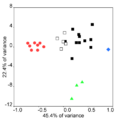
This map shows how different populations are distributed based on genetic markers.

See also
 In Spanish: Pueblo checo para niños
- List of Czechs
- The Greatest Czech
- List of Bohemian monarchs
- List of prime ministers of the Czech Republic
- List of prime ministers of Czechoslovakia
- List of presidents of Czechoslovakia
- List of presidents of the Czech Republic
