
Hydrilla facts for kids
Quick facts for kids Hydrilla |
|
|---|---|
 |
|
| Conservation status | |
Scientific classification  |
|
| Kingdom: | Plantae |
| Clade: | Tracheophytes |
| Clade: | Angiosperms |
| Clade: | Monocots |
| Order: | Alismatales |
| Family: | Hydrocharitaceae |
| Genus: | Hydrilla Rich. |
| Species: |
H. verticillata
|
| Binomial name | |
| Hydrilla verticillata (L.f.) Royle
|
|
| Script error: The function "autoWithCaption" does not exist. | |

Script error: No such module "Check for conflicting parameters".
Hydrilla is a fast-growing aquatic plant that lives completely submerged under freshwater. Most scientists group this hardy water weed under the scientific name Hydrilla verticillata. It belongs to its own special genus within a larger family of water-loving plants. People often call it waterthyme because its tiny leaves look similar to garden thyme. It comes originally from warm and cool freshwater regions in Asia, Africa, and Australia. In Australia, it grows across the Northern Territory, Queensland, and New South Wales. Today, it is famous worldwide because it grows fast and spreads quickly into new waterways.
This amazing freshwater plant can survive where many other plants fail. It can grow an entire inch every single day in warm summer weather. As it grows, it forms thick underwater tangles that reach from the muddy bottom up to the surface. It can tolerate murky water, low sunlight, and even a little bit of salty water. Because of its incredible strength, it often becomes a troublesome invader when people introduce it to new places.
Contents
What Does Hydrilla Look Like?

Hydrilla has long, thin stems that can reach up to 2 meters in length. These flexible green stems stay underwater and wave gently with moving river currents. Along each stem, the leaves grow in tight circles called whorls. A single whorl usually contains between two and eight pointed leaves. Each leaf measures roughly 5 to 20 millimeters long and up to 2 millimeters wide. The leaves have tiny, sharp teeth along their outer edges that feel rough to touch. Fresh stems often show a faint reddish color along the center vein of each leaf. Inside the stems and leaves, tiny air pockets trap gas to keep the plant standing upright.
Small flowers can appear on the plant, though they are quite rare to spot. A single plant can be monoecious, meaning it holds both male and female structures. Sometimes separate plants hold different parts, which scientists describe as dioecious. Each tiny flower has three delicate sepals and three transparent petals. The petals measure only 3 to 5 millimeters long and feature faint red streaks. Because water currents do most of the work moving plant pieces, flowering is not necessary for survival.
Related Plant Lookalikes
Many people confuse Hydrilla with other popular underwater greenery found in ponds. It looks remarkably similar to the common waterweed known as Elodea canadensis. It also closely resembles another submerged green plant called Egeria densa. Both of these lookalikes also feature green leaves arranged in rings around slender stems. However, Hydrilla leaves have sharp, saw-like teeth along their borders. Its lookalikes have much smoother leaf margins that feel soft rather than rough. Looking closely at these edges helps biologists know which plant they are observing.
Over time, different botanists gave this unique water weed various scientific synonyms. Some historical texts call it H. asiatica, while others use H. japonica. Old European books also recorded it as H. lithuanica or H. ovalifolica. Today, botanists agree that these different historical names describe the very same widespread organism.
Life Cycle and Reproduction
Hydrilla has developed several smart ways to survive cold winters and multiply rapidly. Instead of relying on regular seeds, it mainly uses vegetative reproduction. That means pieces of the stem break off and grow into completely new plants. When a boat motor chops up a stem, each broken fragment quickly takes root. A tiny piece floating downstream can start an entirely new patch in another bay. This simple survival trick allows the species to travel great distances along flowing rivers.
The plant also builds specialized storage structures that hide deep within the lakebed. It produces underground food stores called tubers along its creeping roots. It also grows small, bud-like survival packets known as turions on its stems. These buds drop off during autumn and sink deep down into the cold mud. Turions and tubers can rest safely through freezing winters and long droughts. A hidden tuber can remain dormant in the mud for several years before sprouting. When warm spring weather returns, these tough storage pods sprout fresh green shoots immediately.
Role in Freshwater Ecosystems
In its native home, Hydrilla plays a natural and balanced ecological role. Like other large submerged plants, it contributes directly to the vital nutrient cycle. Its leafy green underwater forests provide protective hiding spots for young fish and invertebrates. Snails, aquatic bugs, and various water birds consume parts of the stems for food. The long stems trap loose soil, which helps keep sediment on the river bottom.
However, Hydrilla also uses chemical tricks to stop its plant neighbors from thriving. It shows strong negative allelopathy against common competitors like Ceratophyllum demersum. It also releases special chemical compounds that stunt the growth of C. muricatum. By releasing these natural chemicals into the water, it keeps nearby hornworts from growing. This allows the plant to steal sunlight and take over the best sunny spots.
How It Spread as an Invasive Plant

Problems begin when this hardy plant gets introduced into water systems outside its homeland. It has become a widespread naturalized and highly damaging weed. During the 1950s and 1960s, aquarium dealers brought live samples from Sri Lanka. Sellers labeled the pretty green stems with the fancy commercial name "Indian star-vine." Some unwanted bundles were dumped carelessly into an open canal near Tampa Bay, Florida. The warm Florida sunshine and slow-moving fresh water provided ideal conditions for rapid growth.
By 1955, people transported the attractive plant south from Tampa straight to Miami. Pet shops sold it widely to fish hobbyists across the entire region. From there, accidental dumps and careless releases into lakes allowed it to multiply rapidly. It spread across waterways throughout the entire southeastern United States within a few decades. By the 1990s, wildlife agencies were spending millions of dollars yearly fighting its expansion. Today, it thrives from Connecticut across to Texas, and all the way west to California. It has even reached parts of southern Canada and continues to threaten new watersheds.
Environmental and Human Problems
When this plant invades a lake, it causes serious problems for aquatic wildlife. It grows so fast that it out-competes native species like pondweeds and eelgrass. Instead of a healthy mix of plants, it forms dense monocultures covering everything. These giant green blankets block sunlight from reaching down into deeper water layers. Native plants trapped underneath cannot get enough light and eventually die out completely.
The plant also creates dramatic swings in water chemistry between day and night. During bright daylight, rapid plant growth uses up dissolved carbon dioxide in the water. This reaction raises the overall water pH while releasing high amounts of oxygen. But at night, the massive plant beds switch over to oxidative phosphorylation. This nighttime respiration drains dissolved oxygen from the water, suffocating fish and small critters.
Thick mats can also host a tiny cyanobacteria named Aetokthonos hydrillicola. This microscopic organism produces a deadly neurotoxin named aetokthonotoxin. When water birds eat the plant, this poison causes avian vacuolar myelinopathy. This terrible neurological condition damages the brains of waterfowl, eagles, and other birds of prey. In addition, dense weed blankets block water flow, choke irrigation canals, and trap boat propellers.
How Scientists Manage Hydrilla Infestations

Managing this aggressive plant requires huge effort, specialized equipment, and careful planning. Wildlife managers use selective chemical treatments called herbicides to clear blocked waterways. For years, managers relied on a chemical known as fluridone to treat large lakes. However, over time, some plant populations became completely resistant to that specific herbicide. Today, specialists often turn to alternative approved treatments like endothall to target stubborn patches.
Scientists also use natural animal helpers through smart biological pest control. Specialized insects from the plant's native homeland help slow down its rapid spread. Tiny snout beetles called weevils belonging to the genus Bagous chew through stems. Another helpful helper is the Asian hydrilla leaf-mining fly, whose larvae tunnel through leaves. In certain closed ponds, managers also release plant-eating grass carp to graze on weeds.
Boaters must also do their part to prevent spreading broken plant pieces around. Whenever boats motor through thick beds, spinning propellers chop the stems into tiny pieces. Fragments easily hitch a ride on boat trailers, anchors, paddles, and fishing gear. Boaters are urged to clean, drain, and dry all gear before visiting new lakes. In 2011, officials in Ithaca worked hard to protect Cayuga Lake in the famous Finger Lakes. Similar rapid cleanup operations took place near North Tonawanda along the Niagara River. Constant public watchfulness remains the best defense against new invasions.
Phytoremediation and Helpful Uses
Even though it can cause serious headaches, this plant has several surprising benefits. Because it produces massive amounts of biomass, scientists study it for cleaning dirty water. It serves as an extraordinary bioremediation hyperaccumulator for hazardous dissolved elements. The plant can pull heavy metals straight out of contaminated industrial runoff and mud.
Specialized cleanup projects, known as phytoremediation, use these green beds as living filters. The plant absorbs dangerous contaminants like mercury, cadmium, chromium, and lead. It stores these heavy metals securely inside its own leaves and long stems. Workers can harvest the full-grown plants, safely removing toxic metals from the water. In carefully controlled settings, this troublesome weed becomes an active tool for environmental cleanup.
Images for kids
-
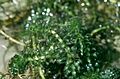
Detailed look at Hydrilla stem showing rings of leaves
See also
 In Spanish: Hydrilla para niños
