
Platypus facts for kids
Quick facts for kids Platypus |
|
|---|---|
_Scottsdale.jpg) |
|
| Platypus swimming in waters near Scottsdale, Tasmania | |
| Conservation status | |
Scientific classification  |
|
| Kingdom: | Animalia |
| Phylum: | Chordata |
| Class: | Mammalia |
| Order: | Monotremata |
| Family: | Ornithorhynchidae |
| Genus: | Ornithorhynchus Blumenbach, 1800 |
| Species: |
O. anatinus
|
| Binomial name | |
| Ornithorhynchus anatinus (Shaw, 1799)
|
|
.png) |
|
| Platypus range (red – native, yellow – introduced) |
|
| Script error: The function "autoWithCaption" does not exist. | |
| Synonyms | |
|
|

Script error: No such module "Check for conflicting parameters".
The platypus (scientific name Ornithorhynchus anatinus), often called the duck-billed platypus, is a unique semiaquatic mammal. It is native only to eastern Australia and Tasmania. It is famous because it lays eggs instead of giving birth to live young.
Together with four kinds of echidna, the platypus belongs to a rare group of egg-laying mammals called monotremes. It has a duck-shaped bill, a wide beaver-like tail, and webbed feet for swimming. It hunts underwater with its eyes and ears closed by sensing tiny electrical signals made by prey.
When European scientists first saw a dried specimen in 1799, they thought it was a stitched-together hoax. Today, the platypus is an iconic Australian animal and a key creature for understanding evolutionary biology.
Contents
- Discovery
- What Does the Name Platypus Mean?
- Appearance
- How the Platypus Senses Its Environment
- Platypus Venom and Spurs
- Where Do Platypuses Live?
- Daily Life and Behavior
- Diet and Foraging
- Reproduction
- Predators and Natural Threats
- Lifespan
- Evolutionary History and Fossil Relatives
- Why Did Modern Platypuses Lose Their Teeth?
- Unique Chromosomes and Genetics
- Conservation
- Cultural Significance
- See also
Discovery
Aboriginal Australians have lived alongside the platypus for tens of thousands of years. They created many different names for it in their languages.
- In the Wiradjuri language, it is called biladurang.
- In the Woiwurrung language of Victoria, it is known as dulaiwarrung.
- In the Bundjalung language of Queensland, it is named djanbang.
- In the Palawa kani language of Tasmania, it is called larila.
In 1798, Captain John Hunter sent a platypus pelt and sketch from Australia to Great Britain. British naturalists were extremely puzzled by the animal's strange mixture of body parts.
Scientist George Shaw wrote the first formal description in 1799. He admitted that it looked like a fake creature made by sewing a duck bill onto a beaver body. He even took scissors to the skin to look for hidden stitches.
What Does the Name Platypus Mean?
The name "platypus" comes from two Ancient Greek words: platys (broad or flat) and pous (foot). Shaw originally called it Platypus anatinus, but a genus of wood-boring beetles already had the name Platypus.
German scientist Johann Blumenbach renamed the genus Ornithorhynchus, which means "bird snout". Its full scientific name, Ornithorhynchus anatinus, translates to "duck-like bird snout". The correct plural is "platypuses", while young platypuses are often called "puggles" or "platypups".
-
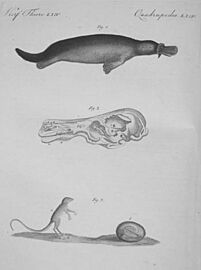
A book for children published in Germany in 1798
-
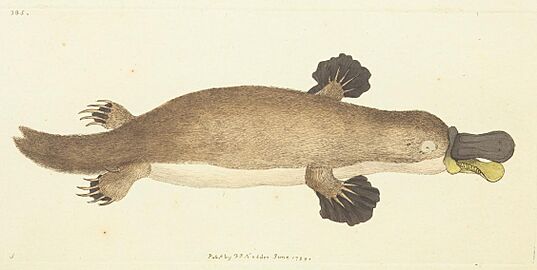
Illustration from the first scientific description in 1799
-
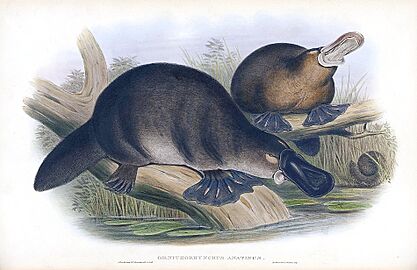
Colour print from 1863

._First_Description_1799.jpg)

Appearance

Body Shape, Fur, and Waterproofing
The platypus has a streamlined body covered with dense, brown, waterproof fur. The coat traps an insulating layer of warm air next to the skin. Only otters have denser fur than a platypus.
Its fur is biofluorescent, glowing blue-green under ultraviolet light. This glow might help camouflage the animal from predators that can see ultraviolet light at dusk.
Bill, Tail, and Webbed Feet
The bill is soft and leathery, unlike a bird's hard beak. It contains sensitive nerve endings for hunting. Cheek pouches inside the mouth store food gathered from riverbeds.
The wide, flat tail stores energy in the form of body fat. The animal uses its tail as a rudder while steering through water.
Its front feet have extensive webbing that extends past the claws to act like paddles. On land, the platypus folds this webbing backward to walk on its knuckles and dig into banks.
Size and Weight
Male platypuses average 50 cm (20 in) in length and weigh about 1.7 kg (3.7 lb). Females are slightly smaller, averaging 43 cm (17 in) and 0.9 kg (2.0 lb).
Internal Anatomy and Body Functions
Adult platypuses do not have teeth. Instead, they use rough, keratin pads to grind up hard-shelled food.
The platypus does not have a typical stomach with digestive acid. Its food passes directly from the gullet into a simple intestinal pouch.
Its average body temperature is 32 °C (90 °F), which is cooler than most other mammals.
-
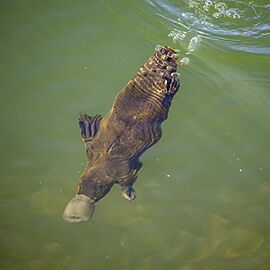
Diving
-
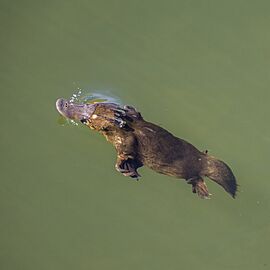
Surfacing
-
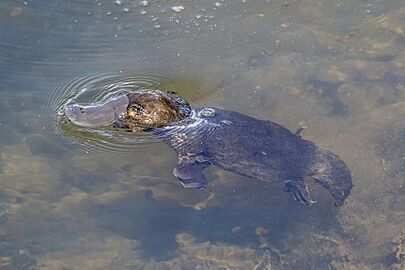
Resting near the surface
_diving_Scottsdale.jpg)
_surfacing_Scottsdale.jpg)
_Scottsdale_4.jpg)
How the Platypus Senses Its Environment

The platypus uses electroreception to find food in murky water. It is one of the very few mammals able to sense natural electricity.
When a small shrimp or insect moves, its muscles create tiny electrical pulses. The platypus's bill has about 40,000 electrical receptors arranged in neat stripes to detect these signals.
When the platypus dives, it seals its eyes, ears, and nostrils inside special skin folds. It cannot see or smell while swimming underwater.
To hunt, it moves its bill from side to side across the riverbed. By comparing electrical signals and water vibrations, it calculates the exact position of its prey.
Out of the water, the platypus relies on its small eyes and sharp ears. Its hearing system has three tiny ear bones, just like other mammals. Its eyes work well on land in low light.
Platypus Venom and Spurs

Male platypuses have a sharp, hollow spur on the inside of each hind leg. These spurs connect to venom glands located in the upper thighs.
Female platypuses lose their spurs before adulthood, but males keep them throughout life.
The venom contains special proteins made by the animal's immune system. While rarely fatal to humans, a sting causes rapid swelling and intense pain that painkillers cannot easily stop.
Male platypuses produce more venom during the breeding season. They use their spurs primarily in fights with rival males over territory.
Where Do Platypuses Live?
The platypus lives only in freshwater rivers, streams, lakes, and lagoons across eastern Australia. Its range stretches from tropical Queensland down through New South Wales, Victoria, and Tasmania.
A small introduced population also lives in Flinders Chase National Park on Kangaroo Island in South Australia.
Platypuses spend their time resting and nesting inside burrows dug into muddy riverbanks. They dig two kinds of burrows: simple resting tunnels and long nesting burrows lined with leaves.
They prefer healthy streams with clear water, rocky bottoms, and overhanging trees that provide shade and insect food.
Daily Life and Behavior
The platypus is a skilled swimmer with a unique paddling technique. It pushes forward by paddling its webbed front feet alternately, using its back feet and tail to steer.
Dives usually last between 30 and 40 seconds. After each dive, the platypus floats on the surface for a few seconds to breathe.
Diet and Foraging
The platypus is a carnivore that hunts along river bottoms. It eats:
- Insect larvae like caddisflies and dragonflies
- Small freshwater crayfish (yabbies)
- Freshwater shrimp
- Aquatic worms and snails
- Tadpoles and small fish eggs
It collects food along the riverbed, packs it into cheek pouches, and surfaces to chew it using hard mouth pads.
Reproduction

Platypuses breed once a year between late winter and spring. After mating in the water, the female builds a deep nesting burrow up to 30 m (98 ft) long.
She lines the burrow with damp leaves, grass, and reeds. She blocks the tunnel entrance with dirt plugs to keep out predators and trap humidity.
The female usually lays one to three small, leathery eggs measuring about 17 mm (21⁄32 in) across. She curls her warm body around the eggs to incubate them.
The eggs hatch after about 10 days of incubation.
Newborn platypuses hatch out blind, hairless, and tiny, measuring only about 2 cm (1 in) long.
The mother does not have teats. Instead, milk seeps through specialized pores on her belly skin, and the babies lap it up from her fur.
Young platypuses remain inside the safe nesting burrow for about four months. By the time they emerge, they have grown a full coat of fur and can swim on their own.
Predators and Natural Threats
In the wild, platypuses are hunted by birds of prey, goanna lizards, carpet snakes, Murray cod, and introduced red foxes.
Lifespan
Wild platypuses can live for over 20 years, while those in protected care have lived past 30 years.
Evolutionary History and Fossil Relatives
|
|||||||||||||||||||||
| Family tree showing how monotremes relate to other mammals |
Ancient Origins of Monotremes
The platypus is an ancient mammal lineage that split away from other mammal groups over 160 million years ago. Monotremes kept the ancestral trait of laying eggs while developing fur and milk production.
Scientists estimate that platypuses and echidnas split from a common ancestor between 19 and 48 million years ago.

Prehistoric Platypus Relatives
Fossil discoveries show that ancient platypus relatives once lived across Gondwana:
- Steropodon: Lived in the Cretaceous period and had fully formed molar teeth.
- Patagorhynchus: Discovered in Argentina, showing that ancient monotremes once lived in South America.
- Obdurodon tharalkooschild: A giant prehistoric platypus that grew up to 1.3 m (4.3 ft) long.
Why Did Modern Platypuses Lose Their Teeth?
Ancient platypus ancestors used molar teeth to crush shellfish. Scientists believe modern platypuses lost their teeth about 2.5 million years ago.
When native water rats called rakali spread across Australia, they competed for hard-shelled prey. Platypuses adapted by eating softer aquatic worms and larvae, replacing their teeth with keratin grinding pads.
Unique Chromosomes and Genetics
The platypus has a fascinating genetic makeup. Most mammals have two sex chromosomes (XY or XX), but the platypus has ten (five XY pairs in males).
Its DNA contains a mix of genes shared with mammals, reptiles, and birds, helping scientists understand how early mammals evolved.
Conservation
Threats to Wild Populations
The IUCN classifies the platypus as "Near Threatened". Wild numbers have declined due to several modern threats:
- River dams and water removal during severe droughts
- Land clearing that damages riverbanks
- Water pollution and plastic litter
- Drowning in illegal closed funnel traps used for catching crayfish
- Extreme wildfires drying up mountain streams
Conservation Measures and Laws
The platypus has been legally protected by Australian law since 1912. Many Australian states have banned dangerous closed funnel traps to prevent accidental drowning.
Wildlife organizations work to restore healthy native trees along rivers and protect freshwater flows during droughts.
Platypuses in Sanctuaries and Zoos
Breeding platypuses in human care is difficult because they need complex stream environments. Notable breeding programs include:
- Healesville Sanctuary in Victoria, which bred the first captive platypus in 1943.
- Taronga Zoo in Sydney, which breeds platypuses for conservation research and release programs.
- San Diego Zoo Safari Park in California, which maintains an educational habitat outside Australia.
Cultural Significance
Aboriginal Australians featured the platypus in traditional stories, often describing it as an animal created from a mix of different river creatures.
Today, the platypus is a world-famous symbol of Australian wildlife. It appears on the Australian 20-cent coin and serves as the state animal emblem of New South Wales.
See also
 In Spanish: Ornitorrinco para niños
- Henry Burrell
- Ellis Joseph
- Fauna of Australia
