
Plasma (physics) facts for kids


Plasma is famous as the amazing fourth state of matter, joining solid, liquid, and gas. It forms when a gas gets superheated or gets hit with strong electricity. When this happens, electrons break free from their atoms. This creates a lively mix of free electrons and charged ions, known as charged particles. This process is called ionization. Plasma is quite rare to touch on Earth, but it is the most common kind of ordinary matter in the universe!
Contents
What Is the Fourth State of Matter?

You already know that ice is a solid, water is a liquid, and steam is a gas. When you heat gas to extreme temperatures, it changes again. It turns into a glowing soup of electrical charges. Because these particles carry an electric charge, plasma acts very differently from regular gas.
Ordinary gases are great insulators, meaning electricity cannot flow through them easily. Plasma is completely different. It is extremely conductive, so electric currents can zoom right through it! Moving charges create strong electric fields and magnetic fields. These forces cause all the particles to move together in swirling, wavy patterns.
Scientists describe plasma in several interesting ways:
- Partially ionized plasma: Only some atoms lose their electrons, like inside glowing neon signs.
- Fully ionized plasma: Every single electron is ripped free, which happens inside extremely hot stars.
- Dusty plasma: A mixture that contains tiny bits of space dust floating among charged particles.
- Non-neutral plasma: A rare type made of only one kind of charge, trapped using magnets in a Penning trap.
How Plasma Was Discovered

Long ago, scientists studied an electric spark leaping across gaps. In 1803, thinkers named Vasily Petrov and Humphry Davy independently found the brilliant electric arc. Later, in 1831, the famous scientist Michael Faraday studied glowing gases inside glass tubes.
In 1879, a chemist named Sir William Crookes realized this glowing gas was special. He called it a fourth state of matter. Later, in 1928, an American scientist named Irving Langmuir named it "plasma." He worked with Lewi Tonks and noticed that the way electrons flowed inside glass tubes looked like cells moving inside human blood plasma!
Where Can We Find Plasma in Nature?

Plasma makes up giant parts of our cosmos. More than 99% of all visible matter in space is plasma!
Plasma in Space and the Solar System
Our Sun is a huge ball of plasma powered by nuclear fusion. The Sun constantly blows a stream of particles called the solar wind across the interplanetary medium. Deep in space, the interstellar medium and the distant intergalactic medium are also filled with thin plasma. Giant swirls called accretion disks spin around heavy neutron stars and black holes. Many active galaxies shoot out massive astrophysical jets made of high-energy plasma.
Plasma Near Planet Earth
Earth has natural plasma high above our heads. The energetic rays from space create a layer called the ionosphere. Further out, Earth's magnetic bubble, the magnetosphere, traps energetic particles. When these particles dive down toward the North or South Pole, they create the colorful auroras. During stormy weather, sudden lightning superheats the air into glowing plasma channels. Very hot fire and strange glows like St. Elmo's fire can also contain plasma!
How Do People Use Plasma Today?

Engineers build clever machines to make plasma on purpose. They push a high voltage across a special gas inside a discharge tube. This pulls electrons toward the positive anode and pushes the heavy centers toward the negative cathode. This chain reaction is called a Townsend avalanche.
We use artificial plasma in many cool modern tools:
- Lighting: Inside a fluorescent lamp, an electrical discharge creates cool plasma that gives off light.
- Displays: Older flat-screen televisions lit up tiny pockets of gas to build bright images.
- Space travel: Deep space probes use an ion thruster to push themselves forward. A returning spacecraft also glows with plasma during atmospheric entry.
- Manufacturing: Factories use plasma etching to carve computer chips and use welding torches to cut thick metals.
- Future clean energy: Scientists use magnetic bottles to hold plasma hotter than the Sun to develop clean fusion power.
Images for kids
-
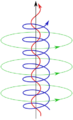
Magnetic field lines winding through a plasma stream.
-
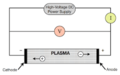
A simple tube showing how electricity creates plasma.
-

An electric spark climbing between metal rods.
-
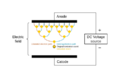
Electrons multiplying as they bump into gas atoms.
-

A special plasma thruster for spaceships.
-

Spraying melted protective coating with a plasma torch.
-

Superheated fusion plasma swirling in a lab.
-

Glowing purple argon plasma inside a laboratory tube.


See also
 In Spanish: Plasma (estado de la materia) para niños
- Quark–gluon plasma
- List of plasma physics software
