
Space Race facts for kids
Quick facts for kids Space Race |
|||||||
|---|---|---|---|---|---|---|---|
|
Clockwise, from top left: Model of the Sputnik 1 satellite; Apollo 11 astronaut Buzz Aldrin on the Moon; US Space Shuttle Atlantis docked to the Soviet Mir Earth orbital space station; US and Soviet crews of Apollo-Soyuz, first joint rendezvous and docking mission
|
|||||||
|
|||||||
| Belligerents | |||||||
 United States United States |
 Soviet Union Soviet Union |
||||||
| Commanders and leaders | |||||||
 Dwight Eisenhower John Kennedy Lyndon Johnson Richard Nixon Wernher von Braun T. Keith Glennan James E. Webb Thomas O. Paine James C. Fletcher Dwight Eisenhower John Kennedy Lyndon Johnson Richard Nixon Wernher von Braun T. Keith Glennan James E. Webb Thomas O. Paine James C. Fletcher |
 Nikita Khrushchev Leonid Brezhnev Sergei Korolev Vasily Mishin Valentin Glushko Kerim Kerimov Mstislav Keldysh Mikhail Yangel Vladimir Chelomey Viktor Makeyev Boris Chertok Nikita Khrushchev Leonid Brezhnev Sergei Korolev Vasily Mishin Valentin Glushko Kerim Kerimov Mstislav Keldysh Mikhail Yangel Vladimir Chelomey Viktor Makeyev Boris Chertok |
||||||
| Casualties and losses | |||||||
|
United States
|
Soviet Union
|
||||||

.jpg)


The Space Race was an exciting 20th-century rivalry between two major world superpowers: the United States and the Soviet Union. Both nations raced to prove who had the best science, technology, and rockets. This competition took place during the Cold War, a long period of political tension where both sides avoided fighting directly.
Instead of fighting on a battlefield, the two nations competed in the skies. Each wanted to show that its way of life and government was superior. The race led to amazing achievements in human history. It brought about the first artificial satellites, the first animals and humans in orbit, robotic probes sent to distant planets, and human footprints on the Moon.
The contest began in the mid-1950s and peaked during the 1960s. It eventually turned from fierce competition into peaceful cooperation. Today, the discoveries made during that era form the foundation of modern space exploration.
Contents
Origins of the Space Race
Early Rocket Science and Missiles

Long before the race officially began, dreamers and scientists wondered about traveling beyond Earth. Early pioneers, like Robert H. Goddard in America and Konstantin Tsiolkovsky in Russia, tested small liquid-fuel rockets.
During World War II, German engineers led by Wernher von Braun built the V-2 rocket. The V-2 was the world's first long-range guided ballistic missile. It was capable of reaching the edge of space before plunging back down.
When the war ended in 1945, both American and Soviet forces rushed to recruit German scientists and capture their equipment. Von Braun and many of his top engineers surrendered to the United States under a secret operation called Operation Paperclip. The Soviet Union also brought German technicians and V-2 parts east to help their engineers learn how to build giant rockets.
Cold War Rivalry and the Missile Race
After World War II, the United States and the Soviet Union became fierce political rivals. This era became known as the Cold War. Both sides developed powerful defensive weapons, including intercontinental ballistic missiles (ICBMs).
An ICBM could carry a payload across oceans in less than an hour. However, scientists soon realized that an ICBM strong enough to carry heavy payloads across continents could also lift a spacecraft into orbit around the Earth. Rocket capability quickly became a sign of national strength and pride.
Soviet Rocket Progress and Sergei Korolev

In the Soviet Union, rocket development was directed by a brilliant engineer named Sergei Korolev. His identity was kept secret for many years, and he was known to the public only as the "Chief Designer."
Korolev led the design of the R-7 Semyorka, the world's first true ICBM. The R-7 was huge and powerful, using four strap-on boosters attached to a central core. In August 1957, the R-7 completed its first successful long-range test flight. Korolev quickly realized that this monster rocket could place an artificial satellite into orbit around the planet.
American Rocket Efforts

In the United States, different branches of the military worked on their own rockets during the late 1940s and 1950s. The Army team, led by von Braun at the Redstone Arsenal in Alabama, built the Redstone rocket.
The Air Force developed the Atlas missile, which used lightweight steel fuel tanks that stayed rigid using internal gas pressure. Meanwhile, the Navy worked on a research rocket called Vanguard.
Because President Dwight D. Eisenhower wanted to keep scientific space exploration separate from military missile testing, he chose the civilian Vanguard project to try to launch America's first satellite.
Early Satellite Triumphs and Challenges
The Launch of Sputnik 1
_1200dpi.jpg)
Both nations announced plans to launch small research satellites for the International Geophysical Year (1957–1958). The Soviets struck first. On October 4, 1957, Korolev's team launched Sputnik 1 atop an R-7 rocket from the Baikonur Cosmodrome.
Sputnik 1 was a polished metal sphere about 58 centimeters (23 in) in diameter, weighing 83.8 kilograms (185 lb), with four whip-like antennas. As it orbited the Earth every 96 minutes, it broadcast a steady radio "beep... beep... beep." Amateur radio operators and scientists worldwide tuned in to listen.
The successful launch astonished the globe. It showed that the Soviet Union possessed powerful rockets capable of reaching orbit, sparking the Space Race in earnest.
American Reaction and the Sputnik Crisis
In the United States, the news triggered the "Sputnik crisis." Many citizens and political leaders worried that the Soviet Union had surpassed American technology.
To answer Sputnik, the US sped up the Vanguard satellite program. On December 6, 1957, a televised launch of the Vanguard TV3 rocket ended in disaster when the rocket exploded on the pad seconds after liftoff. Newspapers called it "Flopnik" and "Kaputnik."
After this setback, the American government turned to von Braun's Army team to prepare their Jupiter-C rocket as quickly as possible.
Explorer 1 Discovers the Radiation Belts

On January 31, 1958, the United States successfully entered orbit with Explorer 1. The small satellite weighed about 14 kilograms (31 lb) and carried scientific gear designed by Dr. James Van Allen.
Explorer 1 carried a cosmic ray detector that discovered intense bands of radiation surrounding the Earth trapped by the planet's magnetic field. Today, these are known as the Van Allen radiation belts. This discovery was the first major scientific triumph of the Space Race.
The Birth of NASA
Recognizing the need for a unified civilian space effort, President Eisenhower signed the National Aeronautics and Space Act on July 29, 1958. This act created the National Aeronautics and Space Administration (NASA).
NASA absorbed older aeronautics labs and military rocket teams, including von Braun's engineering group in Alabama. NASA's job was clear: explore space for peaceful scientific purposes and restore American leadership in aerospace technology.
Animals in Space

Before risking human lives, scientists wanted to see if living creatures could survive the harsh conditions of launch and weightlessness.
On November 3, 1957, the Soviet Union launched Sputnik 2 carrying a dog named Laika. She became the first animal to orbit the Earth. At the time, spacecraft could not safely return, and Laika perished in orbit when the capsule overheated. Her mission proved that a living mammal could survive the launch into orbit.
In subsequent missions, the Soviets tested life-support systems using dogs like Belka and Strelka, who orbited Earth in 1960 and returned safely. Meanwhile, the United States flew tests carrying monkeys and chimpanzees, such as Ham the Chimp, who paved the way for human flight in 1961.
Early Probes to the Moon

Both countries also sent robotic probes toward the Moon in the late 1950s. The Soviet Luna program racked up historic firsts:
- Luna 1 (January 1959) was the first probe to escape Earth orbit and fly past the Moon.
- Luna 2 (September 1959) became the first human-made object to reach and impact the lunar surface.
- Luna 3 (October 1959) swung around the Moon and photographed its far side, which is invisible from Earth.
American attempts with early Pioneer probes suffered several rocket failures, though Pioneer 4 managed a lunar flyby in March 1959.
The First Humans in Space
Yuri Gagarin: First Man in Orbit

On April 12, 1961, Soviet cosmonaut Yuri Gagarin made history aboard Vostok 1. Powered into the sky by an R-7 rocket, Gagarin circled the Earth once in a 108-minute flight.
As he looked out of his porthole at the glowing blue planet, he famously marveled at the beauty of the view. Because engineers were unsure if weightlessness would affect a pilot's mind, the flight was run on autopilot, though Gagarin had an override code in a sealed envelope.
Gagarin reentered the atmosphere and safely ejected with a parachute at high altitude, floating down into a field in Russia. He instantly became a global hero, demonstrating Soviet technological power.
Project Mercury: America's First Astronauts

NASA responded with Project Mercury. The agency selected seven military test pilots, known as the "Mercury Seven," to train for spaceflight. The Mercury capsule was tiny, designed to fit a single astronaut snugly.
On May 5, 1961, Alan Shepard became the first American in space aboard Freedom 7. His flight was a suborbital hop, lasting 15 minutes and reaching an altitude of 187 kilometers (116 mi) before splashing down safely in the Atlantic Ocean. Unlike Gagarin, Shepard manually steered his spacecraft using small thrusters.

On February 20, 1962, astronaut John Glenn climbed aboard Friendship 7 and became the first American to circle the Earth in orbit. Glenn completed three orbits during a dramatic flight and returned home to a massive ticker-tape parade in New York City.
The First Woman in Space
The Soviet Union achieved another major milestone on June 16, 1963, when Valentina Tereshkova launched into orbit on Vostok 6. She was an expert parachutist who completed 48 orbits over three days, remaining the only woman to fly solo in space.
The Race to the Moon Begins
President Kennedy Sets the Goal
I believe that this nation should commit itself to achieving the goal, before this decade is out, of landing a man on the Moon and returning him safely to the Earth.
Shortly after Gagarin's flight, President John F. Kennedy spoke to a joint session of Congress on May 25, 1961. He challenged the nation to land an astronaut on the Moon and bring him safely back before the 1960s ended.
Kennedy knew the Moon goal was so difficult and distant that it gave the United States time to catch up and overtake Soviet rocket capabilities. In September 1962, Kennedy reinforced his vision at Rice University, stating, "We choose to go to the Moon in this decade and do the other things, not because they are easy, but because they are hard."
NASA received major funding increases to turn this ambitious dream into reality, leading to the legendary Apollo program.
Project Gemini: Practicing for the Moon

Before NASA could send astronauts across 240,000 miles of deep space, it needed to practice critical flight techniques. NASA launched Project Gemini, which flew ten two-astronaut missions between 1965 and 1966.
Gemini mastered several vital space skills:
- Long-duration flight: Gemini 7 proved astronauts could live in space for two full weeks, long enough for a lunar round-trip.
- Orbital rendezvous: Gemini 6A and Gemini 7 flew in formation just feet apart.
- Docking: Gemini 8, commanded by Neil Armstrong, docked with an uncrewed Agena target rocket for the first time.
- Spacewalks: Astronauts learned to perform extravehicular activity (EVA) outside the spacecraft, with Buzz Aldrin demonstrating smooth spacewalking techniques on Gemini 12.
Soviet Voskhod Missions
To stay ahead of Gemini, Korolev modified his one-man Vostok capsule to hold up to three cosmonauts without spacesuits, creating the Voskhod spacecraft.

In October 1964, Voskhod 1 carried three cosmonauts into space at once. In March 1965, on Voskhod 2, cosmonaut Alexei Leonov stepped out through an inflatable airlock to perform humanity's very first spacewalk. Leonov floated outside for twelve minutes, proving that humans could survive in the vacuum of space.
Robotic Explorers Map the Moon and Planets

While human missions made headlines, uncrewed probes explored strange new worlds:
- The Moon: In February 1966, the Soviet probe Luna 9 performed the first soft landing on the Moon, sending back photographs of lunar dust and rocks. A few months later, America's Surveyor 1 soft-landed to test lunar soil strength, proving it could easily support the weight of a crewed lunar lander.
- Venus: NASA's Mariner 2 made the first successful flyby of Venus in 1962, revealing a scorching, cloud-covered world. The Soviet Union sent several Venera probes, culminating in Venera 7 making the first landing on another planet in 1970.
- Mars: In 1965, NASA's Mariner 4 flew past Mars, sending back the first close-up photos of its cratered surface.
Tragedies and Triumph: Apollo Steps Ahead
Setbacks for Both Programs

The year 1967 brought severe tragedy to both sides, reminding the world of the immense danger of spaceflight.
On January 27, 1967, American astronauts Gus Grissom, Ed White, and Roger Chaffee lost their lives in a sudden fire during a launch-pad rehearsal aboard Apollo 1. The pure oxygen atmosphere in the capsule caused the blaze to spread instantly, and the difficult hatch kept the crew from escaping. NASA halted flights for over a year to redesign the spacecraft with better safety materials and a quick-opening hatch.
Just three months later, on April 24, 1967, Soviet cosmonaut Vladimir Komarov perished when the parachute lines on his newly designed Soyuz 1 spacecraft tangled during reentry, causing it to crash. The tragedy forced Soviet designers to pause human missions and fix dangerous flaws in the Soyuz capsule.
Apollo 8: Orbiting the Moon

By late 1968, the massive American Saturn V rocket was ready for human spaceflight. Standing 363 feet tall, it was the most powerful machine ever flown.
In December 1968, NASA launched Apollo 8, carrying astronauts Frank Borman, Jim Lovell, and William Anders. Apollo 8 broke free of Earth's gravity, traveled to the Moon, and entered lunar orbit on Christmas Eve.
Anders captured the historic photograph Earthrise, showing our fragile, blue planet rising over the barren lunar horizon. Apollo 8 proved that humans could successfully navigate to the Moon and return home safely.
Apollo 11: Landing on the Lunar Surface

On July 16, 1969, Apollo 11 lifted off from the Kennedy Space Center carrying Neil Armstrong, Buzz Aldrin, and Michael Collins. Four days later, Armstrong and Aldrin climbed inside the Lunar Module, nicknamed Eagle, and separated from Collins in the command ship Columbia.
Armstrong steered the lander away from boulder-strewn craters and touched down safely in the Sea of Tranquility on July 20, 1969, reporting: "The Eagle has landed."
Hours later, Armstrong stepped down the ladder and onto the powdery ground, declaring:
"That's one small step for [a] man, one giant leap for mankind."
Aldrin joined him, and the pair spent over two hours gathering rock samples, deploying science gear, and setting up an American flag. Millions around the globe watched live on television. After rejoining Collins in orbit, the astronauts returned home, splashing down safely on July 24. Kennedy's decade-long goal was accomplished.
Five more Apollo crews successfully landed on the Moon between 1969 and 1972, driving electric rovers and bringing back hundreds of pounds of lunar rocks.
What Happened to the Soviet Lunar Effort?
The Soviet Union also had a secret program to send cosmonauts to the Moon. They built an enormous moon rocket called the N1, which had 30 rocket engines in its first stage.
However, following the sudden death of Sergei Korolev in 1966, the Soviet team struggled with complex engineering challenges. All four uncrewed test launches of the N1 rocket between 1969 and 1972 failed with fiery explosions, and the Soviet piloted lunar project was eventually canceled.
Space Stations, Shuttles, and Cooperation
The First Space Stations

After the Moon landings, both nations shifted their attention toward long-term stays in Earth orbit.
The Soviet Union pioneered orbital outposts with the Salyut program. Salyut 1, the world's first space station, launched in April 1971. Later Salyut stations allowed cosmonauts to break space endurance records, conducting scientific, medical, and Earth-observation experiments.
The United States launched Skylab in May 1973, using an empty Saturn rocket stage converted into a spacious laboratory. Three separate crews lived aboard Skylab, with the final crew staying for 84 days.
The Apollo–Soyuz Handshake in Space

As political tensions between the superpowers softened during the 1970s, the two space agencies planned a joint mission called the Apollo–Soyuz Test Project (ASTP).
On July 17, 1975, an American Apollo capsule docked with a Soviet Soyuz craft in orbit. Astronaut Thomas P. Stafford and cosmonaut Alexei Leonov opened the hatches and shook hands across the docking portal. The crew exchanged flags and gifts, shared meals, and carried out joint scientific experiments. This historic handshake marked the end of the original Space Race and showed that former rivals could work together in peace.
The Space Shuttle and Mir
In 1981, NASA launched the Space Shuttle, the world's first reusable winged spacecraft. Shuttles carried satellites into orbit, deployed the Hubble Space Telescope, and conducted hundreds of scientific investigations over 135 missions.
In 1986, the Soviet Union launched the core module of Mir, the first modular space station. Cosmonauts and international researchers lived aboard Mir for continuous months, testing how the human body adapts to long-duration space journeys.
Images for kids
-
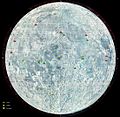
Map of lunar landing locations showing Luna, Surveyor, and Apollo sites
-
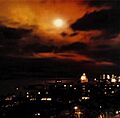
The Starfish Prime high-altitude test seen from Honolulu in 1962
-
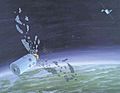
Artist illustration of the Soviet Istrebitel Sputnikov anti-satellite concept
-

The crash site of the Soyuz 1 spacecraft in 1967
-
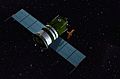
Artist concept of the Soviet Soyuz 7K-L1 Zond spacecraft
-

A newspaper announcing that humans had walked on the Moon
-
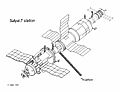
The Soviet Salyut 7 space station in orbit
-
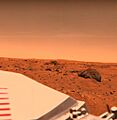
A large Martian boulder photographed by Viking 1 in 1976
-
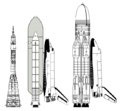
Comparison of the Soyuz, American Space Shuttle, and Soviet Buran


Legacy of the Space Race
The rivalry between the United States and the Soviet Union reshaped science, technology, and society. The competition led to inventions that everyday people use today, including:
- Weather and communication satellites that connect phones and predict storms.
- Advanced computer miniaturization and faster microchips.
- Improved materials like memory foam, freeze-dried food, scratch-resistant lenses, and lightweight thermal fabrics.
Most importantly, the rivalry turned into long-lasting global cooperation. During the 1990s, the Shuttle–Mir program brought American shuttles to dock with Russia's space station.
That successful partnership led directly to the construction of the International Space Station (ISS). Since November 2000, astronauts and cosmonauts from around the world have lived and worked side-by-side in orbit, proving that humanity accomplishes its greatest feats when working together among the stars.
See also
 In Spanish: Carrera espacial para niños
- Apollo program
- Cold War
- History of spaceflight
- International Space Station
- List of space exploration milestones, 1957–1969
- Moon landing
- Project Mercury
- Project Gemini
- Sputnik 1
- Timeline of space exploration
