
Climate of Mars facts for kids
The climate of Mars is a fascinating topic for scientists. Mars is the only other rocky planet whose surface we can easily see from Earth using a telescope. Even though Mars is much smaller than Earth and farther from the Sun, its climate has some surprising similarities.

Mars has polar ice caps, experiences seasonal changes, and shows clear weather patterns. Scientists who study planets (called planetologists) and climate (called climatologists) have been studying Mars for a long time. Like Earth, Mars has even had ice ages in its past. However, there are also big differences, such as Mars's very thin atmosphere. This thin air means Mars heats up and cools down much faster than Earth. Understanding Mars's climate is key to finding out if life ever existed there, or if it could in the future.
Humans have studied Mars from Earth since the 1600s. But we learned much more when spacecraft started visiting Mars in the 1960s. Missions like Mariner 4 in 1965 gave us our first close-up look. Later missions, like the Viking program landers in 1975 and the Mars Reconnaissance Orbiter, have gathered a lot of information. Today, rovers and orbiters send back data about Mars's atmosphere and weather every day. Scientists also use powerful computer programs, called Mars general circulation models, to simulate and understand the planet's climate.
Contents
- Early Discoveries About Mars's Climate
- Mars's Ancient Climate: Was There Water?
- Martian Weather Patterns
- Clouds on Mars
- Martian Temperatures
- Martian Atmosphere: Pressure and Wind
- Mountains and Martian Weather
- Mars's Polar Ice Caps
- Solar Wind and Atmosphere Loss
- Martian Seasons
- Evidence for Recent Climate Change
- Could Humans Live on Mars?
- Current Missions Studying Mars's Climate
- Images for kids
- See also
Early Discoveries About Mars's Climate
Scientists have been curious about Mars for a long time. In 1704, Giacomo F. Maraldi noticed that Mars's south polar ice cap wasn't perfectly centered. He also saw that the ice caps changed size with the seasons.
In 1784, William Herschel figured out that Mars has a very thin atmosphere. He saw faint stars through Mars's atmosphere without their light dimming. This showed him that Mars's air was much thinner than Earth's.
Later, in 1809, Honore Flaugergues saw "yellow clouds" on Mars. These were the first observations of Martian dust storms. He also saw the polar ice melt a lot in spring. He thought this meant Mars was warmer than Earth, but that wasn't quite right.
Mars's Ancient Climate: Was There Water?
Scientists use different ways to understand Mars's long history. One way divides time into periods like Noachian, Hesperian, and Amazonian.

Scientists are learning a lot about Mars's past climate. Long ago, during the Noachian era (over four billion years ago), Mars might have had a thick atmosphere full of carbon dioxide. This gas is a greenhouse gas, meaning it traps heat and could have made Mars warmer.
Rovers like Opportunity and Spirit found minerals like hematite and goethite on Mars. These minerals usually form in the presence of water. This suggests that Mars once had flowing water on its surface. Some craters also look like they formed when the ground was wet. Also, many valley networks on Mars look like they were carved by ancient rivers. All this points to a warmer, wetter Mars in the distant past.
Giant volcanoes, like those in the Tharsis region, might have played a big role. When they erupted, they released huge amounts of water vapor and carbon dioxide. This could have made Mars's atmosphere much thicker and warmer, possibly even creating oceans or lakes. However, it's still hard for computer models to show Mars being warm enough for liquid water for long periods.
Scientists also found evidence of a very recent ice age on Mars. About 370,000 years ago, Mars might have looked much whiter due to more ice.
Martian Weather Patterns

Just like Earth, Mars has changing temperatures and weather patterns throughout its Martian year. A Martian year is about two Earth years long. Because Mars doesn't have oceans, its weather is often more predictable than Earth's. If a weather event happens at a certain time one year, it's likely to happen again around the same time the next year.
In 2008, the Phoenix lander even saw snow falling from clouds high above its landing site. However, this snow evaporated before it could reach the ground, a phenomenon called virga.

Clouds on Mars

Martian dust storms can lift tiny particles into the air. Clouds can then form around these particles, sometimes as high as 100 kilometers (60 miles) above the planet. Clouds can also form naturally from dry ice (frozen carbon dioxide) or water ice.
Sometimes, rare "Mother of Pearl" clouds appear. These clouds look iridescent because all their particles form at the same time. The first images from Mariner 4 in 1965 showed faint clouds high in Mars's atmosphere. They look similar to noctilucent clouds on Earth, which are also very high up.
Martian Temperatures
Scientists have measured Mars's temperature for a long time. Early spacecraft like Mariner 4 and the Viking program used special instruments to figure out the temperature and pressure. Later missions, like Mariner 9 and the Mars Reconnaissance Orbiter, used infrared detectors to get even more detailed measurements.
The average temperature on Mars is about -63 degrees Celsius (-81 degrees Fahrenheit). At the equator, it can reach about 20 degrees Celsius (68 degrees Fahrenheit) at noon. But at the poles, it can drop to a freezing -153 degrees Celsius (-243 degrees Fahrenheit). The Spirit rover once recorded a daytime air temperature of 35 degrees Celsius (95 degrees Fahrenheit) in the shade!
Scientists have noticed that nighttime temperatures in Mars's northern spring and early summer are very consistent year to year. However, daytime temperatures can vary more. Dust storms also affect temperatures, making nights warmer and days cooler.
Scientists believe Mars had a much thicker, warmer atmosphere early in its history. This atmosphere, rich in carbon dioxide, could have raised temperatures above water's freezing point. This would have allowed liquid water to flow and carve out the channels we see today. However, Mars's atmosphere is now very thin. Much of the carbon dioxide was lost to space, stripped away by the solar wind.
Here is some climate data for Gale Crater, where the Curiosity rover landed:
| Climate data for Gale Crater (2012–2015) | |||||||||||||
|---|---|---|---|---|---|---|---|---|---|---|---|---|---|
| Month | Jan | Feb | Mar | Apr | May | Jun | Jul | Aug | Sep | Oct | Nov | Dec | Year |
| Record high °C (°F) | 6 (43) |
6 (43) |
1 (34) |
0 (32) |
7 (45) |
14 (57) |
20 (68) |
19 (66) |
7 (45) |
7 (45) |
8 (46) |
8 (46) |
20 (68) |
| Mean daily maximum °C (°F) | −7 (19) |
−20 (−4) |
−23 (−9) |
−20 (−4) |
−4 (25) |
0 (32) |
2 (36) |
1 (34) |
1 (34) |
4 (39) |
−1 (30) |
−3 (27) |
−5.7 (21.7) |
| Mean daily minimum °C (°F) | −82 (−116) |
−86 (−123) |
−88 (−126) |
−87 (−125) |
−85 (−121) |
−78 (−108) |
−76 (−105) |
−69 (−92) |
−68 (−90) |
−73 (−99) |
−73 (−99) |
−77 (−107) |
−78.5 (−109.3) |
| Record low °C (°F) | −95 (−139) |
−127 (−197) |
−114 (−173) |
−97 (−143) |
−98 (−144) |
−125 (−193) |
−84 (−119) |
−80 (−112) |
−78 (−108) |
−78 (−109) |
−83 (−117) |
−110 (−166) |
−127 (−197) |
| Source: Centro de Astrobiología, Mars Weather, NASA Quest, SpaceDaily | |||||||||||||
Martian Atmosphere: Pressure and Wind

Mars's atmosphere is mostly carbon dioxide and is very thin. Its average surface pressure is about 170 times lower than Earth's. This thin atmosphere means Mars reacts quickly to sunlight, creating strong "thermal tides" that affect air pressure.
Even though temperatures on Mars can sometimes go above freezing, liquid water is usually unstable. This is because the atmospheric pressure is so low that water ice turns directly into vapor (sublimes) instead of melting into liquid. However, in very deep areas like the Hellas Planitia basin, the pressure can be high enough for liquid water to exist if the temperature is also above freezing.
Martian Winds

Mars's surface heats up and cools down very quickly. This causes big temperature changes each day, around 100 degrees Celsius (180 degrees Fahrenheit). These temperature differences create winds, similar to sea breezes on Earth.
At lower latitudes, a global wind pattern called Hadley circulation dominates, much like the trade winds on Earth. At higher latitudes, different pressure systems create weather. Because Mars is so dry, dust lifted by these winds stays in the atmosphere longer than on Earth, where rain would wash it away.
Katabatic Winds

Katabatic winds are winds that flow downhill. They form when cold, dense air sinks and speeds up due to gravity. These winds are common on Earth in places like Greenland and Antarctica. On Mars, katabatic winds are even stronger because of the thin atmosphere and quick temperature changes. They play a big role in shaping the polar regions, moving ice and dust. These winds can also warm the atmosphere over steep slopes.
Dust Storms
When the Mariner 9 probe arrived at Mars in 1971, it found the planet covered by a huge dust storm. Only the giant volcano Olympus Mons poked through the haze. These planet-wide dust storms can last for months and are quite common.

During a global dust storm, temperatures become more even, and wind speeds increase dramatically. For example, in 2001, the Hubble Space Telescope saw a dust storm in Hellas Basin that quickly grew to cover the entire planet. This storm lowered the surface temperature but raised the atmosphere's temperature by 30 degrees Celsius (54 degrees Fahrenheit).
Dust storms are most common when Mars is closest to the Sun (called perihelion). At this time, Mars receives more sunlight, which intensifies atmospheric circulation and lifts more dust. In mid-2007, a planet-wide dust storm threatened the solar-powered Spirit and Opportunity rovers. The dust blocked sunlight, reducing their power. Another massive dust storm covered the entire planet in June 2018.
Scientists believe dust storms contribute to water loss on Mars. During these storms, water vapor can reach very high altitudes. There, ultraviolet light from the Sun breaks the water apart, and the hydrogen escapes into space.


Saltation: How Dust Moves
Saltation is a process where sand particles bounce along the surface. This is an important way that dust gets into Mars's atmosphere. The Spirit rover observed saltating sand particles. On Mars, these particles can bounce 100 times higher and farther than on Earth.
Repeating Northern Annular Cloud

Every Martian year, a large, doughnut-shaped cloud appears over Mars's north pole. It forms in the morning and disappears by afternoon. This cloud is about 1,600 kilometers (1,000 miles) wide, with a 320-kilometer (200-mile) wide hole in the middle. It's made of water ice, so it looks white, unlike dust storms.
It looks like a hurricane but doesn't rotate. This cloud forms during the northern summer due to unique climate conditions. It has been seen by many spacecraft and telescopes, including the Hubble Space Telescope.
Methane on Mars

Methane (CH4) is a gas that doesn't last long in Mars's atmosphere. So, if methane is present, something must be constantly producing it.
In 2003, scientists first reported small amounts of methane in Mars's atmosphere. The amounts varied greatly, suggesting the methane was localized and possibly seasonal. In 2014, the Curiosity rover detected a big increase in methane around its location. This suggested Mars was releasing methane from an unknown source. In 2018, NASA announced that methane levels in the atmosphere change with the seasons.

Scientists are still trying to figure out where this methane comes from. It could be from non-biological processes, like reactions between water and rocks. Or, it could be from tiny living things called microorganisms, like methanogens. However, no other evidence of life has been found on Mars yet.
Carbon Dioxide Carving
Images from the Mars Reconnaissance Orbiter show unusual erosion patterns on Mars. In spring, frozen carbon dioxide (CO2 ice) turns directly into gas and flows upwards. This creates unique "spider gullies" on the surface. The gas bursts through weak points in the ice, forming geyser-like plumes.
Mountains and Martian Weather

Mars's huge mountains greatly affect its storms. Individual mountains like Olympus Mons, which is 26 kilometers (16 miles) high, can change local weather. Larger groups of volcanoes, like those in the Tharsis region, have even bigger effects.
One unique weather event is a spiral dust cloud that forms over Arsia Mons. This cloud can tower 15 to 30 kilometers (9 to 19 miles) above the volcano. Clouds are often present around Arsia Mons, especially in late summer.
Mars's Polar Ice Caps

Mars has ice caps at its north and south poles. These caps are mostly made of water ice, but they also have frozen carbon dioxide (dry ice) on their surfaces. The dry ice at the north pole completely disappears in summer, but the south pole has a permanent layer of dry ice up to 8 meters (26 feet) thick.
A lot of the atmosphere can freeze at the winter pole, causing the atmospheric pressure to change significantly. This freezing and evaporating of carbon dioxide creates strong winds in spring and autumn, which can even cause global dust storms.
The northern polar cap is about 1,000 kilometers (620 miles) wide in summer and holds about 1.6 million cubic kilometers (380,000 cubic miles) of ice. The southern polar cap is 350 kilometers (217 miles) wide and up to 3 kilometers (1.8 miles) thick. Both caps have spiral troughs, which are thought to be formed by strong katabatic winds and the Coriolis effect.

During the southern spring, sunlight warms the dry ice at the south pole. This causes pressurized carbon dioxide gas to build up under the ice. When the pressure is high enough, the gas bursts through the ice in geyser-like plumes. These eruptions leave behind "dark dune spots" and fan-shaped patterns on the ice, made of sand and dust carried by the gas.

Solar Wind and Atmosphere Loss
About four billion years ago, Mars lost most of its magnetic field. Without this protective shield, the solar wind (a stream of charged particles from the Sun) and cosmic radiation could directly hit Mars's atmosphere. This constantly stripped away atoms from the outer atmosphere, making it thinner over time. Scientists believe this solar wind effect caused most of Mars's historical atmospheric loss.
Martian Seasons

Mars has an axial tilt of 25.2 degrees, similar to Earth's. This tilt causes seasons on Mars, just like on Earth. However, Mars's orbit around the Sun is more oval-shaped than Earth's. This means the amount of sunlight Mars receives changes more dramatically throughout its year, which lasts 687 Earth days (almost two Earth years).
Because of this oval orbit, winters in Mars's southern hemisphere are long and cold, while northern winters are shorter and milder.
Scientists believe that Mars's axial tilt has changed a lot over millions of years. Its two small moons can't stabilize its tilt like Earth's large Moon does. A few million years ago, Mars's tilt was as much as 45 degrees, compared to its current 25 degrees. These big changes in tilt explain why we find so much ice in unexpected places on Mars.
When Mars's tilt is very high, ice at the poles becomes unstable. Solid carbon dioxide (dry ice) turns into gas, increasing atmospheric pressure. This allows more dust to stay in the atmosphere. Moisture in the air then falls as snow or ice frozen onto dust grains, collecting in the mid-latitudes. When the tilt returns to lower values, the ice turns back into gas, leaving behind layers of dust.
| Season | Mars Sols | Earth Days |
|---|---|---|
| Northern spring, southern autumn | 193.30 | 92.764 |
| Northern summer, southern winter | 178.64 | 93.647 |
| Northern autumn, southern spring | 142.70 | 89.836 |
| Northern winter, southern summer | 153.95 | 88.997 |
Mars's tilt also changes in cycles over hundreds of thousands of years, leading to periods of global warming and cooling. Scientists believe Mars is currently in a warm period that has lasted over 100,000 years.
Evidence for Recent Climate Change

Scientists have observed changes around Mars's south pole (Planum Australe) in recent Martian years. In 1999, the Mars Global Surveyor photographed pits in the frozen carbon dioxide layer. These pits, known as swiss cheese features, grew larger by about 3 meters (10 feet) in just one Martian year. This shows that the dry ice layer is sublimating (turning directly into gas), revealing the water ice underneath.
More recent observations confirm that the ice at Mars's south pole continues to sublimate. Scientists believe that conditions on Mars today are not right for new ice to form. NASA has even stated that "climate change is in progress" on Mars.
Could Humans Live on Mars?
Mars is not currently suitable for humans to live on. However, many people have suggested terraforming Mars. This means changing its climate to make it more like Earth. For example, some have proposed releasing water vapor and carbon dioxide from the ice caps to warm the planet. This idea is still debated by scientists.
Current Missions Studying Mars's Climate
Several spacecraft are currently orbiting Mars and studying its atmosphere and climate. The 2001 Mars Odyssey takes global atmospheric temperature measurements. The Mars Reconnaissance Orbiter gathers daily weather and climate observations with its specialized Mars climate sounder instrument.
The MSL mission, with its Curiosity rover, landed on Mars in August 2012. It continues to send back valuable climate data from Gale Crater. Orbiters like MAVEN and the TGO are also actively studying Mars's atmosphere.

Images for kids
-
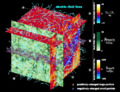
Direct Numerical Simulation of turbulence laden with 168 million electrically charged inertial dust particles (Center for Turbulence Research, Stanford University).
-
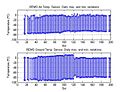
Temperature at Gale Crater on Mars, Curiosity rover (August 2012 – February 2013)
-
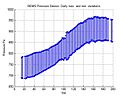
Pressure at Gale Crater on Mars, Curiosity rover (August 2012 – February 2013)
-
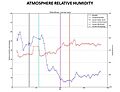
Humidity at Gale Crater on Mars, Curiosity rover (August 2012 – February 2013)
-
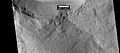
Smooth mantle covers parts of a crater in the Phaethontis quadrangle. Layering suggests the mantle was deposited multiple times.
-
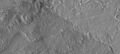
Enlargement of previous image of mantle layers. Four to five layers are visible. Picture taken under HiWish program.


See also
- Geology of Mars
- Mars analog habitat
- Mars Climate Orbiter
- Mars MetNet, a proposed meteorological network on Mars
- Water on Mars
- Terraforming of Mars
- Mars carbonate catastrophe
