
Spanish Marine Infantry facts for kids
Quick facts for kids Marine Infantry |
|
|---|---|
| Infantería de Marina | |

Emblem of the Marine Infantry
|
|
| Founded | 27 February 1537 (489 years, 7 months) |
| Country | Spain |
| Allegiance | King of Spain |
| Type | Naval infantry |
| Role | Amphibious warfare |
| Size | 5,700 marines |
| Part of | Spanish Navy |
| Garrison/HQ | San Fernando, Cádiz |
| Motto(s) | "Per Terra et Mare" ("By Land and Sea!") "Brave by land and sea" ("¡Valientes por tierra y por mar!") |
| March | Marcha heroica de la Infantería de Marina |
| Anniversaries | 27 February |
| Engagements |
|
| Commanders | |
| Current commander |
Divisional General Rafael Roldán Tudela |
The Marine Infantry (called Infantería de Marina in Spanish) are special soldiers who work with the Spanish Navy. Their main job is to perform amphibious warfare, which means they can fight on land after traveling by sea. They are a very old military group, started in 1537 by Charles V, Holy Roman Emperor. This makes them the oldest marine unit still active today!
Contents
History of the Spanish Marines
Early Beginnings (1500s-1700s)

The Spanish Marine Infantry started in 1537. Charles V, Holy Roman Emperor created the "Old Sea Companies of Naples." These soldiers were always with the Mediterranean Galley Squadrons. Later, Philip II of Spain helped shape how marines work today. He wanted forces that could land from ships and fight on shore.
During this time, the marines were organized into groups called Tercios. These were special military units. The Tercio Nuevo de la Mar de Nápoles is seen as the main start of the Spanish Marine Infantry. Their symbol was two crossed anchors. This symbol was used until 1931.
Around 1704, these Tercios changed into regiments. The main part of these groups stayed with the Navy. They became the "Navy Battalions Corps."
The marines fought in many important battles during these early years. Some of these included the Algiers expedition in 1541 and the famous Battle of Lepanto in 1571. They also took part in the Conquest of the Azores in 1583.
Growing Stronger (1700s-1800s)
In 1717, the Navy Battalions Corps became more organized. It had 12 battalions. Their job was to lead landing attacks and serve as soldiers on ships. They also helped operate the ship's cannons. By the mid-1700s, there were many marine infantry and gunners.
During the War of Spanish Independence, marines fought mostly on land. They were part of army groups. A brave woman named Ana Maria de Soto even joined the marines in 1793. She pretended to be a man and served for five years!
Important battles for the marines in this period included the Spanish conquest of Oran in 1732. They also fought in the Battle of Cartagena de Indias in 1741 and the Siege of Havana in 1762.
Changes and New Roles (1800s-1900s)

After the Napoleonic Wars, fighting from ship to ship became less common. The marines focused more on artillery. In 1848, the naval infantry was restarted as a separate group. Their role changed from guarding ships to landing forces in colonies.
The marines fought in the Third Carlist War (1872–1876) as land soldiers. An academy for marine infantry was opened in 1879. They also fought in colonial wars in the Philippines and Cuba. These wars involved many landing operations.
Even after Spain's empire changed, the marines kept serving abroad. Key actions included the Cochinchina campaign in 1858 and the Spanish–American War in 1898. They also served in the Kert campaign in 1911.
Modern Era (1900s-Today)


After World War I, many countries thought large sea landings were too hard. But the Spanish Marine Infantry had success in the Third Rif War in 1925. They used planes and naval guns to support their landing at Alhucemas.
During the Spanish Civil War, the marine corps split. Some marines fought for one side, and others for the other. They guarded bases, led landing parties, and used artillery. After the war, during a period of strong leadership, the Marine Infantry grew stronger.
In 1957, a special amphibious group was created. The Spanish Marine Infantry returned to its main job as a landing force. They established a beachhead in Spanish Sahara and Ifni during the Ifni War in 1958. They also got new vehicles and weapons.
The Tercio de Armada (TEAR) became the main amphibious unit. It has changed over time to meet modern needs. Spanish Marines have served in Europe, Central America, and Asia. They act as an "emergency force" to help civilians or as a strong presence. Their main base is in San Fernando, Cádiz.
Marines in the 21st Century
The Spanish Marine Infantry has been part of various international operations. This includes missions with NATO in places like Afghanistan.
What Spanish Marines Do

The Spanish Marine Infantry is a special group of soldiers. They are experts in amphibious warfare. This means they can quickly move from ships to land to fight. They can go to a coast that might be dangerous.
Because they can get ready and deploy fast, they are very important. They train a lot and can go to faraway places quickly. This makes them a strong force that can help keep peace.
Spanish Marines wear a special uniform. On their sleeves, they have three "Sardinetas." This shows they are part of the Royal House Corps. They earned this honor for their bravery at the Morro Castle in 1762. Only the Spanish Royal Guard also wears these special marks.
Marines use modern tools and vehicles for their missions. They have experts in artillery (big guns), sapping (building defenses), helicopters, and special operations. They also use tanks and have good communication systems. Some of their vehicles are part of the Mechanized Amphibious Group.
Spanish Marines also protect naval bases and facilities. They guard naval schools and training centers.
Special Operations
In 2009, the Special Naval Warfare Force (FGNE) was created. This group combines different special units. It includes the Special Operations Unit of the Marine Infantry. They also have special combat divers and explosive experts.
This unit has taken part in many operations. These include Operation Atalanta in Somalia and missions in Haiti. They also helped with the rescue of the fishing boat Alakrana in Somali waters.
How the Marines are Organized
Marine Infantry Brigade
The main fighting group of the Spanish Marine Infantry is the Marine Infantry Brigade (BRIMAR). It includes several important units:
- Marine Infantry Brigade (BRIMAR)
- A Headquarters Battalion for planning and communication.
- Landing Battalions (1st and 2nd) with soldiers called Naval Fusiliers.
- A 3rd Mechanized Landing Battalion with armored vehicles like the Piranha IIIC 8x8 and M60A3 TTS tanks.
- An Amphibious Mobility Group with engineers and special assault vehicles.
- An Artillery Landing Group with different types of cannons and air-defense missiles.
- A Combat Service Support Group for transport, medical help, and supplies.

Protection Forces

The Protection Force (FUPRO) keeps naval bases and other important places safe. It has about 2000 troops. These forces are divided into several regiments called Tercios:
- Tercio del Norte (Northern Regiment)
- Tercio de Levante (Eastern Regiment)
- Tercio del Sur (South Regiment)
- Unidad de Seguridad del Mando Naval de Canarias (Canary Islands Naval Command Security Unit)
- Agrupación de Infantería de Marina de Madrid (Madrid Marine Infantry Group)
Special Forces
See article: Fuerza de Guerra Naval Especial


The Fuerza de Guerra Naval Especial (FGNE) is the special operations team of the Spanish Navy. They are experts in fighting in sea, land, and coastal areas. This group includes the Special Operations Unit (UOE) and the Special Combat Divers Unit (UEBC).
These units work together for different tasks:
- Command and control: For leading and managing missions.
- Combat: For direct fighting.
- Combat Support: Using boats and parachutes to help in missions.
- Combat Services Support: Providing health care, supplies, and transport.
Marine Company of the Royal Guard

The Compañía Mar Océano de la Guardia Real was formed in 1981. It is part of the Spanish Royal Guard. This company is organized like a regular rifle company.

The Naval Police Units keep order and security. They watch over Navy units and bases. They also guard important people and control military vehicles. They have the power of authority when doing their jobs.
Target Acquisition and Reconnaissance (TAR) Company
The Target Acquisition and Reconnaissance (TAR) Company started in 2012. Their job is to gather information for the Marine Infantry Brigade (BRIMAR). They observe, find targets, and help direct artillery and air strikes. They also train in skydiving and diving to get into difficult areas.
How to Join the Marines
This table shows how people can join the Spanish Marine Infantry.
| Spanish Marines Infantry Direct Entry | ||||||
| Rank Level | Education Needed | Training School | Ranks Achieved | |||
|---|---|---|---|---|---|---|
| Officers | High School Diploma and University Entrance Exam (18–21 years old) |
Escuela Naval Militar (ENM) 5 years of study |
From First Lieutenant to Lieutenant General | |||
| University Degree (Bachelor's), not older than 26 years | ENM 1 year of study | |||||
| Master's Degree, not older than 27 years | ||||||
| Non-commissioned officers | High School Diploma (18–21 years old) |
Escuela de Infantería de Marina General Albacete Fuster * Course to become a Non-commissioned Officer 3 years of study |
From Sergeant to Sergeant Major | |||
| Vocational Secondary Degree, not older than 21 years | ||||||
| Entrance exam to Vocational College, not older than 21 years |
||||||
| Enlisted Personnel | Basic Secondary Education (18–29 years of age) |
Escuela de Infantería de Marina General Albacete Fuster: * Course to become a Professional Soldier or Sailor |
From Private to Corporal First Class | |||
Marine Ranks
The ranks in the Marine Infantry are similar to those in the Spanish Army. However, marines also wear special sleeve and cuff badges. These show they are part of the Navy.
Officer Ranks
These are the badges for officers.
| NATO code | OF-10 | OF-9 | OF-8 | OF-7 | OF-6 | OF-5 | OF-4 | OF-3 | OF-2 | OF-1 | OF(D) | Student officer | ||||||||||||||||||||||||
|---|---|---|---|---|---|---|---|---|---|---|---|---|---|---|---|---|---|---|---|---|---|---|---|---|---|---|---|---|---|---|---|---|---|---|---|---|
| Battledress | ||||||||||||||||||||||||||||||||||||
 Spanish Marine Infantry Spanish Marine Infantry |
 |
 |
 |
 |
 |
 |
 |
 |
 |
 |
 |
 |
 |
|||||||||||||||||||||||
| Teniente general | General de división | General de brigada | Coronel | Teniente coronel | Comandante | Capitán | Teniente | Alférez | Guardiamarina de 2º | Guardiamarina de 1º | Aspirante de 2º | Aspirante de 1º | ||||||||||||||||||||||||


Other Ranks
These are the badges for non-commissioned officers and enlisted personnel.
| NATO code | OR-9 | OR-8 | OR-7 | OR-6 | OR-5 | OR-4 | OR-3 | OR-2 | OR-1 | |||||||||||||||||||||||||||
|---|---|---|---|---|---|---|---|---|---|---|---|---|---|---|---|---|---|---|---|---|---|---|---|---|---|---|---|---|---|---|---|---|---|---|---|---|
| Battledress | ||||||||||||||||||||||||||||||||||||
| Spanish Marine Infantry |
 |
 |
 |
 |
 |
 |
 |
 |
 |
 |
||||||||||||||||||||||||||
| Suboficial mayor | Subteniente | Brigada | Sargento primero | Sargento | Cabo mayor | Cabo primero | Cabo | Soldado de primera | Soldado | |||||||||||||||||||||||||||


Cadets and Recruits
| NATO Code | Officer cadets | NCO candidates | Recruit | ||||||
|---|---|---|---|---|---|---|---|---|---|
 Spanish Marine Infantry Spanish Marine Infantry |
|||||||||
| Alférez (Alumno 5º) |
Guardiamarina de 2º (Alumno 4º) |
Guardiamarina de 1º (Alumno 3º) |
Aspirante de 2º (Alumno 2º) |
Aspirante de 1º (Alumno 1º) |
Sargento Alumno 3º año | Alumno 2º año | Alumno 1º año | Aspirante MPTM | |


The Spanish Marine's 10 Rules
These are the important rules that every Spanish Marine follows:
Original Spanish
- 1º mandamiento : Mi primer deber como infante de marina es estar permanentemente dispuesto a defender España y entregar si fuera preciso mi propia vida
- 2º mandamiento : Seré siempre respetuoso con mis mandos, leal con mis compañeros, generoso y sacrificado en mi trabajo
- 3º mandamiento : Estaré preparado para afrontar con valor abnegación y espíritu de servicio cualquier misión asiganada a la Infantería de Marina
- 4º mandamiento : Seré siempre respetuoso con las tradiciones del cuerpo, estaré orgulloso de su historia y nunca haré nada que pueda desprestigiar su nombre
- 5º mandamiento : Ajustaré mi conducta al respeto de las personas, su dignidad y derechos serán valores que guardaré y exigiré
- 6º mandamiento : Como Infante de marina la disciplina constituirá mi norma de actuación, la practicaré y exigiré en todos los cometidos que se me asignen
- 7º mandamiento : Como Infante de marina mi misión será sagrada, en su cumplimiento venceré o moriré
- 8º mandamiento : Aumentar la preparación física y mental será mi objetivo permanente
- 9º mandamiento : Seré duro en la fatiga, bravo en el combate, nunca el desaliento en mi pecho anidará, nobleza y valentía serán mis emblemas
- 10º mandamiento : ¡Mi lema! ... ¡Valiente por tierra y por mar!
English
- 1st rule: As a Marine, my first duty is to always be ready to defend Spain. I will give my life if needed.
- 2nd rule: I will always respect my leaders. I will be loyal to my friends. I will be generous and dedicated to my work.
- 3rd rule: I will be ready to face any mission with courage and a spirit of service.
- 4th rule: I will always respect the traditions of the Corps. I will be proud of its history. I will never do anything to harm its good name.
- 5th rule: I will always treat people with respect. I will protect their dignity and rights.
- 6th rule: As a Marine, discipline is how I will act. I will practice it and expect it in all my tasks.
- 7th rule: As a Marine, my mission is very important. I will either win or die trying to complete it.
- 8th rule: My goal will always be to improve my body and train my mind.
- 9th rule: I will be strong when tired and brave in battle. I will never lose hope. Honor and courage are my symbols.
- 10th rule: My motto is: Brave by Land and Sea!
Marine Equipment

Infantry Weapons
| Weapon | Image | Origin | Notes |
|---|---|---|---|
| Pistols | |||
| FN Herstal P9-17 |  Belgium Belgium |
Being replaced by the Glock 45. | |
| Glock 17 Gen.5 |  Austria Austria |
Standard pistol for the Special Naval Warfare Force. | |
| Heckler & Koch USP-Compact |  Germany Germany |
||
| Assault rifles | |||
| Heckler & Koch G36 | Germany |
Different versions are used. | |
| Heckler & Koch HK-416A5 | Germany |
New standard rifle. | |
| Grenade launchers | |||
| AG36 | Germany |
A 40mm grenade launcher for the G36 rifle. | |
| LAG-40M1 |  Spain Spain |
A 40mm automatic grenade launcher. | |
| Sniper Rifles | |||
| Heckler & Koch HK417 SNIPER | Germany |
||
| Accuracy International Arctic Warfare |  United Kingdom United Kingdom |
Includes AXM and AXMC .338 models. | |
| Barrett M82A1 |  United States United States |
||
| Submachine guns | |||
| Heckler & Koch MP5 | Germany |
Different versions are still used. | |
| FN P90 | Belgium |
||
| Machine guns | |||
| FN Minimi Para 5.56×45mm NATO | Belgium |
||
| FN Minimi MK3 7.62×51mm NATO | Belgium |
Replaced the CETME Ameli. | |
| Browning M-2 HB QCB | United States |
||
| Anti-tank weapons | |||
| Instalaza C-100 Alcotán | Spain |
A 100mm anti-tank weapon. | |
| Instalaza C-90C | Spain |
A 90mm anti-tank weapon. | |
| Spike missile |  Israel Israel |
Used for attacking tanks. | |
| Anti-aircraft | |||
| Mistral |  France France |
Used to shoot down aircraft. | |

_%D0%B1%D0%B5%D0%B7_%D1%84%D0%BE%D0%BD%D0%B0.jpg)
_modified.png)


.jpg)


Vehicles
| Vehicle | Image | Origin | Notes |
|---|---|---|---|
| Armoured vehicles | |||
| Piranha IIIC 8x8 |  Switzerland Switzerland |
Many different versions, including command and recovery vehicles. | |
| AAV-7A1 | United States |
Amphibious assault vehicles, being replaced by newer ones. | |
| Humvee | United States |
Being replaced by URO VAMTAC ST5 vehicles. | |
| Unarmoured vehicles | |||
| Volkswagen Amarok | Germany |
||
| Land Rover Defender | United Kingdom |
||
| Ssangyong Rexton |  South Korea South Korea |
||


Artillery
| Weapon | Image | Origin | Notes |
|---|---|---|---|
| ECIA | Spain |
81mm mortar. | |
| M-109A5E | United States |
Large self-propelled cannons. | |
| OTO Melara M-56 |  Italy Italy |
A 105mm howitzer. |


Marine Traditions
Hymn
The Marcha Heroica de la Infanteria de Marina (Heroic March of the Marine Infantry) is the official song of the Spanish Marines. It was written by J. Raimundo and composed by Colonel Don Agustín Díez Guerrero. Here are some of the words:
|
Marines |
Motto
The official motto of the Spanish Marines is "Valientes por Tierra y por Mar." This means "Brave by Land and Sea!" It is similar to mottos used by other marine groups around the world.
Bands

The Music Band of the Marines is the main military band for the Marine Infantry and the Spanish Navy. It was created in 1950. The band is made up of skilled musicians and non-commissioned officers. They perform in military ceremonies, parades, and public events. The band is based in Madrid. It has won awards, including a 1st prize in an international military music contest in 1970. They have also performed in other countries like Belgium.
Uniforms
-
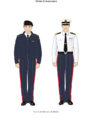
Barrack Dress A
-
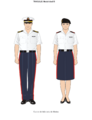
Barrack Dress B
-
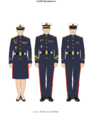
Service Dress A
-
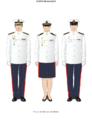
Service Dress B
-
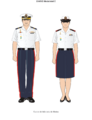
Service Dress C
-
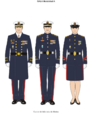
Dress Uniform A
-
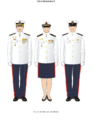
Dress Uniform B
-
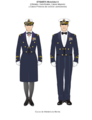
Mess Dress A
-
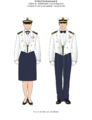
Mess Dress B
-
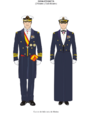
Ceremonial Dress


See also
 In Spanish: Infantería de Marina (España) para niños
- Marine (military)
- Unidad de Operaciones Especiales (UOE)
- Miguel de Cervantes Spain's most famous Marine, injured at the Battle of Lepanto (1571), where the Spanish marines played a decisive part.
- Salve Marinera, Spanish Navy anthem.
- Armada of Spain
