
USS Medusa (AR-1) facts for kids
_at_Pearl_Harbor_February_1942.jpg)
USS Medusa at Pearl Harbor in February 1942, surrounded by floats supporting anti-torpedo netting
|
|
Quick facts for kids History |
|
|---|---|
 United States United States |
|
| Name | USS Medusa |
| Namesake | USS Medusa, a monitor launched in 1869 |
| Builder | Puget Sound Navy Yard, Bremerton, Washington |
| Laid down | 2 January 1920 |
| Launched | 16 April 1923 |
| Commissioned | 18 September 1924 |
| Decommissioned | 18 November 1946 |
| Stricken | 10 June 1947 |
| Honors and awards |
One battle star for World War II service |
| Fate | Sold for scrapping 24 August 1950 |
| Notes | Designated AR-1 on 17 July 1920 |
| General characteristics | |
| Type | Repair ship |
| Displacement | 10,620 tons (8,125 tons standard) |
| Length | 483 ft 10 in (147.47 m) |
| Beam | 70 ft 3 in (21.41 m) |
| Draft | 19 ft 11 in (6.07 m) |
| Installed power | 7,000 shp |
| Propulsion | steam turbines |
| Speed | 16 kn (30 km/h) |
| Complement | 499 |
| Armament |
|
| Armor | none |
| Notes | The U.S. Navy's first purpose-built repair ship |
USS Medusa (AR-1) was the United States Navy's first ship built specifically to repair other ships. She served in the U.S. Navy from 1924 to 1946.
Contents
Building the Medusa
The USS Medusa was built at the Puget Sound Naval Shipyard in Bremerton, Washington. Her construction started on January 2, 1920. She was officially launched on April 16, 1923, and joined the Navy on September 18, 1924.
Before Medusa, the U.S. Navy used older ships that were changed into repair ships. As the Navy grew, it needed a ship designed from the start for repairs. The Medusa was planned to be as good as, or better than, the repair ship Vestal.
She was designed to keep up with the Navy's newest battleships. This meant she needed to be fast enough and have enough range to travel with them. Originally, she was called "Repair Ship No. 1." On July 17, 1920, she was given the new name AR-1.
What the Medusa Could Do
When Medusa joined the fleet in 1924, she was a very modern repair ship. She could do many different kinds of work. This included blacksmith work, fixing boilers, and carpentry. She could also do coppersmithing, electrical work, and foundry work.
Her workshops had special tools like lathes, radial drills, and milling machines. These tools helped her repair many parts of other ships. She could also fix optical and mechanical equipment.
_repair_shop_1924.jpg)
Beyond repairs, Medusa had other useful facilities. She had a motion picture shop, a large laundry, and a bakery. She also had big refrigeration units to keep food fresh. The ship even carried a small team of aviation experts. These experts helped repair floatplanes from battleships and cruisers.
Medusa's Service History
The Medusa spent her entire Navy career with the United States Pacific Fleet. After joining the Navy in 1924, her home port was San Pedro, California. She worked from San Pedro until August 1941.
In 1925, Medusa showed she could support the fleet. She traveled with the battle fleet from Honolulu, Hawaii, across the Pacific Ocean. They visited Australia and New Zealand before returning to San Pedro.
In the late 1920s, Medusa also helped transport U.S. Marines. In May 1927, she carried Marines and their aircraft to Nicaragua. She did this again in July 1928, traveling with the storeship Bridge.
World War II Service
Medusa moved to Pearl Harbor, Hawaii, in August 1941. She was there on December 7, 1941, when Imperial Japanese Navy aircraft attacked. Her commanding officer was ashore, so Lieutenant Commander John F. P. Miller took command.
Medusa fired at a Japanese midget submarine in the harbor. She stopped firing when the destroyer Monaghan moved in to sink the submarine. Medusa's anti-aircraft gunners claimed to have shot down two Japanese Aichi D3A1 dive bombers.
After the attack, Medusa immediately began her repair work. She provided pumps to the damaged seaplane tender Curtiss. She gave machine gun ammunition to the grounded battleship Nevada. She also provided rifles to U.S. Army troops and food, drinks, and fuel to other ships' boats. She helped rescue men trapped in the capsized ship Utah.
In March 1942, Medusa became part of the Service Force, Pacific Fleet. She continued to help with the clean-up efforts at Pearl Harbor.
On April 4, 1943, Medusa sailed to the combat area. She arrived at Havannah Harbor in the New Hebrides on April 20, 1943. She took over from the repair ship Rigel. She worked at Efate for the next 11 months. For a short time, she went to Espiritu Santo to build a temporary bow for the torpedoed light cruiser Honolulu.
On March 27, 1944, Medusa left Efate for other assignments. She sailed to New Guinea and repaired ships of the 7th Fleet. She then went to Guadalcanal in May 1944 to serve with the 3rd Fleet. In June 1944, she went to Sydney, Australia, for repairs to her own hull. Her hull had been damaged when she ran aground in May.
She then continued to Manus Island in the Admiralty Islands. After the ammunition ship Mount Hood exploded there in November 1944, Medusa provided repairs and medical supplies to the ship Mindanao, which was badly damaged.
In January 1945, Medusa left Manus for Hollandia. From there, she joined a convoy to San Pedro Bay in the Philippine Islands. She serviced ships involved in capturing Luzon and other islands from Japan. She stayed there until July 6, 1945, when she returned to Manus.
End of Service
World War II ended on August 15, 1945. In late August, Medusa sailed to Manila. She worked there until November 14, 1945, when she headed back to the United States. On December 8, 1945, she arrived at Terminal Island. Her job was to help prepare ships to be stored in the Inactive Fleet at San Diego.
After this duty, Medusa herself began to be prepared for retirement. In May 1946, it was decided she was too old to be repaired. It was recommended that she be removed from the Naval Vessel Register. An attempt to tow her from San Diego failed. However, the submarine rescue vessel Curb successfully towed Medusa to Bremerton. She arrived there on October 2, 1946.
Medusa was officially taken out of service on November 18, 1946. She was then given to the United States Maritime Commission to be sold. The ship's flag was given to Lieutenant Commander Willard E. Adams, who was the last person to leave the ship. He had also been on Medusa during the attack on Pearl Harbor.
Medusa was removed from the Navy's list of ships on June 10, 1947. After her parts were removed, her hull was sold to Zidell Shipwrecking Company in Portland, Oregon, on August 24, 1950. The scrapping was finished in 1951.
Awards and Honors
The Medusa received one battle star for her service during World War II.
Images for kids
-
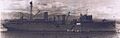
USS Medusa at Pearl Harbor in February 1942.
-
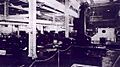
The machine shop of Medusa around the time she joined the Navy in 1924.
