
Empire facts for kids
An empire is a large group of different lands and peoples ruled by a single powerful leader or government. Think of it like a central country (sometimes called the "metropole") that controls many other areas, often far away. In an empire, not everyone has the same rights or is governed in the same way. The idea of an empire comes from the ancient Roman word Imperium, which meant "to command."
Throughout history, empires have looked very different. Some, like the Roman Empire or the Mongol Empire, were built on land, expanding their borders by land armies. Others, like the British Empire, were built on sea power, controlling many islands and distant lands with strong navies.
Sometimes, people use the word "empire" to describe a very large business or a powerful political group, even if it's not a country ruled by an emperor. It can also describe a situation where one group has a lot of control over others.
Contents
What is an Empire?
An empire is a very large political group that controls many separate lands or countries. It's different from a federation, where states join together willingly. Empires usually rule over areas that were not originally part of their main country.
Empires are often made up of many different groups of people with various backgrounds, cultures, and religions. A powerful country or society often takes control over a less powerful one. This control can be formal, like direct rule, or informal, like having a lot of influence. This process of creating and keeping an empire is called imperialism.
Sometimes, a country is called an "empire" just because its ruler takes the title of "emperor." This doesn't always mean they have conquered new lands. For example, the Korean Empire was proclaimed in 1897, even though Korea was about to be taken over by Japan.
Experts often compare empires to nation-states. In an empire, one group (the main country) usually has more power and rights than the groups it controls. A nation-state, on the other hand, has clear borders and one main government that rules everyone equally within those borders. Empires often had changing borders and different rules for different areas.
How Empires Work
Many empires grew through military victories, taking over other states and adding them to their control. However, empires could also gain power in other ways, like through strong influence. There are two main ways empires have been built:
- Direct Control: An empire directly conquers and rules new lands using its military. This gives them strong control but can make it harder to expand further.
- Indirect Control: An empire influences other lands without directly ruling them. This allows them to expand more easily.
Empires could expand by land or by sea. Land empires, like the Macedonian Empire, spread out from their original borders. Sea empires, also called thalassocracies, controlled islands and coastal areas using powerful navies, like the British Empire.
Some empires, like the Holy Roman Empire, even chose their leaders through elections. Over time, many rulers took the title of "emperor" (like tsar or kaiser) and called their lands "empires." This showed they had great power and importance.
Empires often aimed to expand their power, manage their lands, and keep things stable and secure for their people. Some tried to unite different groups by sharing their culture and beliefs. Others allowed many different cultures to exist side-by-side. The cultures created by empires often had a lasting impact, even after the empire itself was gone.
After the two World Wars in the 20th century, the idea of an "empire" started to be seen in a negative way. Many countries that were once proud to be called empires changed their names or broke apart. The world began to focus on countries being independent rather than being part of a larger empire.
A Look at Empire History
Empires have existed for thousands of years, shaping the world we live in.
Early Empires and Ancient Civilizations


The first known empire appeared in southern Egypt around 3200 BC. It grew from three kingdoms into the country of Egypt. Later, the Akkadian Empire (24th century BC) united Mesopotamia and spread its influence. Other early empires included those of Assyria and Babylon.
Around 1500 BC, the New Kingdom became a major power in ancient Africa, controlling Nubia and city-states in the Levant. In China, the Shang Empire and later the Zhou Empire also grew very large.
After a period of decline, the Neo-Assyrian Empire rose again, conquering the entire Fertile Crescent by 673 BC. However, it was defeated by an alliance of groups like the Median Empire and Babylonians. This marked a shift, as empires began to grow even larger and move beyond river valleys.
Classical Period Empires


The period around 600 BC saw a huge growth in empires in the Mediterranean region and China. The Achaemenid Empire (550–330 BC), also known as the first Persian Empire, was a vast empire covering many regions from Mesopotamia to India. It was later taken over by Alexander the Great's short-lived empire, which then split into three Hellenistic empires.
In the western Mediterranean, Rome and Carthage rose to power. After defeating Carthage, Rome built a huge empire around the Mediterranean Sea. In India, the Maurya Empire (321 to 185 BC) united much of the Indian Peninsula. Under Emperor Ashoka the Great, Buddhism became a major religion.
China became an empire in 221 BC with the Qin Empire, known for building parts of the Great Wall of China and the Terracotta Army. This led to the Han dynasty (202 BC–AD 220), which expanded into Central Asia and established trade along the Silk Road.
The Romans were very important in developing the idea of "empire." They spread their laws, culture, and way of life across Europe and beyond. The word imperium originally meant a magistrate's authority, especially in the military. Over time, it came to mean Rome's control over its territories. The Roman Catholic Church also spread across Europe during this time.
Post-Classical Period Empires


After the fall of the Western Roman Empire, other empires continued to thrive. China reunified under the Tang dynasty in the 6th century. In the 8th century, the Caliphate became the largest empire in area, stretching across Asia, Africa, and Europe.
The Mongol Empire in the 13th century, led by Genghis Khan, became the largest continuous land empire in world history, covering a huge part of Eurasia. This led to a period of increased trade and connections across Asia.
In Southeast Asia, the Srivijaya Empire and later the Majapahit Empire were powerful sea-based empires. The Khmer Empire in mainland Southeast Asia was known for its grand city of Angkor. In Eastern Europe, the First Bulgarian Empire was a major power.
The Holy Roman Empire in Europe, which lasted from 800 to 1806, saw itself as a successor to the Roman Empire. Its leaders were called Kaiser, a word derived from Caesar.
Early Modern Empires

.svg)
In 1547, Ivan the Terrible became the first Tsar of Russia, beginning the expansion of the Russian Empire. The Ottoman Empire also grew to be one of the most powerful empires, controlling much of the eastern Mediterranean.
In India, the Mughal Empire (founded in the 16th century) became one of the world's largest economies. The Great Qing Empire of China (1644–1912) was also a massive empire, influencing many surrounding states.
In the Americas, the Aztec and Inca empires were powerful before the arrival of Europeans. In Africa, the Ashanti Empire in West Africa was known for its strong military and organized society.
Colonial Empires and Modern Era

Starting in the 15th century, European countries like Portugal and Spain began to explore and colonize lands across the globe. This "Age of Discovery" led to the creation of vast overseas empires, connecting different parts of the world. The Portuguese Empire and Spanish Empire were among the first global empires.


.svg)
.svg)
The British Empire became the largest empire in history, covering a quarter of the world's land and population. Its influence is still seen today in the English language, legal systems, and democracy. France also built a large colonial empire, second only to Britain.
The late 19th and early 20th centuries saw a "New Imperialism," where European powers, the United States, and Japan expanded their territories even further. This led to events like the Scramble for Africa, where European empires divided almost the entire continent among themselves.
The World Wars (World War I and World War II) were also influenced by imperial rivalries. After these wars, many empires collapsed or became much smaller.
The Fall of Empires
Empires often decline and fall, leading to changes in the world order. This usually involves a loss of influence and power. The empire might shrink its operations and focus more on its home country.
The Roman Empire's Decline
The fall of the Western Roman Empire is a very important event in history. It marked a shift from ancient times to the beginning of Europe as we know it. Many factors contributed to its decline, including financial problems, military challenges, and pressure from invading groups. The Roman army struggled to defend its vast borders.
However, not all empires fall in the same way. Some, like the Chinese Empire, experienced periods of division but always reunified, often stronger than before.
Decolonization and New Nations
After 1945, many European colonial empires began to break apart, a process called decolonisation. Countries that were once colonies gained their independence. For example, the British Empire evolved into the Commonwealth of Nations, a group of independent countries that share historical ties. The French colonial empire also transformed into a similar group of French-speaking nations.
Today, some countries still have overseas territories, like France and the United Kingdom.
How Empires Change
Empires can change over time, sometimes becoming different political entities. For instance, the Holy Roman Empire eventually became the Austrian Empire and then the Austro-Hungarian Empire. The Roman Empire itself continued in the East as the Byzantine Empire.
Sometimes, an empire can become a republic, losing its imperial territories and focusing on its core land. Many of today's "nation-states," like France, were originally formed from smaller empires that gradually merged their central power with surrounding areas.
Empires Today
Most of the great empires have ended. Many of the lands they once ruled are now independent countries. The idea of an empire, with one ruler controlling many lands, is less common now.
Today, the word "empire" is sometimes used differently. People might talk about a "business empire." This means a very large company that controls many different businesses. But these are not empires in the same way as historical political empires.
Timeline of Empires
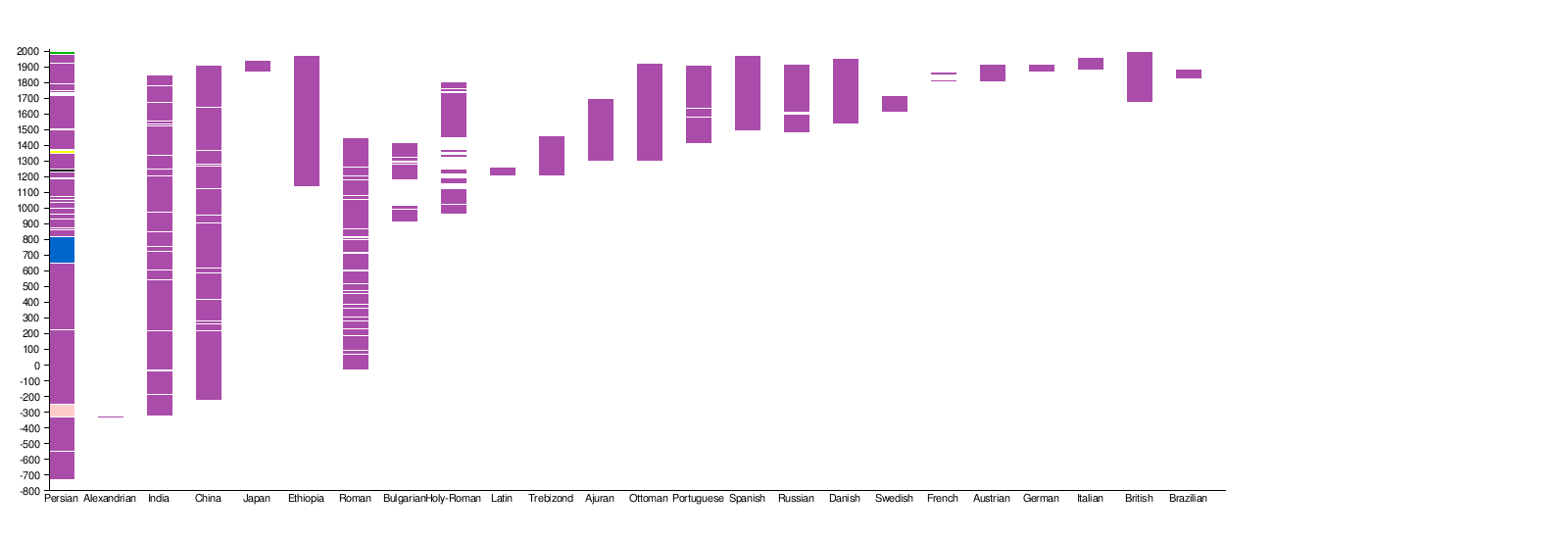
The chart below shows a timeline of political groups that have been called empires. Changes in ruling families are shown with white lines.
- The Roman Empire's timeline includes both the Western and Eastern (Byzantine) parts.
- The Empires of Nicaea and Trebizond were states that continued the Byzantine Empire after a temporary split.
- The original Japanese Empire is not fully shown, but it was one of the longest-lasting.
- Many Indian empires are included, but only a few ruled for very long periods.
Images for kids
-
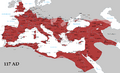
The Roman Empire at its territorial greatest extent in 117 AD, the time of Trajan's death (with its vassals in pink)
-
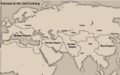
Map showing the four empires of Eurasia in the 2nd century AD
-
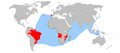
All areas of the world that were once part of the Portuguese Empire. The Portuguese established in the early 16th century together with the Spanish Empire the first global empire and trade network.
-
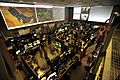
Al Udeid Air Base in Qatar


See also
 In Spanish: Imperio para niños
