
Igneous rock facts for kids
Igneous rocks are one of the three main types of rocks on Earth. The word "igneous" comes from a Latin word meaning "fiery." These rocks form when hot, molten (melted) rock, called magma or lava, cools down and becomes solid.
Magma is found deep inside Earth. It forms when existing rocks in Earth's mantle or crust melt. This melting usually happens because of three things: the temperature goes up, the pressure goes down, or the rock's chemical makeup changes. When this molten rock cools and hardens, it can form rocks with visible crystals, or sometimes it forms natural glass.
You can find igneous rocks in many different places around the world. They are in mountain ranges, flat plains, and even under the ocean.


Contents
What Are Igneous Rocks?
Igneous rocks are like Earth's building blocks. They make up a huge part of our planet's outer layer, called the crust. In fact, igneous and metamorphic rocks form about 90-95% of the top 16 kilometers of Earth's crust. Most of the rock under our oceans is igneous rock.
Why Are Igneous Rocks Important?
Scientists study igneous rocks for many reasons:
- They tell us about the deep parts of Earth. The minerals and chemicals in these rocks show us what the lower crust or upper mantle are made of. They also reveal the temperatures and pressures when the magma formed.
- We can find out their exact age. Using special dating methods, scientists can compare igneous rocks to other rock layers. This helps us create a timeline of Earth's history.
- Their features often show us how Earth's plate tectonics were moving. This helps us understand how continents and oceans have changed over millions of years.
- Some igneous rocks contain valuable ores. For example, tungsten, tin, and uranium are often found with granites. Chromium and platinum are often found with gabbros.
Where Do Igneous Rocks Form?
Igneous rocks form in two main ways: either deep inside Earth or on its surface.

Rocks Formed Underground: Intrusive Rocks
Most igneous rocks form deep inside Earth's crust. These are called intrusive igneous rocks. They form when magma cools and hardens slowly underground. The surrounding rock acts like a blanket, keeping the magma warm. Because it cools slowly, the minerals in intrusive rocks have time to grow large. You can usually see these mineral grains with your bare eyes.
Bodies of intrusive rock are called intrusions. They come in different shapes and sizes. Common intrusive rocks include granite, gabbro, and diorite. The centers of large mountain ranges are often made of these rocks. When erosion wears away the surface, these huge rock bodies, called batholiths, can cover vast areas.
Rocks Formed on the Surface: Extrusive Rocks
Extrusive igneous rocks, also known as volcanic rocks, form when molten magma reaches Earth's surface. This happens through cracks or volcanic eruptions. Once on the surface, the molten rock is called lava. It cools very quickly in the air or water. Because it cools fast, the mineral grains are very tiny, or the rock might even be glassy.


Basalt is the most common extrusive igneous rock. It forms lava flows and large lava plains. Sometimes, basalt cools into amazing long, polygonal columns. A famous example is the Giant's Causeway in Northern Ireland.
The way lava behaves depends on how thick and sticky it is, which scientists call its viscosity. This depends on its temperature and what it's made of.
- Hot, runny lava, like basalt, flows easily. It can travel long distances, like thick oil.
- Thicker lavas, like andesite, are stickier. They often form cinder cones and don't flow as far.
- Very thick and cool lavas, like rhyolite, are extremely sticky. They often cause explosive eruptions and form short, steep lava flows.
When volcanoes erupt explosively, they release dissolved gases, mostly water vapor. This can blast out pieces of rock, ash, and pumice. These materials are called tephra. They can cover huge areas with ash deposits.
It's harder to tell different types of extrusive rocks apart just by looking at them. Their tiny crystals often require a microscope to identify.
How Do We Classify Igneous Rocks?
Scientists classify igneous rocks to understand how and where they formed. They look at things like how the rock looks (its texture), what minerals it contains, and its chemical makeup.
Looking at Texture: How Rocks Feel and Look
The texture of an igneous rock describes the size, shape, and arrangement of its mineral grains.
- Phaneritic rocks have crystals large enough to see with your eyes. This usually means they cooled slowly underground (intrusive).
- Aphanitic rocks have crystals too small to see without a microscope. This means they cooled quickly on the surface (extrusive).
- Sometimes, a rock has large, clear crystals (called phenocrysts) surrounded by a much finer-grained material. This is called a porphyritic texture. It means the magma cooled in two stages: slowly at first, then quickly.

What Are They Made Of? Mineral and Chemical Makeup
The minerals in an igneous rock tell us a lot. Common minerals include feldspars, quartz, olivines, and pyroxenes.
Scientists also classify igneous rocks by their chemical makeup, especially how much silica (SiO2) they contain.
- Felsic rocks have the most silica. They are usually light-colored and contain minerals like quartz and feldspar. Granite and rhyolite are examples.
- Intermediate rocks have a moderate amount of silica. They are typically darker than felsic rocks. Diorite and andesite are examples.
- Mafic rocks have less silica. They are usually dark-colored and contain minerals like pyroxenes and olivines. Basalt and gabbro are examples.
- Ultramafic rocks have very little silica. They are made of more than 90% dark, iron- and magnesium-rich minerals. Komatiite is an example.
This table summarizes the main types:
| Composition | ||||
|---|---|---|---|---|
| Where it forms | Felsic (Lots of silica) |
Intermediate (Medium silica) |
Mafic (Less silica) |
Ultramafic (Very little silica) |
| Underground (Intrusive) | Granite | Diorite | Gabbro | Peridotite |
| On the surface (Extrusive) | Rhyolite | Andesite | Basalt | Komatiite |
How Does Magma Form?
Magma, the molten rock that forms igneous rocks, comes from the melting of existing rocks. This melting happens in a few key ways.
Melting from Less Pressure
Imagine a rock deep inside Earth. It's very hot, but the immense pressure keeps it solid. If this rock moves upwards, the pressure on it decreases. Even though it cools a little, the drop in pressure can cause it to melt. This is called decompression melting. This process is very important for creating the new oceanic crust at mid-ocean ridges.
Water and Carbon Dioxide's Role
Adding water to rocks can make them melt at lower temperatures. This is a major way magma forms in subduction zones. Here, oceanic plates slide under other plates, carrying water deep into the Earth. This water then causes the overlying mantle rock to melt, forming magma that rises to create island arcs, like those in the Pacific Ring of Fire.
Carbon dioxide can also help rocks melt, though it's less common than water. It can lower the melting temperature of rocks at certain depths.
Melting from More Heat
Sometimes, the temperature in Earth's crust simply increases enough to melt rocks. This can happen when hot magma from the mantle rises into the crust, heating the surrounding rocks. It can also occur in areas where the continental crust becomes very thick, like under the Tibetan Plateau. The extra heat can melt the lower crust, forming rocks like granite and rhyolite.
How Magma Changes Over Time
Magma doesn't always stay the same. As it cools, different minerals crystallize out of the melt at different temperatures. This process is called fractional crystallization. If these crystals separate from the remaining melt, the melt's chemical composition changes. For example, a magma that starts as gabbro can become more like granite as it cools and crystals form and sink.
Magma can also mix with other magmas or react with the rocks it moves through. All these processes help create the wide variety of igneous rocks we see.
Where Do the Names Come From?
Many igneous rock names have interesting origins:
- The word igneous comes from the Latin word ignis, meaning fire.
- The term volcanic rock comes from Vulcan, the Roman god of fire.
- The term plutonic rock comes from Pluto, the Roman god of the underworld.
- The name basalt was first used by Georgius Agricola in 1546.
- Granite comes from the Latin word granum, meaning "grain," because of its grainy texture.
- Rhyolite was named in 1860 by the German geologist Ferdinand von Richthofen.
Images for kids
-
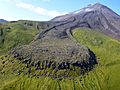
Kanaga volcano in the Aleutian Islands with a 1906 lava flow in the foreground
-
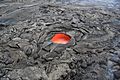
A "skylight" hole, about 6 meters across, in a solidified lava crust reveals molten lava below (flowing towards the top right) in an eruption of Kīlauea in Hawaii
-
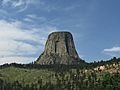
Devils Tower, an eroded laccolith in the Black Hills of Wyoming
-
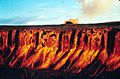
A cascade of molten lava flowing into Aloi Crater during the 1969–1971 Mauna Ulu eruption of Kilauea volcano
-
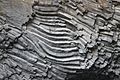
Columnar jointing in the Alcantara Gorge, Sicily
-
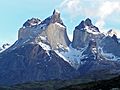
A laccolith of granite (light-coloured) that was intruded into older sedimentary rocks (dark-coloured) at Cuernos del Paine, Torres del Paine National Park, Chile
-
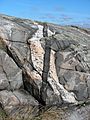
An igneous intrusion cut by a pegmatite dike, which in turn is cut by a dolerite dike
.jpg)

.jpg)
.jpg)


See Also
 In Spanish: Roca ígnea para niños
