
Juan Rodríguez Cabrillo facts for kids
Quick facts for kids
Juan Rodríguez Cabrillo
João Rodrigues Cabrilho |
|
|---|---|

Posthumous depiction of Cabrillo
|
|
| Born | c. 1497 Lapela de Cabril, Montalegre, Kingdom of Portugal
|
| Died | January 3, 1543 (aged 45–46) |
| Known for | First European in Alta California |
Juan Rodríguez Cabrillo (around 1497 – January 3, 1543) was a famous ocean navigator. He sailed along the west coast of North America for the Spanish Empire. He was the first European explorer to reach the coast of California. Cabrillo sailed northward from New Spain (modern Mexico) between 1542 and 1543. His adventurous voyage opened up new maps of the Pacific Ocean for the world.
Contents
The Mystery of Cabrillo's Homeland

Historians have spent many years studying where Cabrillo was born. Some people believe he was from Portugal, while others say he came from Spain.
A Spanish royal historian named Antonio de Herrera y Tordesillas wrote about Cabrillo about sixty years after the explorer died. Herrera stated that Cabrillo was Portuguese. In the Portuguese village of Lapela, part of Montalegre, families have long claimed Cabrillo was born in their town. In Lapela, an ancient house stands where local stories say he grew up. Old records also show the name Cabril existed in regions like Beira Alta.

Other historians found old legal papers from 1532. In those papers, a man named Juan Rodriguez Cabrillo said he was connected to Palma del Río, a town in the province of Córdoba in Spain. Some researchers, like Edward Kritzler, suggested other family backgrounds, including ancestors who were Jewish converts. Other experts argue that these claims lack enough proof.
Maps and family records from the era offer more clues. A map drawn in 1604 by cartographer Matteo di Jacopo Neroni da Peccioli marks a bay in California using the Portuguese spelling "Cabrilho." Many of the sailors and ship owners Cabrillo worked with came from Portugal as well. Because records from the 1500s are very old, researchers still study both sides of the debate.
Early Life and Adventures in New Spain

As a young man, Cabrillo traveled across the Atlantic Ocean to the island city of Havana. Later, he joined forces led by Hernán Cortés in Mexico. Cabrillo traveled with other soldiers across new territories and became very wealthy through his work in Guatemala.
He was a skilled builder who knew how to construct sturdy sailing vessels. Cabrillo also marched with Francisco de Orozco to lands inhabited by the Mixtec people near modern Oaxaca. He soon gained a reputation as an able leader on land and sea.
In 1539, another explorer named Francisco de Ulloa explored the Gulf of California. Ulloa mapped areas near Baja California and proved it was a peninsula rather than an island. The Viceroy of New Spain, named Antonio de Mendoza, wanted to learn what lay farther north. Mendoza asked Cabrillo to lead a brand-new sea expedition along the mysterious Pacific coast.
Goals of the Great Northern Voyage
- Find new sea routes to reach rich trading ports in Asia.
- Search for the legendary Northwest Passage, once called the Strait of Anián.
- Map unknown coastlines and claim new anchorages for the empire.
- Make contact with new peoples and find safe harbors for future trading ships.
In 1540, Cabrillo's fleet set out from Acajutla in El Salvador. They sailed toward Navidad, Mexico, arriving on Christmas Day. A famous commander named Pedro de Alvarado died during a battle at Nochistlán when a horse fell on him. After this accident, Viceroy Mendoza reorganized the ships. Some ships went across the Pacific to the Spanish East Indies under Ruy López de Villalobos. Cabrillo took command of three other ships to sail north into uncharted waters.
Exploring California by Sea

On June 27, 1542, Cabrillo sailed out of the port of Navidad with three vessels. His flagship was the 200-ton galleon named the San Salvador. Cabrillo personally owned and helped build this large vessel. Accompanying him was a smaller ship called La Victoria and a fast boat with oars named the San Miguel.
By August 1, the ships anchored near Cedros Island off the coast of Baja California. Later that month, they sailed past Baja Point into waters no European sailor had ever seen before. The ocean here was rough, and navigation was difficult. Cabrillo relied on skilled pilots to guide the ships through heavy swells and strong winds.
Discovering San Diego Bay
On September 28, 1542, Cabrillo sailed into a large, protected natural harbor. This harbor is now known worldwide as San Diego Bay. Cabrillo named the bay "San Miguel" in honor of Saint Michael.
This landing was the very first recorded visit by Europeans to the coast of Alta California. The crew found calm waters, plenty of fish, and safe anchorages. Cabrillo and his crew stayed for several days to gather fresh water and inspect their wooden ships.
The Channel Islands and Coastal Encounters
On October 7, the small fleet reached Santa Catalina Island. Cabrillo named this island "San Salvador" after his flagship. Nearby, the sailors sighted San Clemente Island, which they named "Victoria."
The following day, on October 8, the ships entered San Pedro Bay. The sailors saw thick smoke rising from campfires inland, so they called it "Baya de los Fumos" (Bay of Smokes). Next, they rested in Santa Monica Bay before sailing farther north. While passing the coast, they observed Anacapa Island, which they learned was uninhabited.
The ships soon reached the homeland of the Chumash people. The Chumash lived in large coastal communities and built remarkable wooden canoes called tomols. Cabrillo recorded many village names in regions that are now Santa Barbara County and Ventura County. On October 18, the fleet rounded a windy headland named Point Conception, which Cabrillo called "Cabo de Galera."
Facing Ocean Storms in the North

As winter approached, the weather in the northern Pacific grew harsh and stormy. On November 13, the sailors sighted a rocky point covered in evergreen trees, possibly Point Pinos or Point Reyes.
Thick ocean fog covered the coast, causing Cabrillo to miss the hidden mouth of San Francisco Bay. European sailors would continue to miss this hidden bay entrance for more than two hundred years. Some records suggest the ships may have reached as far north as the Russian River.
High waves and freezing winds battered the wooden hulls, forcing Cabrillo to turn south. On the way down the coast, he sailed into Monterey Bay and called it the Bay of Pines. The crew needed a safe place to wait out the winter storms.
Cabrillo's Final Days
On November 23, 1542, the fleet returned to the Channel Islands to rest and repair damaged rigging. They anchored at Cuyler Harbor on San Miguel Island.
Around Christmas Eve, trouble broke out on shore with local Tongva islanders. Cabrillo rushed out of his landing boat to protect his men. While leaping onto the rocky beach, he stumbled and badly broke his leg bone.
Without modern medicines, his broken bone became dangerously infected with gangrene. Juan Rodríguez Cabrillo died from the injury on January 3, 1543. His grieving crew buried him on the island. A carved stone that might be his grave marker was discovered centuries later. Cabrillo's second-in-command took charge of the remaining ships and brought the expedition safely back to Mexico in April 1543.
The original official diary of the voyage was lost long ago. Fortunately, an explorer named Andrés de Urdaneta wrote an early summary from the ships' logbooks.
Family and Descendants
Before his northern voyage, Cabrillo married Beatriz Sanchez de Ortega in Spain. Together they traveled to the Americas and had two sons. His primary heir was named Juan Rodríguez Cabrillo de Medrano.
His son Medrano lived in Guatemala and served as an important community leader. In 1577, Medrano served as an magistrate on the local town council of Santiago de Guatemala. Medrano managed local estates called an encomienda in places like Xicalpa and Cobán. He also provided legal testimony for local colonial records.
Generations of Cabrillo's descendants held prominent positions across Central America. A great-grandson named Esteban de Medrano y Solórzano wrote his formal will in 1688. Esteban served as an official regidor and chancellor for the royal court known as the Audiencia of Guatemala.
Remembering Cabrillo's Legacy


Because Cabrillo died during his voyage, his journey was largely overlooked by officials at the time. None of the Spanish names he gave to bays and islands became permanent. Today, however, Cabrillo is remembered as a pioneering navigator of the Pacific coast.
Many landmarks and public places across California celebrate his daring exploration:
- The Cabrillo National Monument stands on the cliffs of Point Loma in San Diego. It features a tall stone statue donated by Portugal and exhibits explaining Cabrillo's voyage.
- A historic plaque honors his arrival, placed by a Portuguese ambassador to the United States.
- The state of California officially celebrates September 28 as "Cabrillo Day."
- Coastal sights include the Point Cabrillo Light in northern California and Cabrillo Beach in San Pedro.
- Visitors can study sea animals at the Cabrillo Marine Aquarium near Los Angeles.
- A massive underwater mountain called the Rodriguez Seamount bears his name.
- The Flag of San Diego proudly includes the year 1542 to mark his arrival in the harbor.
Major roadways also carry his name. The famous scenic highway California State Route 1 is called the Cabrillo Highway along parts of its coastal path. Drivers in San Diego cross the towering Cabrillo Bridge in Balboa Park along California State Route 163. In 1992, the United States Postal Service created a special postage stamp showing Cabrillo's ship.
The Replica Flagship San Salvador

To help modern students experience what sixteenth-century sailing was like, the Maritime Museum of San Diego undertook a major project. Shipwrights built a full-sized, working replica of Cabrillo's flagship, the San Salvador.
Historians and archaeologists studied old Spanish and Portuguese shipbuilding methods to make the vessel historically accurate. Shipbuilders worked outdoors in view of the public, using traditional tools alongside heavy timbers. The ship was launched in 2015 and now sails along the coast of Southern California as an educational museum ship, teaching kids about maritime history.
Modern Discussions
In recent years, historians and students have looked closely at the impact of early explorers on native peoples. Some schools, such as Cabrillo College in Aptos, California, and Cabrillo High School, have held thoughtful community discussions about whether to change their names. These discussions help people understand both the daring achievements of early sea explorers and the experiences of native cultures who lived along the coast long before ships arrived.
Images for kids
-

Portrait depicting the navigator Juan Rodríguez Cabrillo.
-
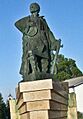
Stone monument built to honor Cabrillo in Montalegre, Portugal.
-
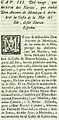
Historical page from Antonio de Herrera y Tordesillas describing Cabrillo.
-
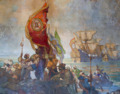
Historic courthouse mural showing Cabrillo landing in California.
-
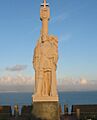
The Cabrillo National Monument statue overlooking San Diego.
-
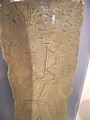
Replica of the historic grave marker found on San Miguel Island.
-

Commemorative bronze plaque at Point Loma presented by Portugal.
-
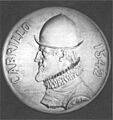
Historic medallion portrait of Cabrillo sculpted in 1902.
-
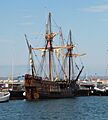
The modern replica of the galleon San Salvador sailing near San Diego.
See also
 In Spanish: Juan Rodríguez Cabrillo para niños
