
Ladybug facts for kids
Quick facts for kids Ladybird, ladybug, lady beetle |
|
|---|---|
 |
|
| Coccinella septempunctata | |
Scientific classification  |
|
| Kingdom: | Animalia |
| Phylum: | Arthropoda |
| Class: | Insecta |
| Order: | Coleoptera |
| Suborder: | Polyphaga |
| Infraorder: | Cucujiformia |
| Superfamily: | Coccinelloidea |
| Family: | Coccinellidae Latreille, 1807 |
| Subfamilies | |
|
(traditional, but see below):
|
|
| Synonyms | |
|
|
Ladybugs, also known as ladybirds or lady beetles, are a large family of small, colorful insects. There are over 6,000 different kinds of ladybugs found all over the world. They are easy to spot with their oval, domed bodies and bright warning colors, like red with black spots. These colors tell predators that ladybugs taste bad!
Most ladybugs are helpful predators. They eat tiny insects like aphids and scale insects that can harm plants. Some ladybugs also eat plants or fungi. Ladybugs mate in spring and summer. They lay their eggs near their prey, so their babies (larvae) have food right away. Like many insects, they go through a full life cycle: egg, larva, pupa, and then adult. Many ladybugs sleep through winter or dry seasons.
Because they eat pests, many ladybugs are considered "good bugs" for farmers. Some have even been moved to new places to help control pests. However, some ladybug species can become pests themselves. They might eat crops or even try to live in people's homes during winter. Invasive types, like the Asian lady beetle, can also harm native ladybug species. Ladybugs are special insects that appear in stories, poems, and nursery rhymes.
Contents
What's in a Name?
The scientific name for ladybugs, Coccinellidae, comes from a Latin word meaning "scarlet." The English name "ladybird" started in Britain. People called them "Our Lady's birds" because of Mother Mary. She was often shown in old paintings wearing a red cloak. The seven spots on the common European ladybird, Coccinella septempunctata, were thought to represent her seven joys and seven sorrows. In America, the name changed to "ladybug." Scientists often call them "ladybird beetles" or "lady beetles." This helps avoid mixing them up with other insects called "true bugs." In Germany, they are called Marienkäfer, which means "Marybeetle."
What Do Ladybugs Look Like?
Ladybugs are usually small, from less than 1 millimeter to about 18 millimeters long. Female ladybugs are often a little bigger than males. They have a round or oval shape with a domed back and a flat underside. Ladybugs have large compound eyes and short, club-shaped antennae. Their strong jaws, called mandibles, help them eat.
Like all beetles, ladybugs have hard front wings called elytra. These elytra protect their softer, flying hindwings underneath. Their legs are short, and each leg has two tiny claws at the end.
Ladybugs are famous for their bright colors and patterns. You might see them in yellow, red, orange, or brown, with black spots. Some even have stripes or checkered patterns! These colors come from natural pigments. The bright colors usually act as a warning to animals that might want to eat them. But sometimes, colors can also help them hide, attract a mate, or control their body temperature. Some ladybugs can even change their colors with the seasons.
Baby ladybugs, called larvae, look very different from adults. They are long and have square heads. Their bodies are often grey, blue-grey, or brown, with spots of white, yellow, red, or orange. Larvae become brighter in color as they grow older.
- Different Ladybug Looks
-
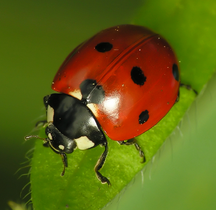
Coccinella septempunctata, black spots on red
-
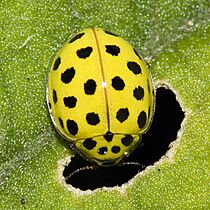
Psyllobora vigintiduopunctata, black spots on yellow
-
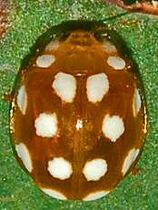
Vibidia duodecimguttata, whitish spots on brown
-
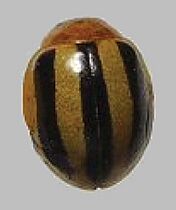
Brumoides suturalis, longitudinally striped
-
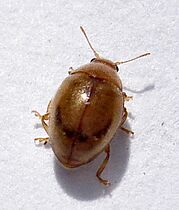
Rhyzobius chrysomeloides, brown, unspotted


.JPG)
.jpg)

Ladybug History
Scientists have found over 6,000 types of ladybugs alive today. Ladybugs have been around for a very long time! The oldest ladybug fossils are about 53 million years old. They were found in amber (fossilized tree sap) in France.
Ladybugs belong to a larger group of beetles called Cucujiformia. This group includes many plant-eating beetles. Ladybugs make up most of the species in their own smaller group, the Coccinelloidea. Many other beetles in this group eat fungi or are scavengers. Early ladybugs likely ate scale insects. Over time, some ladybugs evolved to eat aphids, leaves, or fungi.
Ladybug Biology and Ecology
How Ladybugs Fly
Ladybugs usually fly during the day. Their strong hindwings stiffen for flight and fold neatly when they land. These beetles can fly long distances to find places to sleep for winter or to find new food sources. They seem to look for familiar landmarks to guide them. If an area gets too crowded, or if there isn't enough food, ladybugs will fly away to find a better spot. Some ladybugs in Britain have been recorded flying as far as 120 kilometers (about 75 miles). They can fly at speeds of 30 kilometers per hour (about 18 miles per hour) and reach heights of almost 1,100 meters (about 3,600 feet).
- Ladybug Flight
-
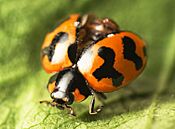
Coccinella transversalis, with open wings ready for flight
-
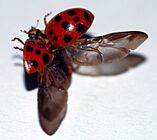
Full wings of a Harmonia axyridis taking flight


Ladybug Life Cycle
In places with changing seasons, ladybugs usually mate from late spring to early summer. In warmer areas, they might reproduce in spring, fall, and winter. Tropical ladybugs mate during the rainy season. Ladybugs lay their eggs close together, standing upright, usually near a good food source. A female can lay hundreds or even over a thousand eggs in her lifetime.
After hatching, the tiny ladybug larvae start eating. Sometimes, they even eat other eggs in their own clutch! Some species lay extra eggs that are not fertile. These "trophic eggs" act as a backup food source for the hungry larvae. Larvae grow through four stages, shedding their skin (molting) three times.
Eventually, the larva changes into a pupa. During this stage, the pupa is mostly still, but its head can move if it's bothered. When the adult ladybug emerges, its wings are soft and light-colored, without their final patterns. It can take hours, or even weeks, for the adult to get its full color and hardened wings. An adult ladybug can live for up to a year.
In colder regions, ladybugs hibernate or go into a deep sleep during winter. They often gather in large groups under leaves, rocks, or in tall grass. In very hot places, they might sleep through the summer. Tropical ladybugs become dormant during the dry season.
- Ladybug Life Cycle
-
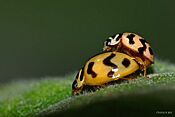
Adults mating
-
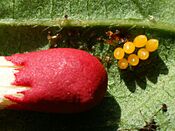
Eggs (match for scale)


.jpg)

What Ladybugs Eat
Ladybugs are part of the food web as both predators and prey. Most ladybugs are carnivorous predators. They mainly eat soft-bodied insects like aphids, scale insects, and whiteflies. Some also eat moth larvae, other beetle larvae, or mites. Since many of their prey are pests that harm crops, ladybugs are very helpful insects! About 68% of ladybug species in temperate areas eat aphids, while 36% worldwide mostly eat scale insects. Both adult and larval ladybugs eat the same kinds of food.
Some ladybugs are picky eaters, like those in the Stethorus genus, which only eat spider mites. Aphid-eating ladybugs are often less picky. They eat a lot and can multiply quickly when there are many aphids. When aphids are scarce, they switch to other prey. Ladybugs that eat scale insects tend to eat less and grow slower, matching their prey's slower life cycle.
Ladybugs sometimes have to defend themselves from ants. Ants often protect aphids to get their sweet "honeydew." Some ladybug species, like Coccinella magnifica, have learned to live inside ant nests as larvae.
Ladybugs can also eat each other. Larvae might eat eggs or other larvae, and adults might eat younger ladybugs. Not all ladybugs are predators. Some, like those in the Epilachna genus, mainly eat plants. Other ladybugs might eat leaves, pollen, nectar, sap, fungi, or honeydew to supplement their diet.
Ladybug Defenses
.jpg)
The bright colors of many ladybugs are a warning to predators that they are toxic. Studies have shown that the brighter and more contrasting a ladybug's colors are, the more toxic it tends to be. Ladybug "blood" (called hemolymph) contains poisonous chemicals and foul-smelling substances. When a ladybug feels threatened, it can "bleed" a few drops of this toxic fluid from its leg joints. This is called reflex bleeding, and it gives predators a taste of how bad they are. These poisons are especially important for the still pupa stage.
Some other insects, like certain clerid beetles, can eat ladybugs. These beetles are also brightly colored, perhaps using the ladybug's toxins for their own defense. There are even spiders, called ladybird spiders, that have evolved to look like ladybugs. This helps them scare away predators, even though the spiders don't have the same toxic chemicals.
Where Ladybugs Live and Their Status
.jpg)
Ladybugs live on every continent except Antarctica. They can be found in many different places, from the ground to the tops of trees. Some species live in extreme environments like high mountains, deserts, or cold regions. While some famous ladybug species are found almost everywhere, others live only in specific areas and might be at risk.
.jpg)
Ladybugs face threats from climate change, farming, city growth, and invasive species. Rising temperatures and heat changes can affect ladybug larvae and their energy needs. Farming and city development destroy their homes and use chemicals that harm them. Invasive ladybugs, like the Asian lady beetle, can outcompete native species and even eat their eggs.
As of 2026, no specific ladybug species are listed on the IUCN Red List as endangered. However, there is a special group of scientists working to protect ladybugs. They suggest things like citizen science projects, protecting and restoring habitats, stopping the spread of invasive species, and tracking ladybug populations worldwide.
Ladybugs and Humans
Helping Farmers

Ladybugs are very valuable in biological pest control. They eat pests like aphids and scale insects that damage crops. People noticed their importance in controlling pests as early as 1814 in England.
One famous example is the vedalia beetle, Novius cardinalis. This ladybug was brought to California from Australia in 1887. It helped protect citrus trees from a pest called cottony cushion scale. This project was a huge success, costing very little and becoming a perfect example of how biological control can work. The vedalia beetle was then used successfully in 29 other countries. It worked well because it mostly eats one type of prey, grows quickly, and finds pests efficiently.
Many other attempts have been made to use ladybugs against pests, with different results. Ladybugs that eat scale insects have been more successful than those that eat aphids. This is because aphid-eating ladybugs breed fast and eat many different things, making them harder to control.
When Ladybugs Become Pests

Sometimes, ladybugs can also be pests. The Asian lady beetle, Harmonia axyridis, is from East Asia but has spread to other parts of the world. In North America, these ladybugs often gather inside homes in the fall to find a warm place for winter. After a very hot summer in the UK in 1976, there was a huge increase in native ladybugs. People reported being bitten as the ladybugs ran out of aphids to eat.
Some ladybugs, like H. axyridis, C. septempunctata, and Hippodamia convergens, can affect the taste of wine. If even a few ladybugs are accidentally crushed with grapes during winemaking, they can change the wine's quality. The Mexican bean beetle is also a pest because it eats plants, especially beans, instead of other insects.
Ladybugs in Culture
Ladybugs have been important in stories, beliefs, and religions for a long time. They are often linked to luck, love, good harvests, and even predicting the future. The term "ladybird" can also be a loving nickname for someone. In old European stories, a ladybug crawling on a woman and then flying away was thought to lead her to her true love. Ladybugs were also believed to predict the weather or how well crops would grow.
In Christianity, ladybugs have been seen as guardians of Heaven. A Swedish name for them means "Keys of Heaven." Jewish people have called them the "Cow of Moses our Teacher." The Cherokee people honored them as the "Great Beloved Woman." This was a title for the highest-ranking woman in their government, who would be painted in the ladybug's colors during ceremonies.
Ladybugs are very popular in poems and nursery rhymes. The most famous one is Ladybird! Ladybird!, which has several versions, including:
Ladybird, ladybird, fly away home,
Thy house is on fire, thy children all roam,
Except little Nan, who sits on her pan,
Weaving gold laces as fast as she can.
-
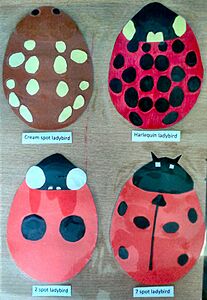
Card cutout ladybirds for a children's
nature trail -
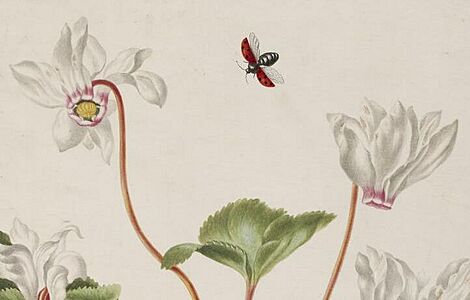
Ladybird flying over cyclamen, detail,
by Maria Sibylla Merian, 1690s -
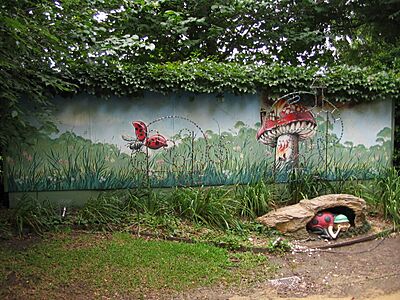
Depiction of the Ladybird! Ladybird! rhyme in Hunter Valley Gardens, Australia

_(ladybird_flying_over_cyclamen).jpg)

See also
 In Spanish: Mariquitas para niños
