
Cherry blossom facts for kids
%E3%81%A8%E8%8A%9D%E6%A1%9C(%E3%81%97%E3%81%B0%E3%81%96%E3%81%8F%E3%82%89).jpg)
The cherry blossom, also known as sakura, is the beautiful flower of certain trees in the Prunus family. When people talk about sakura, they usually mean the flowers from special ornamental cherry trees. These are grown for their beauty, not for their fruit. Cherry blossoms often have a light, vanilla-like scent.
Wild cherry trees grow in many parts of the world, especially in the Northern Hemisphere. They are very common in East Asia, particularly in Japan. In Japan, people have grown and developed many different kinds of cherry trees over hundreds of years.
Most of the lovely cherry trees you see in parks are special types called cultivars. These cultivars were created to have beautiful flowers. One important type is the Oshima cherry, which is native to Japan. It has large, fragrant flowers, grows quickly, and can easily develop into trees with many petals. Because of this, many popular cherry blossom varieties have come from the Oshima cherry since the 14th century. These trees have played a big role in the Japanese tradition of hanami, or flower viewing. Today, new cherry trees are often grown by grafting. This method helps create many new trees that are exactly like the beautiful original plant.
The Japanese word sakura (sakura (桜)) can mean both the tree and its flowers. The cherry blossom is considered the national flower of Japan. It is a very important part of Japanese culture and the custom of hanami.
In English, sakura trees are often called Japanese cherry trees. These ornamental cherry trees started to become popular in Europe and the United States in the early 1900s. Japan even sent cherry trees to the United States in 1912 as a symbol of friendship.
Contents
Understanding Cherry Tree Types
How Cherry Trees Are Grouped
Classifying cherry trees can be a bit tricky. This is because they change easily and have many different kinds of flowers and features. There are many varieties, mixes between different types, and special cultivated kinds. Scientists have sometimes given the same cherry tree different names over time.
In Europe and North America, ornamental cherry trees are usually grouped under the subgenus Cerasus. This group is known as "true cherries" and is part of the larger Prunus family. The Cerasus group includes about 100 types of cherry trees. It does not include other related plants like plums, peaches, apricots, or almonds.
In Japan, cherry trees were also traditionally grouped under Prunus. However, after new research in 1992, it became more common to classify them under the genus Cerasus.

Where Cherry Blossoms Became Popular
Long ago, people in China enjoyed viewing plum blossoms. While China has many wild cherry trees, most had small flowers. There were not many wild cherry trees with large, beautiful flowers suitable for viewing. Similarly, Europe and North America had few cherry types that were good for flower viewing.
However, in Japan, two types of wild cherry trees, the Oshima cherry and Prunus jamasakura (Yamazakura), had large flowers. These trees grew into big sizes and were found in many areas close to where people lived. Because of this, the tradition of cherry blossom viewing, and the creation of many new varieties, mostly developed in Japan.

Creating New Cherry Varieties
Cherry trees can change their traits easily. This has allowed many special varieties, called cultivars, to be created for cherry blossom viewing. This has happened especially in Japan. Since the Heian period (794–1185), Japanese people have chosen the best or most unique wild cherry trees to create new varieties. They also cross-bred trees and then grew them using grafting or cutting.
The Oshima cherry, which is native to Japan, is very special. It often develops into trees with many petals, grows fast, has many large flowers, and smells wonderful. Because of these great features, the Oshima cherry has been used to create many sakura cultivars. These are known as the Sato-zakura Group. Two famous examples are the Yoshino cherry and Kanzan. Yoshino cherries are widely planted in Asian countries, while Kanzan is popular in Western countries.
Hanami: Japan's Flower Viewing Tradition

Hanami (hanami) is a very old Japanese tradition. It involves holding picnics or parties under blooming cherry (sakura) or plum (ume) trees. This custom is thought to have started during the Nara period (710–794). Back then, people mostly admired plum blossoms.
By the Heian period (794–1185), cherry blossoms became much more popular. The word hanami then became mostly linked with sakura. From that time on, in Japanese poetry like waka and haiku, the word "flowers" ("flowers" (花, hana)) usually meant "cherry blossoms."
At first, only the rich people in the Imperial Court enjoyed hanami. But it soon spread to the samurai class and, by the Edo period (1603–1868), to everyone. Leaders like Tokugawa Yoshimune even planted many cherry trees to encourage this tradition. Under the sakura trees, people held happy feasts.

Some cherry trees, like the "weeping cherry" with its drooping branches, have been around for a very long time. The Prunus itosakura 'Pendula' is thought to be the oldest cultivated cherry tree in Japan. During the Kamakura period (1185–1333), the Oshima cherry from Izu Oshima Island was brought to the main island of Honshu. It then made its way to the capital city of Kyoto. The Sato-zakura Group of cultivars first appeared during the Muromachi period (1336–1573).
The Prunus itosakura (also called Edo higan) is a wild cherry tree that grows slowly. However, it lives longer than most other cherry trees and can grow very large. Many old and huge examples of this species exist in Japan. They are often seen as sacred and mark important places like Shinto shrines and Buddhist temples. Famous old trees include the Jindai-zakura (around 2,000 years old), Usuzumi-zakura (around 1,500 years old), and Daigo-zakura (around 1,000 years old).

In the Edo period, many different double-flowered varieties were created. These were planted along rivers, in temples, shrines, and gardens in cities like Edo (now Tokyo). This allowed ordinary people in cities to enjoy them. Books from that time list over 200 types of cherry blossoms, including many we know today, like 'Kanzan'. However, this was mostly in cities. Across the rest of the country, people still mainly viewed wild types like Prunus jamasakura (Yamazakura) and Oshima cherry.
After Japan modernized in the Meiji era (1868–1912), the Yoshino cherry became very popular across the country. It is now the main type of cherry blossom for hanami. Many other older varieties were cut down as cities rapidly modernized. However, some dedicated gardeners worked to save these unique trees. They planted rows of different cherry varieties along the Arakawa River bank. In Kyoto, a gardener named Sano Toemon XIV also collected and grew many different types. After World War II, these special varieties were preserved by research institutes and associations. From the 1960s onwards, they were again used for hanami.
Every year, the Japanese Meteorological Agency (JMA) and private companies track the "cherry blossom front" (sakura zensen). This is how the blossoms move northward across Japan as warmer weather arrives. The blooming starts in Okinawa in January. It usually reaches Kyoto and Tokyo by early April, though recently it has been happening earlier, in late March. The front then moves north to Hokkaido a few weeks later. Both Japanese people and tourists pay close attention to these forecasts.
Most Japanese schools and public buildings have cherry blossom trees planted outside. Since the school and financial years both start in April, the first day of work or school often happens during the cherry blossom season. While most cherry trees bloom in spring, there are also lesser-known winter cherry blossoms (fuyuzakura) that bloom between October and December.
The Japan Cherry Blossom Association has a list of Japan's Top 100 Cherry Blossom Spots. There is at least one famous spot in every prefecture.
When Cherry Blossoms Bloom

Many cherry tree types and varieties bloom between March and April in the Northern Hemisphere. Wild cherry trees, even of the same type, are all a little different genetically. So, even if they are planted in the same area, they might bloom at slightly different times. However, cultivated varieties are clones, meaning they are exact copies grown by grafting or cutting. Because they are genetically identical, all trees of the same variety in the same area will bloom at the same time.
Some wild types, like Edo higan, and the varieties made from them, bloom before their leaves appear. The Yoshino cherry became popular for viewing because it blooms all at once and before its leaves come out. It also has many flowers and grows into a large tree. Many varieties from the Sato-zakura group, which came from complex mixes based on the Oshima cherry, are often used for decoration. They usually bloom a few days to two weeks after the Yoshino cherry.
How Climate Change Affects Blooming
The time when cherry trees bloom is changing due to global warming and the "heat island effect" in cities. Records of the Prunus jamasakura (Yamazakura) in Kyoto, Japan, have been kept for about 1200 years. These records show that the blooming time was quite steady until the 1800s. After that, the full bloom time started happening much earlier. In 2021, the earliest full bloom date in 1200 years was recorded. The average peak bloom day in the 1850s was around April 17, but by the 2020s, it was April 5. The average temperature rose by about 3.4°C during this period.
Records for the Yoshino cherry in the Tidal Basin in Washington, D.C., also show changes. The bloom date was April 5 in 1921, but it was March 31 in 2021. These records match the history of fast increases in global temperatures since the mid-1800s.
Japanese cherry trees grown in the Southern Hemisphere bloom at different times of the year. For example, in Australia, trees in the Cowra Japanese Garden bloom in late September to mid-October. The Sydney cherry blossom festival is in late August.
There is growing concern that climate change could harm sakura varieties. They are very sensitive to changes in temperature and weather. Warmer temperatures and earlier springs might change when they bloom. This could lead to fewer flowers and affect their cultural importance.
In 2023, cherry blossoms in China reached their peak bloom weeks earlier than they had decades ago. Data from Kyoto, Japan, and Washington, D.C., also showed earlier blooming periods.
Scientists use AI to make predictions. The Japan Meteorological Agency has suggested that if we don't work hard to slow down climate change, the Somei-Yoshino cherry tree might face big problems. It could even disappear from some parts of Japan, like Miyazaki, Nagasaki, and Kagoshima prefectures, by the year 2100.
Cherry Blossom Symbolism in Japan

Cherry blossoms are often written about in waka poems. In these poems, they often represent how short-lived things are. Because cherry blossoms bloom all at once and then fall quickly, they are a strong symbol for the briefness of life.
Cherry blossoms appear often in Japanese art, manga, anime, and movies. They are also used in stage designs for music shows. There is a popular folk song called "Sakura", and many modern pop songs also use the name. The flower is also seen on many everyday items, like kimonos, stationery, and dishware.
Mono no aware: Appreciating Fleeting Beauty
The traditional meaning of cherry blossoms, as a symbol of life's short nature, is linked to the idea of mono no aware. This Japanese idea means feeling a gentle sadness or appreciation for the beauty of things that don't last forever. The way the blossoms are beautiful but quickly disappear has often been connected to life, death, and accepting what happens.
A Symbol of Bravery and Sacrifice
During World War II, cherry blossoms were used as a powerful symbol to inspire the Japanese people. They encouraged a strong sense of national pride and bravery. A Japanese saying, hana wa sakuragi, hito wa bushi ("the best blossom is the cherry blossom, the best man is a warrior"), was used to motivate soldiers. It suggested that soldiers should be ready to make a great sacrifice for their country, just as cherry blossoms fall beautifully.
Cherry blossoms were used in songs and poems to inspire a "Japanese spirit." They spoke of "warriors" who were "ready like the myriad cherry blossoms to scatter." Poems compared falling cherry blossoms to the sacrifice of Japanese soldiers who fought for their country. Japanese pilots sometimes painted sakura flowers on their planes before important missions. This symbolized the intense and short nature of life. In this way, falling cherry petals came to represent the brave sacrifice of young people for their country.
Artistic and Popular Uses Today
.jpg)
Cherry blossoms are also used as symbols in Japanese sports. The Japan national rugby union team has used the flower as an emblem on its uniforms since the 1930s. The team is known as the "Brave Blossoms." The cherry blossom is also in the logos of the Japan Cricket Association and the Japan national American football team.
Cherry blossoms are a common symbol in irezumi, the traditional art of Japanese tattoos. In these tattoos, cherry blossoms are often seen with other classic Japanese symbols like koi fish, dragons, or tigers.
The cherry blossom is still a strong symbol today. It was used for the mascot of the Tokyo 2020 Paralympics, named Someity. It is also a common way to show the start of spring in video games, like the Animal Crossing series, where many trees become flowering cherries.
Different Kinds of Cherry Blossoms


Japan has many different kinds of cherry trees, including hundreds of special cultivars. Some ways of counting say there are over 600 varieties in Japan, while others claim 800. DNA studies in 2014 showed that many of the varieties found around the world are mixes. They were created by crossing the Oshima cherry and Prunus jamasakura (Yamazakura) with other wild types. Many of these varieties, like those in the Sato-zakura Group, have many petals. A good example is Prunus serrulata 'Kanzan'.
Here are some of the types of cherry trees used to create these beautiful sakura varieties:
- Prunus apetala (Clove Cherry)
- Prunus campanulata
- Prunus incisa
- Prunus itosakura (Edo higan)
- Prunus jamasakura
- Prunus nipponica
- Prunus sargentii
- Prunus speciosa (Oshima cherry)
- Prunus × yedoensis (Yoshino cherry)

The most popular cherry blossom variety in Japan is 'Somei-yoshino' (Yoshino cherry). Its flowers are almost pure white, with a very light pink tint, especially near the stem. They bloom and usually fall within a week, before the leaves come out. This makes the trees look almost completely white. This variety was developed in the mid-to-late 1800s.

The ''Prunus'' × ''kanzakura'' 'Kawazu-zakura' is a well-known variety that blooms before spring arrives. It is a natural mix of the Oshima cherry and Prunus campanulata. It has deep pink petals. Wild cherry trees usually don't bloom in cold weather because they need insects to pollinate them in spring. However, 'Kawazu-zakura' blooms early because one of its parent trees, Prunus campanulata, came from Okinawa, where it's warmer. For cultivated varieties like 'Kawazu-zakura', early blooming and beautiful flowers are desired, so they are grown using grafting.
Cherry trees are often grouped by their species and variety. But in Japan, they are also named based on their flower and tree features. Cherry trees with more than the usual five petals are called yae-zakura (double-flowered sakura). Those with drooping branches are called shidare-zakura, or weeping cherry. Most yae-zakura and shidare-zakura are cultivated varieties. Famous weeping cherry varieties include 'Shidare-zakura' and 'Yae-beni-shidare'. These all came from the wild species Prunus itosakura.
The color of cherry blossoms is usually a mix of white and red. But there are also varieties with unusual colors like yellow and green. Famous yellow and green varieties are ''Prunus serrulata'' 'Grandiflora' A. Wagner (Ukon) and ''Prunus serrulata'' 'Gioiko' Koidz (Gyoiko). These were developed in Japan during the Edo period.
In 2007, a research institute called Riken created a new variety called 'Nishina zao'. They did this by using a special light beam on cherry trees. This new variety is a change from the green-petaled ''Prunus serrulata'' 'Gioiko' (Gyoiko). It has pale yellow-green-white flowers when it blooms and pale yellow-pink flowers when they fall. Riken also created other varieties in a similar way, like 'Nishina otome' (blooms in spring and autumn), 'Nishina haruka' (larger flowers), and 'Nishina komachi' (flowers that stay partly closed).
-
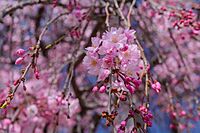
Prunus itosakura 'Plena Rosea' (Yae-beni-shidare) is a variety with both many petals and weeping branches.
-
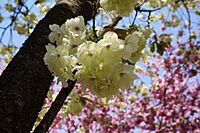
''Prunus serrulata'' 'Grandiflora' A. Wagner (Ukon) with rare yellow flowers, developed in Japan during the Edo period.
-
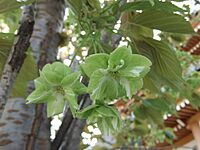
''Prunus serrulata'' 'Gioiko' Koidz (Gyoiko) with rare green flowers, developed in Japan during the Edo period.
-
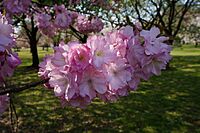
''Prunus × sieboldii'' 'Beni-yutaka'.


All wild cherry trees produce small fruits, some of which are edible cherries. However, some cultivated varieties have changed so they cannot reproduce naturally. For example, ''Prunus serrulata'' 'Hisakura' (Ichiyo) and ''Prunus serrulata'' 'Albo-rosea' Makino (Fugenzo), which came from the Oshima cherry, have a changed part of the flower that becomes leaf-like. These can only be grown by artificial methods like grafting. Cherry trees grown for their fruit are usually different types of related species.
Where Cherry Blossoms Grow Around the World

Today, ornamental cherry blossom trees are grown all over the world. While flowering cherry trees have always been present in places like Europe, North America, the Philippines, and China, the main place for growing ornamental cherry trees was Japan. Many of the varieties planted worldwide, such as the Prunus × yedoensis, came from Japanese mixes.
The spread of ornamental cherry trees and flower viewing festivals, or hanami, mostly began in the early 1900s. Often, Japan gave these trees as gifts to other countries. However, some regions have always grown their own native types of flowering cherry trees, like the Himalayan wild cherry tree Prunus cerasoides.
The Origins of Wild Cherry Trees
_Cibodas_Botanical_Garden.JPG)
The wild Himalayan cherry, Prunus cerasoides, grows naturally in the Himalayan region of Asia. It is common in countries like Nepal, India, Bhutan, and Myanmar, where it is also grown by people.
In 1975, three Japanese researchers suggested that cherry trees first appeared in the Himalayan region. They believed the trees then spread east to Japan long before humans lived there, when Japan was connected to the Asian continent. They thought that many different cherry species developed actively in Japan.
According to Masataka Somego, a professor at Tokyo University of Agriculture, cherry trees started 10 million years ago in what is now Nepal. They later developed into unique species in Japan.
DNA research from the Kazusa DNA Research Institute shows that the Prunus itosakura and the Prunus speciosa, which is native to Japan, became separate species 5.52 million years ago.

However, other modern theories, based on detailed DNA research, suggest a different origin. According to Ko Shimamoto, a professor at Nara Institute of Science and Technology, the ancestor of the cherry tree is thought to be a plant related to the Prunus grayana, not directly the Himalayan cherry tree.
According to HuffPost, many experts agree that the first cherry blossoms originated somewhere in the Himalayas or Eurasia. Scholars believe the blossoms may have reached Japan several thousand years ago. In Japan, hundreds of years of mixing different types have created more than 300 varieties of the cherry blossom.
Eating Cherry Blossoms


Cherry blossoms and leaves can be eaten, and both are used in Japanese food:
- The blossoms are pickled in salt and a type of plum vinegar. They are used to add flavor to wagashi, which are traditional Japanese sweets, or anpan, a sweet Japanese bun. This pickling method, called sakurazuke, is thought to have started around the end of the Edo period.
- Salt-pickled blossoms in hot water are called sakurayu. People drink this at special events like weddings instead of green tea.
- The leaves are pickled in salted water and used to wrap sakuramochi, a sweet rice cake.
- Cherry blossoms are also used to flavor Japanese Roku gin.
Important Safety Information
Cherry leaves and blossoms contain a natural chemical called coumarin. In large amounts, coumarin can be harmful to the liver. Because of this, food safety rules limit how much coumarin can be in food. However, coumarin has a pleasant vanilla-like smell. The special salt-curing process used for most food uses, which involves washing, drying, and salting the blossoms or leaves, greatly reduces the amount of coumarin to safe levels while keeping its scent. Coumarin can also be taken from plants to be used in perfumes or to add flavor to vanilla.
It is important to know that cherry seeds and bark contain another chemical called amygdalin and should not be eaten.
See also
 In Spanish: Sakura (cerezo) para niños
- The Cherry Orchard: a famous play
- Cherry Tree Park
- Kabazaiku: beautiful crafts made from sakura wood
- Kigo: how sakura is used in Japanese poetry
- List of Award of Garden Merit flowering cherries
- Sakura Square
- Subaru Cherry Blossom Festival of Greater Philadelphia
- Vancouver Cherry Blossom Festival
