
Supernova facts for kids

A supernova (plural: supernovae) is a giant, super-bright explosion of a star out in space. A supernova takes place during the last life stages of a massive star. It can also happen when a tiny, dense star called a white dwarf triggers an out-of-control nuclear fusion blast. When a star explodes, its core either crushes down into an ultra-dense neutron star or a mysterious black hole. Sometimes, the blast completely blows the star apart into a glowing gas cloud called a diffuse nebula. The peak optical brightness of a supernova can easily outshine an entire galaxy filled with billions of stars before slowly fading over many weeks or months.
Astronomers calculate that supernovae occur in our home galaxy about once every 61 years on average. The last one seen directly in our galaxy was Kepler's Supernova in the year 1604. Another famous blast, named SN 1987A, exploded in the Large Magellanic Cloud, which is a small satellite galaxy nearby. Every year, powerful sky surveys spot several thousand supernovae in distant galaxies across outer space.
Scientists know that these massive cosmic blasts happen in two main ways. The first way happens when a white dwarf pulls in too much fuel and ignites a runaway nuclear explosion. The second way happens when a giant star core runs out of fuel and suffers a sudden gravitational collapse. When that heavy core falls inward, it unleashes an incredible shock wave.
These energetic explosions blast star material into space at several percent of the speed of light. This flying matter creates a huge shock wave that plows through the space gas. The expanding cloud left behind is called a supernova remnant. Supernovae are amazing cosmic factories that forge chemical elements from oxygen to rubidium. Their shock waves can compress gas clouds to cause the birth of brand new stars. They also produce fast particles called cosmic rays and ripples in space called gravitational waves.
Contents
How Supernovae Happen in Space

Supernovae are among the most violent events in the entire universe. They mark the spectacular end of a star's life cycle. Most stars shine steadily for millions or billions of years by turning atoms into heavier elements inside their cores. When a star's fuel runs out, gravity wins the battle against the star's heat and crushes it down. Depending on the size of the star, this collapse creates different kinds of amazing cosmic fireworks.
White Dwarf Nuclear Explosions
A white dwarf is the small, dense ember left behind by an older, normal star. Left alone, it slowly cools off forever. However, if it circles close to another star in a binary pair, things get exciting. The white dwarf's strong gravity pulls gas from its partner through a process called accretion. Sometimes, two white dwarf stars can even smash together in a huge stellar merger.
When the white dwarf piles on too much mass, it gets squeezed tighter and hotter. Once it nears the famous Chandrasekhar limit, which is about 1.44 times the mass of our Sun, its core gets hot enough to trigger runaway carbon burning. This rapid heat wave triggers an explosion so powerful that it completely destroys the white dwarf. It leaves no solid core behind at all.
Giant Star Core Collapse

Huge stars that have at least eight times the mass of our Sun end their lives differently. Deep inside, these giant stars fuse light elements into heavier ones, building up layers like the rings of an onion. At the very center sits an iron core. Fusing iron takes away energy instead of producing it, so the star suddenly loses its energy balance.
Without the outward push of heat, gravity causes the core to collapse in just a tiny fraction of a second. The outer layers crash down onto the solid core at amazing speeds and bounce off with tremendous power. This sudden rebound creates a huge shock wave that blasts the rest of the star into outer space. This core collapse leaves behind a tiny, spinning neutron star or an inescapable black hole.
Types of Supernova Explosions

Astronomers group supernovae into distinct types by examining their light. They look at rainbow-like color bands called absorption lines using special tools for astronomical spectroscopy. They also track how the explosion brightens and fades over time using graphs called light curves. The first big clue comes from hydrogen, which is the most common gas found in the universe.
| Type I No hydrogen |
Type Ia Presents a singly ionised silicon line near peak light |
Thermal runaway | ||||||
| Type Ib/c Weak or no silicon absorption feature |
Type Ib Shows a non-ionised helium line |
Core collapse | ||||||
| Type Ic Weak or no helium |
||||||||
| Type II Shows hydrogen |
Type II-P/-L/n Type II spectrum throughout |
Type II-P/L No narrow lines |
Type II-P Reaches a plateau in its light curve |
|||||
| Type II-L Displays a steady, linear decrease in its light curve |
||||||||
| Type IIn Some narrow lines |
||||||||
| Type IIb Spectrum changes to become like Type Ib |
||||||||
Type I Supernovae
Type I supernovae do not have any trace of hydrogen in their light spectra. The most famous group is the Type Ia supernova, which comes from exploding white dwarf stars. These blasts always shine with an extremely predictable brightness. Because of this uniform shine, astronomers use Type Ia supernovae as cosmic measuring tapes called standard candles. They help scientists measure the vast distances between far-away galaxies.
Other Type I blasts, named Type Ib and Type Ic, actually come from giant stars that collapsed. These old stars lost their outer shells of hydrogen and helium to violent stellar winds before exploding. When they explode, they display very different chemical signatures than standard white dwarf blasts. Some rare Type Ic explosions unleash ultra-powerful beams of energy called a gamma-ray burst.
Type II Supernovae
A Type II supernova occurs when a massive, puffy giant star still has plenty of hydrogen gas in its outer shell. When this star collapses and blows up, the hydrogen glows brightly in space. Type II explosions show a rich variety of light patterns. Some show a steady flat period of light called a plateau, which astronomers label as Type II-P supernovae.
Other explosions, called Type II-L, fade away on a straight downward path without stopping at a plateau. Scientists also watch Type IIb supernovae, which start with lots of visible hydrogen but quickly change as helium lines take over. Another unique type, known as Type IIn, shoots expanding gas into a dense shell of dust, producing thin, bright lines of light.
The History of Stargazing and Discoveries

Before people invented the telescope, seeing an exploding star with the naked eye was a rare, once-in-a-lifetime event. Ancient skywatchers around the globe carefully wrote down notes whenever an unfamiliar bright star suddenly appeared in the night sky. They called these mysterious objects "guest stars" because they stayed visible for a few months before vanishing into darkness.
The word supernova itself comes from the Latin word nova, which means "new." In the 1930s, astronomers Walter Baade and Fritz Zwicky added "super" to separate these gigantic cosmic blasts from smaller stellar outbursts. Today, historians compare ancient star charts with modern space photographs to trace the exact spots where stars exploded centuries ago.
Famous Historical Supernovae
The earliest clearly recorded blast was SN 185, spotted by astronomers in ancient China in the constellation of Centaurus. Later on, the brilliant explosion known as SN 1006 shone so brightly in the constellation of Lupus that people could read books by its light at night. Observers across China, Japan, Egypt, Iraq, and Europe wrote down descriptions of its dazzling shine.
Another celebrated guest star was SN 1054, which appeared in the year 1054 within the constellation of Taurus. This powerful explosion left behind the breathtaking Crab Nebula, which contains a rapidly spinning pulsar at its heart. Later, famous astronomers Tycho Brahe and Johannes Kepler tracked the bright appearances of SN 1572 and SN 1604. These historic events proved to European scholars that the distant heavens could change over time.
| Year | Observed in | Certainty of identification |
|---|---|---|
| 185 | Constellation of Centaurus | Possible supernova, but could be a comet |
| 386 | Constellation of Sagittarius | Uncertain whether supernova or smaller nova |
| 393 | Constellation of Scorpius | Possible supernova |
| 1006 | Constellation of Lupus | Certain |
| 1054 | Constellation of Taurus | Certain; remnant and pulsar known |
| 1181 | Constellation of Cassiopeia | Likely Type Iax supernova |
| 1572 | Constellation of Cassiopeia | Certain; remnant known |
| 1604 | Constellation of Ophiuchus | Certain; remnant known |
Modern Space Hunting

With the invention of modern telescopes, scientists started finding supernovae in distant galaxies across the cosmos. In 1885, astronomers spotted SN 1885A shining inside our galactic neighbor, the giant Andromeda Galaxy. As optical cameras and computers improved, skywatchers moved from taking glass photograph plates to using sensitive digital CCD detectors. Today, robotic sky scanners run every single night.
Dedicated people in amateur astronomy work alongside professionals to scan the dark sky. Amateurs often catch explosions early because they regularly point their telescopes at bright nearby galaxies. When someone spots a candidate, the discovery is reported to the Central Bureau for Astronomical Telegrams at the International Astronomical Union. The object receives an official code starting with "SN," followed by the year and special tracking letters, such as SN 2021afdx.
How Supernovae Shape the Universe

Supernovae are far more than just pretty fireworks in the night sky. They are the primary cosmic engines that shape entire galaxies. Without these energetic explosions, the universe would be a simple, cold place made almost entirely of hydrogen and helium gas. Supernovae spread rich chemicals across deep space and help ignite the next generation of stars and planets.
Creating Heavy Elements
During the birth of the universe in the Big Bang, only the simplest elements like hydrogen, helium, and tiny traces of lithium formed. Everything heavier had to be cooked inside stars or forged during catastrophic stellar collisions. When massive stars reach the end of their lives, their hot interiors act like giant nuclear furnaces.
Inside dying stars, nuclear fusion creates essential elements like carbon, oxygen, and silicon. When the star finally detonates as a supernova, it creates intense bursts of free neutrons through a reaction called the r-process. This rapid capture process builds heavy elements like gold, platinum, and rubidium. The blast scatters these newly made atoms far out into space, enriching giant gas clouds where rocky planets like Earth can eventually form.
Igniting New Stars and Space Clouds

When a supernova explodes, it drives a fast-moving wall of gas outward through space. This violent shock wave slams into cold clouds of floating gas and dust. If the shock wave compresses a quiet cloud just enough, gravity takes over and pulls the squeezed clumps together. This helpful push directly triggers new star birth.
Scientists studying the origin of our own home found traces of rare radioactive atoms preserved inside ancient space meteorites. This chemical evidence shows that a nearby supernova explosion helped trigger the birth of our own Solar System over 4.5 billion years ago. We, and everything around us on Earth, are made from ancient star dust scattered by giant stellar explosions.
Cosmic Messengers and Space Particles
Supernovae act as natural particle accelerators in space. The raging magnetic fields within an expanding supernova remnant whip atomic particles into a frenzy, firing high-speed cosmic rays through the galaxy. These charged particles cruise across space at nearly the speed of light.
When a giant star core collapses, it also releases an unimaginable flood of tiny, ghost-like particles called neutrinos. Neutrinos barely interact with regular matter at all, meaning they fly straight out of the collapsing star minutes before visible light breaks through. In 1987, special underground detectors caught the first wave of neutrinos from SN 1987A. Astronomers also built the Supernova Early Warning System to watch for neutrino bursts, giving them advance notice before an explosion becomes visible.
Stars Waiting to Explode

Astronomers keep a watchful eye on several famous, massive stars inside our Milky Way galaxy that are nearing the ends of their fuel supplies. Many of these stars are well-known favorites visible in the night sky. While scientists know these giant stars will explode soon in cosmic terms, "soon" in astronomy can mean tonight, tomorrow, or thousands of years from now.
Famous Dying Giants
One of the most famous candidates is the red supergiant star Betelgeuse, found marking the bright shoulder in the winter constellation of Orion. Betelgeuse has swelled to a gigantic size and occasionally dims as it puffs out dark clouds of dust. Another giant red star is Antares, the glowing red heart of the constellation Scorpius. Other huge stars like Rigel, Deneb, and Spica are massive blue stars that will one day burn out their cores and detonate.
Extreme Star Systems
Some stellar candidates are far more unstable and unpredictable. The monster star system Eta Carinae contains an enormous, restless star called a luminous blue variable. In the nineteenth century, it unleashed a massive eruption that mimicked a supernova without completely destroying the star. Another dangerous candidate is WR 104, a swirling binary system containing a fiery Wolf–Rayet star that could unleash an explosive death blast in the future.
Images for kids
-

The Crab Nebula is a pulsar wind nebula associated with the 1054 supernova.
-
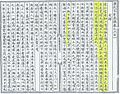
A 1414 text cites a 1055 report: since "the baleful star appeared, a full year has passed and until now its brilliance has not faded".
-
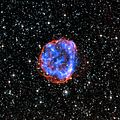
Supernova remnant SNR E0519-69.0 in the Large Magellanic Cloud
-

"A star set to explode", the SBW1 nebula surrounds a massive blue supergiant in the Carina Nebula.
-
Light curve for Type Ia SN 2018gv
-
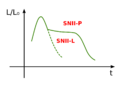
Light curves are used to classify Type II-P and Type II-L supernovae.
-

In the galaxy NGC 1365 a supernova (the bright dot slightly above the galactic center) rapidly brightens, then fades more slowly.
-
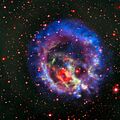
The blue spot at the centre of the red ring is an isolated neutron star in the Small Magellanic Cloud.
-
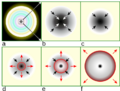
Within a massive, evolved star the onion-layered shells undergo fusion, forming an iron core that collapses.
-

The atypical subluminous Type II SN 1997D
-

Type Ib SN 2008D at the far upper end of the galaxy, shown in X-ray (left) and visible light (right), with the brighter SN 2007uy closer to the centre
-
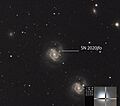
Messier 61 with supernova SN2020jfo, taken by an amateur astronomer in 2020
-
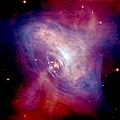
The pulsar in the Crab Nebula is travelling at 375 km/s relative to the nebula.
-
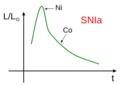
The radioactive decays of nickel-56 and cobalt-56 that produce a supernova visible light curve
-
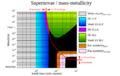
Supernova types by initial mass-metallicity
-
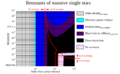
Remnants of single massive stars
-
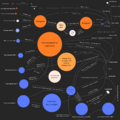
Approximate stellar evolution pathways of supernova progenitor stars
-
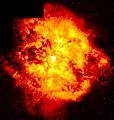
The nebula around Wolf–Rayet star WR124, which is located at a distance of about 21,000 light-years


See also
 In Spanish: Supernova para niños
- Collapsar
- Kilonova
- List of supernova candidates
- List of supernova remnants
- List of supernovae
- Quark-nova
- Superluminous supernova
- Supernovae in fiction
- Timeline of white dwarfs, neutron stars, and supernovae
