
Bridlington facts for kids
Quick facts for kids Bridlington |
|
|---|---|
| Town and civil parish | |
|
From the top to bottom-right, View of the North Bay, The Town Hall, The Priory, The Harbour, The Promenade
|
|
 Arms of Bridlington Town Council |
|

 Bridlington
|
|
| Area | 8.91 sq mi (23.1 km2) |
| Population | 38,404 (2021 census) |
| • Density | 4,310/sq mi (1,660/km2) |
| Civil parish population | 35,369 (2011 census) |
| OS grid reference | TA1866 |
| • London | 180 mi (290 km) S |
| Civil parish |
|
| Unitary authority | |
| Ceremonial county | |
| Region | |
| Country | England |
| Sovereign state | United Kingdom |
| Post town | BRIDLINGTON |
| Postcode district | YO15/YO16 |
| Dialling code | 01262 |
| Police | Humberside |
| Fire | Humberside |
| Ambulance | Yorkshire |
| EU Parliament | Yorkshire and the Humber |
| UK Parliament |
|


Bridlington is a fun seaside town and civil parish in the East Riding of Yorkshire, England. It sits on the Yorkshire Coast by the North Sea. The town is about 28 miles (45 km) north of Hull and 34 miles (55 km) east of York. A stream called Gypsey Race flows through the town and into the North Sea at the harbour.
The Priory Church of St Mary and its old gate, called the Bayle, are very important historic buildings. Bridlington is a busy sea-fishing port. It is famous for shellfish and is known as the "Lobster Capital of Europe". More than 300 tonnes of lobsters are caught here every year! Besides fishing, the town's main business is welcoming summer tourists.
Contents
History of Bridlington
How old is Bridlington?
People have lived in the Bridlington area since the Bronze Age and Roman Britain times. We don't know exactly when the first people settled here. But a large man-made ditch called Danes Dyke, near Flamborough Head, is from the Bronze Age. It is about 2.5 miles (4 km) long.
A Roman road from York, now called Woldgate, leads to the town. Roman coins have been found, and even two Greek coins from long ago. This suggests the harbour was used even before the Romans arrived.
In the 300s AD, the Romans set up signal stations along the coast. These stations warned of attacks from the Saxons. Some people think Bridlington was built near a Roman sea station. This station might have been called Gabrantovicorum.
The Manor of Bretlinton
Near Dukes Park, there are two ancient burial mounds called Butt Hills. These are protected historic sites. An Anglo-Saxon cemetery was also found nearby. The name Bridlington comes from the Anglo-Saxon language. It means a small farming community linked to a person's name, like Bretel or Bridla.
In 1086, the Domesday Book first mentioned Bridlington as Bretlinton. The town's name changed over time before becoming Bridlington in the 1800s. The Domesday Book also shows that the area was badly affected by the Harrying of the North. Its value dropped a lot.
Priory, Port, and Town Growth
In 1133, Walter de Gant started an Augustinian priory here. This was a type of monastery. Kings later gave Bridlington special rights. King Henry I allowed it to have a port. King John gave permission for a weekly market and a yearly fair in 1200. Later, King Henry VI allowed three yearly fairs. In 1415, King Henry V visited the Priory to celebrate his victory at the Battle of Agincourt.
After the monasteries were closed down, the land stayed with the Crown until 1624. Then, King Charles I gave it to Sir John Ramsey. Later, 13 people from the town bought the land for all the town's residents.
Corn, Breweries, and Wars

Bridlington started to grow around the old priory site. In 1643, Queen Henrietta Maria of France landed here with troops during the English Civil War. She was supporting the Royalist side.

The town used to be two separate places: the Old Town, about 1 mile (1.6 km) inland, and the Quay area by the harbour. In 1837, the old wooden piers were replaced with two stone piers. Besides fishing, the port was used to transport corn. The 1826 Corn Exchange building is still in Market Place. There were also mills for grinding corn, which led to local breweries opening.
During the Second World War, Bridlington had several air raids. These caused damage and sadly, some deaths. The Royal Air Force had training schools in the town. After the 1960s, seaside tourism became less popular. This meant fewer pleasure steamers worked from the harbour.
How Bridlington is Governed

Bridlington is part of the East Riding of Yorkshire. It has three areas: Bridlington North, Bridlington South, and Bridlington Old Town and Central. These areas elect eight councillors to the main council. The town also has its own Town Council with twelve councillors.
The Town Council has a special coat of arms. Its motto is Signum Salutis Semper, which means Always the bringer of good health.
Bridlington is in a large area called Bridlington and The Wolds for national elections. This area covers the northern part of the county. Over the years, Bridlington's parliamentary representation has changed several times.
In 1899, Bridlington became a municipal borough. In 1974, it became part of a new county called Humberside. Many local people were not happy about this because they felt they belonged to Yorkshire. Humberside was later removed in the 1990s. Bridlington is now part of the East Riding of Yorkshire again.
Geography of Bridlington
Bridlington is about 19 miles (31 km) north-north-east of Beverley and 17 miles (27 km) south-east of Scarborough. It is 179 miles (288 km) north of London. The land rises from the beaches to about 167 feet (51 m) on the edge of town. The Gypsey Race river flows through Bridlington. The last half-mile (0.8 km) of the river runs underground.
The coast around Bridlington is known for having a high rate of coastal erosion. South of the town, the coast is low. But to the north, it is steep and beautiful, with Flamborough Head sticking out into the sea. The seafront has a sea wall and a wide beach with wooden structures called groynes. These help to trap the sand. Bridlington's north and south beaches have won awards for their environmental quality.
Areas of the town
-
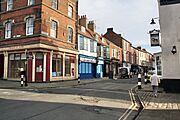
Old-town's High Street
-
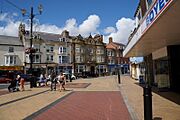
The centre's Manor Road from King Street
-
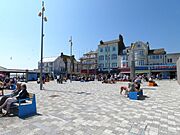
The seaside resort (Garrison Square)
-
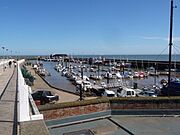
The harbour
-
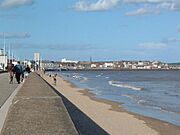
South Sands
-
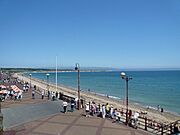
North Beach


Bridlington's Climate
Bridlington has a mild climate. Summers are warm, and winters are cool and wet. The warmest months are from June to September. Temperatures then reach about 20°C (68°F) during the day. At night, they fall to about 13°C (55°F). In winter, daytime temperatures are around 8°C (46°F). At night, they drop to about 2°C (36°F).
| Climate data for Bridlington, 15 m asl, 1991–2020 | |||||||||||||
|---|---|---|---|---|---|---|---|---|---|---|---|---|---|
| Month | Jan | Feb | Mar | Apr | May | Jun | Jul | Aug | Sep | Oct | Nov | Dec | Year |
| Mean daily maximum °C (°F) | 7.3 (45.1) |
7.9 (46.2) |
9.7 (49.5) |
11.8 (53.2) |
14.6 (58.3) |
17.3 (63.1) |
19.7 (67.5) |
19.8 (67.6) |
17.5 (63.5) |
14.0 (57.2) |
10.2 (50.4) |
7.6 (45.7) |
13.1 (55.6) |
| Mean daily minimum °C (°F) | 2.3 (36.1) |
2.4 (36.3) |
3.4 (38.1) |
5.1 (41.2) |
7.7 (45.9) |
10.4 (50.7) |
12.5 (54.5) |
12.7 (54.9) |
10.9 (51.6) |
8.4 (47.1) |
5.0 (41.0) |
2.5 (36.5) |
6.9 (44.5) |
| Average rainfall mm (inches) | 55.0 (2.17) |
47.9 (1.89) |
43.6 (1.72) |
44.9 (1.77) |
41.9 (1.65) |
57.9 (2.28) |
48.7 (1.92) |
58.5 (2.30) |
50.7 (2.00) |
57.3 (2.26) |
65.6 (2.58) |
63.5 (2.50) |
635.5 (25.04) |
| Average rainy days (≥ 1.0 mm) | 12.0 | 10.7 | 9.6 | 8.4 | 8.1 | 8.9 | 9.0 | 10.1 | 8.6 | 10.9 | 12.3 | 12.6 | 121.2 |
| Source: Met Office | |||||||||||||
Economy and Jobs
Bridlington started as a small fishing port. In the 1800s, it became a popular seaside resort after a special spring was found. The first hotel opened in 1805. It soon became a favourite place for factory workers from other parts of Yorkshire. A new railway station opened in 1846, connecting the Quay and the Old Town. This helped the two areas grow together.

Bridlington's popularity as a holiday spot decreased in the 1960s. This was partly because cheap holidays abroad became available. Even though the fishing fleet also got smaller, the port is still popular. Many people come for sea fishing trips. Bridlington also sells a lot of shellfish to France, Spain, and Italy. This trade is worth millions of pounds each year.
Culture and Community Life
Bridlington has its own monthly newspaper, the Bridlington Echo. You can also read the weekly Bridlington Free Press. Local radio stations include BBC Radio Humberside and Greatest Hits Radio Yorkshire Coast.


The town has three main parks. Duke's Park is the largest. It has the Bridlington Sports and Community Club, a skate park, and the Bridlington Town Football Club. There is also a Sports Centre on Gypsey Road. It has a sports hall, a gym, and squash courts.
The Bridlington Leisure World on the Promenade closed for rebuilding in 2014. A new, modern leisure centre opened in May 2016. Famous athletes like Rebecca Adlington helped open it.
Bridlington has a public library in King Street. The Town Hall and Magistrates Court are near Station Avenue. On South Marine Drive, you'll find the RNLI Life Boat Station. Bridlington has had a lifeboat since 1805, run by volunteers.
The town also has a hospital, an ambulance station, and a fire station. There is a post office near Quay Road.
Town Crier

David Hinde was Bridlington's first town crier since 1901. He was appointed in 2012. Town criers used to announce news and important events. David Hinde was famous for having a very loud voice. His cry was once recorded at 114.8 decibels! He even appeared in the 2016 Dad's Army movie.
Famous Landmarks
Bridlington Priory, also called the Priory Church of St Mary, is a very old and important building. It is a Grade I listed building. The Bayle (gate) nearby is also a Grade I listed building. It is what remains of the priory's old defences. The Priory has a large organ and a set of eight bells.
Bridlington's war memorial is in a garden at the junction of Prospect Street and Wellington Road. It was opened in 1921 to remember those who served.


Bridlington Spa opened in 1896. It was once a very famous place for entertainment and dancing. Many well-known performers, like David Bowie, appeared there. The building was fully renovated between 2006 and 2008. Now, it attracts big names again, like the Kaiser Chiefs and Kasabian.
Blue plaques have been put up for famous people connected to Bridlington. These include Herman Darewski, a composer, and Wallace Hartley, who led the orchestra on the Titanic.
Along the seafront, you can see interesting public artworks. One is called 'Promenade'. It includes beach huts, a metal sculpture, and text that tells about the area. It won an award in 1998.
Transport in Bridlington

Bridlington has a railway station. It is on the Yorkshire Coast Line, which connects Hull and Scarborough. The station opened in 1846.
Local and out-of-town bus routes are run by East Yorkshire Motor Services. You can catch buses to places like York, Scarborough, and Hull. In summer, they also run a special open-top bus service called the Beachcomber.
The town is where two main roads meet: the A165 (from Hull to Scarborough) and the A614 (which goes towards Nottingham).
Bridlington also has four special land trains. These trains run along the promenades. They link the town centre with places like Sewerby Hall and Gardens and the car parks.
Education and Learning
Primary Schools
Bridlington Civil Parish has seven primary schools for children aged three or four to eleven.
- Bay Primary School
- Burlington Infant School
- Burlington Junior School
- Hilderthorpe Primary School
- Martongate Primary School
- Quay Academy
- Our Lady and Saint Peter RC Primary Academy
- New Pasture Lane Primary School
Secondary Schools
Bridlington School is a mixed-gender school for students aged 11 to 18. It is a specialist Sports and Design and Technology College. Many famous people have attended this school.
Headlands School also teaches students aged 11 to 18. It works with Bridlington School.
Further Education
East Riding College offers education for students aged 16 and older. It provides both academic and vocational courses.
Religious Sites


The main Anglican church is the Priory Church of St Mary. Christ Church in Quay Road was built in 1841. Emmanuel Church is another modern Church of England building.
There are also other churches in Bridlington. These include the Harbourside Evangelical Church, the Kingdom Hall of Jehovah's Witnesses, and the Cornerstone Church. The town has had a Baptist church since 1698. There is also a Free Presbyterian Church and an independent Evangelical Church.
The Methodist Church has been strong in Bridlington since 1770. St John's Burlington Methodist Church is still active.
The Roman Catholic Church of Our Lady and St Peter is on Victoria Road. It was built in 1893–1894. The church is dedicated to Our Lady, also known as the Star of the Sea, and to St Peter, who is the Patron Saint of Fishermen.
Sports in Bridlington
Bridlington has a semi-professional football team called Bridlington Town A.F.C.. They play in the Northern Counties East League Premier Division. Their home ground is at Queensgate. They won the FA Vase in 1993. There is also a junior football club called Bridlington Rangers. Bridlington Rovers F.C. is the oldest club in town, formed in 1903.
Bridlington Cricket Club plays in the York and District Senior League. They have several teams, including junior teams.
Bridlington Rugby Union Football Club plays at Dukes Park. They have men's, women's, and junior teams. In 2013, the men's team reached the final of the RFU Intermediate Cup at Twickenham.
Bridlington Hockey Club has been around for over 100 years. They play at the Bridlington Astro Centre. They also host an annual hockey festival.
Other sports in Bridlington include tennis, pétanque, fencing, and archery.
Bridlington has hosted the Tour de Yorkshire cycling race several times, including the start of stages in 2015, 2017, and 2019.
Bridlington Spa is also home to the popular British Open darts championships.
Notable People from Bridlington
Many interesting people were born or lived in Bridlington:
- William of Newburgh (1100s) – a historian.
- William Kent (1686–1748) – a famous architect and designer.
- Sir John Major, 1st Baronet (1698–1781) – a merchant and politician.
- Benjamin Fawcett (1808) – a printer and expert on birds.
- Henry Freeman – a brave lifeboatman.
- A. E. Matthews (1869) – a stage and film actor.
- Thomas Fenby (1875) – a politician and former Mayor of Bridlington.
- Cecil Burton (1887–1971) and Claude Burton (1891–1971) – cricketers who played for Yorkshire.
- Francis Johnson (1911–1995) – a well-known church architect.
- Gordon Lakes (1928) – helped improve working conditions in UK prisons.
- Bob Wallis (1934–1991) – a jazz musician.
- David Pinkney (1952) – a businessman and car racing driver.
- Andrew Dismore (1954) – a politician and lawyer.
- Mark Herman (1954) – a film director and screenwriter, known for Brassed Off.
- Angela Eagle and Maria Eagle (1961) – twin sisters who are both politicians.
- Craig Short (1968) – a professional football player and manager.
- Richard Cresswell (1977) – a professional football player.
- Adam Khan (1985) – a racing driver.
- Charlie Heaton – an actor known for Stranger Things.
- Stephen W. Parsons – a musician and composer.
- Rosie Jones – a comedian and writer.
Residents of note
- John Twenge (St John of Bridlington) (1300s) – a saint who was a Canon at Bridlington Priory.
- David Hockney – a famous artist who used to own a house in Bridlington.
Twin Towns

Bridlington is connected to other towns around the world. These are called twin towns or sister cities:
- Bad Salzuflen, Germany
- Millau, France
The signs when you enter Bridlington often show the names of these twin towns.
Images for kids
See also
 In Spanish: Bridlington para niños
